Open-end or closed-end? The choice can look like a simple upgrade: pay more for a sealed rivet. In practice, the two types address different requirements, and choosing a closed end without a specific need can add cost without adding useful function.
Open-end and closed-end blind rivets use the same basic setting principle, but their end construction changes what the fastener can contain or allow through.
This is not a specification sheet walkthrough, but a way to decide whether the end configuration is a decision your application needs.
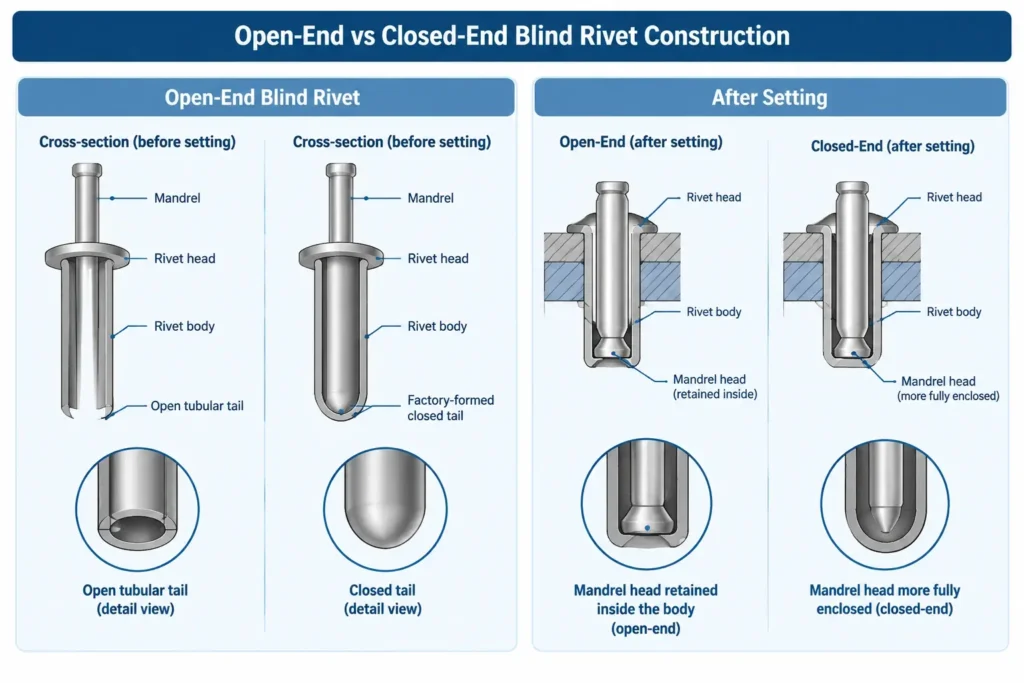
Open-End vs Closed-End: The Seven Differences at a Glance
The two types differ in seven practical ways, from how the tail of the body is formed to how the part is supplied. The table below is orientation; the sections that follow cover the differences that change a decision.
Table 1 — The Seven Differences at a Glance
| # | Difference | Open-End | Closed-End |
|---|---|---|---|
| 1 | End construction | Open tubular end | Factory-formed closed end |
| 2 | Mandrel head after setting | Retained inside the body | Retained, more fully enclosed |
| 3 | Passage through the body | Open passage | Closed by end construction |
| 4 | Strength | Determined by design and joint | Same determinants, not automatically higher |
| 5 | Setting | Standard tooling practice | May require tool capacity check |
| 6 | Cost and availability | Generally lower, wider range | Generally higher, narrower range |
| 7 | Head style | Independent of end type | Independent of end type |
Two rows are routinely misread: what happens to the mandrel head after setting, and whether a closed end makes the rivet stronger.
Construction and Mandrel Retention: What Actually Changes
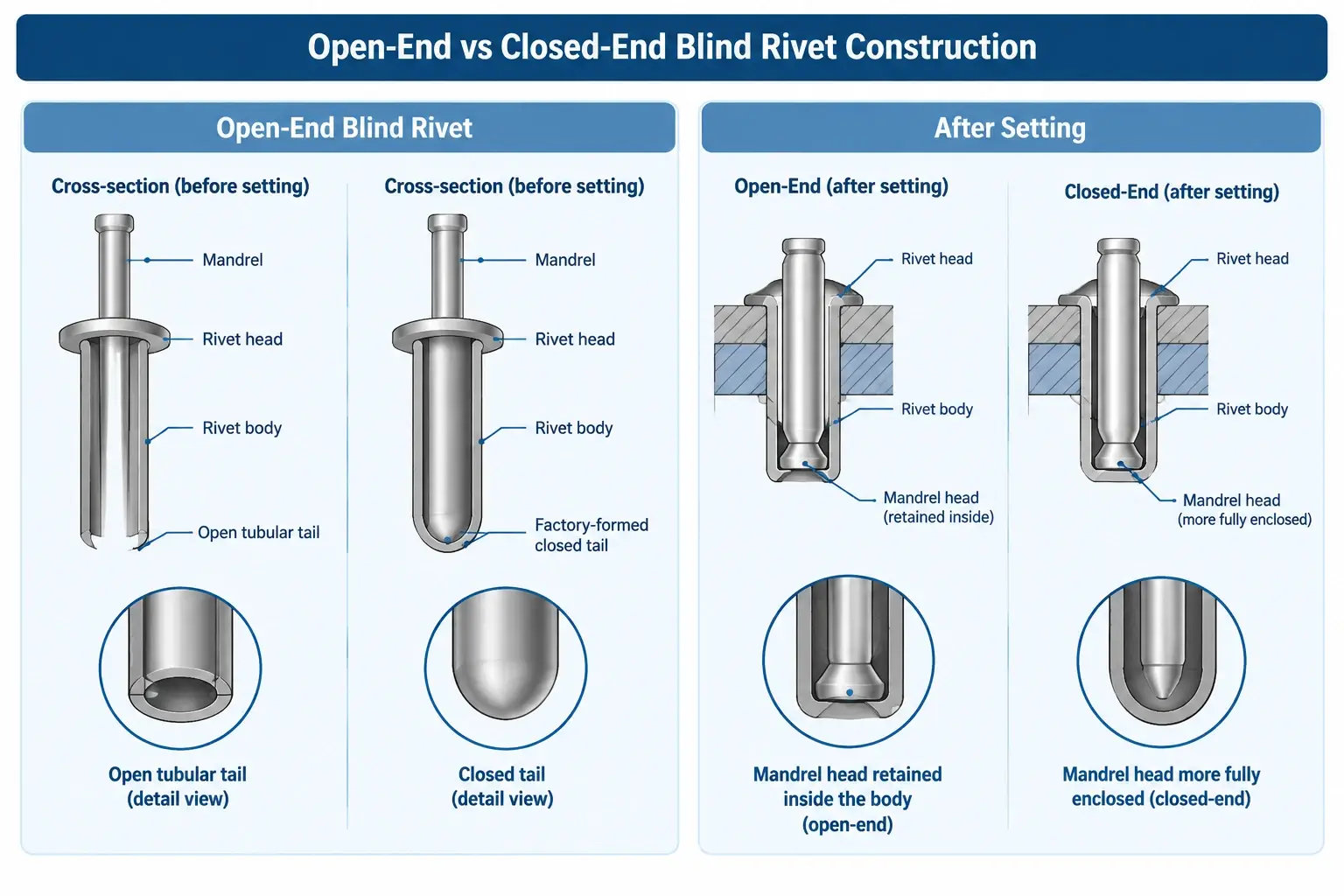
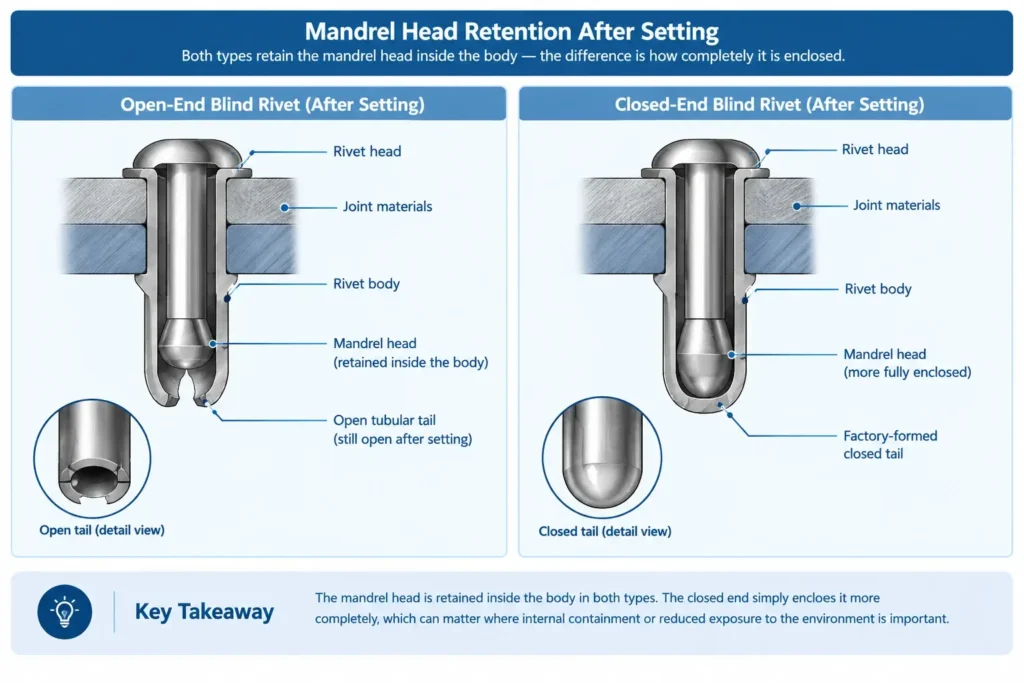
The first difference is where the difference physically sits. An open-end rivet has a tubular body with an open tail. During setting, the mandrel head is drawn into the body to form the blind side, while the tail remains open. A closed-end rivet has the tail closed during manufacture, which makes the body closer to a cup than a tube.
That construction change has a familiar but often misstated consequence. In a correctly set open-end rivet, the mandrel head is also retained inside the body. What changes with a closed end is how completely that head is enclosed, which can matter where internal containment or reduced exposure to the surrounding environment is important.
Sealing: What a Closed End Changes — and What It Does Not
Closed-end rivets are usually sold on sealing, so this is where the clearest thinking is needed.
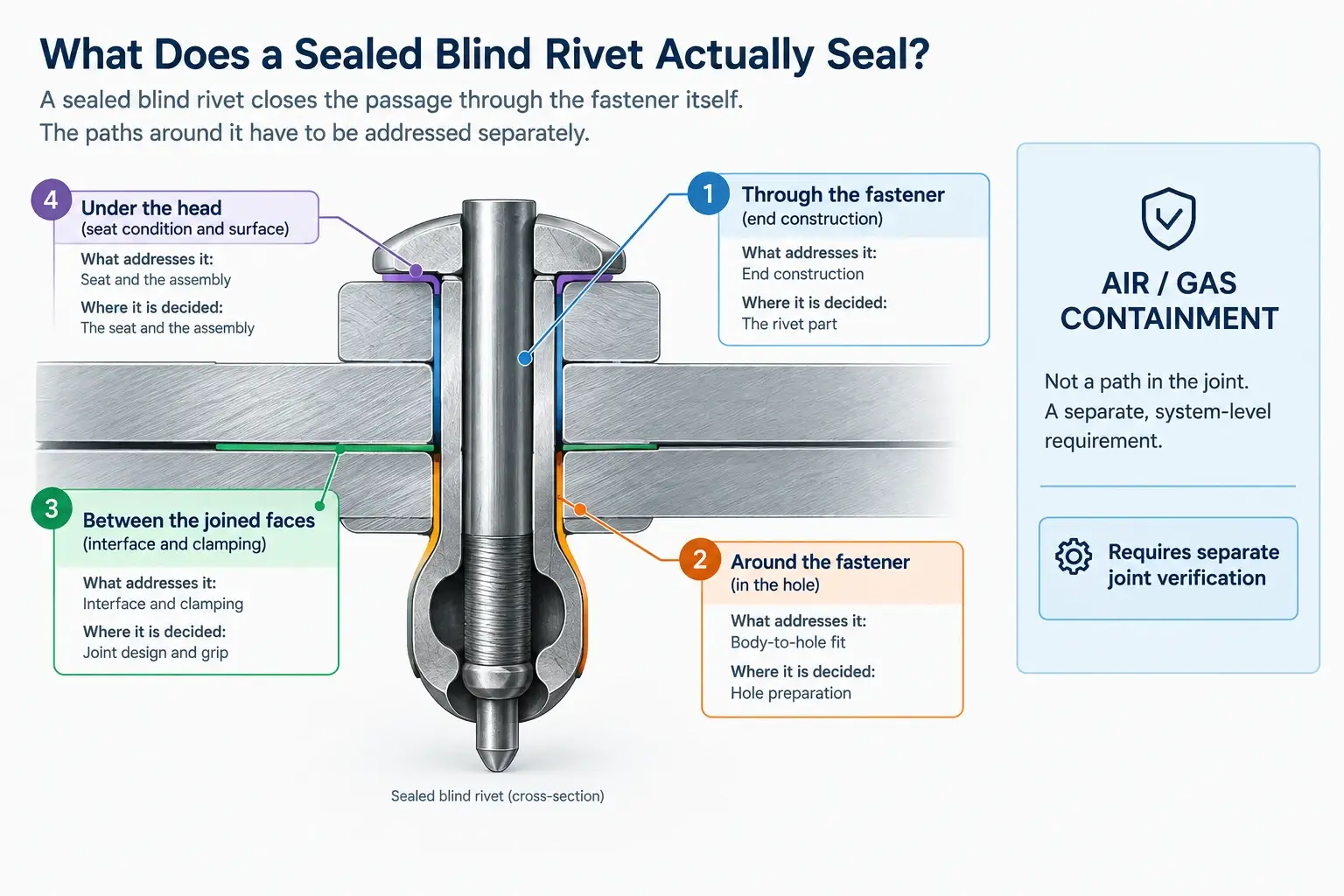
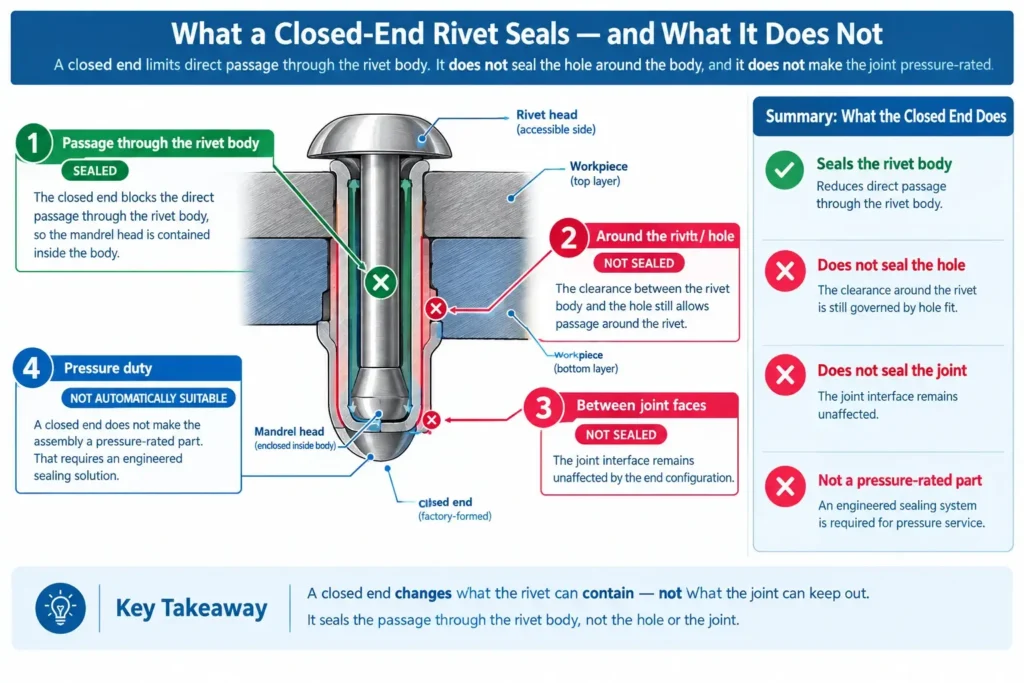
A closed end seals the passage through the rivet body. It does not seal the hole around the body, and it does not make the assembly a pressure-rated part. Those are three different boundaries, and only the first belongs to the end configuration.
The first boundary is the one the closed end addresses: it limits direct passage through the rivet body itself.
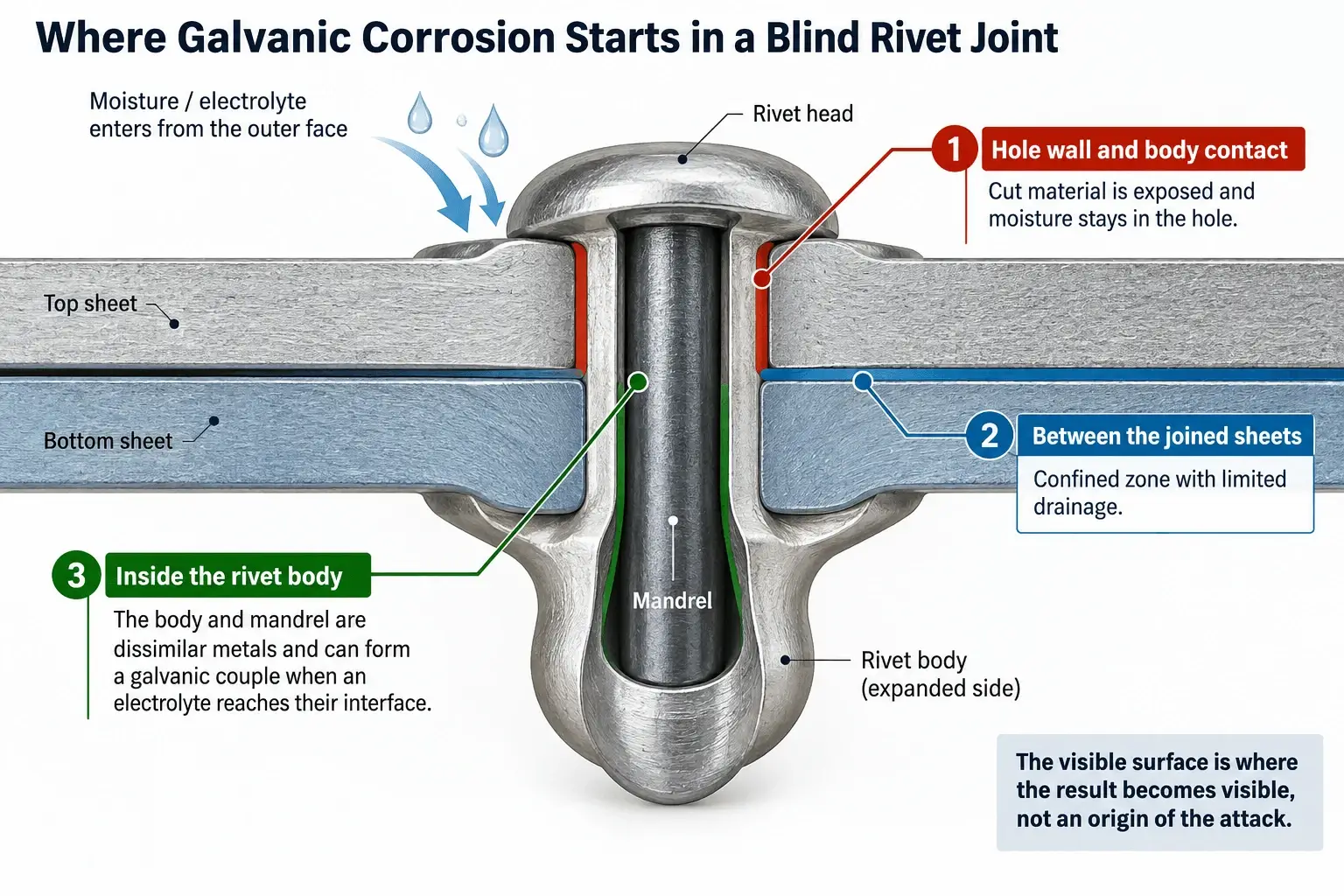
The second boundary is around the rivet, and it is a hole question rather than an end question. Whatever the tail configuration, the fit between the rivet body and the prepared hole governs what can pass around it, and a closed end does not change the hole or its clearance.
The third boundary is the joint itself. Two surfaces held together by a rivet still have an interface between them, and the end configuration has no effect on it. A closed-end rivet should not be treated as a complete sealing solution for the joint.
What a closed end can do is narrower and more useful: A closed-end rivet can reduce direct passage through the rivet body, which can be useful where moisture, dust or other contaminants must be kept from passing through the fastener itself. It should not, however, be treated as a substitute for an engineered sealing or pressure-rated connection.
Table 2 — What a Closed End Actually Changes
| Requirement | Closed-End Changes | Still Depends On |
|---|---|---|
| Passage through the rivet body | Limits direct passage | End construction |
| Around the rivet / hole | Not sealed by end configuration | Hole and fit |
| Between joint faces | Not sealed by rivet end | Joint interface |
| Pressure duty | Not automatically suitable | Engineered sealing system |
| Mandrel head containment | More fully enclosed | Exact rivet design |
Where the hole side is the limiting factor, our guide to blind rivet hole tolerance covers how the hole is specified and held in production.
Strength: Sealed Does Not Automatically Mean Stronger
Sealing is a genuine advantage where it is needed. Strength is a different question, and it is where the two types are most often conflated.
Published comparisons can vary between manufacturers and product designs. That is why the end configuration should not be used as a shortcut for judging joint strength.
Sealed does not automatically mean stronger. Strength depends on the exact rivet design and the joint conditions, including body diameter, material and installation. The tail of the body is one of several design characteristics, and it is not the one that sets the load the joint can carry.
The two properties should therefore be evaluated separately: the end configuration addresses containment, while joint strength must be evaluated from the rivet design and the joint conditions.
If you want to read published strength values correctly before comparing parts, see our guide to blind rivet shear vs tensile strength.
Cost, Availability and Setting: What You Pay For
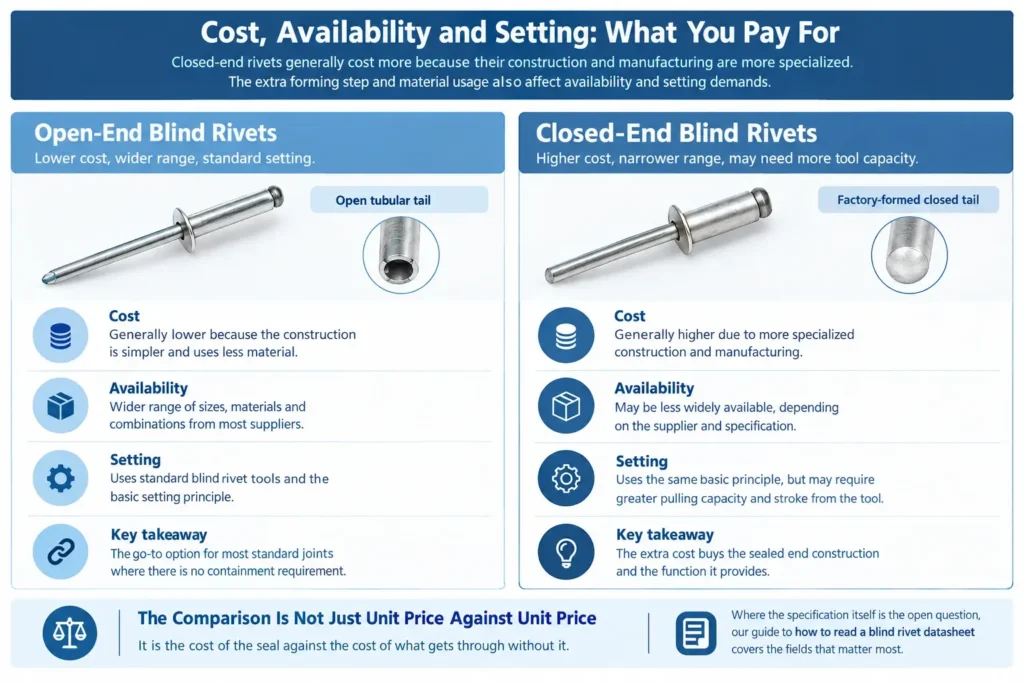
Closed-end rivets generally cost more because their construction and manufacturing are more specialized. Their size and material combinations may also be less widely available than standard open-end rivets, depending on the supplier and specification.
That difference is best read as the price of additional function rather than of a better rivet. A closed tail generally involves additional material and forming requirements, and the extra manufacturing work contributes to the higher cost.
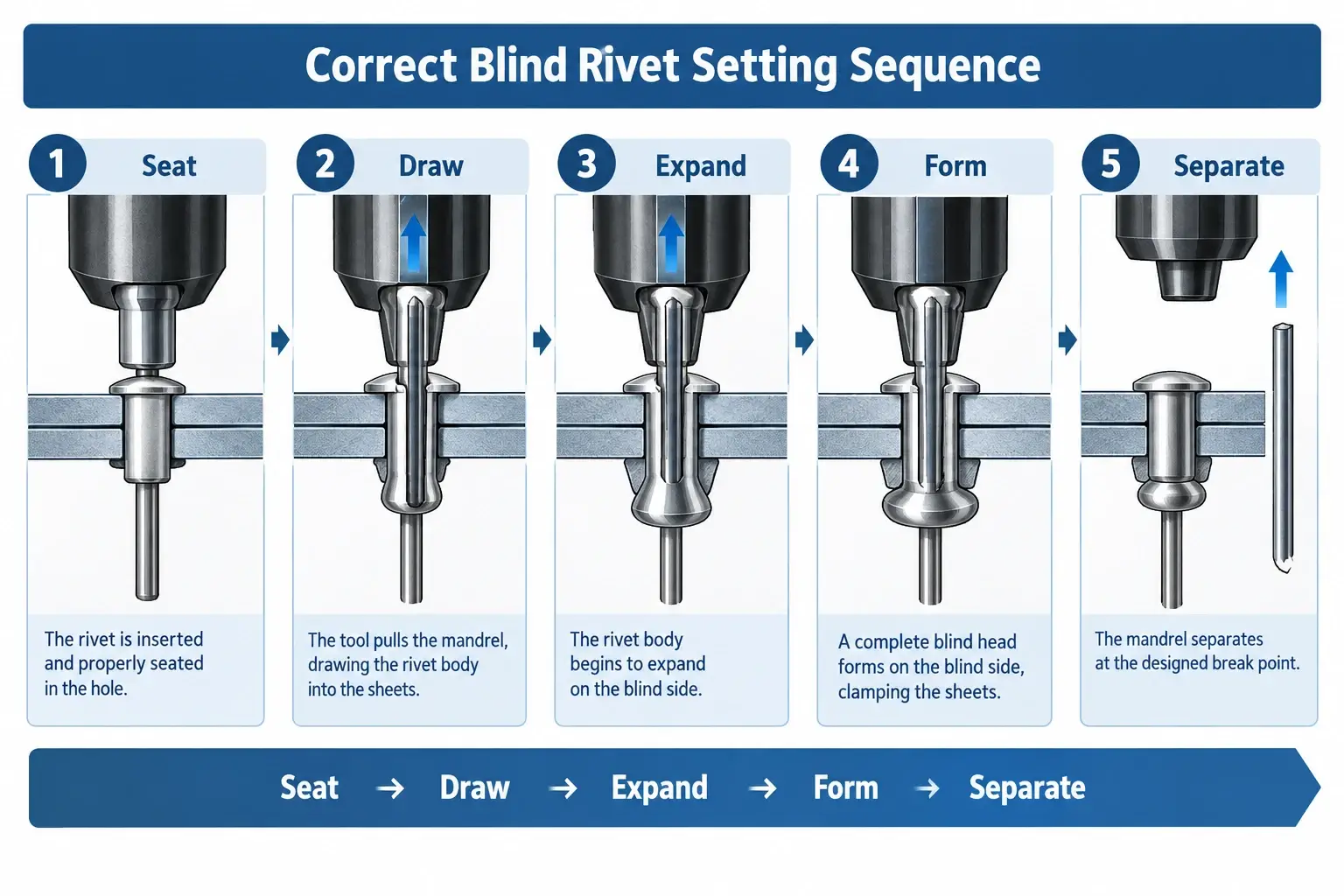
Setting follows the same logic. Both types are set on the same basic principle — insert, pull, form, separate — but depending on the specific rivet design and material, a closed-end rivet may place greater demands on the setting tool. The tool’s pulling capacity and stroke should therefore be verified against the specific rivet and joint configuration rather than assumed.
The comparison is not simply unit price against unit price — it is the cost of the seal against the cost of what gets through without it.
Where the specification itself is the open question, our guide to how to read a blind rivet datasheet covers the fields that matter most.
Head Style Is a Separate Question
A closed end does not come with a head style attached. Dome, large flange and countersunk heads are available independently of the end configuration, and choosing one does not constrain the other.
Head style is about bearing surface, load distribution and finish on the accessible side. The end configuration is about the containment question on the far side.
Head geometry has its own selection logic — see our guide to blind rivet head types for how the three heads differ in use.
Which End Configuration Fits the Application?
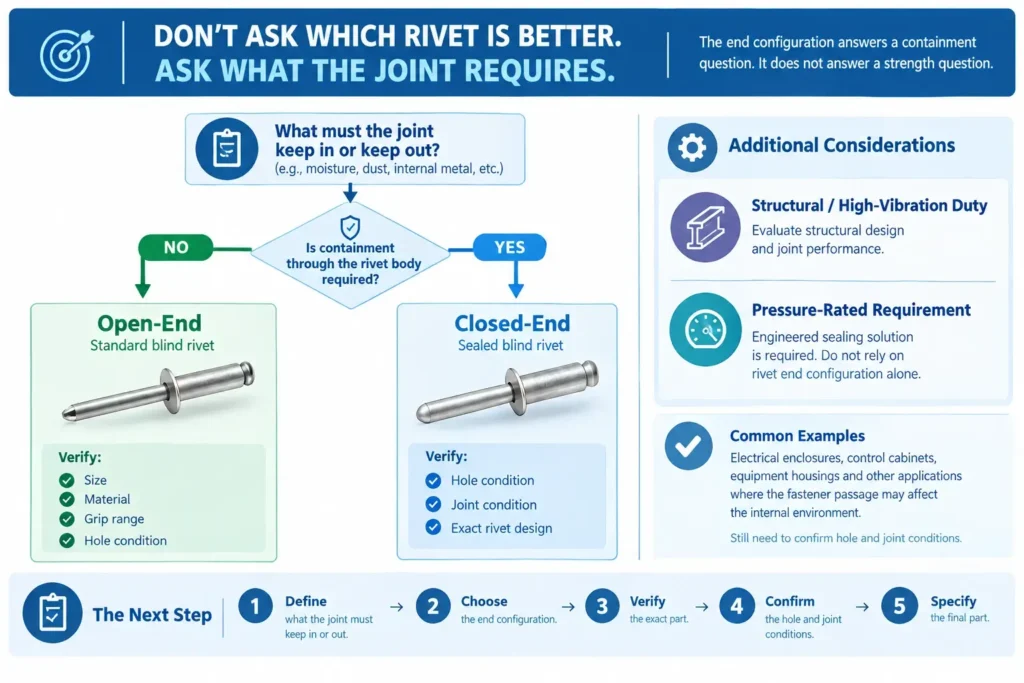
The question to start from is not which type is better, but what the joint must keep in or keep out.
For most standard blind-riveted joints, open-end is the starting point unless the application has a specific containment requirement. The closed end adds a function, and the function is worth paying for only where it is needed.
Table 3 — Requirement-Based Selection
| Joint Requirement | Usual Direction | Still Verify |
|---|---|---|
| No containment requirement | Open-end | Size, material, grip and hole |
| Reduce passage through the rivet body | Closed-end | Hole and joint conditions |
| Keep loose internal metal more fully enclosed | Closed-end | Exact rivet design |
| Moisture or dust exposure affecting the fastener passage | Closed-end may be considered | Joint sealing and environment |
| Structural or high-vibration duty | Evaluate structural design | Strength and installation requirements |
| Pressure-rated sealing requirement | Engineered sealing solution | Do not rely on rivet end configuration alone |
The middle rows are where the decision is usually made. Exposure to moisture or dust alone does not determine the rivet type; the key question is whether direct passage through the rivet body needs to be reduced. Where it does, the answer also depends on what the enclosure behind the joint can tolerate. Common examples include electrical enclosures, control cabinets and equipment housings.
The bottom row is the one to hold firmly. A pressure-rated sealing requirement is an engineering problem, and the end configuration of a rivet is not a pressure rating.
FAQ
Short answers to the questions this comparison is asked most.
1. What is the difference between open-end and closed-end blind rivets?
Open-end rivets have an open tubular tail; closed-end rivets are formed with the tail closed during manufacture. The difference affects what can pass through the rivet body and how fully the mandrel head is enclosed.
2. Are closed-end rivets stronger than open-end rivets?
Not automatically. Strength depends on the exact rivet design and the joint conditions, including body diameter, material and installation.
3. Are closed-end blind rivets waterproof?
No. A closed-end blind rivet can reduce direct passage through the rivet body, but it does not seal the surrounding hole or the joint interface. A closed-end rivet should not be treated as a waterproof joint by itself.
4. When should I use a closed-end blind rivet?
Use a closed-end blind rivet when the joint has a specific containment requirement — such as reduced passage through the rivet body or loose internal metal kept more fully enclosed. Without that requirement, an open-end rivet is usually the starting point.
5. Why are closed-end rivets more expensive?
Their construction and manufacturing are more specialized, and a closed tail generally involves additional material and forming requirements. Size and material combinations may also be less widely available.
6. Do closed-end rivets need a special tool?
The same basic setting principle applies, but depending on the rivet design and material, a closed-end rivet may place greater demands on the tool. Verify the tool’s pulling capacity and stroke against the specific rivet and joint configuration.
7. Can I use closed-end rivets in a pressure application?
A closed end alone does not qualify a riveted joint for pressure service. If pressure containment is required, the connection and sealing system must be specifically engineered and verified for that duty.
8. Does a closed-end rivet seal the hole?
No. A closed end seals the passage through the rivet body, not the hole around it. Anything passing around the rivet is governed by hole fit and joint design.
Start With What the Joint Must Keep In or Out
Read side by side, the two types come down to one question about the joint. The end configuration answers a containment question. It does not answer a strength question.
Once the requirement is clear, the rest is verification rather than preference: Define what the joint must keep in or out → choose the end configuration → verify the exact part → confirm the hole and joint conditions → then specify.
If you are weighing the two types for a specific joint: Send us your application, joint thickness and the environment around the joint. Our team can help review whether a closed-end configuration is necessary — or whether a standard open-end rivet is sufficient.
Send Your Details | Request a Quote
And if a joint has already failed in service, see our guide to the common causes of blind rivet failure.