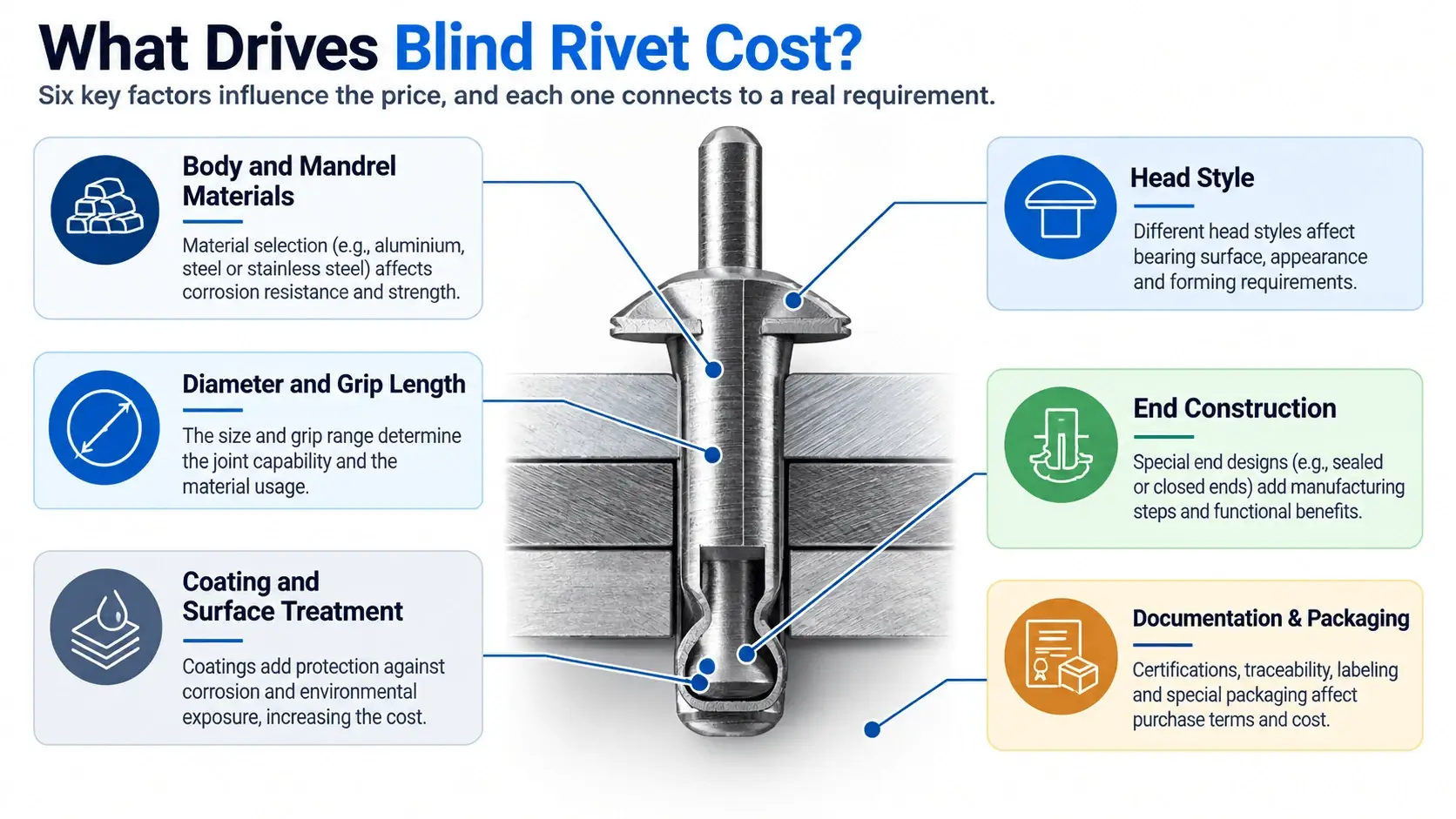
The rivet head is the interface between the fastener and the workpiece. Its diameter and shape affect how load is distributed across the surface, how the finished assembly looks, and how much space the installation requires.
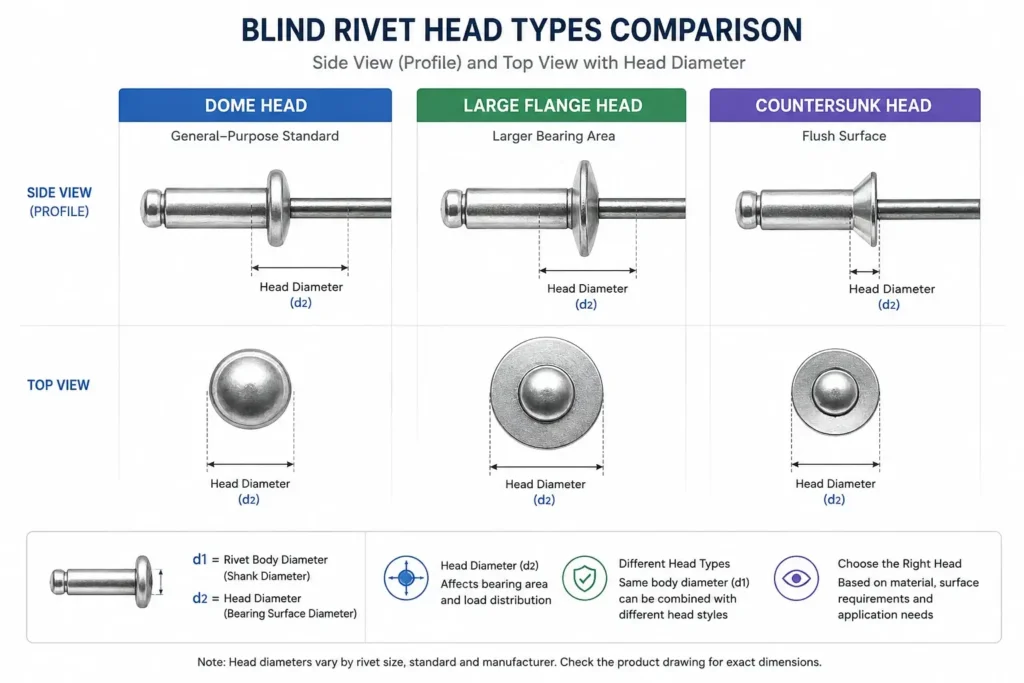
Blind rivets are available in three common head styles. Dome heads are the general-purpose standard. Large flange heads spread the clamping load over a wider bearing area. Countersunk heads sit flush with the surface for a smooth finish.
This guide compares the three types using typical head diameter data, a geometric comparison and a practical selection framework, so you can specify the right head for your application — and ask your supplier the right questions before ordering.
What Is a Rivet Head and Why Does It Matter?
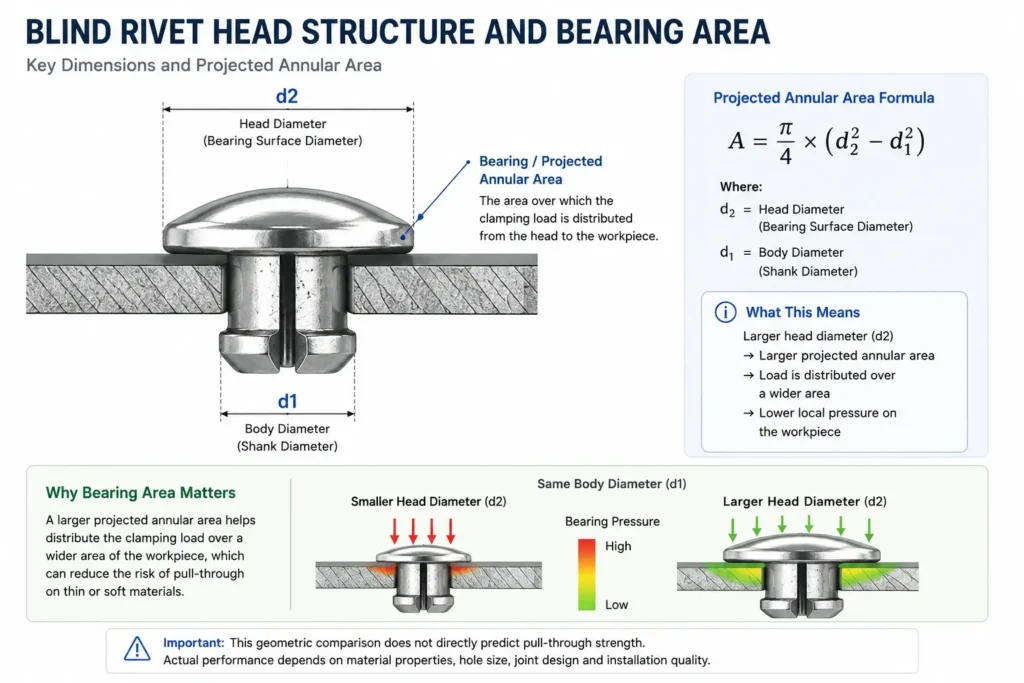
The head of a blind rivet is the portion that remains on the visible side of the workpiece after setting. It performs a mechanical function rather than a purely cosmetic one: it provides the bearing surface that spreads the clamping load from the rivet body across the workpiece.
A simple principle applies: the larger the head diameter, the greater the area over which the clamping load is distributed. For a quick geometric comparison of head sizes, the projected annular area of the head can be used:
A = π/4 × (d2² − d1²)
where d2 is the head diameter and d1 is the rivet body diameter. This is a useful tool for comparing head designs. It is not a direct calculation of pull-through strength.
Two clarifications prevent common confusion. First, head style is separate from rivet body design: a dome, large flange or countersunk head can be combined with different body materials, diameters and grip ranges. Second, the head type does not directly determine the shear or tensile strength of the rivet — strength is driven by the rivet body diameter, material and mandrel design, a point we cover in detail in our guide to blind rivet shear vs tensile strength.
Head type is also independent of another key specification: the blind rivet grip range. The head determines how load reaches the workpiece; the grip range determines which rivet length fits your joint thickness. Both must be specified correctly.
Dome Head: The Standard Workhorse
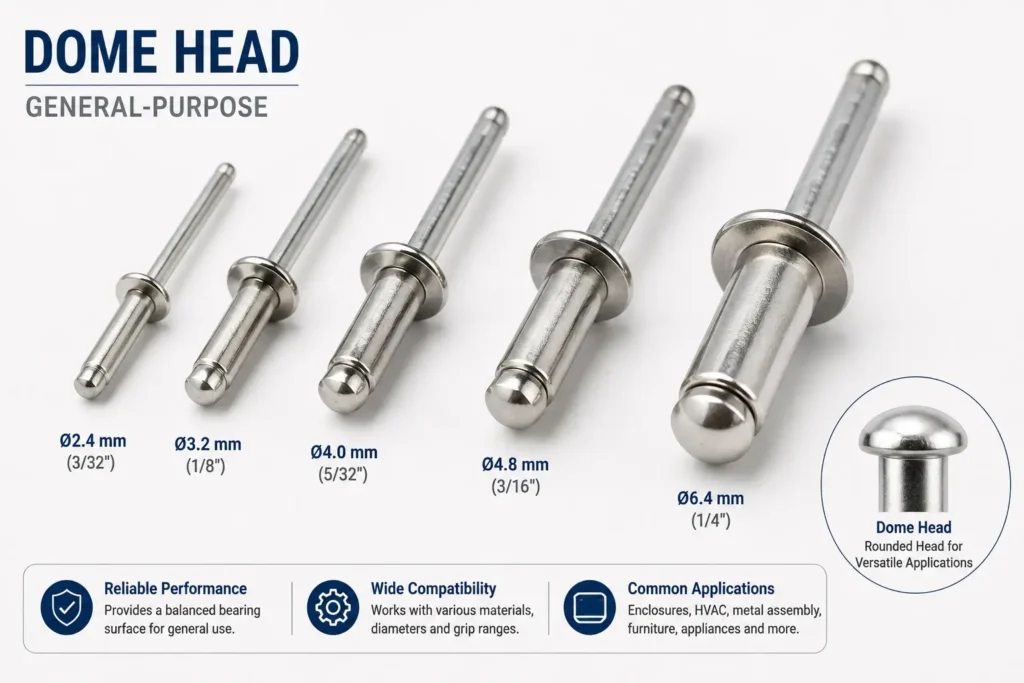
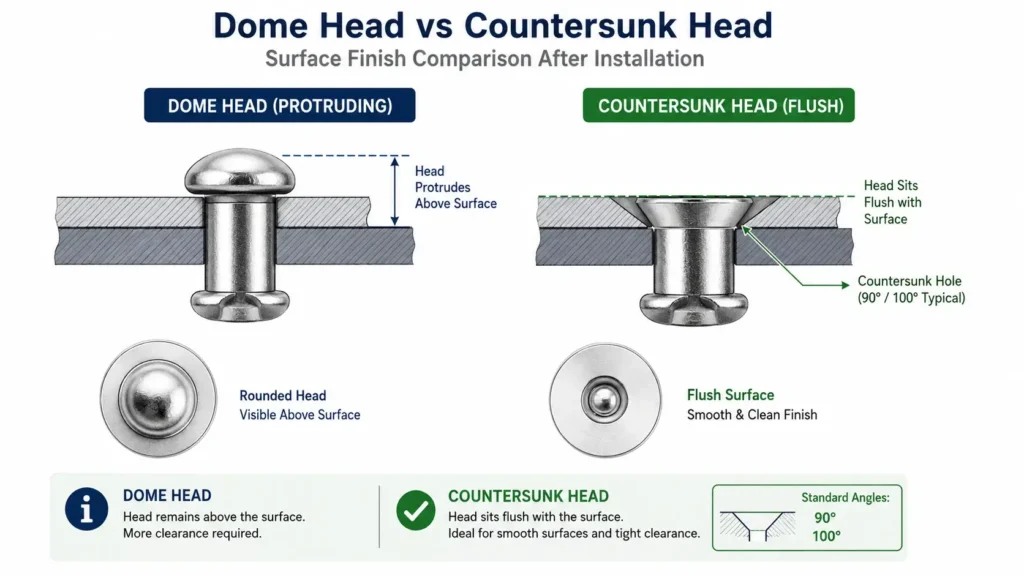
The dome head — a low-profile, rounded head — is the standard configuration for blind rivets. It is typically one of the most economical blind rivet head designs, and it is the most common general-purpose configuration in many industrial applications.
For a sense of scale, a 4.8 mm rivet may have a dome head diameter of approximately 9.5 mm, depending on the applicable standard and product design.
Why it is the default choice:
- Simple hole preparation — a straight drilled hole is sufficient, with no countersinking required
- No orientation issues during installation
- Suitable for most metal-to-metal connections
The trade-offs are equally straightforward. A dome head sits proud of the surface, which matters if the assembly requires a flush finish. And its head provides a smaller bearing area than a large flange head of the same body diameter, which matters on thin or soft materials.
Typical dome head applications include general sheet metal assembly, enclosures, HVAC ducting, metal structures and appliances. RivetFast supplies dome-head blind rivets across standard industrial sizes and materials, including aluminum, steel and stainless steel options.
If you are deciding between standard, multi-grip and structural rivets, head type is only one part of the picture — our type-by-type guide to standard vs multi-grip vs structural blind rivets covers the other differences.
Large Flange: When Bearing Area Matters
A large flange head is a dome head with a substantially wider bearing surface. It is selected primarily when the material under the rivet head needs a larger bearing area — not simply because higher strength is required. The benefit is better load distribution at the sheet-to-head interface.
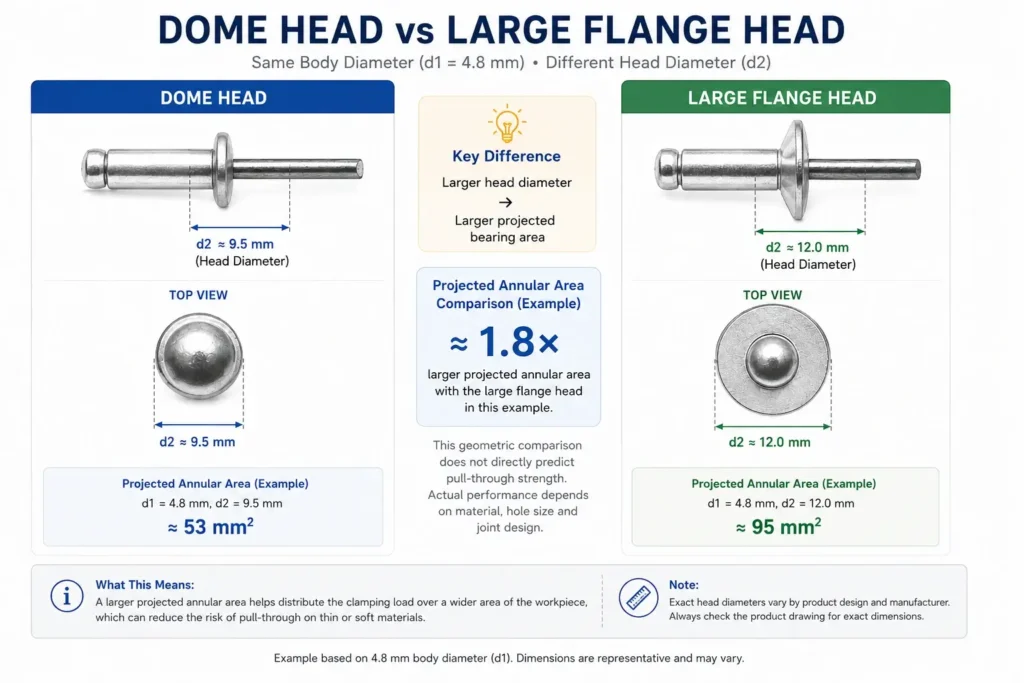
The size difference is visible in practice. For a 4.8 mm rivet, a 12 mm flange head provides a substantially larger bearing surface than a 9.5 mm standard dome head — around 1.8 times the projected annular area in this example, as the calculation in the next section shows.
Large flange heads are the right choice for:
- Thin sheet materials, especially when a larger bearing area is needed to reduce the risk of pull-through. Thin aluminum sheet, for example, can benefit from a large flange head
- Oversized holes or applications where the available bearing area is limited
- Soft or brittle materials such as plastics and composites
The trade-off is space. A large flange needs more room on the surface: spacing between rivets and edge distances must be checked, and the larger head footprint can be a constraint in tight assemblies.
Typical applications include thin sheet metal, plastic housings, roofing and cladding, vehicle body panels and furniture. Large flange heads are one of the head types we can customize for OEM projects — the flange diameter can be adjusted to the product drawing. For more on thin material joints, see our complete guide on how to choose rivets for sheet metal.
Countersunk: Flush Surface Solutions
A countersunk head is conical, and after setting it sits flush with — or slightly below — the workpiece surface. Countersunk heads are selected primarily for surface requirements and clearance, not because they provide higher joint strength.
The flush result requires preparation. The workpiece must be countersunk before installation — either machined or dimpled — to accept the conical head. The included angle of the rivet head and the prepared countersink must match, otherwise the head will not sit flush.
Countersunk blind rivets are available with different included angles, commonly including 90° and 100°. The rivet head angle and the prepared countersink angle must match the manufacturer’s specification to achieve a flush installation. Always confirm the required angle before ordering. Do not assume that all countersunk blind rivets use the same angle.
The main trade-off of a countersunk head is not necessarily lower rivet-body strength. It is the additional preparation required in the workpiece and the smaller bearing surface at the head-to-sheet interface.
Countersunk heads are common in:
- Transportation and vehicle applications where appearance matters
- Surfaces that must be smooth to avoid snagging
- Sliding or contact surfaces
- Appliance and electrical panels
To summarize the three head types: large flange heads are about bearing area, countersunk heads are about surface and clearance, and dome heads are the general-purpose default.
Because countersunk installation depends on precise hole and countersink dimensions, checking the full blind rivet size chart is a useful next step before specifying.
Blind Rivet Head Diameter Comparison
Head diameter is the specification to compare when selecting a head type. The table below shows representative head diameters for common rivet body sizes.
Table 1 — Typical Blind Rivet Head Diameter Comparison
| Rivet Body Diameter | Dome Head | Countersunk Head | Large Flange Head |
|---|---|---|---|
| 3.2 mm | ~6.5 mm | ~5.5 mm | Product dependent |
| 4.0 mm | ~8.0 mm | ~7.0 mm | Product dependent |
| 4.8 mm | ~9.5 mm | ~8.5 mm | Product dependent |
| 6.4 mm | ~13.0 mm | ~11.0 mm | Product dependent |
Dimensions shown are representative examples. Exact head dimensions vary by rivet standard, design and manufacturer. Check the product drawing before specifying a rivet.
What the numbers mean: a worked example. Take a 4.8 mm rivet (d1 = 4.8 mm). With a standard dome head of d2 ≈ 9.5 mm, the projected annular area of the head is approximately 53 mm². With a large flange head of d2 ≈ 12 mm — a typical flange example — the projected annular area is approximately 95 mm², about 1.8 times larger in this example.
The projected annular area is substantially larger. This helps explain why a large flange can distribute the load over a wider area of the workpiece. This geometric comparison does not directly predict pull-through strength — actual pull-through performance depends on material properties, hole size and joint design — but it explains why bearing area is the deciding factor in these applications.
How to Choose the Right Head Type
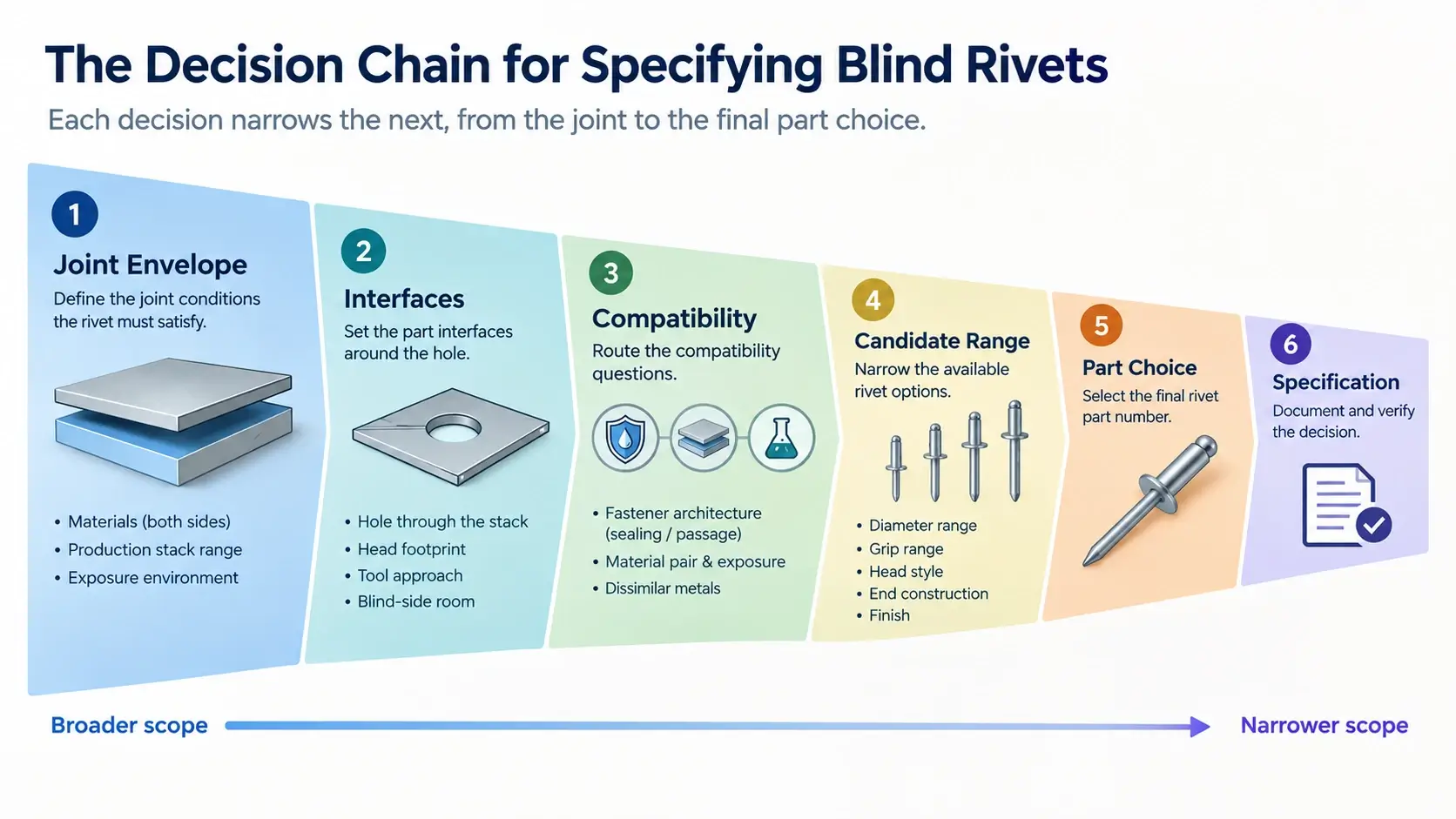
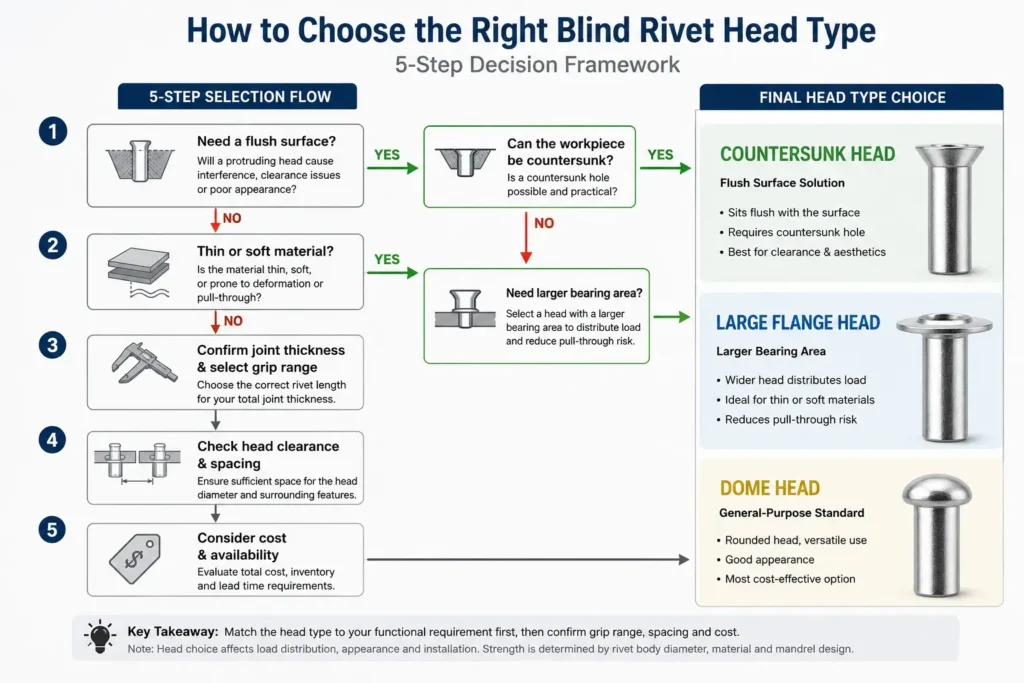
Work through the following five steps to narrow down the head type for your application.
Step 1 — Surface and countersink. Do you need a flush surface, and can the workpiece accept a countersunk hole, considering material thickness and available manufacturing steps? If both answers are yes, a countersunk head is the right choice. If not, continue to Step 2.
Step 2 — Material. Is the material thin, soft, or prone to pull-through? If the joint needs additional bearing area, consider a large flange head. For conventional metal joints, move to Step 3.
Step 3 — Joint thickness and grip. Once the head type is selected, confirm the total joint thickness and choose a rivet with the appropriate grip range.
Step 4 — Space. Are there head clearance or spacing constraints? Large flange heads generally require more surface clearance because of their larger head diameter — confirm the head diameter fits the layout.
Step 5 — Cost and availability. If cost sensitivity or stock availability is the deciding factor, the dome head is usually the simplest general-purpose option.
The table below summarizes the common application-to-head-type decisions.
Table 2 — Application Decision Table
| Application | Recommended Head | Main Benefit | Key Trade-off |
|---|---|---|---|
| General sheet metal / enclosure | Dome | Economical, versatile | Head remains proud |
| Thin sheet / soft material | Large Flange | Larger bearing area | More space required |
| Plastic / composite | Large Flange | Reduces pull-through risk | Larger head footprint |
| Flush exterior surface | Countersunk | Flush finish | Requires countersink |
| Sliding / contact surface | Countersunk | Reduced protrusion | More preparation |
If you are still unsure after working through the steps, send us your material, joint thickness, hole size and application requirements — our engineers can recommend a head type based on the actual application.
Common Misconceptions About Rivet Heads
Four misconceptions come up repeatedly with buyers and engineers.
Misconception 1: A large flange head is stronger. Not exactly. A large flange distributes load over a larger area at the sheet surface. Shear and tensile strength depend on the rivet body material, diameter and mandrel design — covered in our guide to blind rivet shear vs tensile strength.
Misconception 2: Countersunk heads are only suitable when strength is not important. Not necessarily. Rivet-body strength depends primarily on body diameter, material and design. Countersunk heads are mainly chosen for flush installation and clearance requirements.
Misconception 3: Head types can be swapped freely. Changing head type means re-evaluating hole size, spacing and assembly clearance — the three dimensions are linked.
Misconception 4: A larger head means a larger hole. No. The hole size is determined by the rivet body diameter. Changing from a standard head to a large flange head does not necessarily mean a larger body diameter or installation hole — always check the manufacturer’s specification.
FAQ
1. What are the different head types of blind rivets?
Blind rivets are available in three main head types: dome, large flange and countersunk. Dome heads are the standard general-purpose choice. Large flange heads provide a larger bearing surface for thin or soft materials. Countersunk heads sit flush with the workpiece for a smooth surface.
2. What is a large flange blind rivet used for?
Large flange blind rivets are used on thin, soft or brittle materials where a standard head could pull through, and on oversized holes. The wider head distributes clamping load over a larger bearing area, reducing local stress at the head-to-sheet interface.
3. Is a countersunk blind rivet weaker than a dome head?
Not necessarily. Shear and tensile strength are primarily determined by rivet body diameter, material and design. A countersunk head changes the head geometry and installation requirements, so compare the manufacturer’s rated performance rather than assuming one head style is inherently stronger.
4. What countersink angle do blind rivets use — 90° or 100°?
Countersunk blind rivets are available with different included angles, commonly including 90° and 100°. The rivet head angle and the prepared countersink angle must match to achieve a flush installation. Confirm the required angle with the manufacturer before ordering.
5. Can large flange rivets be used without changing the hole size?
Usually yes, if the body diameter is unchanged. The larger flange changes the head diameter, not necessarily the rivet body diameter or the required hole size. Always check the manufacturer’s specification for the exact hole recommendation.
6. Does a large flange blind rivet require more edge distance?
Large flange rivets generally require more surface clearance because of their larger head diameter. Check the manufacturer’s recommended edge distance and spacing, especially when multiple rivets are installed close together.
7. Can I get custom head sizes for OEM applications?
Yes. For OEM projects, head diameters — particularly large flange sizes — can be customized to the product drawing. Provide the drawing or application requirements, together with the required head diameter, body diameter, material and joint thickness, and the supplier can produce a rivet to specification.
8. How do I choose between dome and countersunk heads?
Choose a countersunk head when the surface must be flush, smooth or snag-free, and the workpiece can be countersunk. Otherwise, a dome head is the simpler and more economical general-purpose option.
Need Help Choosing a Head Type?
Send us your material, joint thickness, hole size and application requirements — our engineers will recommend the right configuration for your joint.
Request a Quote or Send Your Drawing for OEM projects, where head diameters can be customized to your specification. For more on the customization process, see our custom blind rivet OEM guide.
Note: all dimensions in this article are representative examples. The final product drawing and factory specification are the reference for ordering.
Data Sources
Dome and countersunk head dimensions in Table 1 are representative dimensional examples based on commonly used rivet specifications, including DIN 7337-based dimensions. Large flange dimensions are product-dependent and should be confirmed against the manufacturer’s drawing. Always refer to the product drawing and factory specification before specifying a rivet.