You have selected the rivet. You have checked the grip range. You have prepared the hole. But is the hole actually within the specified tolerance?
Hole tolerance is part of joint strength — not just a paperwork detail. Hole tolerance is only one factor affecting joint performance, alongside rivet diameter, grip, sheet material, head geometry and setting conditions. At the moment of setting it helps decide how closely the installed joint matches the conditions represented by published data for that part number.
This guide explains why the tolerance band exists, what happens when a hole falls outside it, how to hold and verify the hole in production, and what to do when a measured hole is out of band. The examples throughout use an illustrative 4.8 mm blind rivet.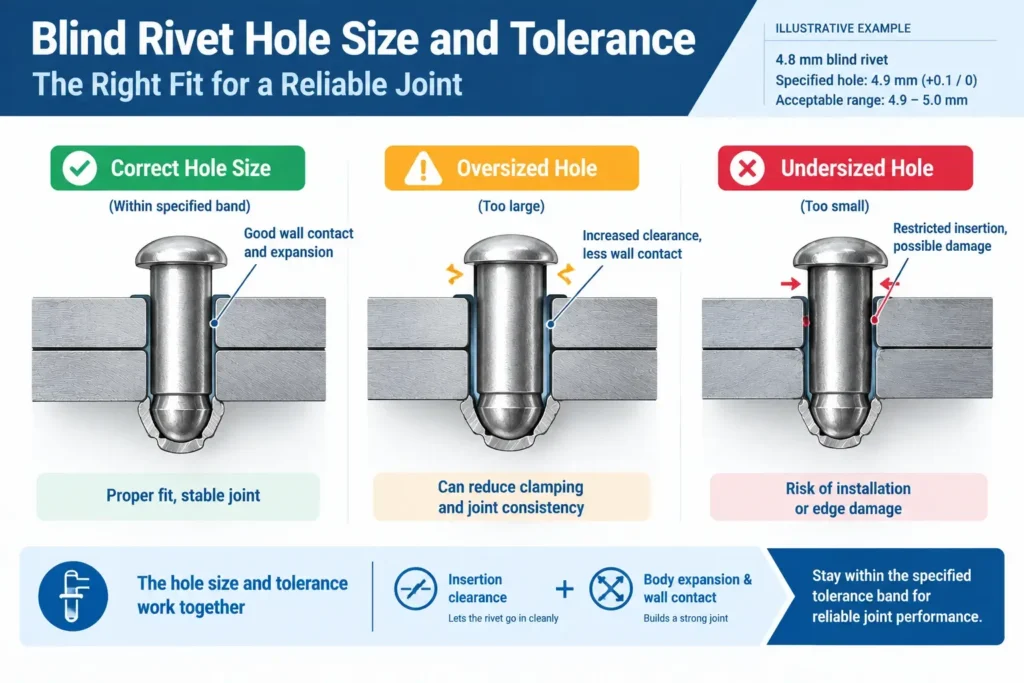
How Hole Tolerance Affects the Installed Joint
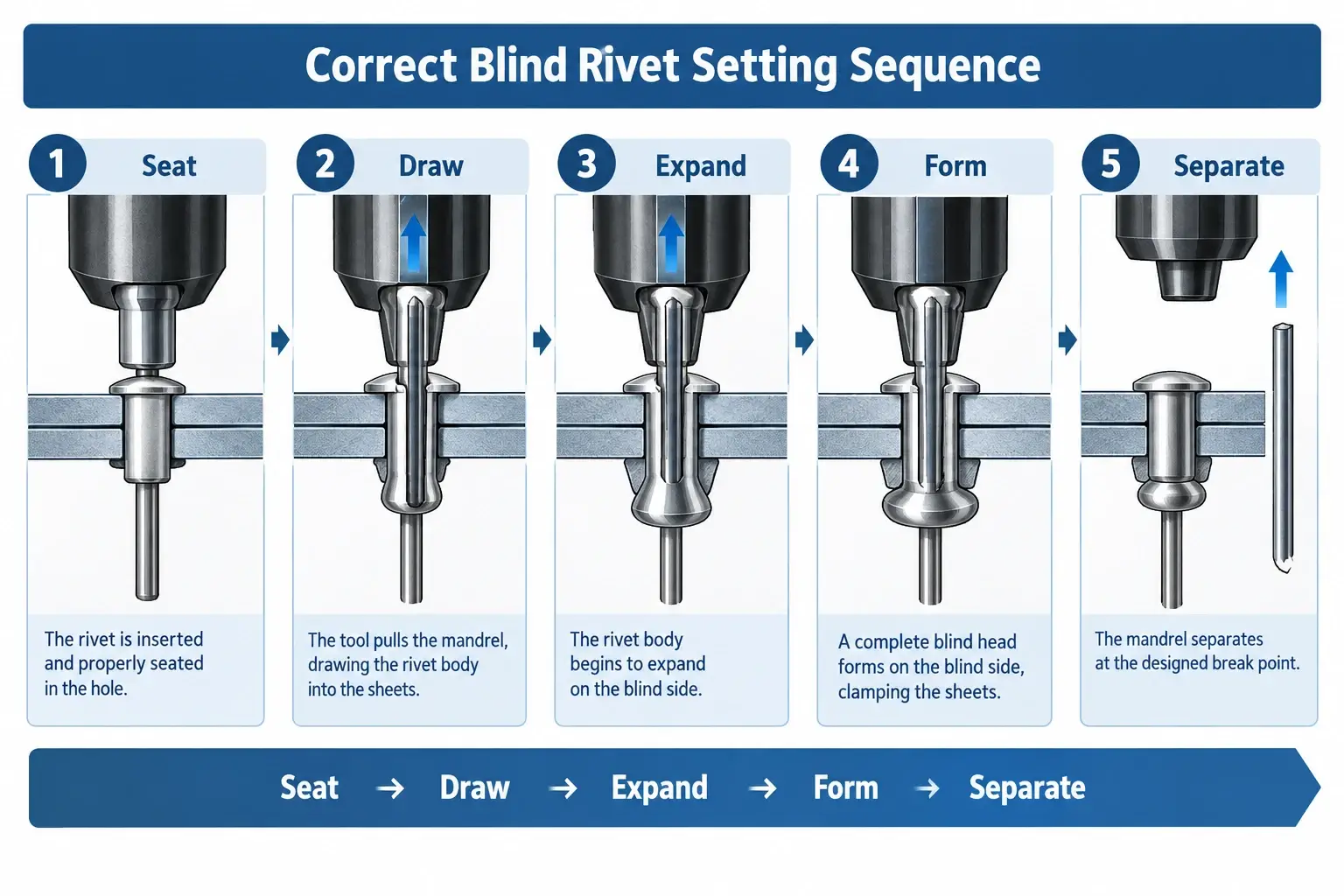
A blind rivet works by expanding its body against the hole wall while it forms a blind head on the far side. The hole size you prepare therefore shapes the installed joint from the very first moment of setting.
Table 1 — Hole Condition and the Installed Joint
| Hole condition | During setting | Joint implication |
|---|---|---|
| Within the specified band | Body expands and contacts the hole wall | Intended installation condition |
| Too large | Excess clearance remains around the body | Reduced contact and clamp-up |
| Too small | Insertion or seating becomes difficult | Risk of installation or edge damage |
The table above is an overview. Each condition is explained in the sections below.
Why a Blind Rivet Hole Needs a Tolerance Band
A datasheet typically specifies a hole size together with an allowable tolerance band. For an illustrative 4.8 mm blind rivet with a grip range of 6.0–8.0 mm, the specified hole is 4.9 mm (+0.1 / 0). That band is not a loophole in the drawing; it reflects how setting actually works.
Clearance is functional, not simply extra space. The gap between the rivet body and the hole exists to allow insertion, tool access, body expansion and seating to happen together.
The specified hole provides the clearance needed for the rivet to be inserted and set under the manufacturer’s intended conditions. That clearance also allows the rivet body to expand and seat against the hole during setting. In other words, the small gap is doing two jobs at once: it lets the rivet go in cleanly, and it gives the body room to form against the wall once the tool pulls the mandrel.
In production, hole size can vary within a controlled range. The tolerance band defines the acceptable window in which the rivet can both insert cleanly and expand against the hole wall.
If the hole is too small for the specified rivet body, insertion can become difficult and forcing the rivet may damage the hole edge or rivet body. If the hole is too large, the increased clearance can reduce effective wall contact during setting. The two ends of the band are both real limits — going past either one moves the joint away from the conditions assumed by published data, just in different ways.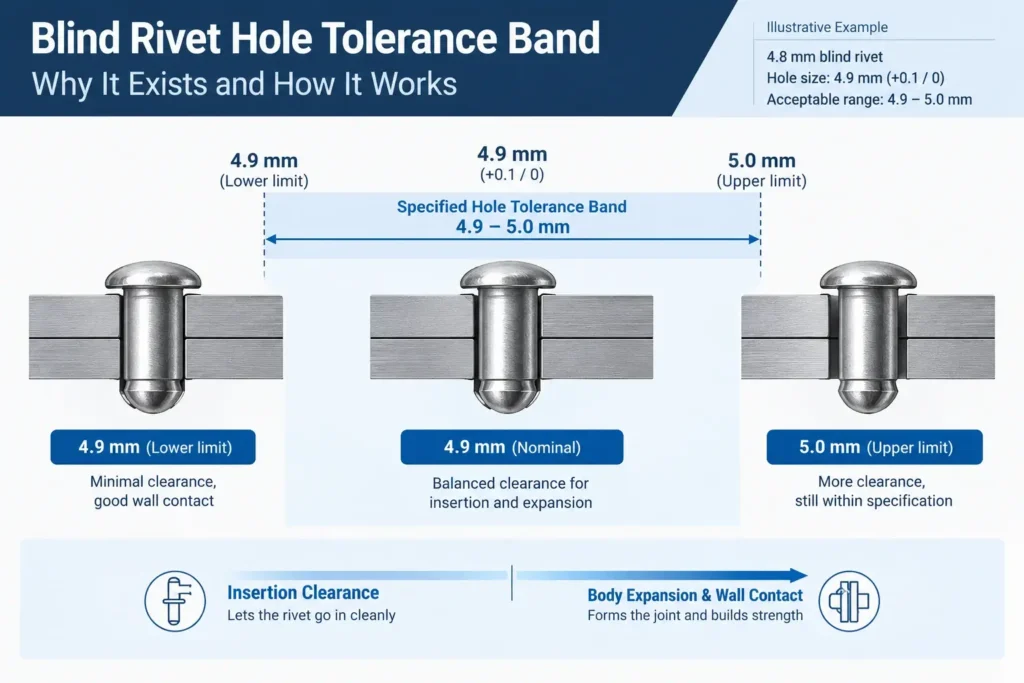
What Happens When the Hole Is Too Large or Too Small
A blind rivet hole that is too large leaves excessive clearance around the rivet body, reducing wall contact and effective clamping. A hole that is too small can restrict insertion and damage the hole edge or rivet body. The specified tolerance band provides the practical window needed for both proper insertion and body expansion.
An Oversized Hole: Less Contact, Less Clamp-Up
An oversized hole increases the clearance around the rivet body, which can reduce effective wall contact during setting. The rivet may still set, but with less wall contact the clamp-up can be weaker and the joint can move or behave inconsistently.
The chain starts with clearance. When the prepared opening is larger than the band allows, the body has room to expand but not enough wall to press against firmly. The result can be less effective clamping across the joint, and an assembly that feels looser or less consistent than one set in a correctly sized hole.
In soft or thin sheet, excessive clearance can also increase the risk of local sheet deformation or pull-through. For the role of the head in supporting thin or soft sheet, see our guide to blind rivet head types.
An Undersized Hole: Restricted Insertion and Edge Damage
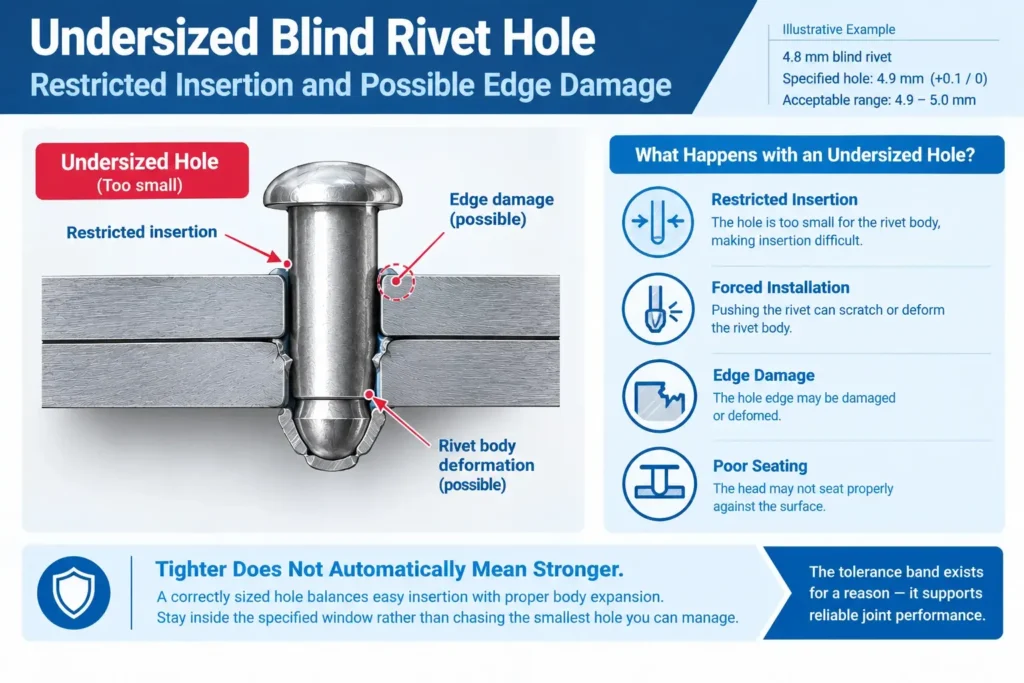
A hole that is too small does not make the joint stronger. It restricts insertion and risks damaging the rivet body or the hole edge on the way in.
When the prepared hole is tighter than the rivet body allows, the rivet cannot enter freely. Forcing it can scratch or deform the body and damage the hole edge. In that situation the head may also fail to seat properly against the surface, so the joint is not formed as intended even though the rivet looks fitted.
Tighter Is Not Automatically Stronger
Tighter does not automatically mean stronger. A correctly sized hole balances easy insertion with proper body expansion. The band already accounts for that balance — stay inside the specified window rather than chasing the smallest hole you can manage.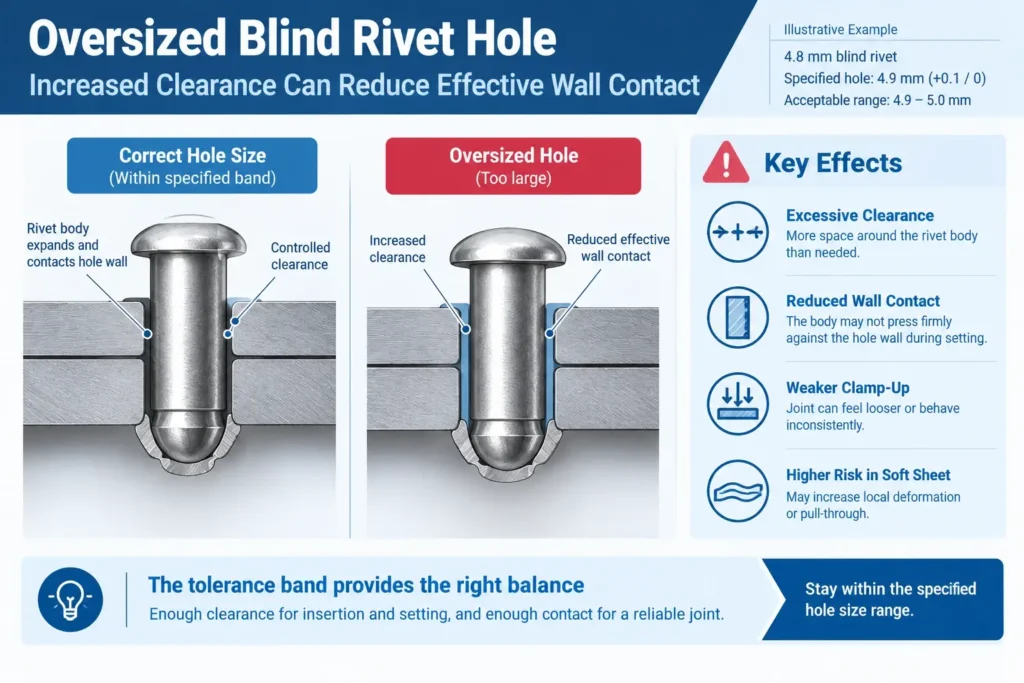
How to Hold and Verify Hole Tolerance in Production
A single out-of-band hole is one thing; a drift across a whole batch is another. Batch-wide drift usually points to a process change — such as tool wear, fixture movement or other process variation — and it needs a check that can catch the problem before parts leave the specified window.
A measurement inside the specified band is acceptable. A measurement outside the band is a decision point — not a reason to force the rivet.
Table 2 — Holding and Verifying the Specified Hole
| Production check | What it helps detect |
|---|---|
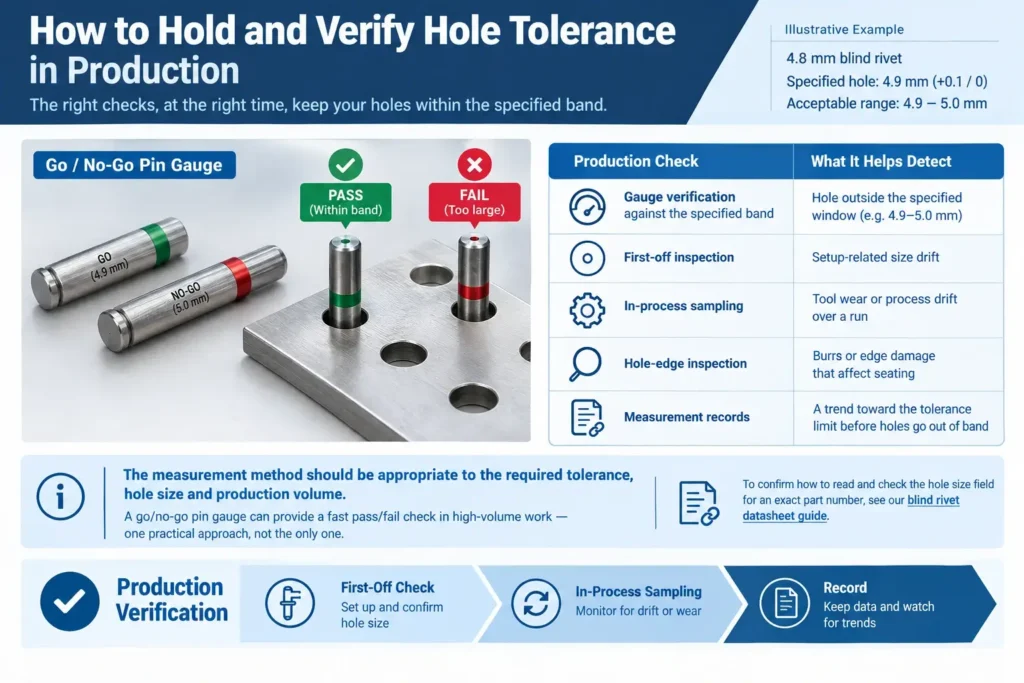
| Gauge verification against the specified band | Hole outside the specified window (for example, outside 4.9–5.0 mm) |
| First-off inspection | Setup-related size drift |
| In-process sampling | Tool wear or process drift over a run |
| Hole-edge inspection | Burrs or edge damage that affect seating |
| Measurement records | A trend toward the tolerance limit before holes go out of band |
The measurement method should be appropriate to the required tolerance, hole size and production volume. A go/no-go pin gauge can provide a fast pass/fail check in high-volume work — one practical approach, not the only one. To confirm how to read and check the hole size field for an exact part number, see our blind rivet datasheet guide.
What to Do When the Hole Is Out of Tolerance
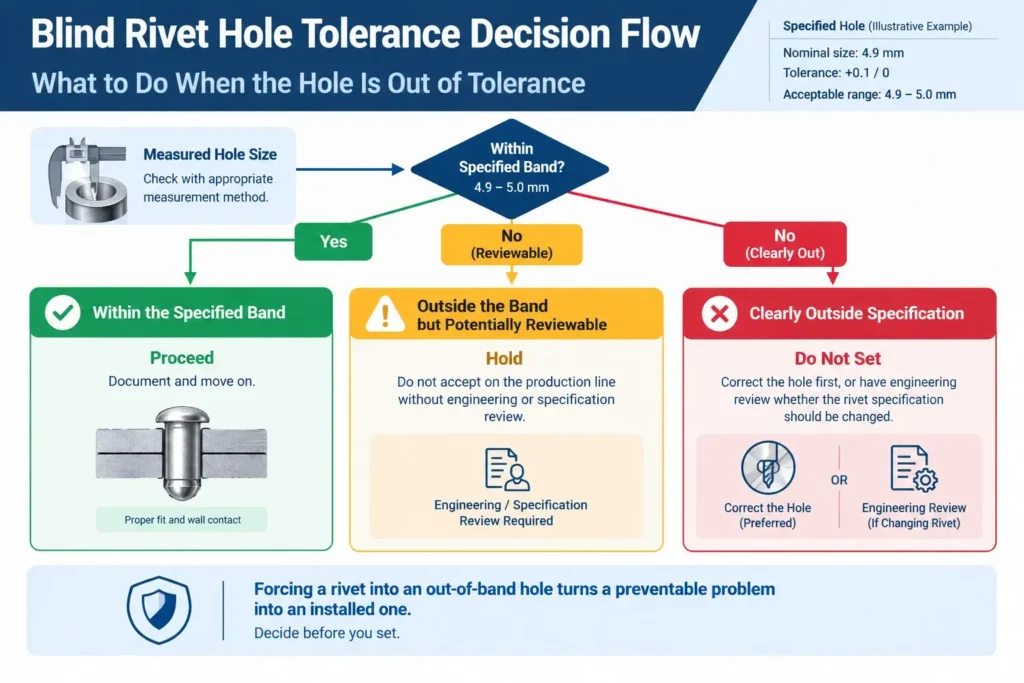
The moment that matters most is the one just before you set the rivet. A hole measures out of band — now what? Decide before you set, using the three levels below.
- Within the specified band → Proceed. Document and move on.
- Outside the band but potentially reviewable → Hold. Do not accept the condition on the production line without engineering or specification review.
- Clearly outside the specification → Do not set. Correct the hole first, or have engineering review whether the rivet specification should be changed.
When a hole is out of tolerance, decide before you set the rivet. Forcing a rivet into an out-of-band hole turns a preventable problem into an installed one.
Correcting the hole, where the material allows, keeps the prepared joint within the specification you selected. Changing the rivet to suit an oversized hole is a specification decision, not a workaround — it should go through engineering review rather than being accepted on the line. If a hole problem has already caused a loose or failing joint, see our guide to the common causes of blind rivet failure.
FAQ
1. What happens if a blind rivet hole is too big?
An oversized hole leaves too much clearance around the rivet body, so the body cannot grip the wall firmly. The clamp-up can be weaker and the joint may move or behave inconsistently. In soft or thin sheet, a very large hole can also increase the risk of local deformation or pull-through.
2. What happens if a blind rivet hole is too small?
A hole that is too small does not make the joint stronger. It restricts insertion, and forcing the rivet can damage the rivet body or the hole edge. The head may also fail to seat properly against the sheet.
3. How do I find the correct hole size for a 4.8 mm blind rivet?
The correct hole size depends on the exact blind rivet part number and the manufacturer’s specification. For this illustrative example, a 4.8 mm blind rivet is specified with a 4.9 mm (+0.1 / 0) hole, giving a 4.9–5.0 mm allowable range.
4. What does +0.1 / 0 mean on a blind rivet hole?
The tolerance defines the acceptable dimensional range for the hole. In this illustrative example, the hole may be up to 0.1 mm larger than the specified 4.9 mm size (5.0 mm maximum) but not smaller than 4.9 mm. That range balances easy insertion with proper body expansion.
5. Does a tighter hole make a stronger blind rivet joint?
No. A hole that is too tight can damage the rivet body or the hole edge and may not let the rivet seat correctly. The specified window is designed to balance easy insertion with proper body expansion, so staying inside it is what matters.
6. How do I check whether my blind rivet hole is within tolerance?
Use a gauge or measurement method suited to the hole size, the tolerance and your production volume. A go/no-go pin gauge gives a fast pass/fail in high-volume work. Use a first-off check followed by in-process sampling, and keep records so you can see a trend toward the limit before holes go out of band.
Hold the Hole, Then Set the Rivet
A correctly prepared hole is part of the rivet’s installed performance — not an optional extra. Hole tolerance is part of joint strength. Hold it, verify it, and decide on it before you set the rivet.
Run the checks in order:
- Confirm the specified hole for the exact part number.
- Verify the prepared hole stays within the band.
- Hold out-of-band holes and decide before setting.
Always use the specified hole for the exact part number, and treat the tolerance band as a production control limit — not just a datasheet number.
If you are setting blind rivets and want to confirm a prepared hole matches the rivet, send RivetFast your exact part number, the measured hole size, the sheet material and thickness, and a drawing or datasheet if available. Our engineers can confirm whether the hole and the rivet are matched, and recommend the next step before you set it.
Send Your Hole & Joint Details | Request a Quote
Note on illustrative values
Illustrative values in this article are based on blind rivet product data published by Westfield Fasteners for its DIN 7337 product range. These are supplier-published values, not values issued by the DIN standard itself. Exact values vary by manufacturer, product series and mandrel design. Always refer to the manufacturer’s datasheet for the specific part number.