The diameter matches. The price is lower. Everything looks comparable — until you notice the grip range, material combination or rating basis is different. The problem is not only what number is shown, but what that number represents and whether it was reported on the same basis.
This guide shows you the ten specifications buyers should check, the fields commonly misread, and how to align datasheets before comparing suppliers.
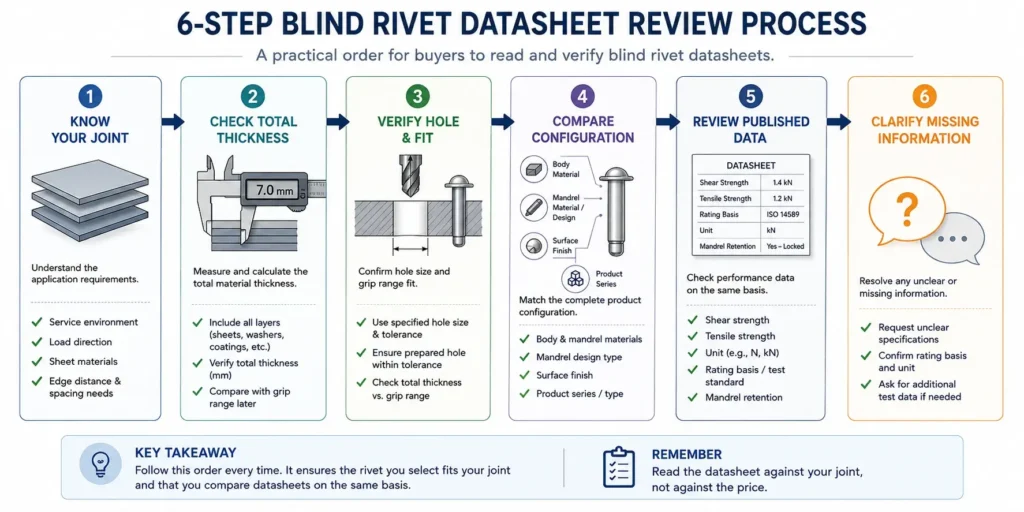
Read the datasheet against your joint, not against the price.
The 10 Specifications on a Blind Rivet Datasheet
A datasheet may be organized by dimensions first, but your review should begin with the requirements of the joint. A practical review order is: know your joint → check total thickness → verify hole and fit → compare configuration → review published data → clarify missing information.
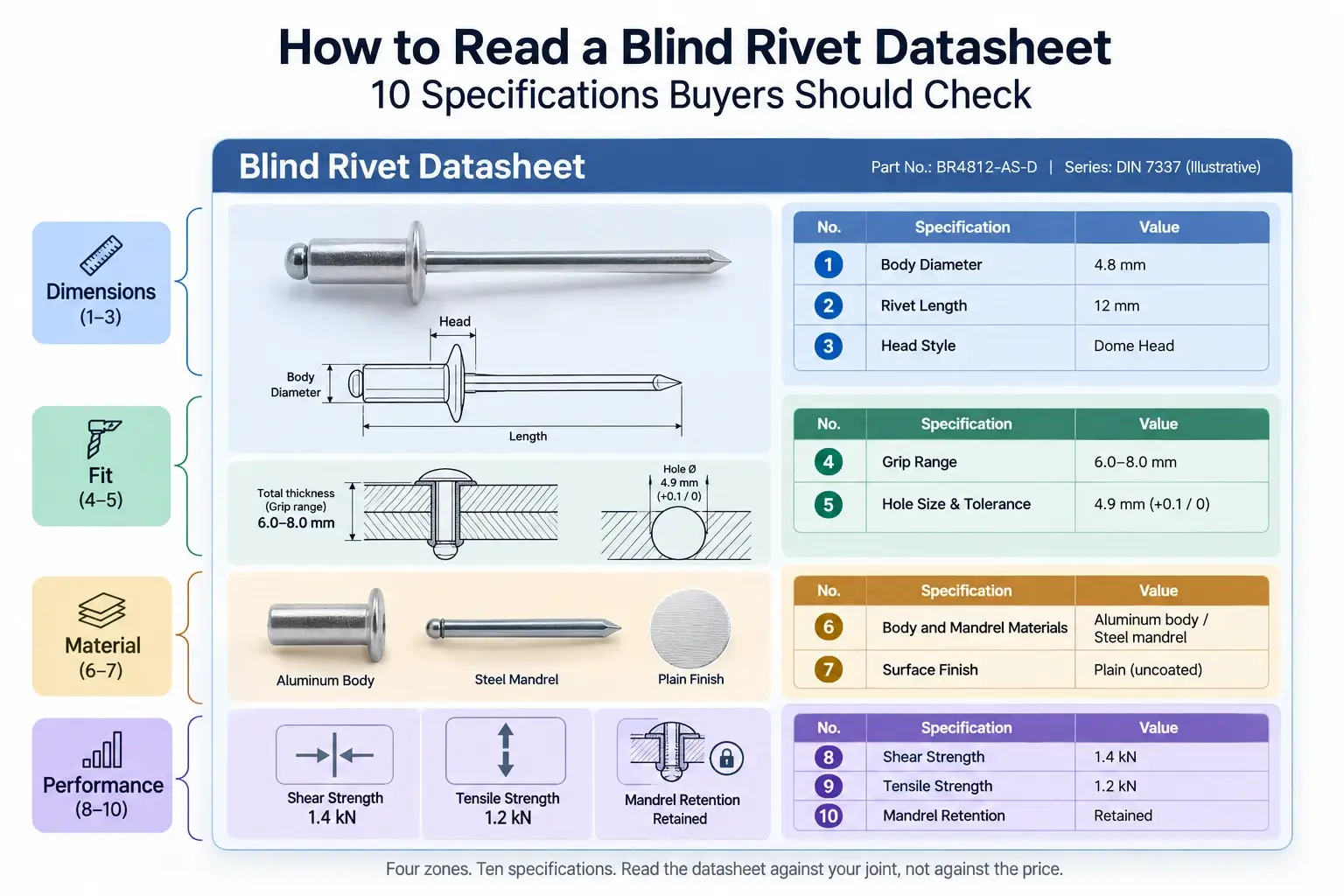
The ten fields below describe what product information to check. Rating basis is not an eleventh field — it describes how that information is reported and compared. The checklist below is grouped by specification type.
Table 1 — Blind rivet datasheet: buyer checklist
| # | Specification | What It Answers | Common Misread | Buyer Check |
|---|---|---|---|---|
| 1 | Body Diameter | Nominal body diameter, used with the specified hole size | Treating diameter as the only specification that matters | Confirm against hole size for the exact part number |
| 2 | Rivet Length | Overall rivet length for the specified product | Assuming length alone decides fit | Use grip range, not length, to judge fit |
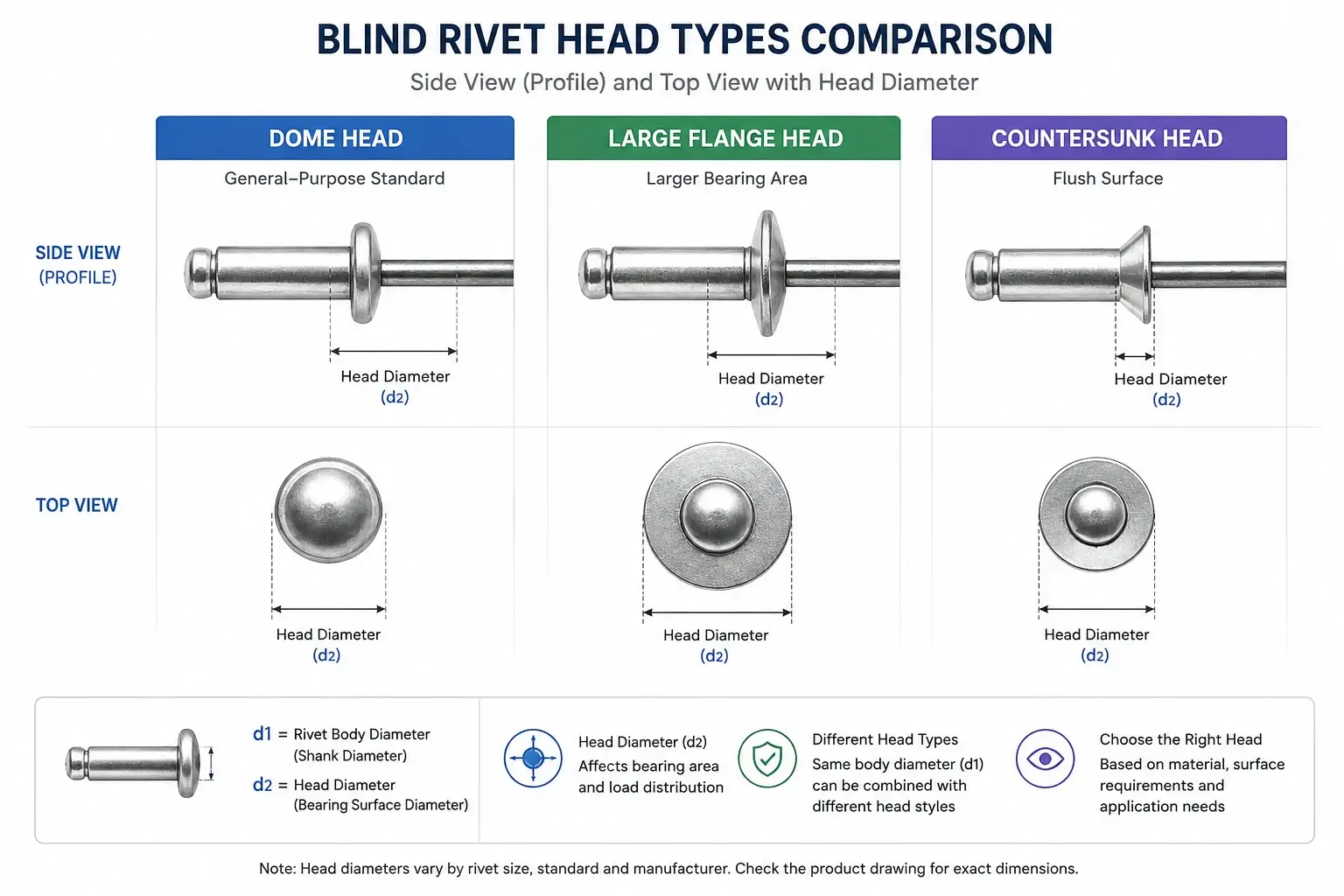
| 3 | Head Style | Surface profile, bearing area and finished appearance | Assuming head style alone determines published strength ratings | Match head style to surface, clearance and bearing-area needs |
| 4 | Grip Range | Total material thickness the rivet can join | Reading only one end of the range | Check total thickness against the full range |
| 5 | Hole Size & Tolerance | Required hole diameter and allowed deviation | Treating hole size as interchangeable by series | Use the hole size specified for the exact part number |
| 6 | Body and Mandrel Materials | Body and mandrel material combination | Reading body material only, ignoring mandrel | Confirm both materials, then the full product configuration |
| 7 | Surface Finish | Environmental suitability and material compatibility | Treating finish as appearance only | Match finish to environment and joined materials |
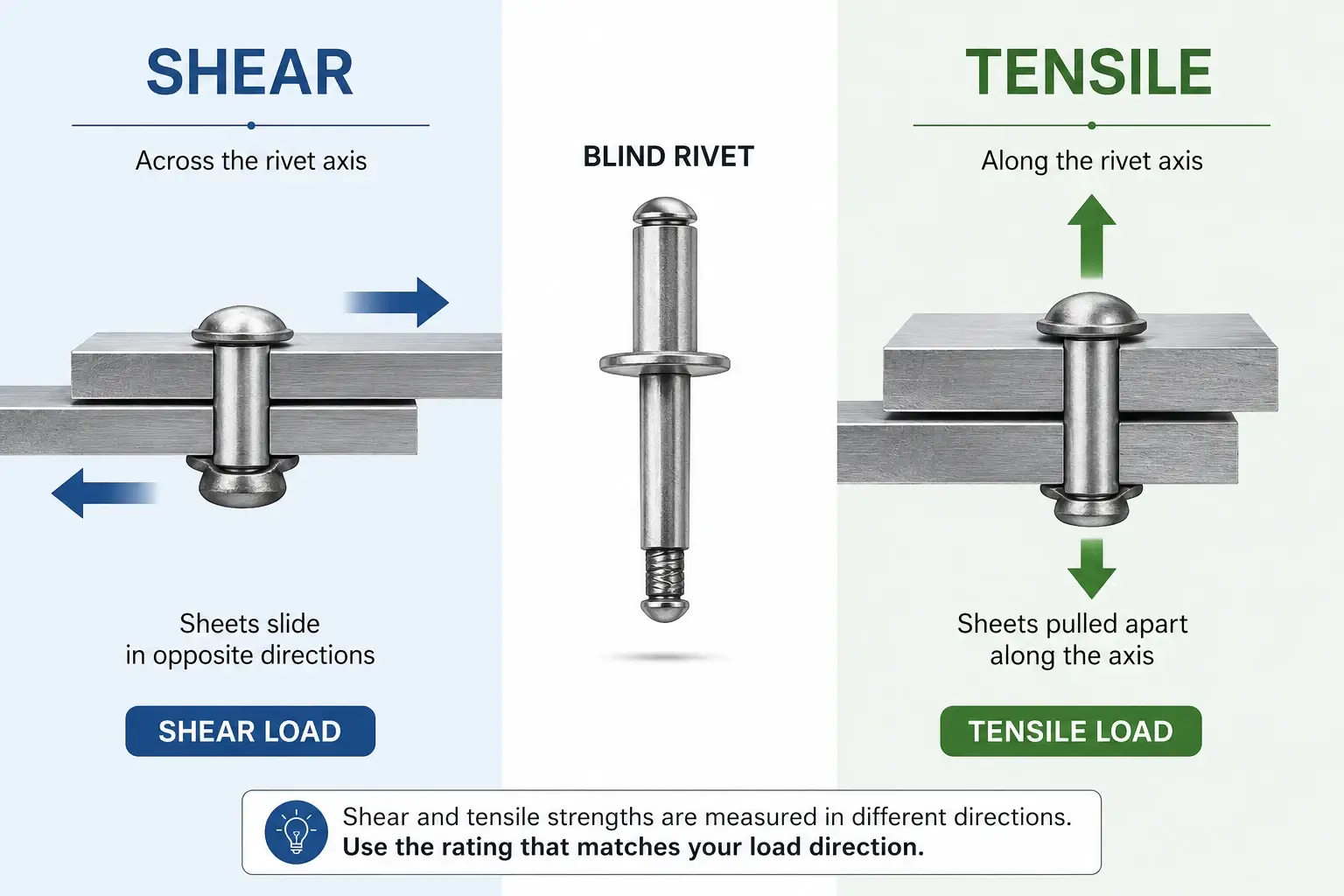
| 8 | Shear Strength | Published shear rating for the exact configuration | Comparing values without checking unit or rating basis | Check value, unit and rating basis together |
| 9 | Tensile Strength | Published tensile rating for the exact configuration | Assuming the rating predicts complete joint performance | Check value, unit and rating basis together |
| 10 | Mandrel Retention | Whether the mandrel stays locked after setting | Assuming retention always appears as a standard field | Check how retention is specified for the product |
One illustrative example runs through this guide: a 4.8 mm blind rivet, aluminum body with steel mandrel, dome head, plain finish, grip range 6.0–8.0 mm, hole size 4.9 mm (+0.1 / 0), published ratings 1.4 kN in shear and 1.2 kN in tensile.
How to Check Each Specification
Dimensions: Body Diameter, Rivet Length and Head Style
Body diameter — what it tells you: the nominal diameter of the rivet body — 4.8 mm in the example — used together with the specified hole size to check fit.
Common misread: treating diameter as the only specification that matters. Two rivets of the same 4.8 mm size can differ in grip range, configuration and rating basis.
What to check: confirm it against the hole size specified for the exact part number.
Rivet length — what it tells you: the overall length of the rivet — 12 mm in the example. The usable clamping range is stated directly as grip range.
Common misread: assuming length alone decides fit. Two rivets of the same length can carry different grip ranges.
What to check: use grip range — not length — to judge fit.
Head style — what it tells you: the shape and diameter of the head — dome head in the example. It forms the bearing surface on the set side and the finished appearance.
Common misread: assuming head style alone determines published strength ratings. Head style is not the primary determinant of a blind rivet’s published strength ratings — its main role is to meet the assembly’s surface, clearance and bearing-area requirements. For dome, large flange and countersunk heads compared, see our guide to blind rivet head types.
What to check: match the head style to the required surface profile, available access and bearing-area needs.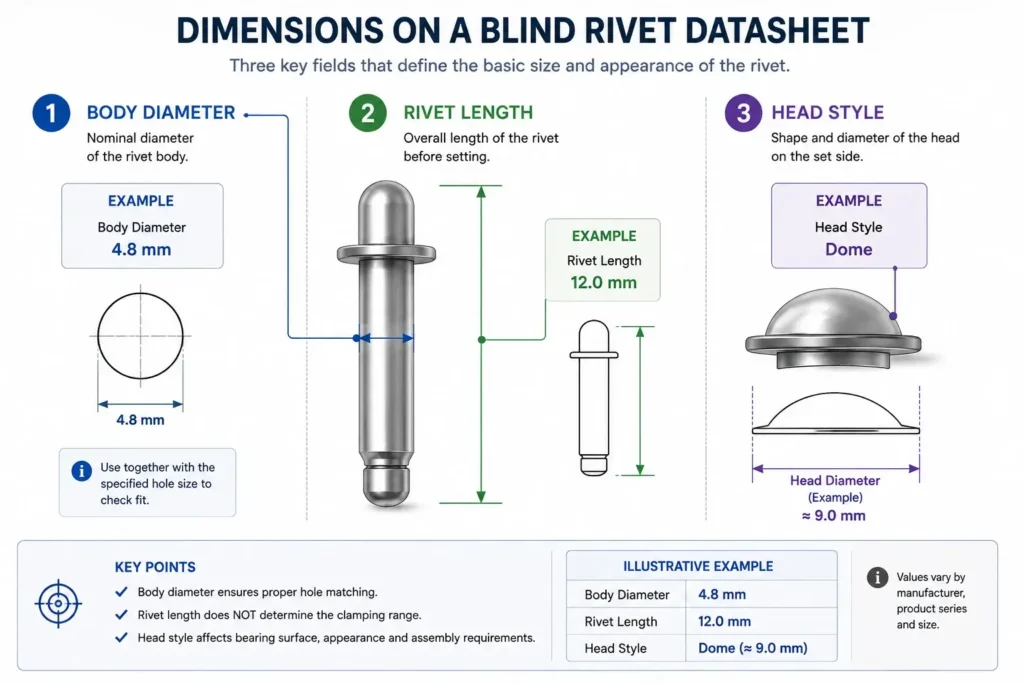
Fit: Grip Range and Hole Size
Grip range — what it tells you: the total material thickness the rivet is designed to join — 6.0–8.0 mm in the example.
Common misread: reading only one end of the range, or inferring the grip range from the rivet length.
What to check: add up every layer to be joined and compare the total against the full range — a 7 mm stack suits the example; a 5 mm or 9 mm stack does not.
Hole size and tolerance — what it tells you: the hole diameter the rivet is designed for, stated with its tolerance band — Hole Ø: 4.9 mm (+0.1 / 0) in the example.
Common misread: treating hole size as interchangeable across rivet series. The nominal hole diameter is not the complete specification — the tolerance band is part of it.
What to check: use the hole size specified for the exact rivet part number, and ensure the prepared hole falls within the specified tolerance. For hole size data by diameter, see our blind rivet hole size guide.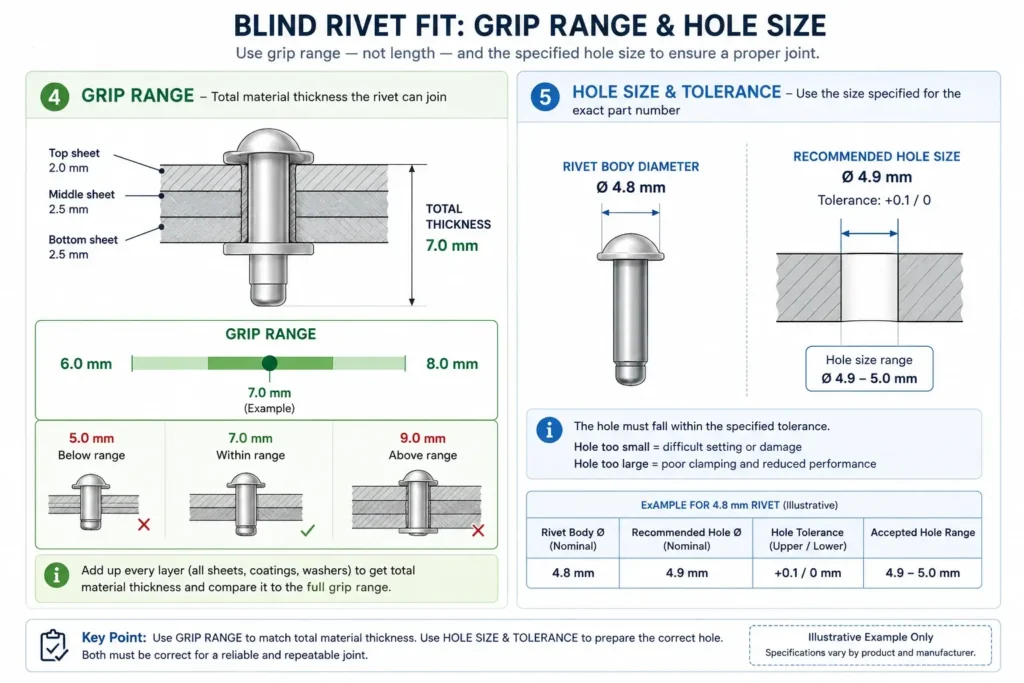
Material: Body and Mandrel Materials, and Surface Finish
Body and mandrel materials — what it tells you: the body-and-mandrel material combination — aluminum body with a steel mandrel in the example.
Common misread: reading the body material only. Rivets with the same body material can differ in mandrel material, design and other product specifications.
What to check: confirm the body-and-mandrel material combination, then review the full product configuration for the exact part number — our guide to choosing blind rivet materials covers the options.
Surface finish — what it tells you: the surface treatment of the rivet — plain (uncoated) in the example — relating to environmental suitability and material compatibility. Read it together with the base material and the service environment, not as an isolated appearance specification.
Common misread: treating finish as appearance only.
What to check: match the finish to the service environment and the joined materials.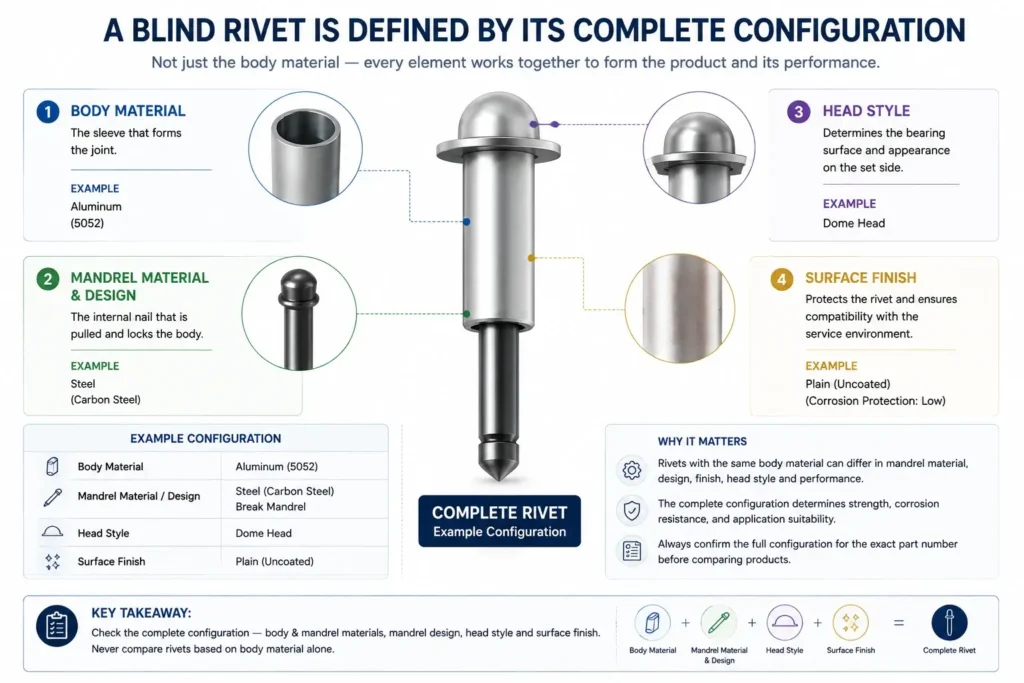
Performance: Shear Strength, Tensile Strength and Mandrel Retention
Shear strength — what it tells you: the published shear rating for the exact configuration — 1.4 kN in the example.
Common misread: comparing ratings without checking the unit or rating basis. Compare published values only when both are aligned.
What to check: read the value, the unit and the rating basis together. For applying strength ratings to a joint decision, see our guide to blind rivet shear vs tensile strength.
Tensile strength — what it tells you: the published tensile rating for the exact configuration — 1.2 kN in the example.
Common misread: assuming the number represents total joint capacity. It is published product data for the exact rivet configuration, not a direct prediction of complete joint performance.
What to check: again, value, unit and rating basis together — see our shear vs tensile strength guide for how the two ratings differ.
Mandrel retention — what it tells you: whether the mandrel is designed to stay locked in the set rivet. This information is not always presented as a standardized standalone field — it may appear as a product feature or be described using different retention terminology.
Common misread: assuming retention always appears as a standard field, or ignoring it because the wording is unfamiliar.
What to check: read how retention is specified, and ask the supplier when the description is unclear.
What the Datasheet Does Not Tell You
Every field above describes the rivet as a product. None of them describes your joint. The datasheet rating covers the rivet, not the joint. Joint performance also depends on factors outside the datasheet, including hole condition, sheet properties, edge distance, rivet spacing and installation quality. Datasheet values are a starting point for comparing products, not a guarantee of complete joint performance. For applying strength ratings to a joint evaluation, see our blind rivet shear vs tensile strength guide.
Comparing Datasheets from Different Suppliers
When two suppliers quote what looks like the same rivet, the datasheet — not the price — decides whether the offers are comparable. A blind rivet datasheet is not a price comparison sheet.
Comparing two datasheets is an alignment exercise — the order matters:
1. Exact product identification. Both datasheets should identify the exact part number and product series — a diameter alone is not enough to confirm that two products are equivalent.
2. Rating basis and unit. Strength values should be compared on the same reporting basis and converted to the same unit before comparison.
3. Material and configuration. Body and mandrel materials, mandrel design and product series must match, or the comparison quietly shifts to a different product.
4. Grip range and hole size. The ranges and hole tolerances must both fit the actual joint.
Table 2 — Aligning two blind rivet datasheets for comparison
| Check | Alignment Requirement |
|---|---|
| Exact product identification | Both datasheets identify the same part number and product series |
| Rating basis and unit | Same reporting basis, values converted to the same unit before comparison |
| Material and configuration | Body and mandrel materials, mandrel design and product series agree |
| Grip range and hole size | Range and hole tolerance both fit the actual joint |
If two datasheets cannot be aligned field by field, they should not be treated as directly comparable alternatives. A lower price on a non-aligned datasheet is not automatically a like-for-like saving.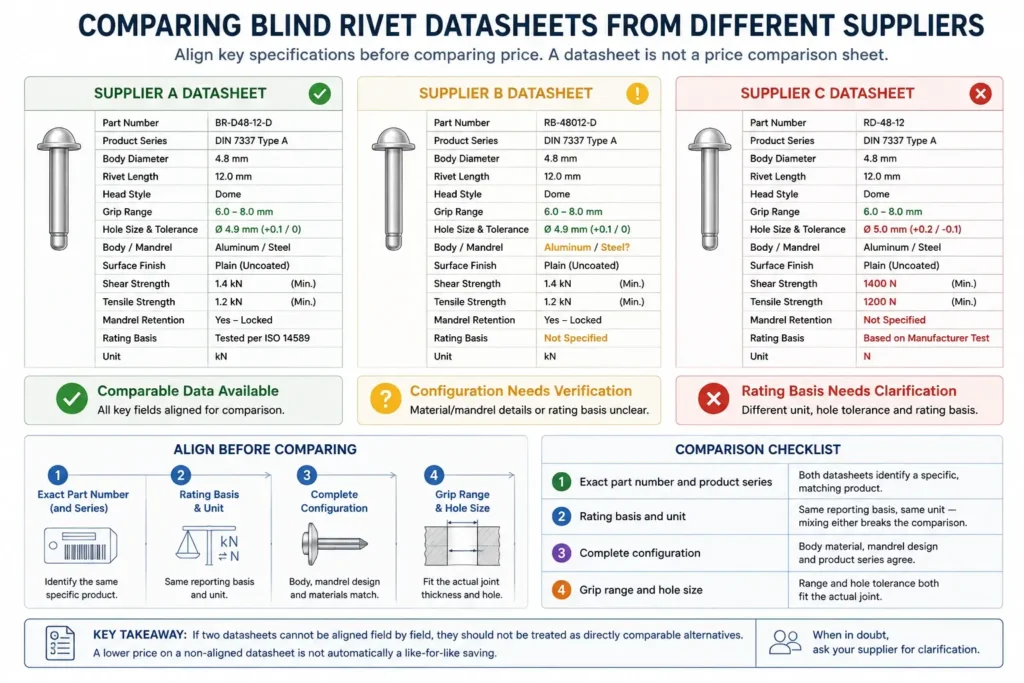
FAQ
1. What is grip range on a blind rivet datasheet?
Grip range is the total material thickness the rivet is designed to join. To use it, add up every layer to be joined and compare the total against the full range. For example, a grip range of 6.0–8.0 mm suits a total material thickness within that band.
2. What does rivet length mean on a blind rivet datasheet?
Rivet length is the overall length of the rivet before setting. The datasheet states the usable clamping range directly as grip range. To judge fit, compare total material thickness with the grip range — not with the length.
3. What hole size should I use for a 4.8 mm blind rivet?
Use the hole size specified for the exact rivet part number — requirements vary by diameter and product design. In the illustrative 4.8 mm example, the specified hole size is 4.9 mm (+0.1 / 0), tolerance included.
4. Why do two rivets with the same diameter have different strength values?
Published ratings are tied to the exact product configuration and the reporting basis used by the manufacturer, so the same nominal diameter can carry different values. Compare the exact part number and align the rating basis before comparing values.
5. Does head style affect the strength rating on a datasheet?
Head style alone does not determine the published strength rating. Compare the complete product configuration and the manufacturer’s published data rather than using head style as a strength shortcut.
6. What is mandrel retention on a blind rivet?
Mandrel retention describes whether the mandrel is designed to stay locked inside the set rivet. It is not always presented as a standardized standalone field — it may appear as a product feature or under different terminology. Check how your product specifies it, and ask the supplier when the description is unclear.
7. Can I compare two blind rivet datasheets directly if the specifications look the same?
Only after aligning them field by field: exact product identification, rating basis and unit, material and configuration, and grip range and hole size. If two datasheets cannot be aligned, they are not directly comparable alternatives — a lower price on a non-aligned datasheet is not automatically a like-for-like saving.
8. Where can I get the specifications for a blind rivet part number?
Start with the manufacturer’s or supplier’s datasheet for the exact part number. If specifications are missing or unclear, ask the supplier to provide the relevant product data and rating information.
Need Help Checking a Blind Rivet Datasheet?
Send us the supplier datasheet or the exact part number you are evaluating. We can help review the grip range against your total material thickness, check the specified hole requirements and product configuration, and clarify the published rating basis before you compare options. For custom specifications, see our custom blind rivet OEM guide.
Whatever you are comparing, start from the joint: read the datasheet against your joint, not against the price.
Note on illustrative datasheet values
The illustrative values used in this guide are based on blind rivet product data published by Westfield Fasteners for its DIN 7337 product range. They are supplier-published values, not values issued by the DIN standard itself. Exact values vary by manufacturer, product series and mandrel design. Always refer to the manufacturer’s datasheet for the specific part number.