You open a blind rivet datasheet and see two numbers:
- Shear strength: 1.4 kN
- Tensile strength: 1.2 kN
Which number should you use?
The answer depends on the direction of the load — not on which number is higher. Shear strength measures resistance to loads acting across the rivet axis; tensile strength measures resistance to loads pulling along it. Choose the rating that matches your load case, then read the value against your application.
The higher number is not necessarily the number you need.
This guide explains what the two ratings measure, how to tell which one governs your joint, how diameter and material configuration change the values, and how to use them with a practical five-step checklist.
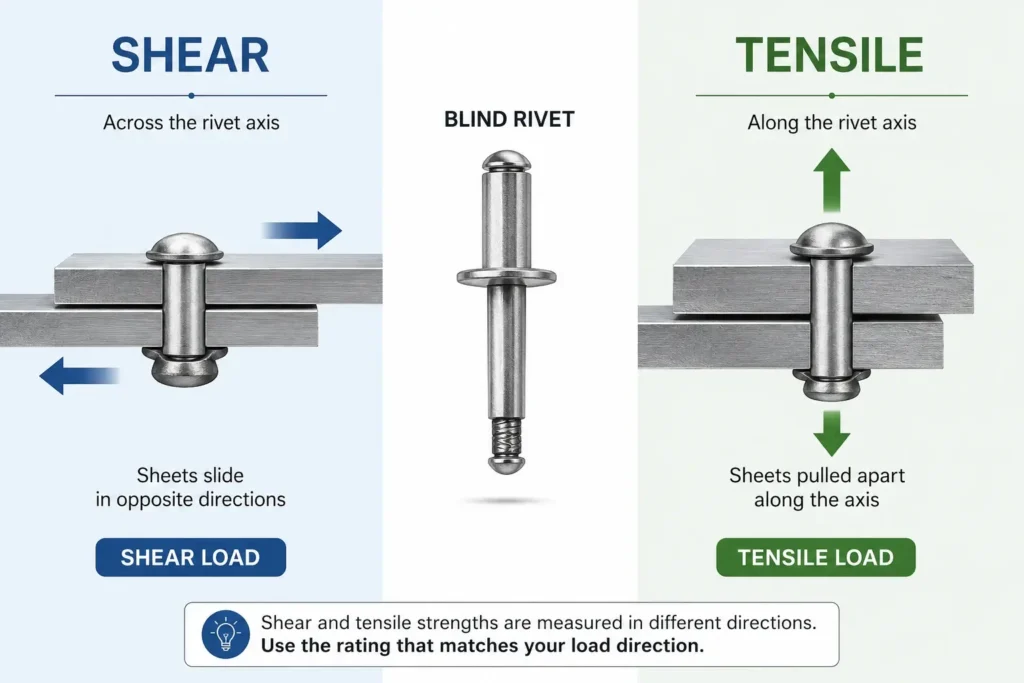
What Do Shear and Tensile Strength Ratings Measure?
Both ratings come from single-rivet laboratory tests, and each describes resistance to one specific loading direction.
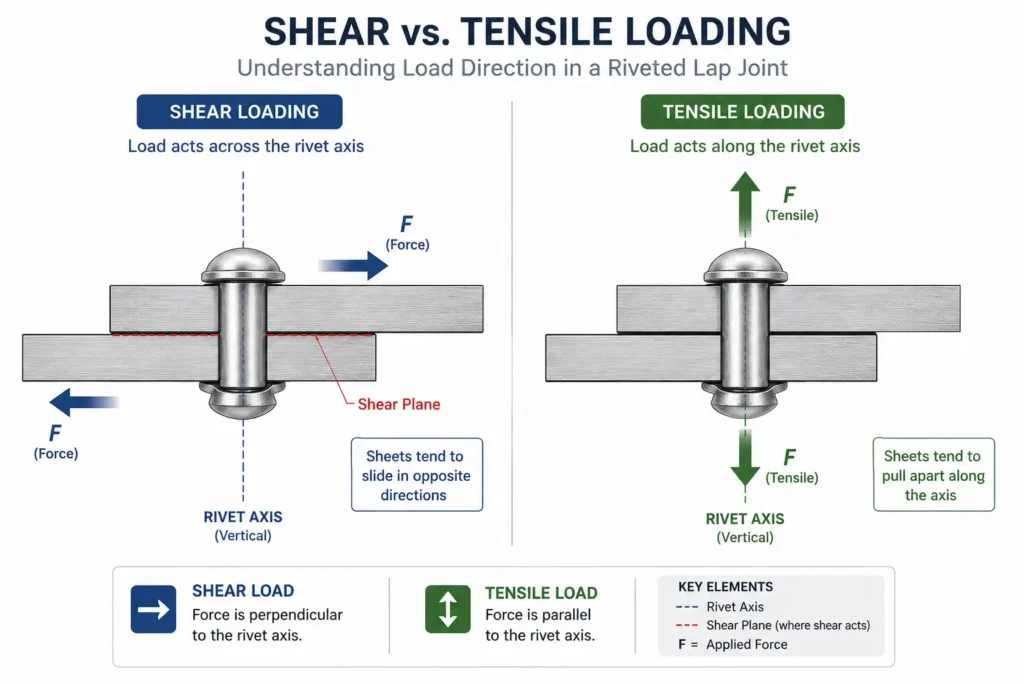
Shear strength — the rivet is loaded across its axis. The joined sheets tend to slide in opposite directions, and the rivet body resists this sliding along the shear plane.
Tensile strength — the rivet is loaded along its axis. The load pulls the two sheets directly apart, and the rivet resists this axial pull.
Two points follow. First, each value belongs to one exact rivet configuration — body diameter, material combination, mandrel design and product series. Second, both values come from controlled laboratory conditions, not from your joint in service. We return to that distinction in the worked example below.
Which Strength Rating Applies to Your Joint?
Once you know what each rating measures, the practical question follows: which one applies to my joint?
Start from the load direction, not from the rivet.
Lap joint under lateral load. Two sheets overlap and the load tries to slide them past each other. The force acts perpendicular to the rivet axis, so the shear rating is the one to check. This is the most common blind rivet configuration.
Hanging or suspended component. The load pulls along the rivet axis, trying to separate the sheets. The tensile rating governs.
Combined or offset load. Many real assemblies see both directions at once, or a load applied at an angle. Evaluate both ratings against the load components — neither number alone tells the full story.
The order matters. Identify the load direction first, then go back to the datasheet and find the matching number. Reverse the sequence — start from the higher number — and you may be checking the wrong rating entirely.
What Determines Blind Rivet Shear and Tensile Strength?
Rivet Diameter
Within a comparable rivet series and material configuration, a larger body diameter generally produces a higher published strength rating. The relationship is not linear, and exact values vary by product series, but the direction is consistent: more material in the rivet body means more resistance to both shear and tensile loading. The chart below shows the trend for one common configuration — aluminum body with steel mandrel.
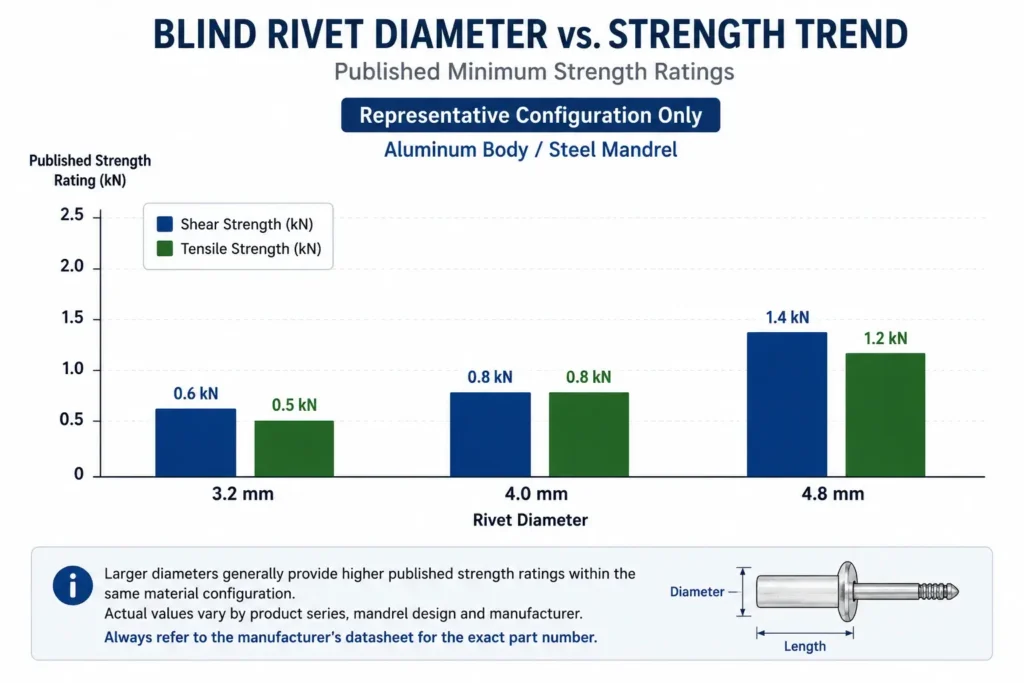
One caution before you trade up in size: diameter raises the rivet’s own rating, not necessarily the joint’s capacity. The sheet material, hole size and edge distance may govern first. That is why “a larger rivet is always better” appears in the misconceptions section later. For a full overview of sizes and hole data, see our blind rivet size chart.
Body and Mandrel Material Combination
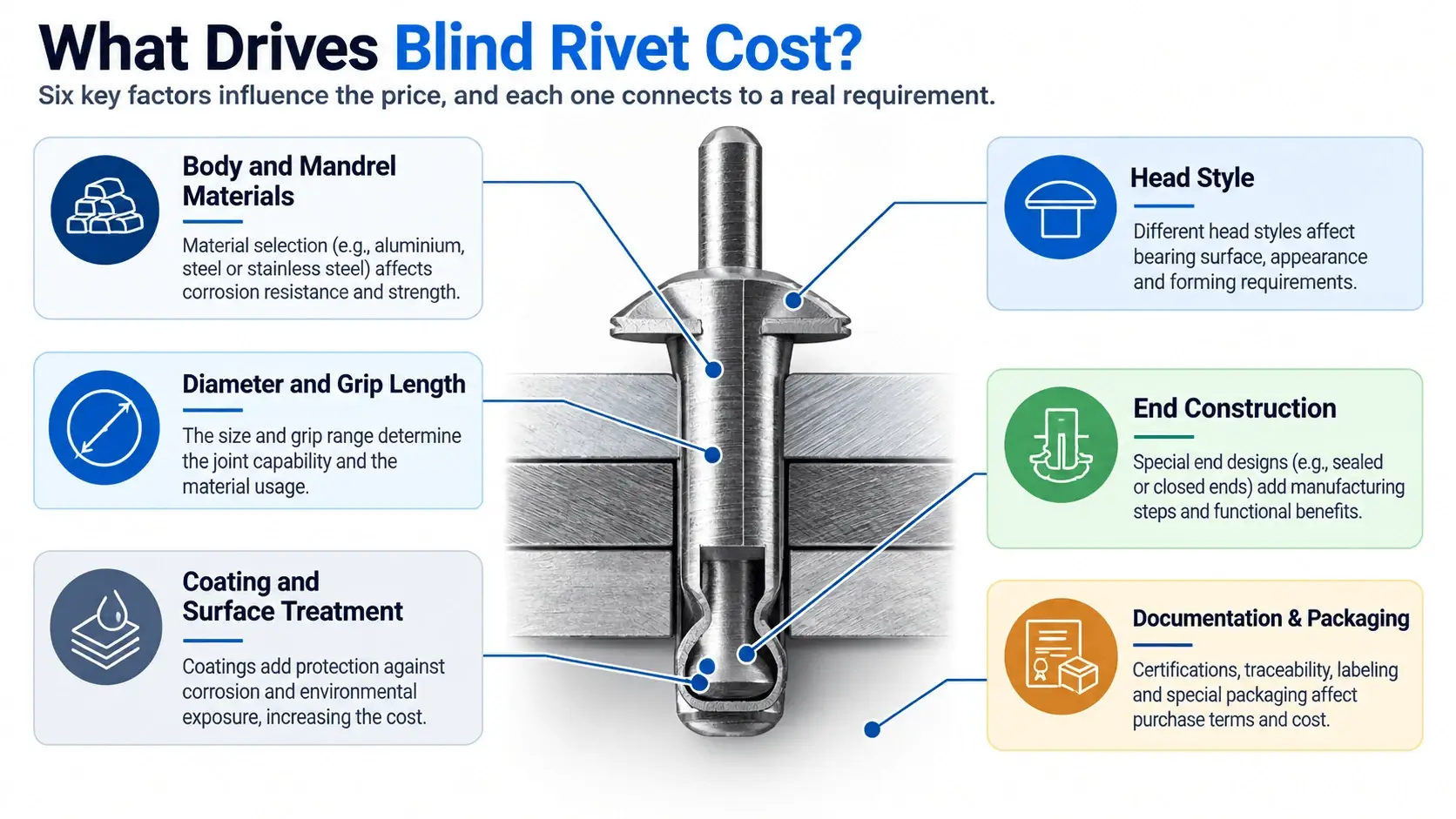
Material configuration is the second major variable — and it is a combination, not a single material name. An aluminum body with a steel mandrel is a common blind rivet configuration, and its ratings differ from an aluminum/aluminum configuration. Steel and stainless configurations sit in a different range again. When you compare rivets, compare the full configuration — body material, mandrel and series — not just the body material. Our guide to choosing blind rivet materials covers the options in detail.
The examples below illustrate how diameter and material configuration can affect published minimum strength ratings. They are not intended as a universal cross-series ranking.
Table 1 — Illustrative published minimum strength ratings by diameter and material combination:
| Body Diameter | Common Material Combination | Shear (kN) | Tensile (kN) |
|---|---|---|---|
| 3.2 mm | Al body / steel mandrel | 0.6 | 0.5 |
| 4.0 mm | Al body / steel mandrel | 0.8 | 0.8 |
| 4.8 mm | Al body / steel mandrel | 1.4 | 1.2 |
| 4.8 mm | Steel body / steel mandrel | 2.4 | 3.0 |
| 6.4 mm | Steel body / steel mandrel | 3.6 | 4.0 |
| 4.8 mm | Stainless body / stainless mandrel | 3.8 | 4.5 |
These values are illustrative examples, not universal industry ratings. Blind rivet strength depends on the exact body material, mandrel design and product series. Always verify the manufacturer’s datasheet for the exact part number.
In these illustrative examples, a useful observation stands out: at the same 4.8 mm diameter, the aluminum/steel configuration rates higher in shear than in tensile, while the steel and stainless configurations rate higher in tensile. Even the direction of “the bigger number” changes with the material configuration — which is exactly why the only dependable method is to match the rating to your load direction.
So treat diameter and material as selection variables, not as a shortcut to predicting strength.
How to Read Blind Rivet Strength Numbers in a Datasheet
Worked Example: A 4.8 mm Blind Rivet
Take a concrete case: a 4.8 mm blind rivet with an aluminum body and steel mandrel, with published minimum ratings of 1.4 kN in shear and 1.2 kN in tensile. What can you actually do with these two numbers?
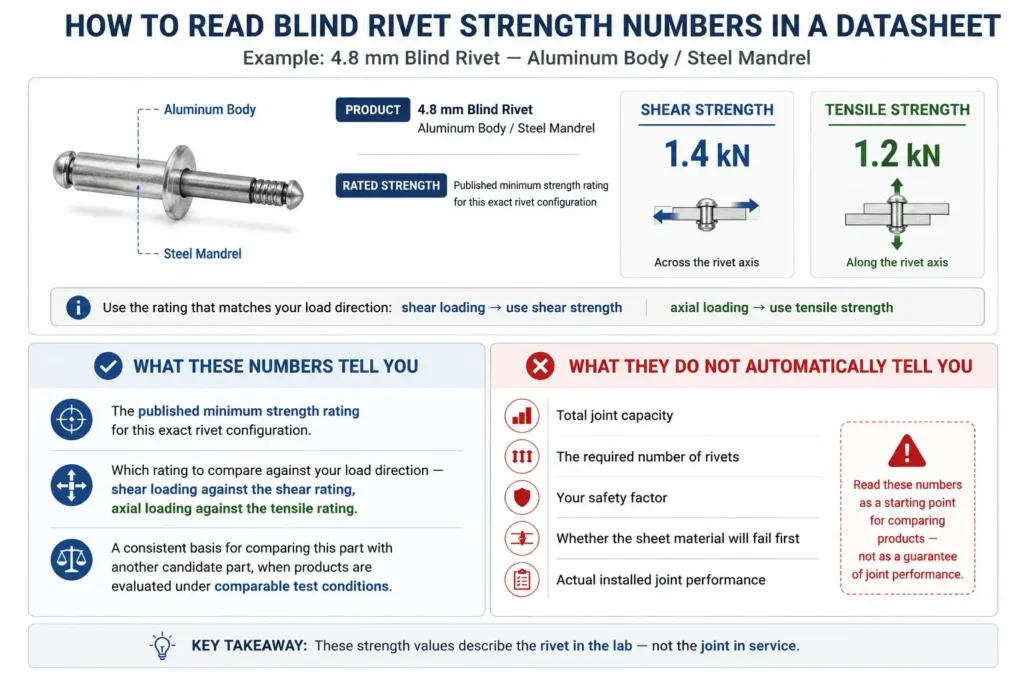
What the numbers tell you:
- The published minimum strength rating for this exact rivet configuration
- Which rating to compare against your load direction — shear loading against the shear rating, axial loading against the tensile rating
- A consistent basis for comparing this part with another candidate part, when the products are evaluated under comparable test conditions
What they do not automatically tell you:
- Total joint capacity
- The required number of rivets
- Your safety factor
- Whether the sheet material will fail first
- Actual installed joint performance
Read these numbers as a starting point for comparing products — not as a guarantee of joint performance.
The Rivet Is Not Always the First Part to Fail
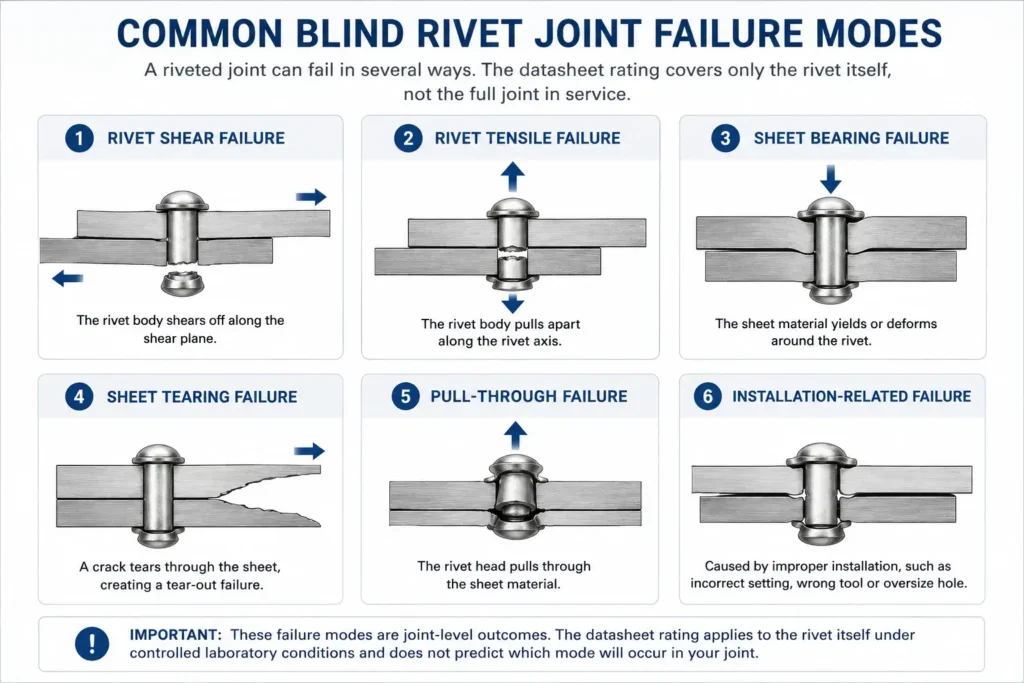
A riveted joint can fail in several ways, and the rivet is not always the first component to give way. Possible modes include rivet shear failure, rivet tensile failure, sheet bearing failure, sheet tearing, pull-through, and installation-related failure. The datasheet rating covers only the rivet itself. It does not predict which mode will occur in your joint.
Joint Factors That Affect Real Performance
Beyond the rivet, several joint-level factors affect real performance: hole size and tolerance, sheet material and thickness, edge distance, rivet spacing, and installation quality — correct tooling, nosepiece selection and setting conditions. Each belongs to joint design rather than the datasheet. For the thickness side of the equation, see our blind rivet grip range guide.
How to Use Blind Rivet Strength Ratings: A 5-Step Checklist
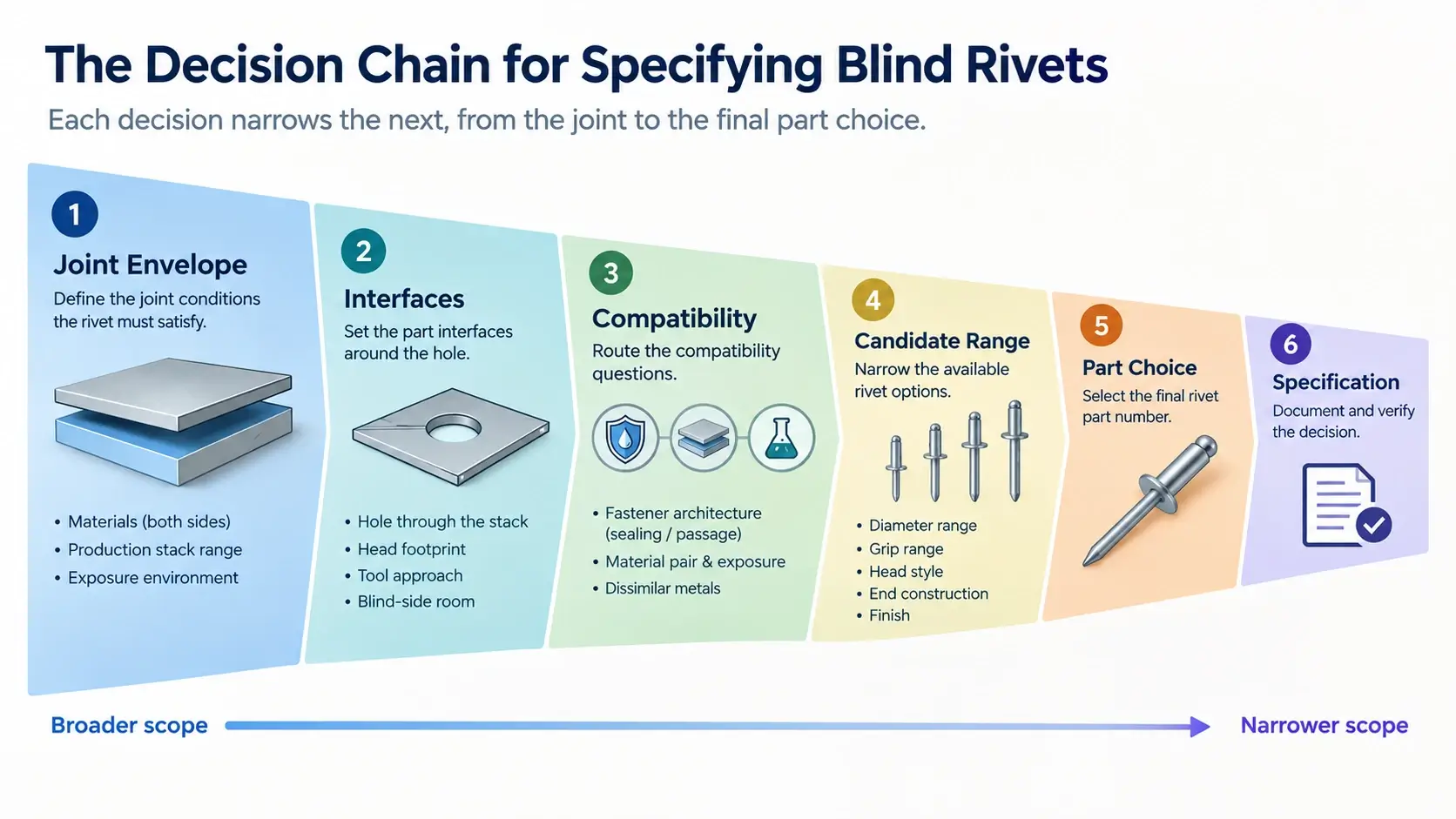
The sections above cover the concepts; this checklist turns them into a repeatable process.
Step 1 — Identify the load direction. Where does the load act on the joint — lateral, axial, or a combination?
Step 2 — Identify the governing rating. Match the load direction to the shear rating, the tensile rating, or both. The table below shows typical cases.
Table 2 — Typical load cases and governing rivet ratings:
| Load Case | Primary Direction | Governing Rating |
|---|---|---|
| Lap joint under lateral load | Perpendicular to rivet axis | Shear |
| Hanging / suspended component | Along rivet axis | Tensile |
| Bracket with offset load | Combined | Both require evaluation |
These are simplified examples. Real joints may involve combined loads and should be evaluated based on the actual load case.
Step 3 — Check the exact rivet datasheet. Look up the exact part number, not a generic diameter. Different series and manufacturers rate the same size differently.
Step 4 — Evaluate the joint configuration. Review the hole, sheet material and thickness, edge distance, spacing and installation quality. These can govern the joint before the rivet does.
Step 5 — Apply the required design margin. The margin comes from your application standard, industry practice or your engineering requirements — not from a fixed number in an article. Apply the required design margin as part of your overall joint design and engineering verification.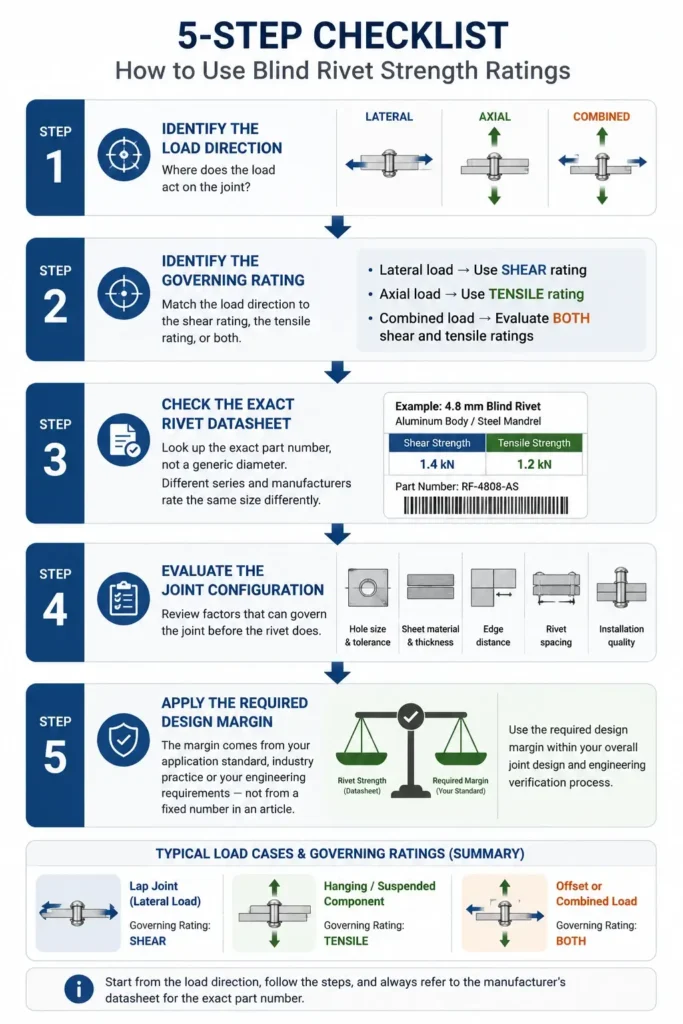
Common Misconceptions About Blind Rivet Strength
1. “The higher number is the better rivet.”
A high tensile rating is irrelevant to a shear-loaded joint. Which number matters depends on the load direction, not on the value.
2. “Joint strength equals rivet strength × rivet quantity.”
Joint capacity is not a simple sum of rivet ratings. Sheet failure, load distribution and installation quality all participate in the result. Datasheet values are a comparison baseline, not a capacity calculator.
3. “A larger rivet is always the better solution.”
A bigger diameter raises the rivet’s own rating, but the hole gets larger, edge distance requirements change, the sheet may fail first, and assembly constraints shift. Size is a trade-off, not a free upgrade.
4. “Head type determines the shear/tensile rating.”
Head type is not the primary determinant of a blind rivet’s published shear and tensile ratings. Strength is driven mainly by body diameter, material configuration and mandrel design. Head type primarily affects factors such as bearing area, installation profile and joint interaction — not the published rating. For the head side of the question, see our guide to blind rivet head types.
5. “Same size means the same strength across manufacturers.”
Published values vary with product series, mandrel design and test conditions. Compare rivets by exact part number against their own datasheets — not by nominal size alone.
FAQ
1. What is the difference between shear and tensile strength in blind rivets?
Shear strength measures resistance to loads acting across the rivet axis, while tensile strength measures resistance to axial pull. Use the rating that matches your load direction. Both values are single-rivet laboratory ratings — they describe the rivet, not the joint in service.
2. Do shear and tensile strength need to be compared directly?
They do not usually need to be compared directly, because they apply to different load directions. Which value is numerically higher can vary by rivet configuration — match the rating to your load case instead.
3. Does a bigger rivet diameter always mean a stronger joint?
A bigger diameter raises the rivet’s own rated strength, but the joint may fail elsewhere first — in the sheet, the hole or the edge distance. Diameter alone does not guarantee a stronger joint; evaluate the whole configuration.
4. Can I calculate joint capacity by multiplying rivet strength by the number of rivets?
No. Joint capacity is not a simple sum of rivet ratings. Load distribution, sheet strength, edge distance, spacing and installation quality all affect the result. Treat the datasheet value as a comparison baseline, not a joint capacity number.
5. Why do two rivets of the same size have different strength values from different manufacturers?
Published ratings can differ because manufacturers may use different product designs, rating methods and specifications. Product series, mandrel design and test conditions vary between suppliers, so the same nominal size can rate differently. Compare rivets by exact part number against their own datasheets.
6. Does the mandrel affect the strength of a blind rivet?
Yes. The mandrel is part of the strength picture. Mandrel material, design and retention can change the published ratings — which is why strength should be tied to the complete configuration (body, mandrel and series) rather than the body material alone.
7. How do I know which strength rating my application needs?
Work through the load direction first, then the governing rating, then the exact part datasheet, then the joint configuration, then the design margin — the five-step checklist in this guide. If you are unsure about the load case, send the application details to your supplier so they can help identify suitable rivet options and the information needed for further joint evaluation.
8. Can I request strength test data or reports for a blind rivet?
Depending on the product and the test requirement, we can discuss the strength test data or inspection reports available for the specific part. Send us the exact part number and the report format you need, and we will confirm what we can provide before you order.
Need Help Selecting the Right Blind Rivet?
Not sure which rating applies to your application? Send us your application details — load direction, approximate load, sheet materials and thicknesses, hole size and application context. Our team can help you compare suitable rivet configurations, review the published data available for the selected part, and identify the information needed for further joint evaluation.
Request a Quote or Send Your Drawing — for custom specifications, see our custom blind rivet OEM guide.
Strength values in Table 1 are illustrative published minimum ratings based on blind rivet product data published by Westfield Fasteners for its DIN 7337 product range. They are supplier-published strength values, not values issued by the DIN standard itself. Exact values vary by manufacturer, product series and mandrel design. Always refer to the manufacturer’s datasheet for the specific part number.