Southeast Asia’s manufacturing sector is expanding rapidly. Automotive suppliers in Thailand, electronics manufacturers in Vietnam, construction companies in Indonesia, and HVAC and sheet metal fabricators across Malaysia and the Philippines are all driving growing demand for industrial fasteners.
Blind rivets have become a preferred fastening solution in these industries because they enable one-side installation, fast assembly, and reliable performance with thin sheet metal — reducing labor costs and simplifying production.
However, sourcing blind rivets from overseas suppliers presents real challenges. Many purchasing managers, distributors, and OEM manufacturers face the same difficulties: finding suppliers that provide stable quality, competitive pricing, and reliable delivery. Many buyers also struggle with comparing suppliers, evaluating specifications, and calculating the real landed cost before placing bulk orders.
This blind rivet sourcing guide covers five essential steps — supplier evaluation, quality and material verification, total cost calculation, logistics management, and long-term relationship building — plus country-specific sourcing tips for five key Southeast Asian markets. It also highlights common red flags when sourcing blind rivets and how to avoid them.
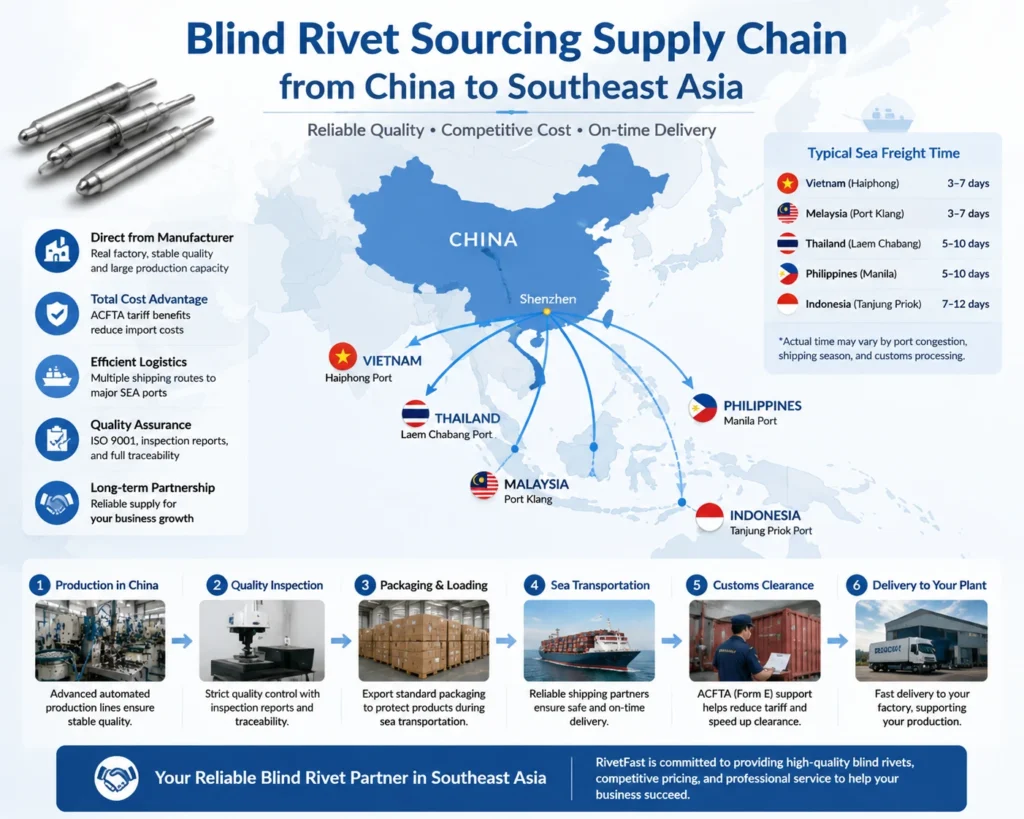
Why Southeast Asian Buyers Source Blind Rivets from China
Manufacturing Growth and Import Demand
Southeast Asia’s industrial expansion across automotive, electronics, appliances, and metal fabrication continues to increase fastener demand. As production volumes grow, many manufacturers find that local supply cannot always meet the scale, material variety, or pricing requirements of bulk industrial orders.
Traditional welding methods require skilled workers, higher equipment investment, and longer processing times. Blind rivets offer a practical alternative — faster installation, lower labor requirements, and consistent results without specialized training. This shift is driving import demand across the region.
For many Southeast Asian buyers, China remains the primary sourcing destination for blind rivets. The reasons go beyond price: China offers a mature fastener supply chain with large-scale production capacity, extensive material options, customization capability, and stable export experience serving global markets. Southeast Asian buyers also benefit from shorter shipping distances compared to sourcing from Europe or North America.
However, the best sourcing decision depends on order volume, application requirements, quality expectations, and delivery priorities — not solely on where the supplier is located.
ASEAN-China Free Trade Area (ACFTA) Benefits
One significant advantage for Southeast Asian buyers is the ASEAN-China Free Trade Area (ACFTA). Under ACFTA, many qualifying fastener products may receive reduced or zero tariff rates when imported with a valid Form E certificate of origin. Actual rates vary by HS code, product classification, and importing country — so buyers should verify the specific tariff treatment for their product category.
Without Form E documentation, goods are subject to standard MFN (Most Favored Nation) rates, which can add approximately 5–15% to total landed cost. The final supplier choice should always be based on production capability, quality control, compliance requirements, and total sourcing cost — not solely on tariff advantages.
China vs Local SEA Suppliers: A Regional Comparison
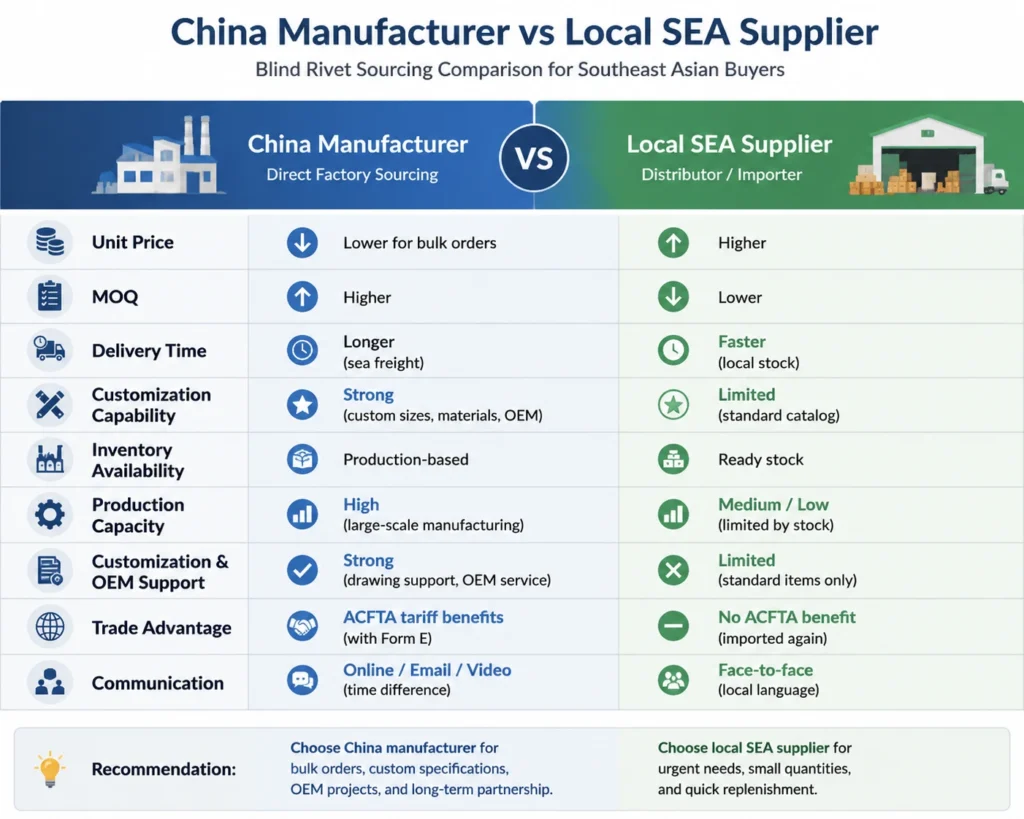
Southeast Asian buyers can source blind rivets either directly from Chinese manufacturers or through local distributors and importers. Each channel serves different purchasing needs.
| Factor | China Manufacturer | SEA Distributor |
|---|---|---|
| Unit price | Lower for bulk orders | Higher |
| MOQ | Higher | Lower |
| Delivery time | Longer (sea freight) | Faster (local stock) |
| Customization capability | Strong (custom sizes, materials, OEM) | Limited (standard catalog) |
| Inventory availability | Production-based | Ready stock |
Chinese manufacturers typically offer lower unit prices for bulk quantities, higher production capacity for continuous supply, stronger customization capability for OEM requirements, and ACFTA tariff benefits. Local distributors — including importers, wholesalers, and industrial fastener distributors — offer faster delivery from local stock, lower minimum order quantities, and easier face-to-face communication.
Recommended sourcing scenarios:
- Direct from China manufacturer — best for: Monthly volume exceeding 100,000 pcs · OEM or custom specification projects · Consistent batch-to-batch quality requirements · Long-term supply partnerships
- Local distributor — best for: Urgent replacement and emergency stock · Small-quantity standard sizes · Trial orders before committing to bulk
Many professional buyers use both channels: direct factory sourcing for planned production demand and local distributors for urgent replenishment.
Step 1 — Evaluate Supplier Manufacturing Capability
The first step in any reliable sourcing process is verifying that your supplier is a genuine manufacturer with real production capability — not a trading company that outsources production.
Production Capacity and Automation Level
Buyers should verify whether the supplier operates its own production facility or relies mainly on trading channels. Key indicators include factory size, number of automated machines, monthly production capacity, and years of manufacturing experience. A supplier with automated production lines generally delivers more consistent quality than one relying on manual operations.
Warning signs of a non-manufacturer:
- Cannot provide a verifiable factory address or facility photos
- Cannot show specific production equipment or explain the manufacturing process
- Cannot answer technical questions about tolerances, materials, or quality control
- Offers an unusually broad product range with no clear production specialization
For a detailed framework on verifying manufacturer production capacity before bulk ordering, see our guide on how to verify blind rivet manufacturer production capacity. Understanding the blind rivet manufacturing process also helps buyers ask the right questions during factory audits.
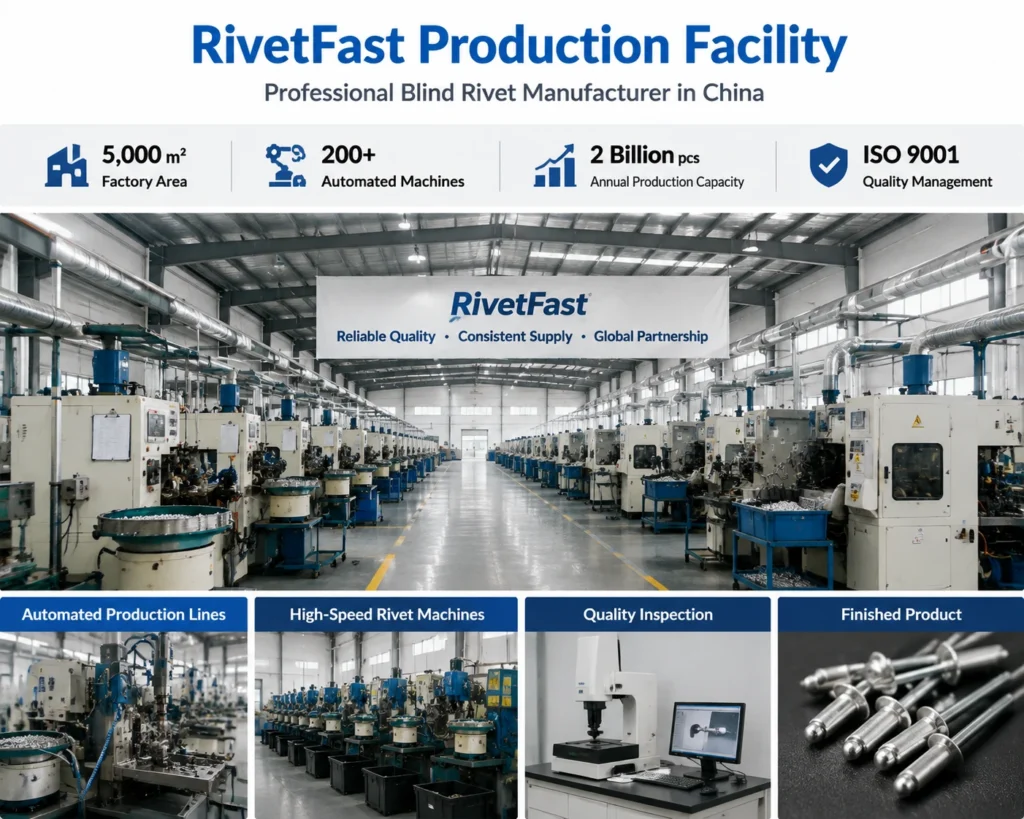
These factors help buyers evaluate whether a supplier can support stable long-term production. For example, RivetFast operates a 5,000 sqm facility with 200+ automated machines and 2 billion pieces annual capacity, backed by ISO 9001 certification.
Product Range and Customization Capability
Confirm the supplier’s standard product range — including aluminum, steel, and stainless steel blind rivets in standard sizes — and whether they can manufacture according to technical drawings. If custom specifications are needed, ask about their drawing development process. For a comprehensive OEM guide, refer to custom blind rivet OEM development.
Export Experience and Regional Familiarity
Evaluate the supplier’s international shipping experience, export documentation handling, packaging standards for sea freight, and communication responsiveness. Suppliers familiar with Southeast Asian markets can provide Form E documentation, understand regional certification requirements, and offer appropriate packaging for tropical climate shipping.
Step 2 — Verify Quality and Material Standards
Selecting the right material and surface treatment is critical for product performance — especially in Southeast Asia’s tropical climate. But quality verification goes beyond material choice: buyers must also request and review inspection documentation.
Material Selection — Match Rivet to Application
Different applications require different material combinations. Here’s a quick reference:
| Rivet Combination | Typical Applications | Suitable Environment |
|---|---|---|
| Aluminum body + Steel mandrel | Electronics, HVAC, light sheet metal | Indoor / dry environments |
| Steel body + Steel mandrel | General industrial assembly | General industrial environments |
| Stainless steel body + Stainless mandrel | Marine, outdoor, food equipment | Outdoor, coastal, marine environments |
For a detailed comparison of material properties and selection criteria, see our guide to choose the right blind rivet material.
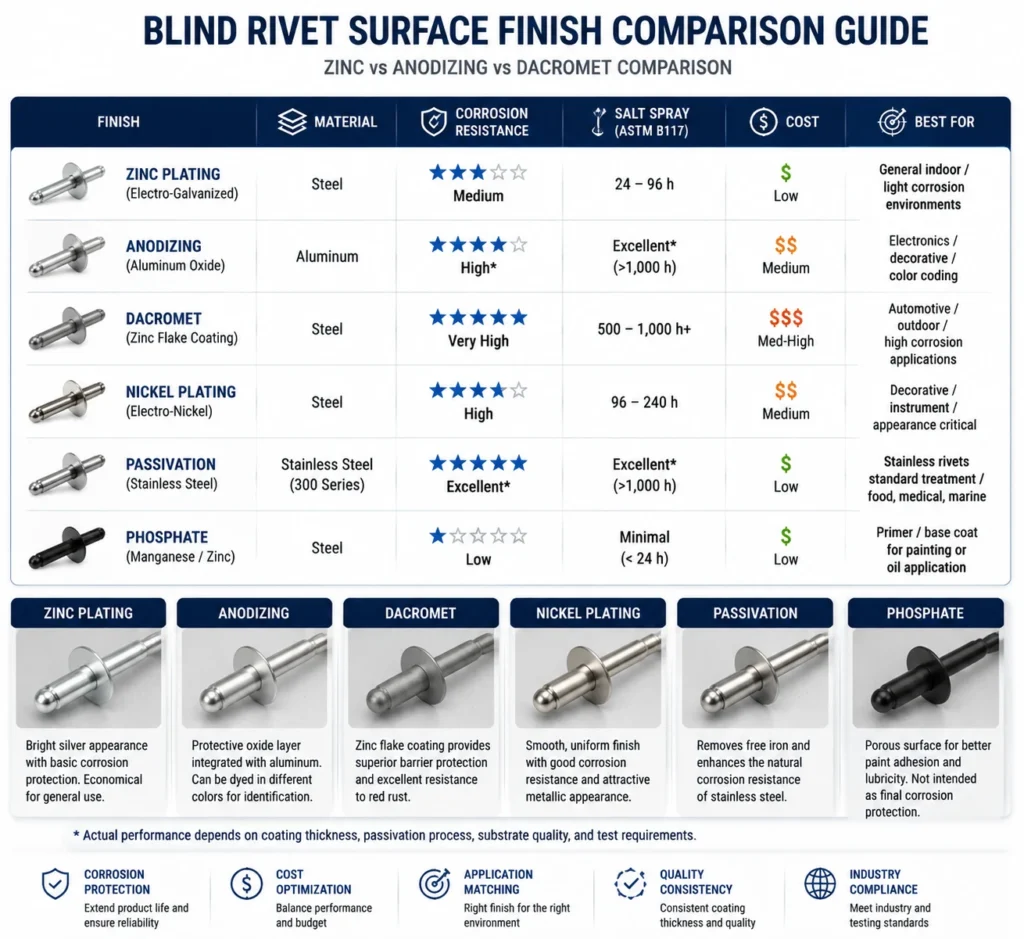
Surface Treatment for Tropical Climates
Southeast Asia’s high humidity and coastal environments require careful surface treatment selection:
| Environment | Recommended Treatment |
|---|---|
| Indoor equipment | Aluminum / Zinc-plated steel |
| Outdoor construction | Stainless steel / Dacromet |
| Coastal areas (Indonesia, Philippines, Malaysia) | Stainless steel or high-corrosion-resistant coatings |
For a comprehensive explanation of surface finishes and coatings, see our guide to blind rivet surface finishes and coatings.
Request Quality Inspection Reports and Documents
Professional suppliers should provide traceable quality records with each shipment. Request these documents in priority order:
- Material Certificate — confirms material composition and authenticity
- Dimensional Inspection Report — verifies size compliance against the blind rivet size chart and specifications
- Mechanical Test Report — tensile and shear strength performance
- Salt Spray Test Report — corrosion resistance (especially critical for tropical climates)
Suppliers who cannot provide these documents may lack structured quality management. For repeat orders, buyers should confirm whether inspection records are provided per batch or only during initial approval. For detailed testing methods and acceptable standards, refer to our blind rivet quality testing methods and standards guide.
Step 3 — Understand Total Sourcing Cost
The most common mistake in blind rivet sourcing is comparing only unit prices. The true cost of sourcing from China includes multiple components beyond the product itself.
For example, a supplier offering $0.012/pc without Form E documentation may appear cheaper than one at $0.015/pc with full ACFTA support. But once tariffs, quality rejection rates, and supply reliability are factored in, the higher-priced supplier often delivers a lower total cost. In other words, the lowest quotation is not always the lowest purchasing cost. This is why calculating total landed cost matters more than comparing unit prices alone.
Unit Price Factors
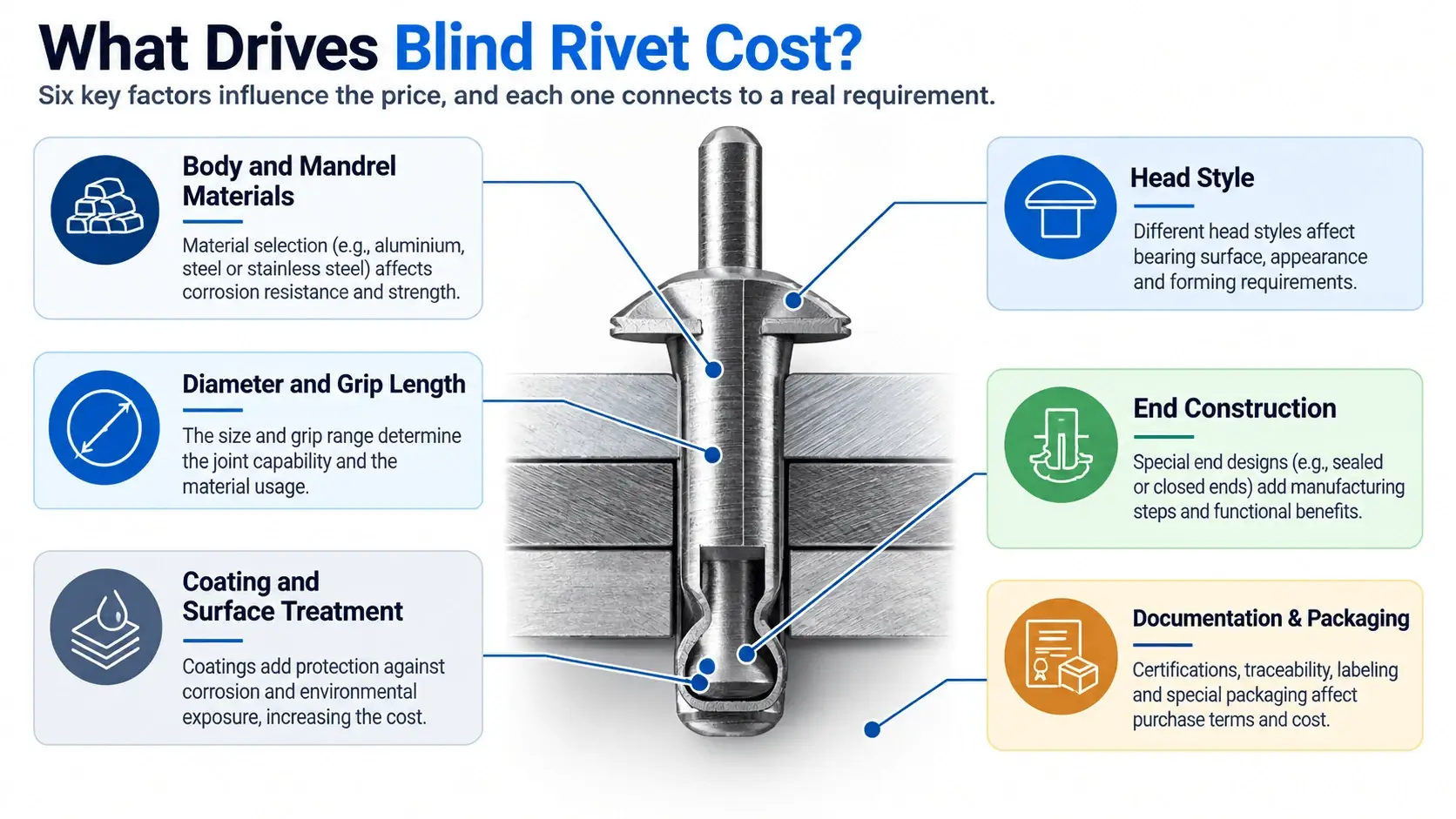
Unit price is influenced by material (aluminum is generally lowest cost, stainless steel highest), size and specification (larger diameters and special head styles increase cost), surface treatment (zinc plating, anodizing, Dacromet each add different cost layers), and packaging requirements (OEM boxes, custom labels, carton and pallet specifications).
Total Landed Cost Calculation
To accurately compare sourcing options, calculate total landed cost:
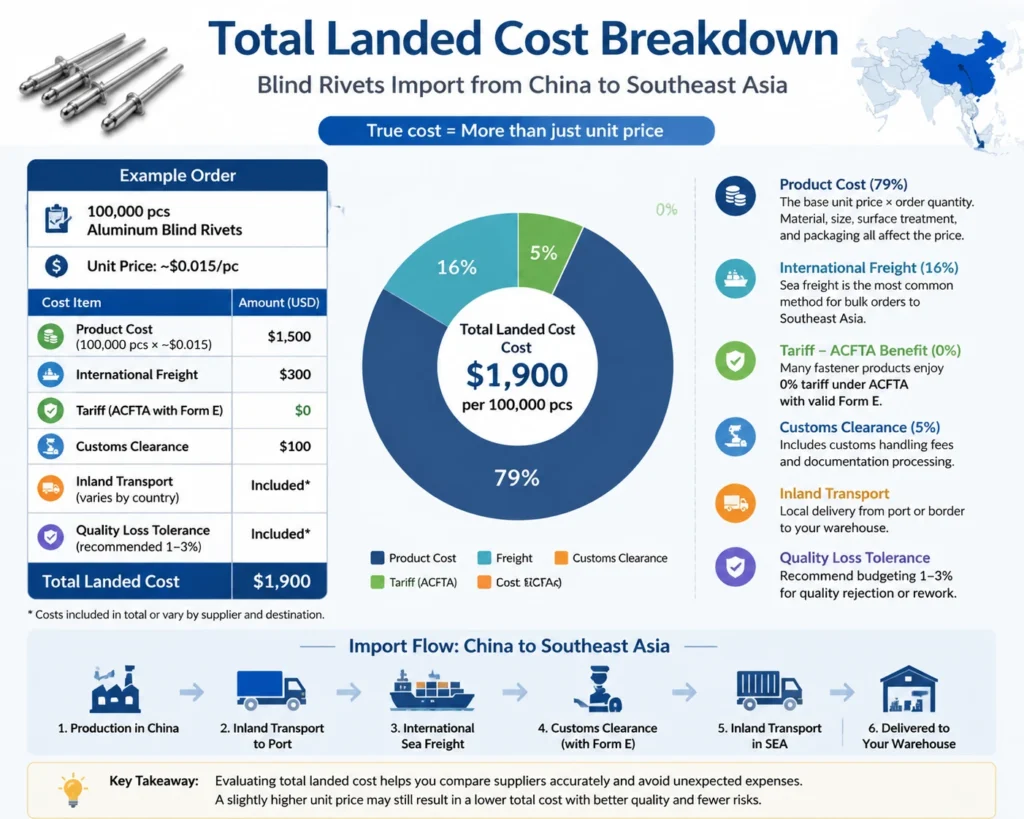
Total Landed Cost = Unit Price + International Freight + Import Tariff + Customs Clearance + Inland Transport + Quality Loss Tolerance
Here’s an example calculation for a typical order of 100,000 pcs aluminum blind rivets:
| Cost Item | Amount |
|---|---|
| Product cost (100,000 pcs × ~$0.015) | $1,500 |
| International freight | $300 |
| Tariff (ACFTA with Form E) | $0 |
| Customs clearance | $100 |
| Total landed cost | $1,900 |
Example only — actual prices vary by specification, material, and order volume.
This calculation confirms the principle introduced above — a lower unit price without tariff support and quality documentation often results in a higher total cost.
MOQ and Order Optimization
Minimum order quantity directly affects unit pricing. Standard blind rivets typically have lower MOQ thresholds, while custom specifications require higher MOQ due to tooling and setup costs. Buyers should balance inventory holding costs against the price advantage of larger orders. For detailed MOQ guidance, see our blind rivet MOQ requirements guide, and for a comparison of standard versus custom options, refer to standard vs custom blind rivets.
Step 4 — Manage Logistics and Lead Times
Efficient logistics management ensures your blind rivet orders arrive on time and within budget. Understanding shipping routes, documentation requirements, and customs procedures helps prevent delays.
Major Shipping Routes and Typical Lead Times
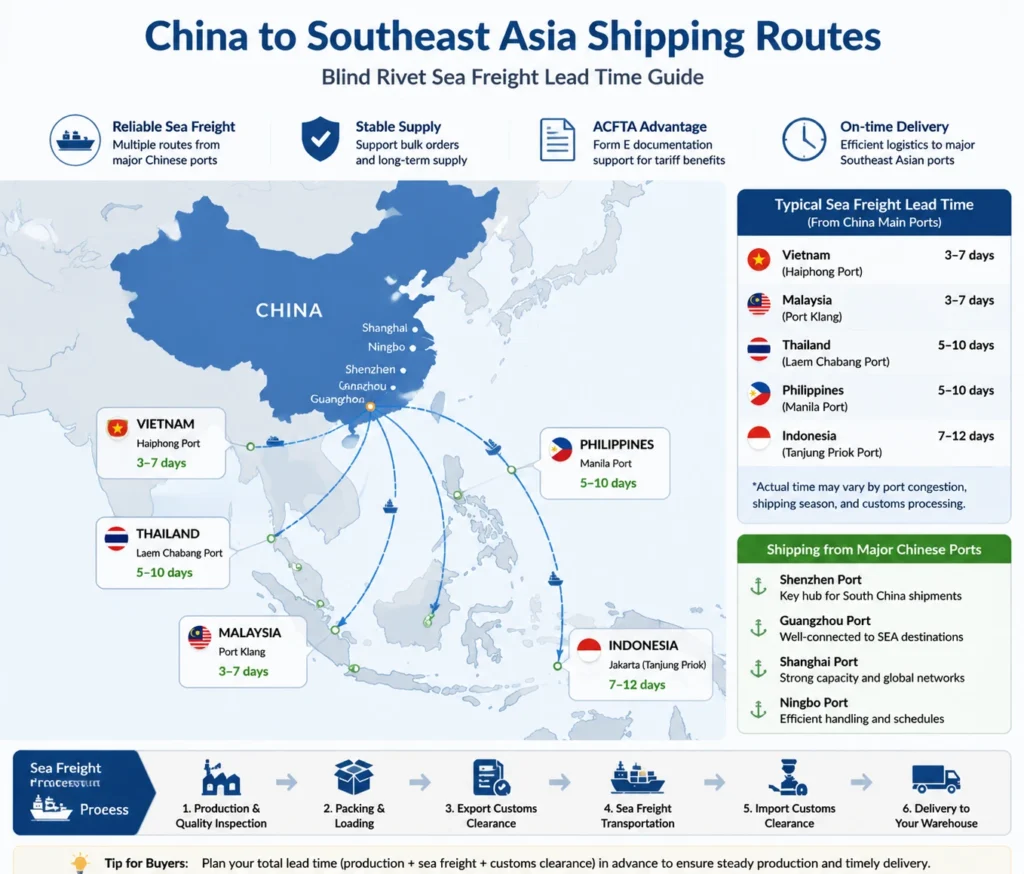
Most blind rivet shipments from China to Southeast Asia depart from major Chinese ports such as Shenzhen, Guangzhou, or Shanghai. Typical sea freight lead times are often around the following ranges (actual times vary by port congestion, shipping season, and customs processing):
- Vietnam: 3–7 days (Haiphong port)
- Malaysia: 3–7 days (Port Klang)
- Thailand: 5–10 days (Laem Chabang port)
- Philippines: 5–10 days (Manila port)
- Indonesia: 7–12 days (Jakarta port)
Production lead time varies — standard specifications are typically around 7–10 days, while custom sizes or special materials may require additional time. Buyers should plan total lead time (production + shipping + customs clearance) when scheduling production.
Air freight is available for urgent orders but significantly increases cost and is generally impractical for bulk industrial quantities.
FTA Documentation and Customs Clearance
To claim ACFTA tariff benefits, ensure your supplier provides a valid Form E certificate of origin with each shipment. Standard customs clearance documents include:
- Commercial Invoice
- Packing List
- Bill of Lading
- Form E (Certificate of Origin)
- Certificate of Origin (CO) if required by importing country
Without Form E, goods are subject to standard MFN rates, which may significantly increase the final landed cost. Work with a supplier experienced in Southeast Asian export documentation to avoid clearance delays.
Step 5 — Build Long-Term Supply Relationships
Single-transaction sourcing focuses on the lowest price. Long-term partnerships focus on supply stability, quality consistency, and continuous improvement — which ultimately deliver better total value.
Key elements of a successful long-term supply relationship include stable quality (consistent batch-to-batch performance reduces production interruptions and customer complaints), clear communication (shared drawings, specifications, and delivery schedules prevent misunderstandings), continuous improvement (a good supplier supports product optimization, packaging improvements, and cost reduction initiatives), and capacity flexibility (ability to scale production for seasonal or project-based demand spikes).
Sample-to-Bulk Ordering Process
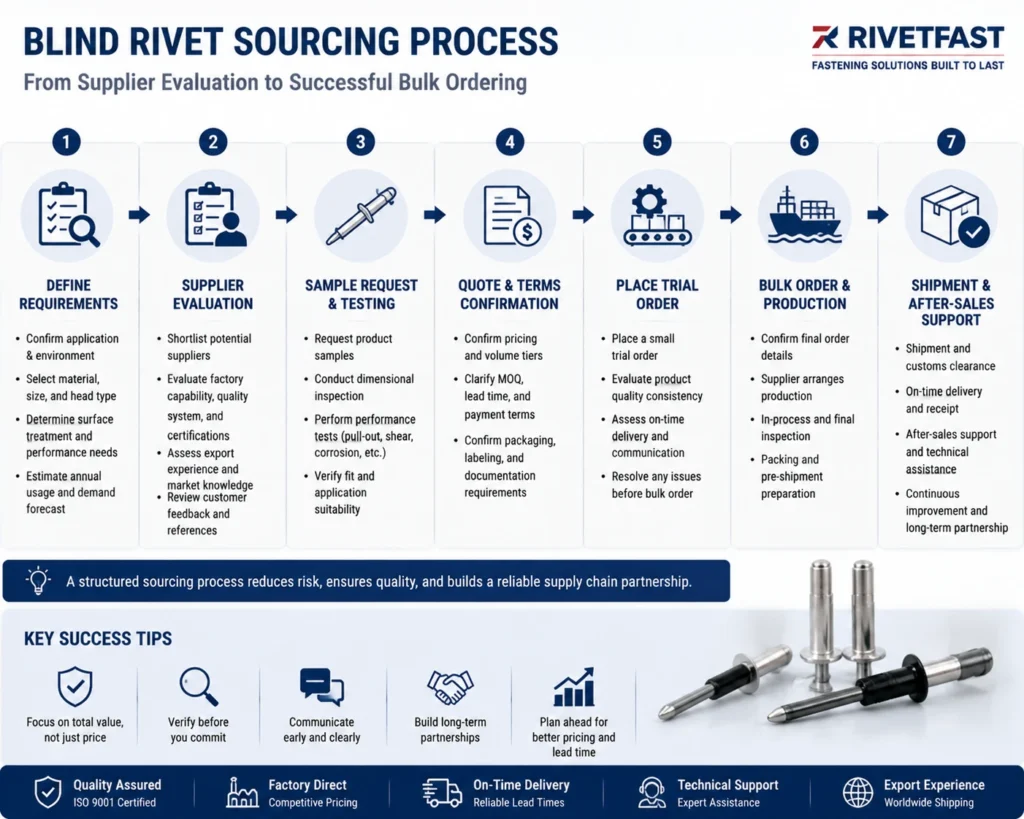
A structured ordering process minimizes risk:
- Supplier Selection — verify factory capability, quality systems, and export experience
- Sample Testing — evaluate installation performance, tensile strength, appearance, and corrosion resistance
- Trial Order — place a small production batch to validate quality at scale
- Bulk Production — proceed with full-volume orders after trial approval
- Long-term Cooperation — establish ongoing supply with documented quality standards
For trial order requirements and MOQ guidance, see our blind rivet MOQ requirements guide.
Continuous Improvement and OEM Support
A capable supplier doesn’t just manufacture — they support your product development. This includes recommending material optimizations for specific applications, improving packaging for your logistics flow, and developing custom specifications from drawings. For OEM customization guidance, refer to custom blind rivet OEM development.
Country-Specific Sourcing Tips
Each Southeast Asian market has distinct industry demands, common product requirements, and logistics considerations. Understanding these differences helps buyers select the right material, size, and treatment for their target market.
Vietnam
- Industry: Electronics assembly, furniture manufacturing, growing automotive components sector
- Common demand: Aluminum blind rivets in standard sizes (4mm–5mm diameter), steel rivets for furniture frames
- Logistics: Shortest shipping distance from China; Haiphong port offers fast clearance; land border crossing via Friendship Pass also viable for southern China suppliers
Thailand
- Industry: Automotive parts and assembly, appliance manufacturing, metal fabrication
- Common demand: High-strength blind rivets for automotive and equipment assembly, stainless steel rivets for outdoor equipment, multi-grip rivets for variable thickness assemblies
- Logistics: Laem Chabang port; well-established customs procedures; Thai industrial standards (TISI) may apply to certain imported industrial components
Indonesia
- Industry: Construction, infrastructure development, mining equipment, shipbuilding
- Common demand: Steel blind rivets for heavy-duty structural applications, stainless steel for coastal and marine projects
- Logistics: Jakarta port (Tanjung Priok); note local SNI certification requirements for certain imported industrial products; customs processing can take additional days compared to other SEA markets
Malaysia
- Industry: E&E (Electrical & Electronics), HVAC, oil and gas equipment
- Common demand: Aluminum rivets for electronics enclosures, multi-grip rivets for sheet metal assembly, stainless steel for outdoor HVAC units
- Logistics: Port Klang offers efficient handling; English is widely used in industrial business communication; free trade zones simplify import procedures for re-export manufacturing
Philippines
- Industry: Electronics assembly, building materials, ship repair and maintenance
- Common demand: Standard aluminum blind rivets for general assembly, steel rivets for construction
- Logistics: Manila port (Port of Manila); English is widely used in industrial business communication; customs clearance is generally straightforward with proper documentation
Supplier Evaluation Checklist
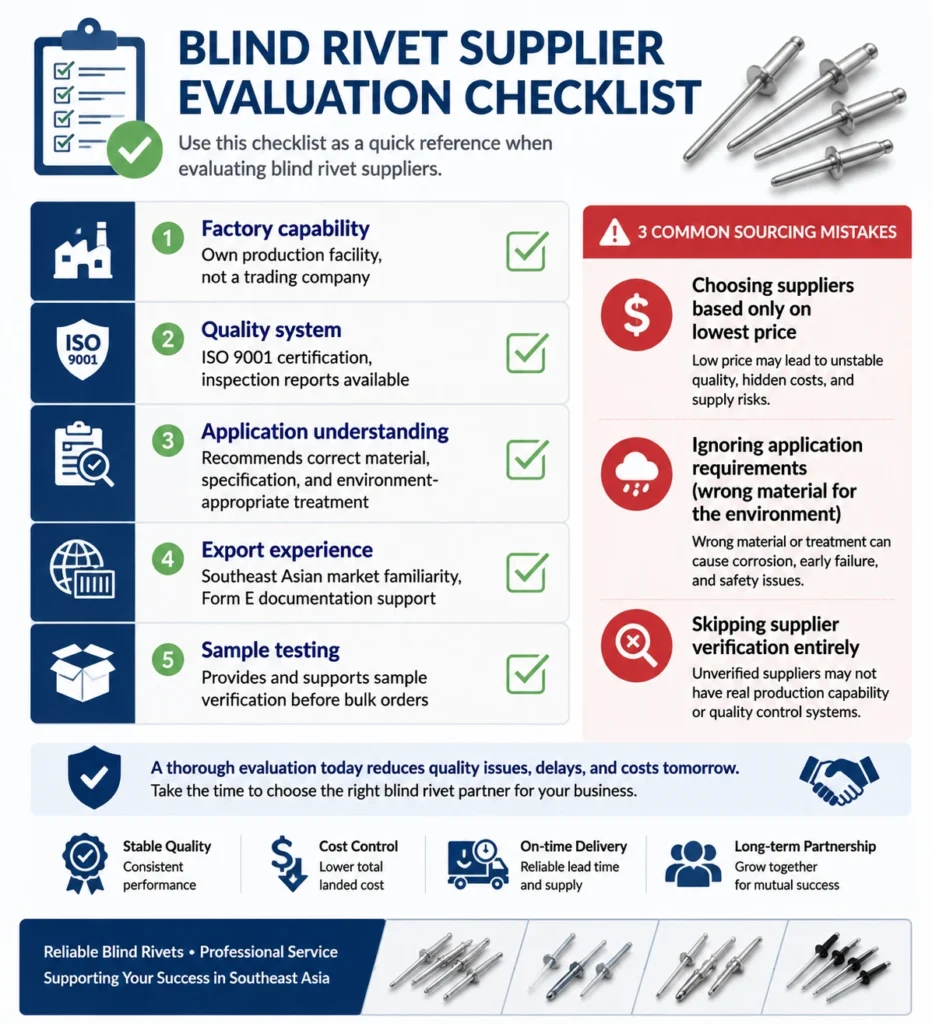
Use this checklist as a quick reference when evaluating blind rivet suppliers:
- Factory capability — own production facility, not a trading company
- Quality system — ISO 9001 certification, inspection reports available
- Application understanding — recommends correct material, specification, and environment-appropriate treatment
- Export experience — Southeast Asian market familiarity, Form E documentation support
- Sample testing — provides and supports sample verification before bulk orders
3 Common Sourcing Mistakes:
- Choosing suppliers based only on lowest price
- Ignoring application requirements (wrong material for the environment)
- Skipping supplier verification entirely
For a detailed guide on warning signs to watch for, see red flags when sourcing blind rivets.
Conclusion
Successful blind rivet sourcing for Southeast Asian markets comes down to four principles: choose the right supplier by verifying real manufacturing capability, calculate total landed cost — not just unit price, manage logistics and documentation proactively, and invest in long-term supply relationships rather than chasing single-transaction savings.
By following the five-step framework in this blind rivet sourcing guide, Southeast Asian buyers can reduce sourcing risks, control costs, and build supply partnerships with a reliable blind rivet supplier for Southeast Asian markets that supports stable production for years to come.
FAQ
Q1: How do I find a reliable blind rivet supplier in China for Southeast Asian markets?
Look for verified manufacturers with their own production facilities, ISO 9001 certification, documented quality testing capability, and experience exporting to Southeast Asia. Request factory photos, production capacity data, and sample inspection reports before placing bulk orders. A manufacturer with ACFTA documentation experience can also help you prepare the required documentation.
Q2: What information should I provide when sourcing blind rivets?
To get an accurate quotation, provide rivet diameter and length, material combination (e.g., aluminum-steel, all stainless steel), head style, grip range, required quantity, surface treatment requirements, and packaging preferences. If you need custom specifications, share technical drawings or sample references. The more details you provide, the more precise the pricing and lead time estimate will be.
Q3: What affects blind rivet sourcing cost and how do I calculate total landed cost?
Unit price is influenced by material, size, surface treatment, order quantity, and packaging. But the true cost comparison requires calculating total landed cost: Unit Price + International Freight + Import Tariff (0% under ACFTA with Form E) + Customs Clearance + Inland Transport + Quality Loss Tolerance. Many buyers compare only unit prices and underestimate shipping and customs costs, leading to unexpected expenses.
Q4: Can I get tariff benefits under ACFTA when importing blind rivets from China?
Yes. Under the ASEAN-China Free Trade Area (ACFTA), many qualifying fastener products may receive reduced or zero tariff rates when imported with a valid Form E certificate of origin. Actual rates vary by HS code, product classification, and importing country. Without Form E, goods are subject to standard MFN rates, which can add approximately 5–15% to your landed cost. Ask your supplier to provide Form E documentation with each shipment.
Q5: How long does shipping take from China to Southeast Asian countries?
Typical sea freight lead times from Chinese ports to major Southeast Asian ports are often around: Vietnam 3–7 days, Malaysia 3–7 days, Thailand 5–10 days, Philippines 5–10 days, Indonesia 7–12 days. Production time varies — standard specifications are typically faster (around 7–10 days), while custom sizes or special materials may require additional time. Total lead time includes both production and shipping, so plan accordingly. Air freight is available for urgent orders but significantly increases cost.
Q6: What quality tests should I request before bulk ordering blind rivets?
Request tensile strength test, shear strength test, salt spray test (especially important for tropical Southeast Asian climates), hardness test, and dimensional inspection reports for each production batch. For a comprehensive guide to testing methods and acceptable standards, refer to our blind rivet quality testing methods and standards guide.
Q7: What is the difference between buying from a Chinese manufacturer vs a local Southeast Asian supplier?
Chinese manufacturers typically offer lower unit prices, higher production capacity, stronger customization capability, and ACFTA tariff benefits. Local suppliers — including distributors, importers, and wholesalers — offer faster delivery, lower minimum order quantities, and easier communication. For bulk industrial orders with customization needs, direct factory sourcing from China usually provides better total landed cost. For small urgent orders, local distributors may be more practical.