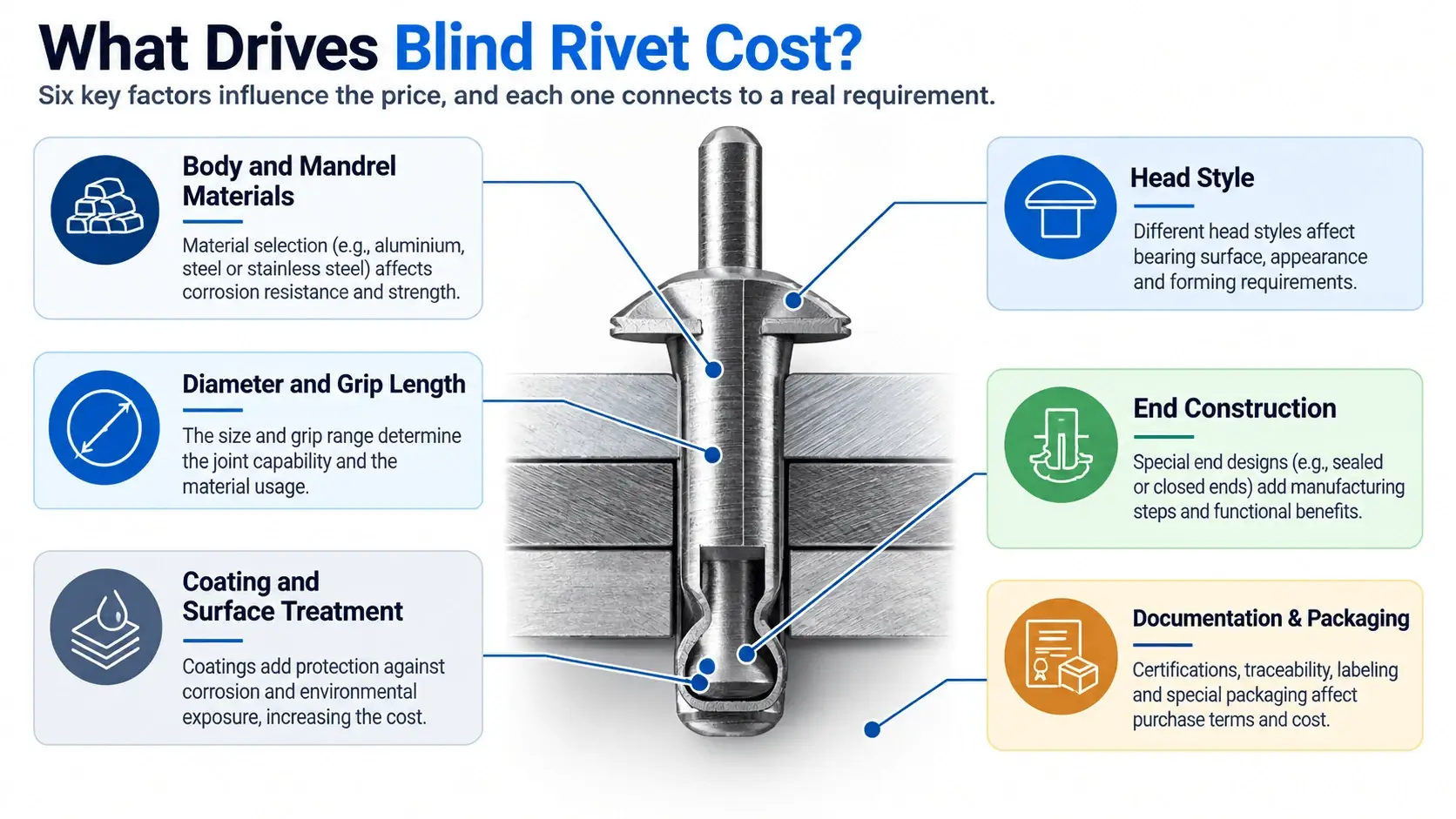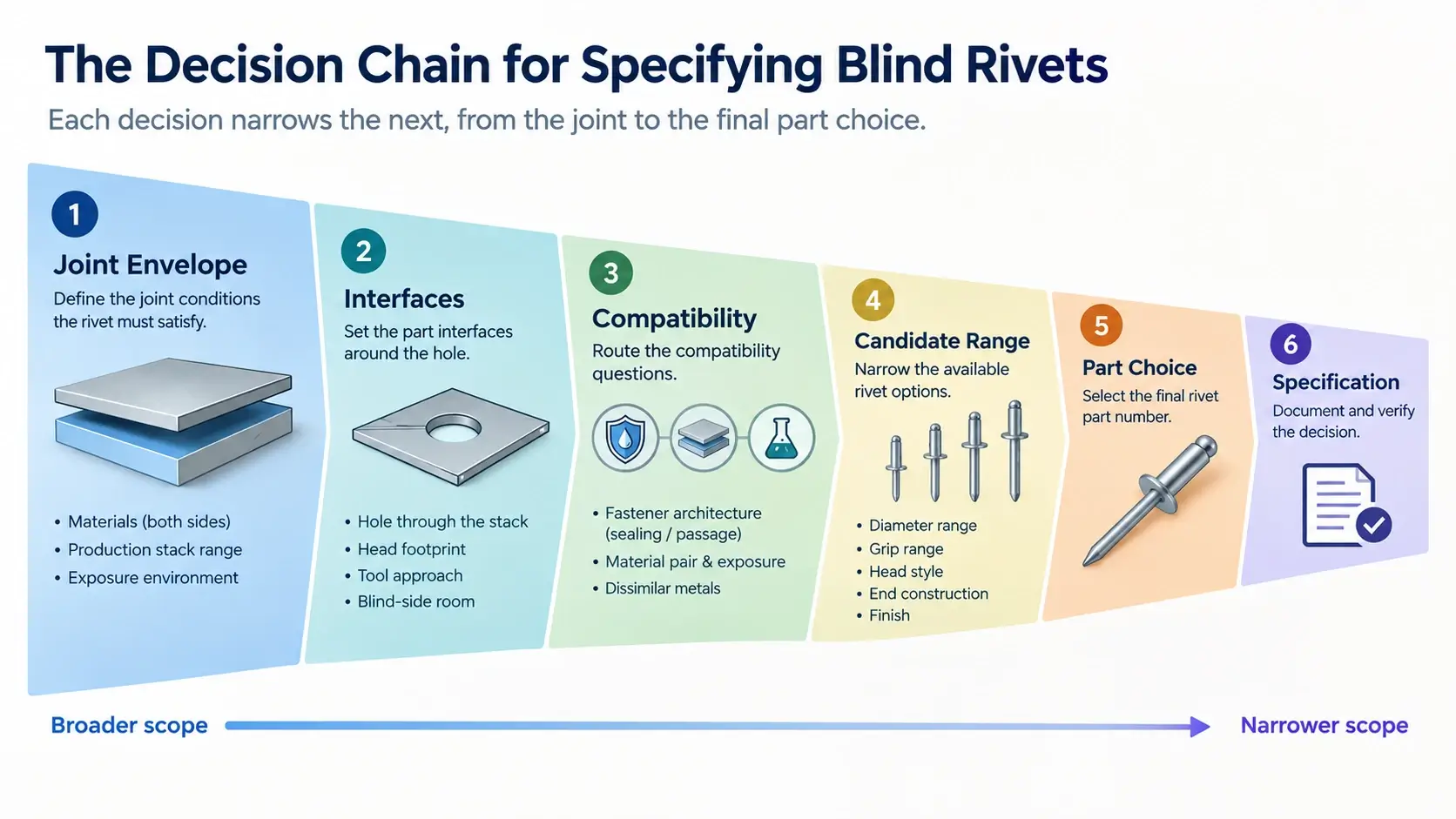
Choosing the right rivet material is only the first step. The surface finish applied to that material determines how well the rivet resists corrosion, how long it lasts in service, and whether it meets the appearance standards of the end product.
Many procurement specifications leave surface treatment as a vague afterthought — “corrosion-resistant” or “coated” without defining what that means. The result is often a rivet that looks correct on arrival but fails prematurely because the coating was inadequate for the actual environment.
In bulk purchasing, surface finish specifications are frequently overlooked. Two rivets made from the same steel material can have completely different service lives depending on whether they use zinc plating, Dacromet, or another protective treatment — yet all three may appear identical on a packing list that simply reads “coated steel rivet.”
This guide covers the most common blind rivet surface finishes — zinc plating, anodizing, Dacromet, and other options — and explains how to select the right coating based on corrosion resistance, cost, material compatibility, and application requirements. For material fundamentals, see our guide to aluminum vs steel vs stainless steel blind rivets.
Why Surface Finish Matters for Blind Rivets
Surface Finish vs Rivet Material: What Is the Difference?
Rivet material and surface finish address two different layers of performance. Material determines inherent strength, weight, and basic corrosion resistance. Surface finish determines the additional protection, service life, and appearance layered on top.
A steel rivet without coating will rust within weeks in a humid environment, even though steel offers excellent mechanical strength. Actual service life depends on humidity, exposure conditions, coating thickness, and corrosion requirements — the material provides the foundation, but the surface finish determines real-world durability.
Material and finish are complementary decisions — see our blind rivet material selection guide for the full material comparison including body and mandrel combinations.
Main Benefits of Blind Rivet Surface Treatment
Surface treatment creates a protective layer on the rivet surface that serves four primary functions:
- Corrosion protection — Without a coating, steel rivets corrode rapidly in humid environments. Even stainless steel benefits from passivation.
- Extended service life — A properly selected finish can extend functional life from months to years for a modest cost increase.
- Improved appearance — Finishes provide consistent color or visual identification. Anodized aluminum rivets can be color-coded to distinguish specifications on the assembly line.
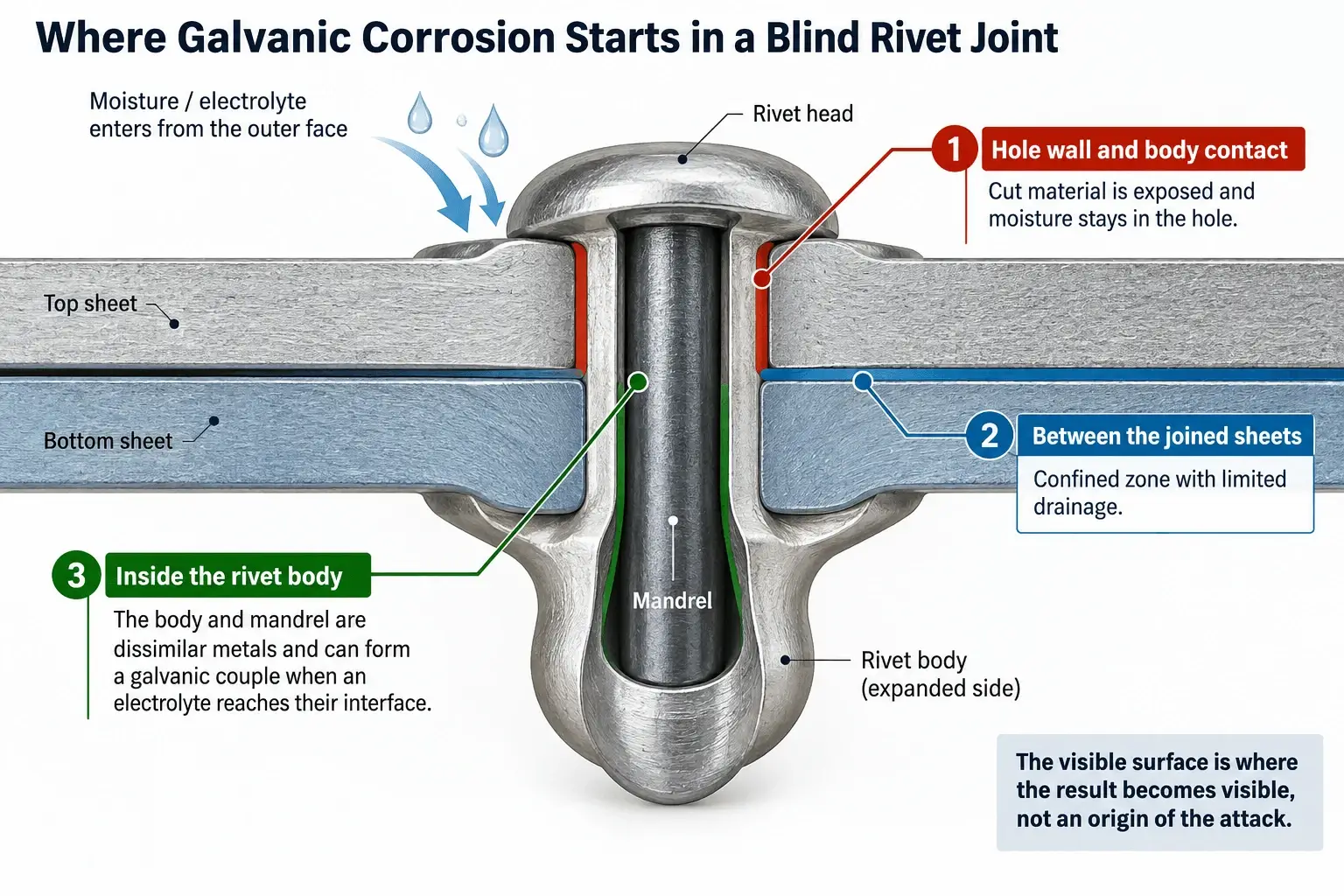
- Application reliability — Coatings act as a barrier that reduces galvanic corrosion between dissimilar metals.
Zinc Plated Blind Rivets: Cost-Effective Corrosion Protection
How Zinc Plating Protects Steel Rivets
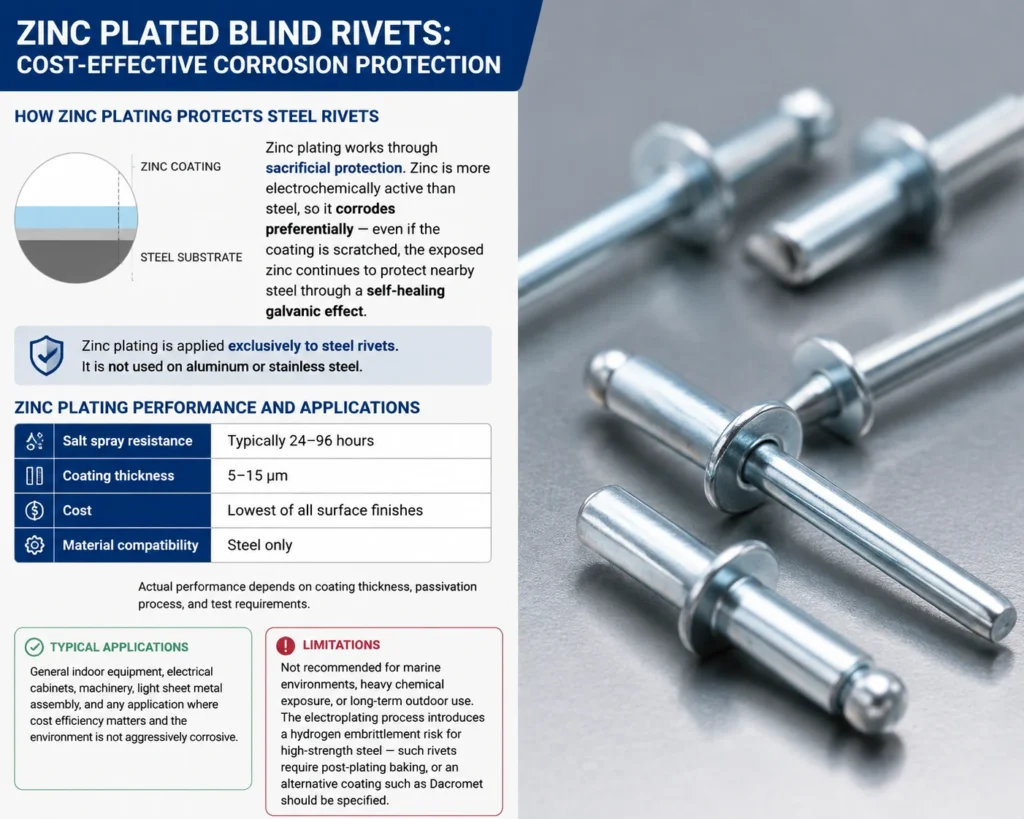
Zinc plating works through sacrificial protection. Zinc is more electrochemically active than steel, so it corrodes preferentially — even if the coating is scratched, the exposed zinc continues to protect nearby steel through a self-healing galvanic effect.
For blind rivets, electrogalvanizing (electroplating) is the standard process — it produces a thin, uniform zinc layer (5–15 μm) that does not affect dimensional accuracy, which is critical for blind rivets requiring precise tolerance control.
Zinc plating is applied exclusively to steel rivets. It is not used on aluminum or stainless steel.
Zinc Plating Performance and Applications
| Property | Specification |
|---|---|
| Salt spray resistance | Typically 24–96 hours |
| Coating thickness | 5–15 μm |
| Cost | Lowest of all surface finishes |
| Material compatibility | Steel only |
Actual performance depends on coating thickness, passivation process, and test requirements.
Typical applications: General indoor equipment, electrical cabinets, machinery, light sheet metal assembly, and any application where cost efficiency matters and the environment is not aggressively corrosive.
Limitations: Not recommended for marine environments, heavy chemical exposure, or long-term outdoor use. The electroplating process introduces a hydrogen embrittlement risk for high-strength steel — such rivets require post-plating baking, or an alternative coating such as Dacromet should be specified.
Anodized Blind Rivets: Premium Finish for Aluminum Applications
How Anodizing Works
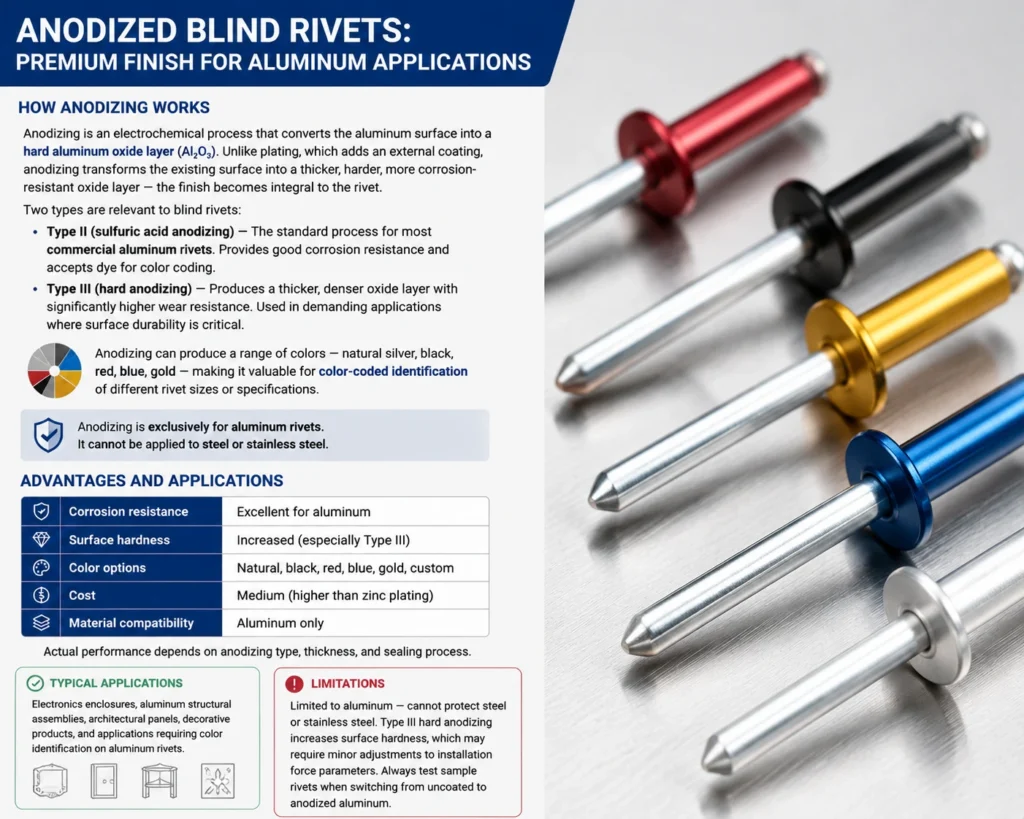
Anodizing is an electrochemical process that converts the aluminum surface into a hard aluminum oxide layer (Al₂O₃). Unlike plating, which adds an external coating, anodizing transforms the existing surface into a thicker, harder, more corrosion-resistant oxide layer — the finish becomes integral to the rivet.
Two types are relevant to blind rivets:
- Type II (sulfuric acid anodizing) — The standard process for most commercial aluminum rivets. Provides good corrosion resistance and accepts dye for color coding.
- Type III (hard anodizing) — Produces a thicker, denser oxide layer with significantly higher wear resistance. Used in demanding applications where surface durability is critical.
Anodizing can produce a range of colors — natural silver, black, red, blue, gold — making it valuable for color-coded identification of different rivet sizes or specifications.
Anodizing is exclusively for aluminum rivets. It cannot be applied to steel or stainless steel.
Advantages and Applications
| Property | Specification |
|---|---|
| Corrosion resistance | Excellent for aluminum |
| Surface hardness | Increased (especially Type III) |
| Color options | Natural, black, red, blue, gold, custom |
| Cost | Medium (higher than zinc plating) |
| Material compatibility | Aluminum only |
Actual performance depends on anodizing type, thickness, and sealing process.
Typical applications: Electronics enclosures, aluminum structural assemblies, architectural panels, decorative products, and applications requiring color identification on aluminum rivets.
Limitations: Limited to aluminum — cannot protect steel or stainless steel. Type III hard anodizing increases surface hardness, which may require minor adjustments to installation force parameters. Always test sample rivets when switching from uncoated to anodized aluminum.
Dacromet Coated Blind Rivets: High Corrosion Resistance Solution
What Is Dacromet Coating?
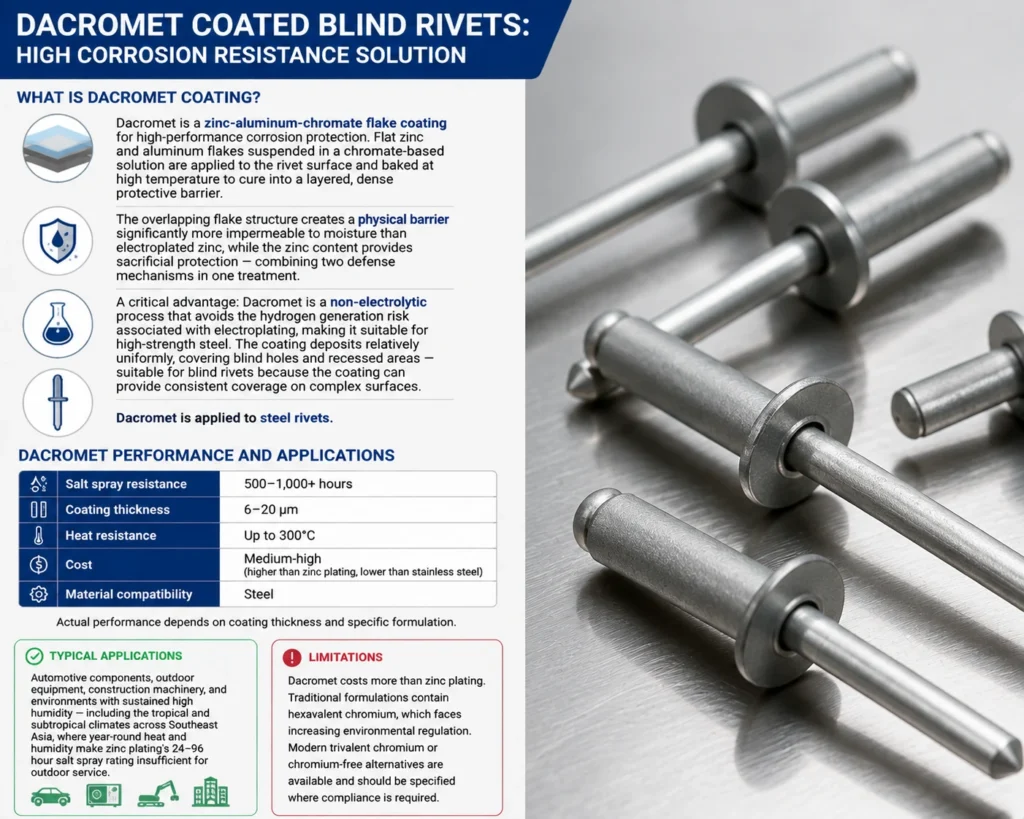
Dacromet is a zinc-aluminum-chromate flake coating for high-performance corrosion protection. Flat zinc and aluminum flakes suspended in a chromate-based solution are applied to the rivet surface and baked at high temperature to cure into a layered, dense protective barrier.
The overlapping flake structure creates a physical barrier significantly more impermeable to moisture than electroplated zinc, while the zinc content provides sacrificial protection — combining two defense mechanisms in one treatment.
A critical advantage: Dacromet is a non-electrolytic process that avoids the hydrogen generation risk associated with electroplating, making it suitable for high-strength steel. The coating deposits relatively uniformly, covering blind holes and recessed areas — suitable for blind rivets because the coating can provide consistent coverage on complex surfaces.
Dacromet is applied to steel rivets.
Dacromet Performance and Applications
| Property | Specification |
|---|---|
| Salt spray resistance | 500–1,000+ hours |
| Coating thickness | 6–20 μm |
| Heat resistance | Up to 300°C |
| Cost | Medium-high (higher than zinc plating, lower than stainless steel) |
| Material compatibility | Steel |
Actual performance depends on coating thickness and specific formulation.
Typical applications: Automotive components, outdoor equipment, construction machinery, and environments with sustained high humidity — including the tropical and subtropical climates across Southeast Asia, where year-round heat and humidity make zinc plating’s 24–96 hour salt spray rating insufficient for outdoor service.
Limitations: Dacromet costs more than zinc plating. Traditional formulations contain hexavalent chromium, which faces increasing environmental regulation. Modern trivalent chromium or chromium-free alternatives are available and should be specified where compliance is required.
Other Blind Rivet Surface Finishes and Special Treatments
Beyond the three primary finishes, several additional surface treatments serve specific application requirements.
Nickel Plating Blind Rivets
Nickel plating applies a copper-nickel dual-layer deposit providing a bright, silver-white finish with better corrosion resistance than zinc plating. It is chosen for decorative and appearance-critical applications — instrument panels, visible consumer product hardware, and equipment where the fastener remains visible.
| Property | Specification |
|---|---|
| Salt spray resistance | 96–240 hours |
| Appearance | Bright silver-white, uniform |
| Cost | Medium (higher than zinc plating) |
Actual performance depends on plating thickness and underlayer specification.
Nickel plating is applied to steel rivets where zinc plating’s appearance would be insufficient.
Passivation for Stainless Steel Rivets
Passivation is a chemical treatment — using nitric or citric acid — that removes free iron from stainless steel and enhances the natural chromium oxide passive layer. It is not a coating but a surface optimization.
Passivation is the standard treatment for stainless steel blind rivets, performed after forming to restore the passive layer and remove iron particles picked up from tooling.
Phosphate and Mechanical Galvanizing
Phosphate coating forms a zinc or manganese phosphate conversion layer on steel. It provides minimal standalone corrosion protection but excels as a primer or base coat improving adhesion of subsequent paint or coating layers.
Mechanical galvanizing applies zinc through a tumbling process — zinc powder is cold-welded to the rivet surface via impact with glass beads. Like Dacromet, it is a non-electrolytic process that avoids hydrogen embrittlement risk, making it an alternative for high-strength steel fasteners.
Blind Rivet Surface Finish Comparison Guide
Zinc vs Anodizing vs Dacromet Comparison
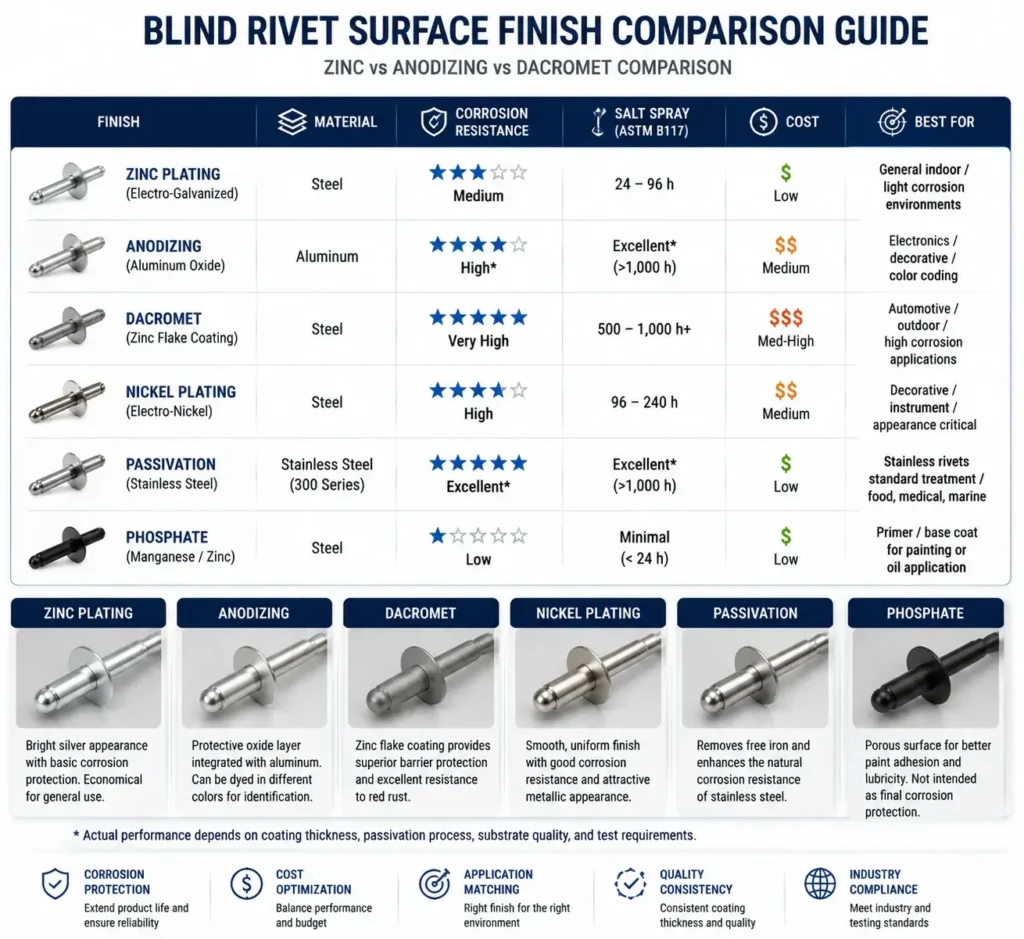
| Finish | Material | Corrosion Resistance | Salt Spray | Cost | Best For |
|---|---|---|---|---|---|
| Zinc Plating | Steel | Medium | 24–96h | Low | General indoor / light corrosion |
| Anodizing | Aluminum | High* | Excellent* | Medium | Electronics / decorative / color coding |
| Dacromet | Steel | Very High | 500–1,000h+ | Med-High | Automotive / outdoor / high corrosion |
| Nickel Plating | Steel | High | 96–240h | Medium | Decorative / instrument / appearance |
| Passivation | Stainless | Excellent* | Excellent* | Low | Stainless rivets standard treatment |
| Phosphate | Steel | Low | Minimal | Low | Primer / base coat only |
*Actual performance depends on coating thickness, passivation process, and test requirements.
How to Choose the Right Surface Finish
Selection should follow three decision dimensions:
1. By application environment
- Indoor, dry environment → Zinc plating
- General outdoor exposure → Dacromet
- Marine or chemical environment → Stainless steel + passivation
2. By base material
- Aluminum rivets → Anodizing
- Steel rivets → Zinc plating or Dacromet
- Stainless steel rivets → Passivation
3. By cost vs service life
The lowest unit cost does not always mean the lowest total cost. A better coating reduces replacement frequency, maintenance labor, and downtime. Outdoor equipment using zinc-plated rivets (24-hour salt spray) may corrode within months; the same assembly with Dacromet (500+ hours) could serve years without intervention. Buyers should calculate total lifecycle cost, not just per-piece price.
Quick Selection Chart
| Requirement | Recommended Finish |
|---|---|
| Lowest cost corrosion protection (steel) | Zinc Plating |
| Color-coded identification (aluminum) | Anodizing |
| Automotive / outdoor high corrosion | Dacromet |
| Marine / chemical environment | Stainless Steel + Passivation |
| General indoor use (steel) | Zinc Plating |
| High-strength steel (no hydrogen risk) | Dacromet / Mechanical Galvanizing |
| Electronics / decorative (aluminum) | Anodizing |
| Decorative appearance (steel) | Nickel Plating |
| Southeast Asian humid climate | Dacromet |
How to Specify Blind Rivet Surface Finish for Bulk Orders
Selecting the right finish is only useful if it is communicated clearly to the supplier. Vague specifications like “corrosion-resistant” leave room for interpretation and create disputes when the delivered product doesn’t match expectations. The following framework helps buyers define surface finish requirements with enough precision to ensure verifiable quality.
Define Corrosion Requirement
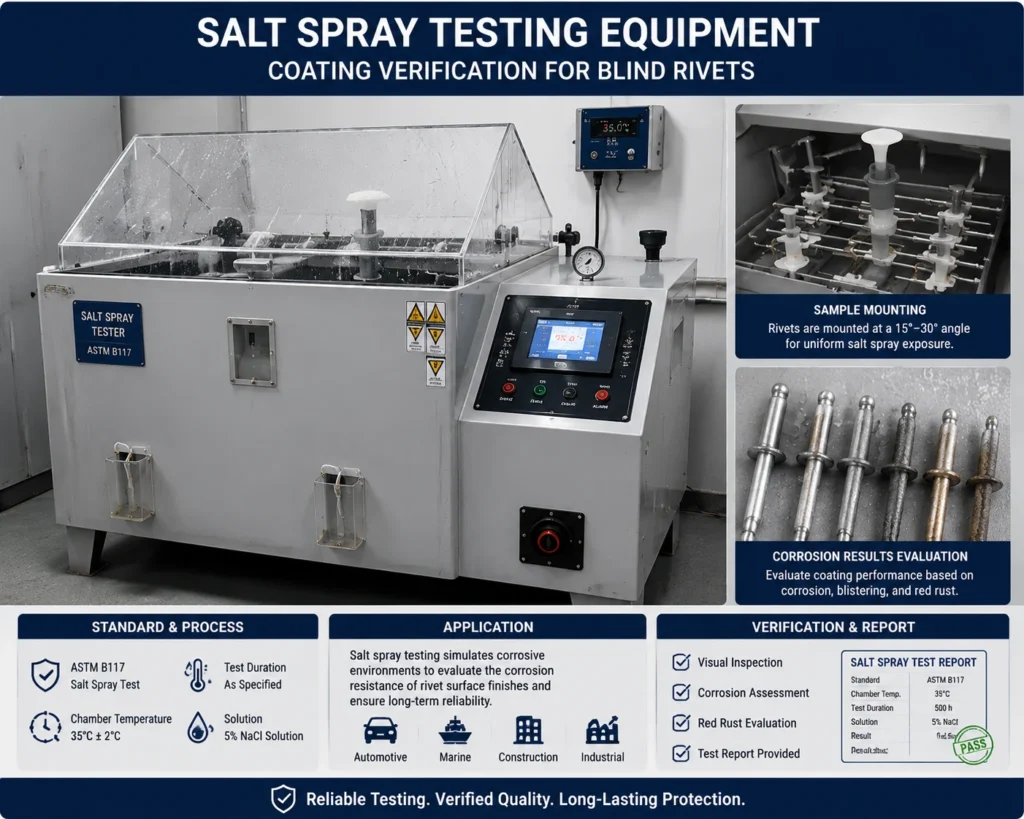
ASTM B117 salt spray testing is the industry standard for evaluating coating corrosion resistance. Rather than accepting “corrosion-resistant,” buyers should specify the exact salt spray hours required:
| Application Environment | Minimum Salt Spray Hours | Typical Finish |
|---|---|---|
| Indoor, light corrosion | ≥ 24h | Zinc plating |
| General outdoor | ≥ 96h | Zinc plating with passivation, or Dacromet |
| Automotive / harsh outdoor | ≥ 500h | Dacromet |
| Marine / chemical | ≥ 1,000h | Dacromet or stainless steel + passivation |
Actual performance depends on coating thickness, passivation process, and test requirements.
For a detailed guide to blind rivet testing methods and standards, see our blind rivet quality testing guide .
Confirm Coating Thickness and Inspection
Coating thickness directly affects corrosion protection lifespan. Below are typical thickness ranges for common blind rivet surface finishes:
| Finish | Typical Thickness | Notes |
|---|---|---|
| Zinc Plating | 5–15 μm | Standard for steel rivets; thicker coatings improve corrosion resistance |
| Dacromet | 6–20 μm | Higher thickness for demanding environments |
| Nickel Plating | 10–30 μm | Dual-layer copper-nickel for appearance |
| Anodizing | 5–25 μm | Depends on Type II (standard) vs Type III (hard) |
| Passivation | N/A (surface modification) | No measurable coating — enhances existing oxide layer |
Require suppliers to provide:
- Coating thickness test reports — measured in micrometers (μm), confirming the deposit meets the specified range
- Adhesion test results — typically via cross-hatch or tape test, confirming the coating will not peel during installation
- Appearance inspection records — covering color consistency, surface defects, and coating coverage completeness
Request OEM Surface Treatment Capability
For buyers with custom requirements, verify that the supplier can deliver:
- Custom coatings — zinc plating, nickel plating, Dacromet, anodizing, passivation, or phosphate, specified by application
- Custom colors — anodized aluminum in red, blue, black, gold, or custom-matched tones
- Drawing-based customization — material and coating combinations per customer drawings, with OEM packaging and labeling
- Test reports — salt spray test reports, coating thickness reports, and spectrometer material analysis per batch
For a full guide to custom blind rivet development from drawing to bulk production, see our custom blind rivets OEM guide .
At RivetFast, surface treatment capabilities include zinc plating, anodizing, Dacromet, nickel plating, passivation, and phosphate coating. Salt spray testing capability is available to verify coating performance according to ASTM B117 standards, with test reports accompanying each batch on request. Production operates under ISO 9001 quality management, with full OEM customization for custom dimensions, colors, and packaging.
Common Surface Finish Selection Mistakes
- Assuming zinc plating is sufficient for outdoor use — Standard electrogalvanized zinc provides 24–96 hours of salt spray protection. In sustained outdoor exposure, corrosion can begin within months. Specify Dacromet (500h+) or stainless steel instead.
- Ignoring hydrogen embrittlement risk — High-strength steel rivets electroplated with zinc may absorb hydrogen, leading to delayed brittle fracture. Specify Dacromet or mechanical galvanizing, or require post-plating baking.
- Not specifying salt spray test hours — Writing “corrosion-resistant treatment” without a quantified standard leaves no basis for acceptance inspection.
- Not adjusting installation parameters after anodizing — Type III hard anodizing increases surface hardness, which may affect pull-break behavior. Test sample rivets before full production runs.
For a broader guide to sourcing pitfalls, see our article on 5 red flags when sourcing blind rivets .
Recommended Surface Finish by Application
| Application | Recommended Finish | Why |
|---|---|---|
| HVAC equipment & ductwork | Zinc Plating / Dacromet | Indoor protected: zinc; outdoor units: Dacromet for humidity |
| Automotive components | Dacromet | High corrosion resistance, no hydrogen embrittlement risk |
| Electronics enclosures | Anodized Aluminum | Lightweight, corrosion-resistant, color-coded identification |
| Outdoor structures & equipment | Dacromet | 500–1,000h salt spray for sustained weather exposure |
| Marine / chemical environments | Stainless Steel + Passivation | Maximum corrosion resistance for harsh conditions |
| General indoor machinery | Zinc Plating | Cost-effective for low-corrosion environments |
| Decorative / visible hardware | Nickel Plating | Premium appearance with good corrosion resistance |
| Southeast Asian humid climate | Dacromet | Year-round heat and humidity require high salt spray rating |
Conclusion: Material Selection Plus Surface Finish Equals Reliable Performance
There is no single “best” blind rivet surface finish — the right choice depends on application environment, base material, cost targets, and required service life. Zinc plating delivers economical protection for general indoor use. Anodizing provides premium corrosion resistance and color options for aluminum. Dacromet offers high-performance protection for automotive, outdoor, and humid-climate applications. Nickel plating serves decorative requirements. Passivation is the standard treatment for stainless steel.
For procurement specifications, the key is precision: define the coating type, salt spray test hours, thickness range, and inspection requirements explicitly. A well-specified surface finish eliminates ambiguity and prevents the premature failures that result from under-specified coatings.
FAQ
What is the best surface finish for outdoor blind rivets?
For general outdoor use, Dacromet coating provides 500–1,000+ hours of salt spray protection — significantly better than zinc plating (24–96 hours). For marine or highly corrosive environments, stainless steel rivets with passivation offer the best long-term performance. Actual performance depends on coating thickness and formulation.
What is the difference between zinc plating and Dacromet coating?
Zinc plating uses electrolysis to deposit a thin zinc layer (5–15 μm) with 24–96 hours of salt spray protection. Dacromet is a zinc-aluminum-chromate flake coating providing 500–1,000+ hours. Dacromet also avoids the hydrogen generation risk of electroplating, making it safer for high-strength steel. Zinc plating is more economical; Dacromet is the premium choice for demanding environments.
What is the difference between anodized and zinc plated rivets?
Anodizing is exclusively for aluminum rivets — it converts the aluminum surface into a harder, more corrosion-resistant oxide layer and can add color. Zinc plating is applied to steel rivets for economical rust protection. They are not interchangeable: anodizing cannot be used on steel, and zinc plating is not used on aluminum.
How many ASTM B117 salt spray hours should blind rivets pass?
It depends on the application. For indoor use, 24–96 hours (zinc plating) is typically sufficient. For general outdoor use, specify at least 500 hours (Dacromet). For automotive, marine, or chemical environments, require 1,000+ hours. Always specify the exact salt spray hours — do not accept vague descriptions like “corrosion-resistant.”
Does surface treatment affect blind rivet installation?
Generally, standard zinc plating and Dacromet do not significantly affect installation. However, hard anodizing (Type III) increases surface hardness, which may require minor adjustments to installation force parameters. Always test sample rivets before full production runs when changing surface treatments.
How should I specify blind rivet surface finish when ordering?
Include four key details in your purchase specification: (1) the specific coating type (zinc plating, anodizing, Dacromet, etc.), (2) required salt spray test hours per ASTM B117, (3) coating thickness range, and (4) any color or OEM packaging requirements. Also request a salt spray test report and coating thickness inspection report with each batch. This ensures verifiable quality and avoids disputes over vague “corrosion-resistant” descriptions.