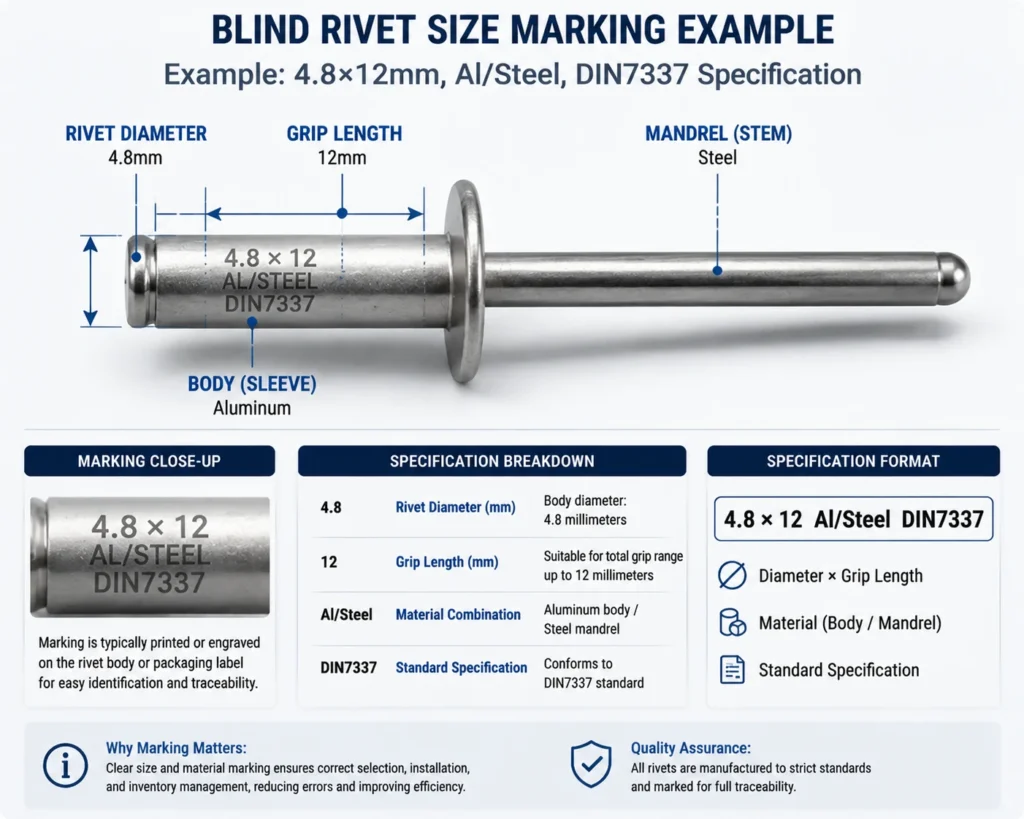
Many buyers select blind rivets only by diameter or length, but the correct size depends on the complete joint thickness, hole size, and required grip range. Choosing the wrong size leads to loose joints, poor installation, insufficient strength, or even material damage — problems that often surface only after bulk delivery, when reordering costs time and money.
Another common source of confusion is the mixing of metric (mm) and imperial (inch) dimensions. A drawing might specify 4.8mm while a supplier quotes 3/16″ — close enough to seem interchangeable, but not always identical. Grip range adds another layer of difficulty: select a range too short and the rivet won’t clamp properly; too long and the body won’t expand fully, resulting in an unstable joint.
This guide provides a complete blind rivet size chart covering eight standard diameters in both millimeters and inches, along with grip range, hole size, and head diameter data. You’ll also find a step-by-step selection method, a hole size tolerance table, and practical examples to help you specify the right rivet for your application. This guide is designed for engineers, purchasing teams, and industrial buyers who need a quick reference before ordering blind rivets in bulk. Note: “pop rivet” is a common industry term for blind rivets — pop rivet size charts and blind rivet size charts are used interchangeably throughout this guide.
For material selection — aluminum, steel, or stainless steel — see our companion guide: Aluminum vs Steel vs Stainless Steel Blind Rivets.
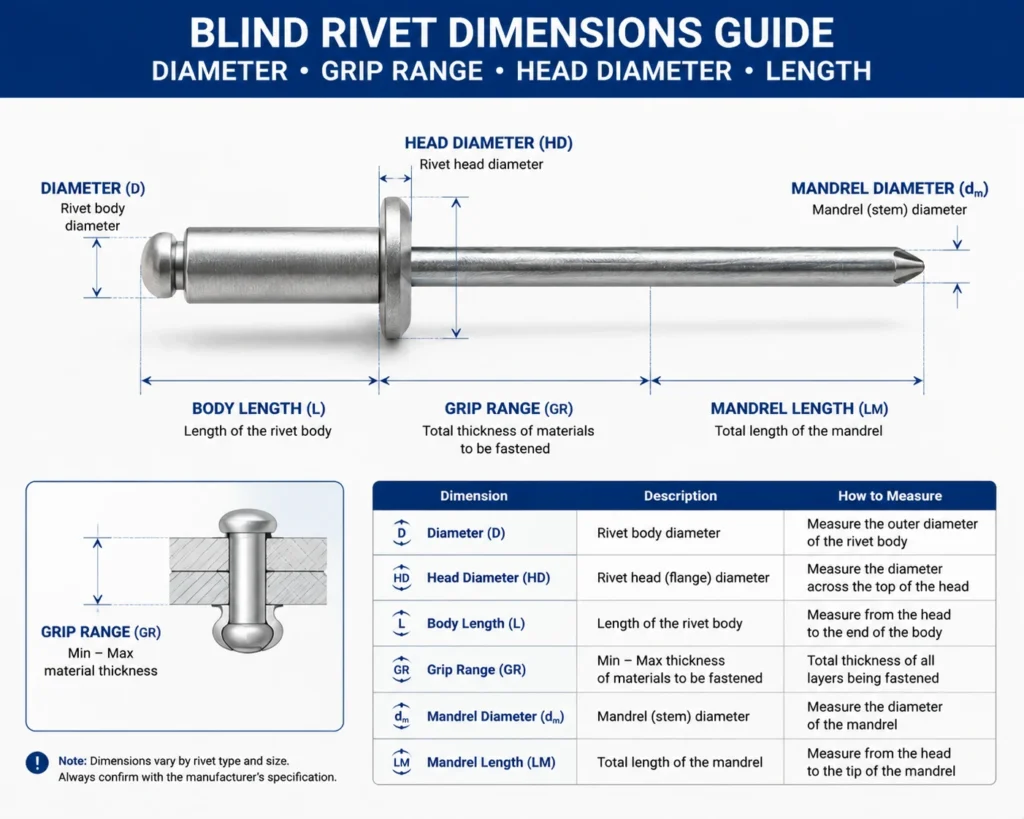
Understanding Blind Rivet Dimensions: Key Terms Explained
Before diving into the size chart, it’s worth clarifying the four dimensions that matter most when specifying a blind rivet. Much of the confusion in procurement comes from mixing up these terms — particularly grip range and overall length.
Rivet Body Diameter (Nominal Diameter)
The nominal diameter is the outside diameter of the rivet body — the part that sits inside the drilled hole. It determines the hole size required and directly affects the rivet’s load-bearing capacity. Common standard diameters include 2.4mm, 3.0mm, 3.2mm, 4.0mm, 4.8mm, 5.0mm, 6.0mm, and 6.4mm. The most common inch equivalents are 3/32″, 1/8″, 5/32″, 3/16″, and 1/4″. Larger diameters provide higher tensile and shear strength but require larger holes and more installation clearance.
Grip Range (Grip Capacity)
Grip range is the total material thickness that a blind rivet can securely fasten. Each rivet specification has a minimum and maximum grip — your material stack thickness must fall within this range. A general rule of thumb: rivet length should be selected based on the required grip range and manufacturer specifications. Always refer to the supplier’s specification sheet to match rivet length to grip range.
The most common mistake is treating rivet length as grip range — they are not the same. To determine your required grip range: (1) measure the total stacked thickness of all materials being joined, (2) add coating or gasket thickness if applicable, and (3) select a rivet whose grip range covers your material thickness near the middle of the range — not at the extremes.
Hole Size (Drill Hole Diameter)
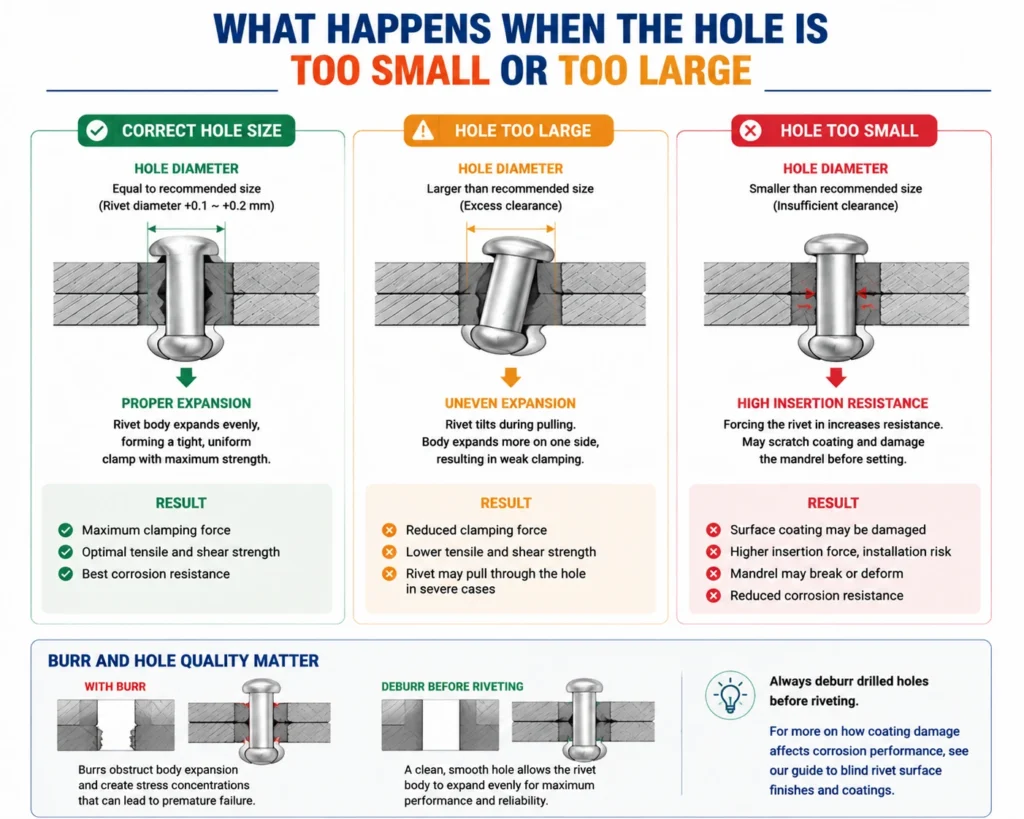
Typically, the recommended hole size is slightly larger than the rivet diameter, commonly around +0.1 to +0.3mm depending on specifications. A hole that is too large causes the rivet to tilt, leading to uneven expansion and reduced holding force. A hole that is too small makes insertion difficult and can scratch the rivet’s surface coating. Always drill to the size specified in the chart — don’t approximate with whatever drill bit is handy.
Head Diameter and Mandrel Diameter
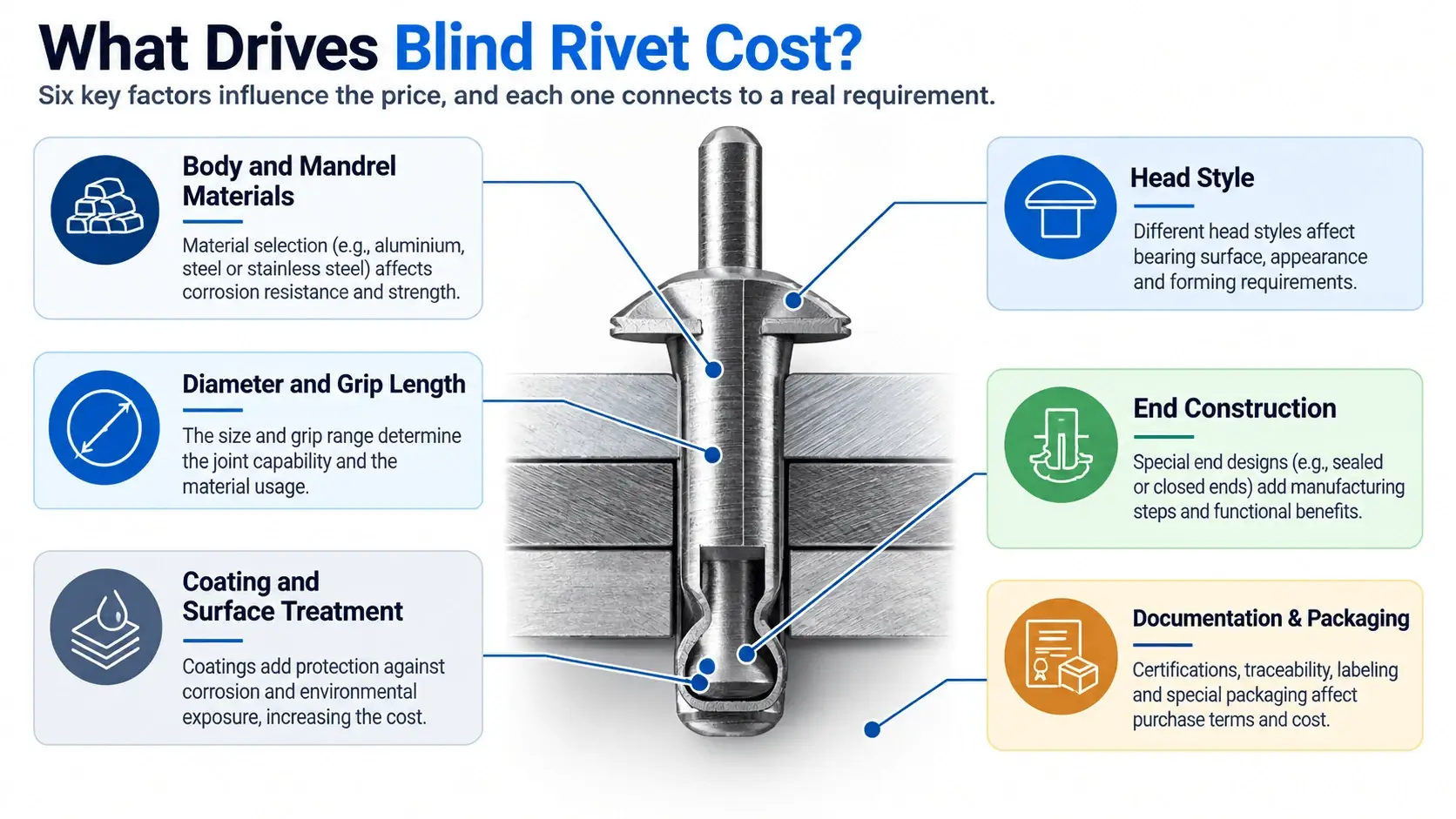
Head diameter determines the clamping area and load distribution on the material surface. A larger head spreads stress over a wider area but requires more surface space. Mandrel diameter is an engineering parameter that affects break-load and mandrel retention strength — most buyers don’t need to focus on this, but it’s available in manufacturer spec sheets for specialized applications. Countersunk head rivets have different head dimensions from standard dome-head types, which are covered in our type comparison guide.
Standard Blind Rivet Size Chart (MM + Inch)
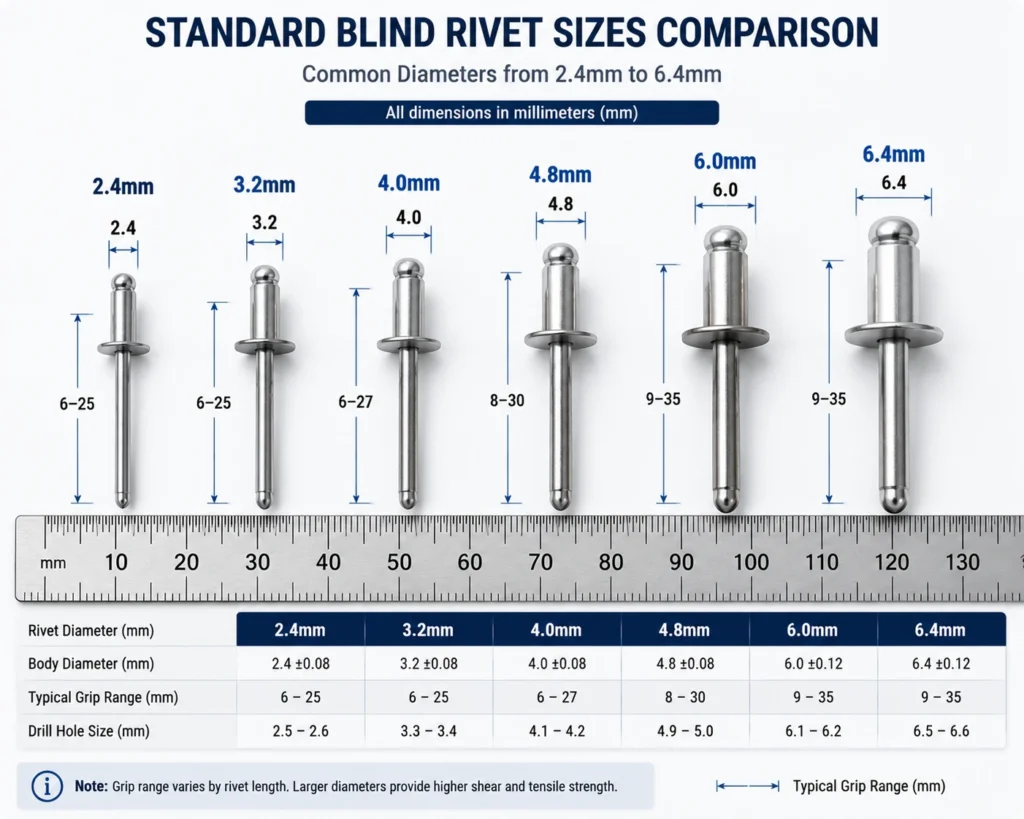
This is the core of the guide — a complete size reference covering all standard blind rivet diameters. The table below presents both metric and imperial measurements side by side, including common lengths, hole sizes, head diameters, and typical grip ranges.
Blind Rivet Size Chart: Diameter, Length, Hole Size & Grip Range
| Nominal Dia (mm) | Nominal Dia (inch) | Common Length (mm) | Hole Size (mm) | Head Dia (mm) | Typical Grip Range |
| 2.4 | 3/32″ | 4 – 12 | 2.5 | 4.8 | 0.5 – 6 mm |
| 3.0 | — | 6 – 14 | 3.1 | 5.6 | 1 – 8 mm |
| 3.2 | 1/8″ | 6 – 16 | 3.3 | 6.0 | 1 – 10 mm |
| 4.0 | 5/32″ | 6 – 20 | 4.1 | 7.2 | 2 – 14 mm |
| 4.8 | 3/16″ | 8 – 25 | 4.9 | 8.4 | 3 – 18 mm |
| 5.0 | — | 8 – 25 | 5.1 | 9.0 | 3 – 18 mm |
| 6.0 | — | 10 – 30 | 6.1 | 10.5 | 5 – 25 mm |
| 6.4 | 1/4″ | 10 – 30 | 6.5 | 11.5 | 5 – 30 mm |
Note: This table refers to common open-end blind rivet configurations. Closed-end, structural, and multi-grip rivets may have different grip ranges for the same diameter. Typical grip ranges shown are for reference only — actual grip capability depends on rivet type, head style, material combination, and manufacturer specifications. Values based on DIN 7337 / IFI-114 common standards. 4.8mm (3/16″) is the most widely used blind rivet size.
3.0mm, 5.0mm, and 6.0mm are primarily metric-market sizes with no direct inch equivalent. Mandrel diameter is an engineering parameter — refer to manufacturer spec sheets for detailed mechanical data.
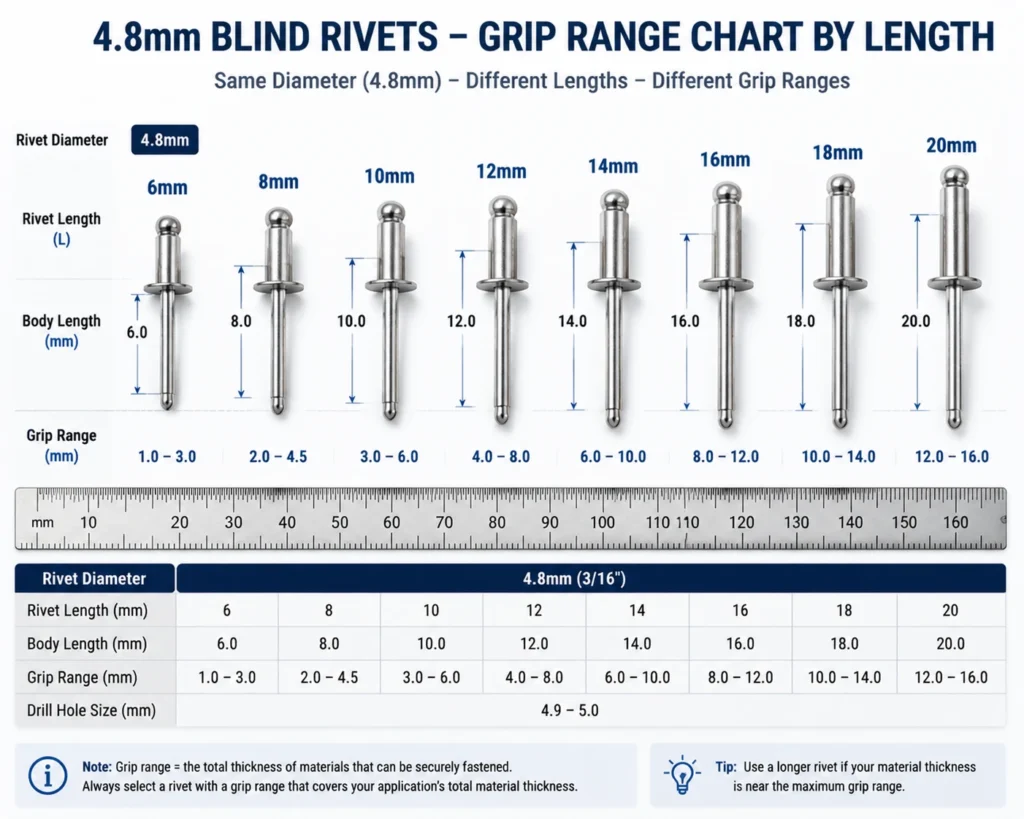
Typical Grip Range Chart for 4.8mm Blind Rivets
Since 4.8mm (3/16″) is the most commonly used blind rivet diameter, the table below shows how different lengths correspond to specific grip ranges. The same logic applies to other diameters — always check the manufacturer’s specification sheet.
| Rivet Length (mm) | Rivet Length (inch) | Typical Grip Min (mm) | Typical Grip Max (mm) | Typical Grip Max (inch) |
| 8 | 5/16″ | 2.0 | 4.0 | 5/32″ |
| 10 | 3/8″ | 4.0 | 6.0 | 1/4″ |
| 12 | 1/2″ | 6.0 | 8.0 | 5/16″ |
| 14 | 9/16″ | 8.0 | 10.0 | 3/8″ |
| 16 | 5/8″ | 10.0 | 12.0 | 15/32″ |
| 18 | 11/16″ | 12.0 | 14.0 | 9/16″ |
| 20 | 3/4″ | 14.0 | 16.0 | 5/8″ |
| 25 | 1″ | 18.0 | 21.0 | 13/16″ |
Typical grip ranges shown are for reference only. Actual grip capability depends on rivet type (open-end, closed-end, structural, multi-grip), head style, material combination, and manufacturer specifications. Longer grip ranges (e.g., 25mm for 4.8mm diameter) may require special or multi-grip series — always confirm with the supplier’s specification sheet.
How to Choose the Right Rivet Size: Step-by-Step Guide
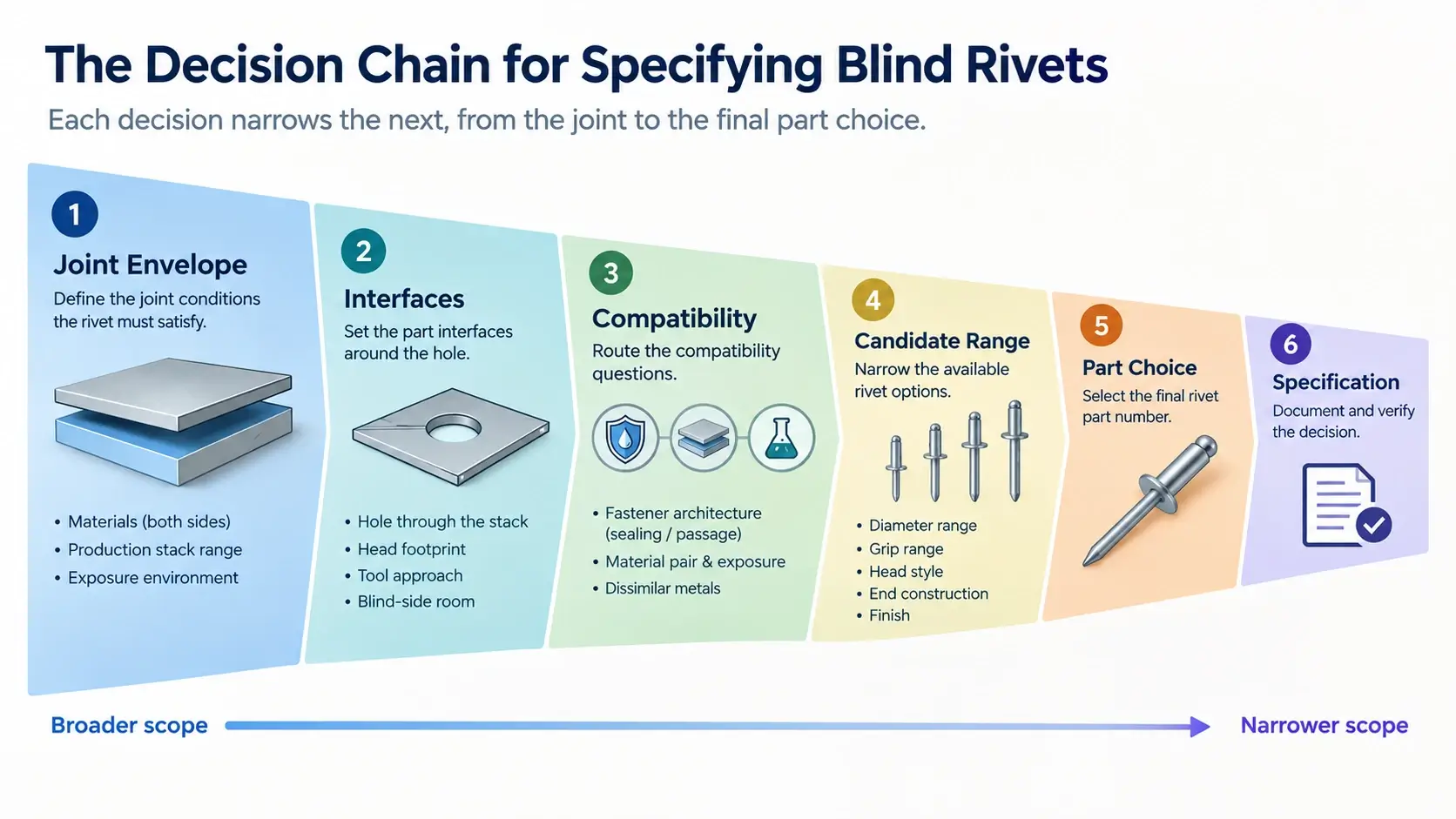
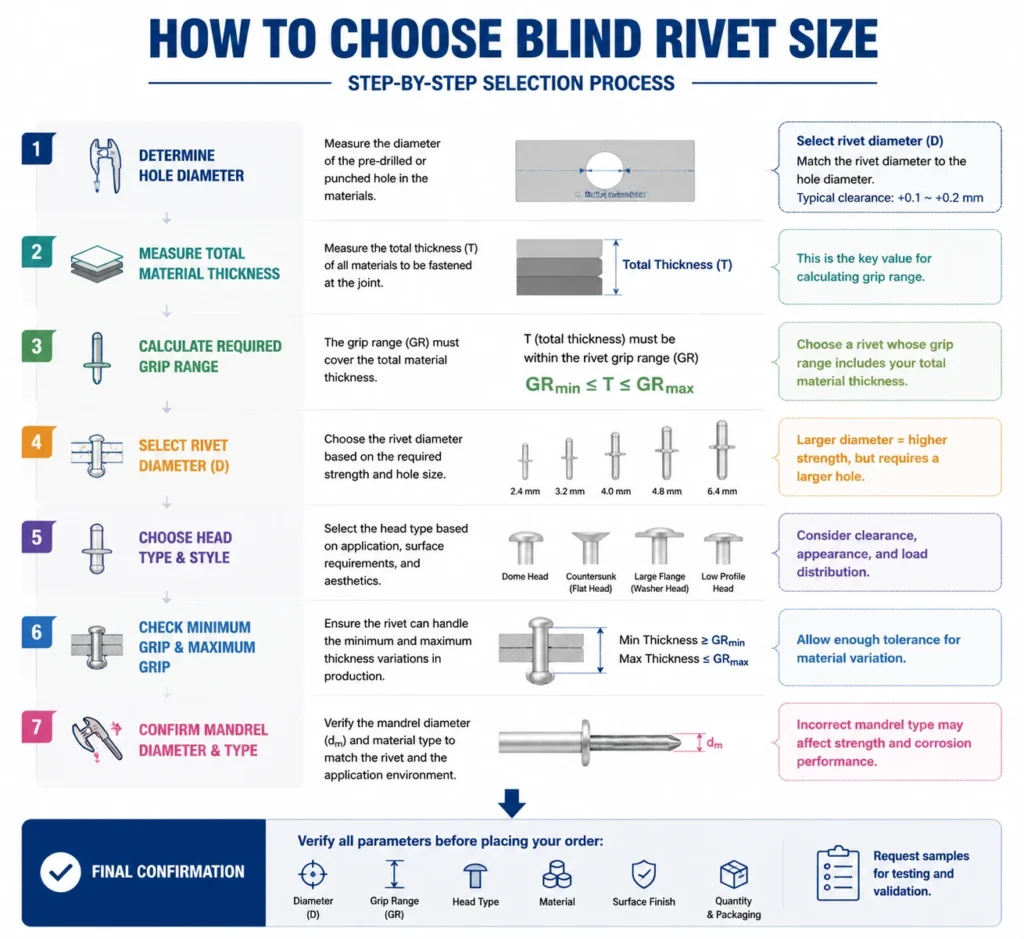
Selecting the correct blind rivet size comes down to a straightforward process: measure your material stack, match it to a grip range, and then choose a diameter based on load requirements. The formula and examples below walk through this process.
Blind Rivet Size Selection Formula
Step 1 — Calculate Total Material Thickness:
Total Material Thickness = Sheet 1 + Sheet 2 + (Coating / Gasket thickness, if applicable)
Step 2 — Match to Grip Range:
Grip Range Min ≤ Total Material Thickness ≤ Grip Range Max
Step 3 — Best Practice:
Avoid operating at the extreme limits of the grip range — leaving margin improves installation reliability.
This formula gives procurement teams a quick reference for narrowing down rivet specifications before consulting a supplier’s detailed spec sheet.
Quick Reference — Blind Rivet Selection Rule: Material Thickness → Select Grip Range → Choose Diameter → Confirm Hole Size
Step 1 — Measure Total Material Thickness
Measure the combined thickness of all layers being joined — including any gaps, coatings, or gaskets. For example, if you’re fastening a 2mm steel sheet to a 3mm aluminum plate, your total thickness is 5mm, and you need a rivet with a grip range that covers 5mm. Keep measurement error within ±0.5mm — a 1mm difference can mean selecting the wrong specification.
Step 2 — Match Grip Range to Material Stack
Your total material thickness must fall between the minimum and maximum grip range of the selected rivet. As a general practice, avoid selecting a rivet that operates at the extreme limits of its grip range. Leaving some margin helps improve installation reliability and accommodates measurement variation and material compression.
For example, with a total thickness of 5mm, a grip range of 3–7mm is ideal. A range of 0–3mm would be too short (the rivet body can’t expand enough), while a range of 5–10mm would be too long (the body won’t deform properly). Avoid the “bigger is better” mentality — when the grip range far exceeds the actual thickness, the rivet body cannot expand sufficiently to fill the hole.
Step 3 — Select Diameter Based on Load Requirements
Diameter determines tensile and shear strength — larger diameters handle higher loads. General guidelines:
- 2.4–3.2mm: Light-duty applications (electronics, labels, thin sheet metal)
- 4.0–4.8mm: General industrial use (sheet metal, HVAC, general structural) — the most commonly used range
- 5.0–6.4mm: Heavy-duty applications (steel structures, automotive, construction)
Actual strength values vary significantly by material combination and diameter — always verify with the supplier’s specification sheet. For different rivet types (multi-grip, structural, standard) and their size ranges, see our type comparison guide.
Real-World Selection Examples
Example 1 — HVAC Sheet Metal
Material: 0.8mm galvanized steel + 1.2mm aluminum bracket = 2.0mm total Recommended: 3.2mm (1/8″) blind rivet — grip range 1–4mm covers 2.0mm with margin
Why: Thin sheet metal requires a smaller diameter to avoid oversizing the hole; 3.2mm provides adequate holding force for HVAC applications.
Example 2 — Electrical Enclosure Assembly
Material: 1.5mm steel panel + 2.0mm steel frame = 3.5mm total Recommended: 4.0mm (5/32″) blind rivet — grip range 2–6mm covers 3.5mm comfortably
Why: Enclosure joints need moderate strength and vibration resistance; 4.0mm balances load capacity with installation convenience.
Example 3 — Automotive Sheet Metal Assembly
Material: 1.0mm steel panel + 2.5mm steel bracket = 3.5mm total Recommended: 4.8mm (3/16″) blind rivet — grip range 3–7mm covers 3.5mm with margin
Why: Automotive assemblies require higher shear strength and vibration resistance; 4.8mm is the standard choice for sheet metal joints in vehicle manufacturing and supplier chains.
These examples are for general reference. Actual selection should also consider material combination, vibration environment, and corrosion protection requirements.
Blind Rivet Hole Size Guide: Drill Diameter and Tolerance
Even the correctly sized rivet will fail if the hole is wrong. Hole diameter is one of the most overlooked factors in blind rivet installation — and one of the most common causes of joint failure.
Standard Hole Size Tolerance
| Rivet Dia (mm) | Min Hole (mm) | Max Hole (mm) | Recommended Drill Bit |
| 2.4 | 2.5 | 2.7 | 2.5mm (3/32″) |
| 3.2 | 3.3 | 3.5 | 3.3mm (1/8″) |
| 4.0 | 4.1 | 4.3 | 4.1mm (5/32″) |
| 4.8 | 4.9 | 5.1 | 4.9mm (3/16″) |
| 6.4 | 6.5 | 6.7 | 6.5mm (1/4″) |
Typically, the recommended hole size is slightly larger than the rivet diameter, commonly around +0.1 to +0.3mm depending on specifications. Different standards may specify slightly different tolerance ranges. When fastening multiple layers, ensure all holes are aligned — misalignment effectively enlarges the hole and weakens the joint.
What Happens When the Hole Is Too Small or Too Large
Too small: Forcing a rivet into an undersized hole can scratch the surface coating — particularly zinc plating or Dacromet — reducing corrosion resistance. Increased insertion resistance may also damage the mandrel before the rivet sets properly.
Too large: A rivet in an oversized hole will tilt during pulling, causing the body to expand unevenly on one side. This dramatically reduces clamping force and tensile strength — in severe cases, the rivet pulls straight through the hole.
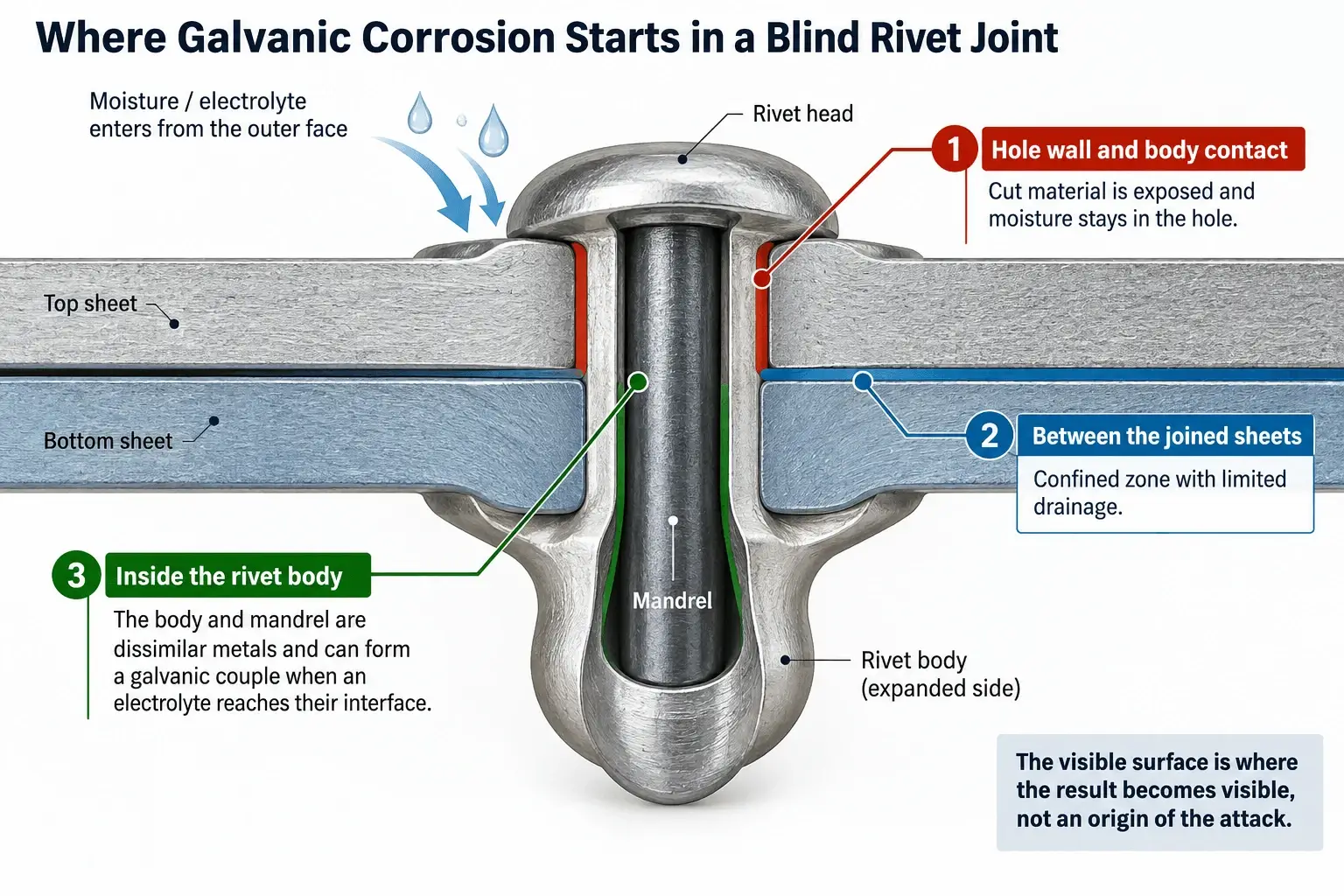
Burr and hole quality: Always deburr drilled holes before riveting. Burrs obstruct body expansion and create stress concentrations that can lead to premature failure. For more on how coating damage affects corrosion performance, see our guide to blind rivet surface finishes and coatings.
Blind Rivet Standards: DIN 7337, IFI-114 & ISO
Different markets reference different blind rivet standards. Knowing which standard your customer or drawing specifies helps avoid specification ambiguity when ordering.
Common Blind Rivet Standards Overview
DIN 7337: The German standard, most commonly referenced in European markets. It defines dimensions, tolerances, and mechanical properties for open-end blind rivets.
IFI-114: The U.S. Industrial Fastener Institute standard, widely used in North American markets. Its sizing system is based on imperial measurements.
ISO 15977–15984: The international standard series, classified by material and head style (e.g., ISO 15977 covers steel/steel open-end, ISO 15983 covers stainless/stainless open-end).
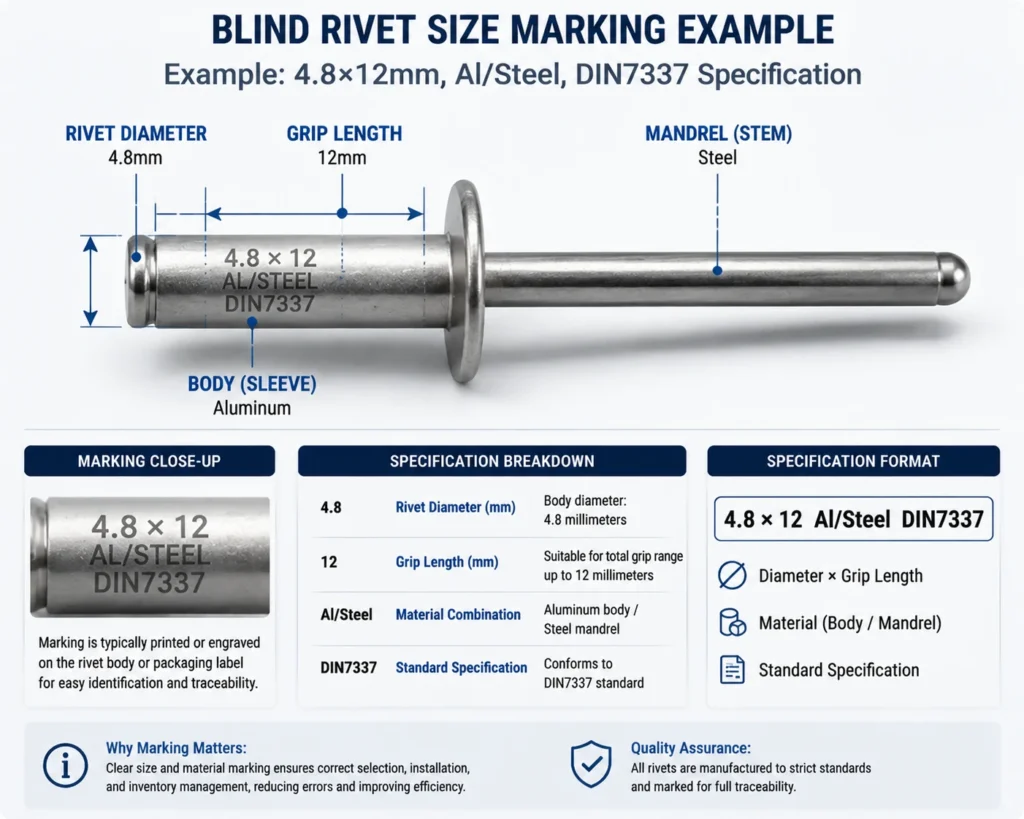
The three standards may have overlapping dimensional references, but they are not fully interchangeable — buyers should always confirm the required standard with the supplier. When ordering, specify the standard being followed (e.g., “DIN 7337, 4.8mm × 12mm”) to avoid ambiguity.
Dimensional Tolerance per Standard
Typical tolerance ranges:
- Diameter tolerance: ±0.05mm (nominal diameter)
- Length tolerance: ±0.5mm (nominal length)
- Hole tolerance: +0.1mm to +0.3mm (larger than rivet diameter)
- Head diameter tolerance: ±0.3mm
Buyers should request dimensional inspection reports from suppliers to confirm that each batch meets tolerance requirements. For inspection methods and testing standards, see our blind rivet quality testing guide. For the relationship between dimensional precision and manufacturing process control, see our blind rivet manufacturing process article.
Common Size Selection Mistakes to Avoid
These five mistakes come from real procurement scenarios. Each one can result in batch-level installation failures — and each is preventable.
Five Common Blind Rivet Sizing Mistakes
1. Confusing rivet length with grip range — The most common error. A 12mm-long rivet does not fasten 12mm of material. Grip range maximum is typically less than rivet length — always refer to the manufacturer’s specification sheet to confirm the relationship.
2. Selecting the wrong grip range — too short or too long
- Too short (grip range max < material thickness): The rivet body cannot expand sufficiently, resulting in insufficient expansion, a weak joint, and loose fastening. In extreme cases, the rivet pulls through the hole.
- Too long (grip range min > material thickness): The excess body length prevents proper deformation, leading to unstable installation and unnecessary cost.
- Correct approach: Avoid operating at the extreme limits of the grip range — material thickness should fall within the middle portion of the range for optimal installation reliability.
3. Ignoring hole size compatibility — Selecting the right rivet but drilling the wrong hole leads to installation failure. Hole diameter must match the rivet diameter — don’t use whatever drill bit happens to be available.
4. Choosing a diameter that’s too small — Selecting based on “it fits” rather than strength. A 3.2mm rivet in a 5mm steel joint may not provide adequate load capacity. For thick plates or high-load applications, use 4.8mm or larger.
5. Mixing metric and imperial sizes — A drawing specifies 4.8mm but the order is placed as 3/16″ (4.76mm). The 0.04mm difference is usually acceptable, but 5.0mm and 3/16″ differ more significantly — always confirm. For more sourcing pitfalls, see our guide on 5 red flags when sourcing blind rivets.
How to Specify Blind Rivet Size When Ordering
When placing an order, clearly specifying these four parameters eliminates most procurement errors and reduces the risk of receiving non-conforming product.
Four Key Parameters to Include in Your Purchase Specification
1. Nominal diameter and length — e.g., “4.8mm × 12mm” or “3/16″ × 1/2″”. Specify the measurement system and avoid mixing metric and imperial in the same order.
2. Grip range requirement — e.g., “grip range 6–8mm”. The supplier uses this to match the correct rivet length.
3. Hole size requirement — e.g., “hole size 4.9mm”. This ensures the installation team drills to the correct diameter.
4. Applicable standard — e.g., “DIN 7337, Al/Steel, 4.8×12mm”. Specifying the standard prevents ambiguity about tolerances and material specifications.
The sizes listed in the charts above represent standard product specifications. If you need non-standard diameters, special lengths, or custom head styles, these fall under OEM customization. For guidance on when customization is worth it, see our article on standard vs custom blind rivets. For the full OEM development process, see our custom blind rivets OEM guide.
RivetFast Standard Size Availability
RivetFast supplies standard blind rivets from 2.4mm to 6.4mm diameters with stable batch production capability. Supported by 200+ production machines and a 5,000㎡ manufacturing facility, RivetFast provides stable batch production for industrial customers worldwide. An annual capacity of 2 billion pieces supports high-volume and continuous supply requirements.
Production follows ISO 9001 quality management, with dimensional tolerances per DIN 7337 standards. In-house testing equipment — including spectrometer, tensile tester, and hardness tester — supports dimensional inspection reports for every batch.
Non-standard sizes are available through OEM customization based on drawings.
Conclusion
Selecting the right blind rivet size comes down to four steps: measure total material thickness accurately, choose a grip range that covers it with margin, select a diameter that matches your load requirements, and confirm the correct hole size. When ordering, specify diameter, length, grip range, hole size, and applicable standard — and avoid mixing metric and imperial units.
For a complete selection workflow, pair this size chart with our guides on material selection and surface finish selection.
FAQ
Q1: What is the most common blind rivet size?
The most common blind rivet size is 4.8mm (3/16″) diameter. It balances strength, versatility, and cost — making it the standard choice for sheet metal, HVAC, and general industrial applications. Typical common lengths for 4.8mm rivets range from 8mm to 25mm, with typical grip ranges covering 3mm to 18mm.
Q2: How do I know what size blind rivet to use?
Follow three steps: (1) Measure the total thickness of all materials being joined. (2) Select a rivet whose grip range covers your material thickness, avoiding the extreme limits of the range. (3) Choose a diameter based on load requirements — 2.4–3.2mm for light duty, 4.0–4.8mm for general industrial, and 5.0–6.4mm for heavy-duty applications. Always confirm the hole size matches the rivet diameter.
Q3: What is grip range and why does it matter?
Grip range is the total material thickness that a blind rivet can reliably fasten. Each rivet has a minimum and maximum grip range. If your material thickness falls outside this range, the rivet will not form a proper joint — too short and it won’t clamp (loose fastening); too long and the body won’t expand fully (unstable installation). Grip range is not the same as rivet length — always check the manufacturer’s specification sheet to match rivet length to your required grip range.
Q4: What hole size should I drill for a blind rivet?
Typically, the recommended hole size is slightly larger than the rivet’s nominal diameter, commonly around +0.1 to +0.3mm depending on specifications. For example, a 4.8mm rivet requires approximately a 4.9–5.1mm hole. Using the correct drill bit size ensures proper insertion and optimal rivet expansion. A hole that is too large causes the rivet to tilt and reduces joint strength; a hole that is too small can damage the rivet’s surface coating.
Q5: Are mm and inch blind rivet sizes interchangeable?
Most standard sizes have close mm-inch equivalents (e.g., 4.8mm ≈ 3/16″). The difference is typically within 0.05mm and functionally interchangeable. However, metric-only sizes like 3.0mm, 5.0mm, and 6.0mm have no direct inch equivalent. When ordering, always specify the measurement system and confirm with your supplier to avoid confusion.
Q6: Can blind rivets be customized to non-standard sizes?
Yes. Custom diameter, length, head style, material combination, and packaging can be developed based on drawings. While standard sizes (2.4mm–6.4mm) cover most industrial applications, non-standard dimensions may be required for specialized equipment or legacy designs. Minimum order quantities apply for custom sizes — contact the supplier with your drawings or specifications for a quote.