Introduction — Should You Buy Standard or Custom Blind Rivets?
Standard blind rivets are cheaper, faster to source and easy to reorder. Custom blind rivets solve problems that standard specifications cannot — but they bring a higher MOQ, development cost and longer lead time. The question is not whether you can customize, but whether it is worth paying for.
If a standard blind rivet already meets the required dimensions, strength and environment, standard is usually the better choice. Customization becomes worthwhile when it solves a measurable assembly, performance or procurement problem.
Quick decision
- Standard specification works → Choose standard
- Minor modification needed → Consider semi-custom
- Technical requirement cannot be met → Consider custom
- High recurring demand → Custom may justify the MOQ
- No measurable benefit → Stay with standard
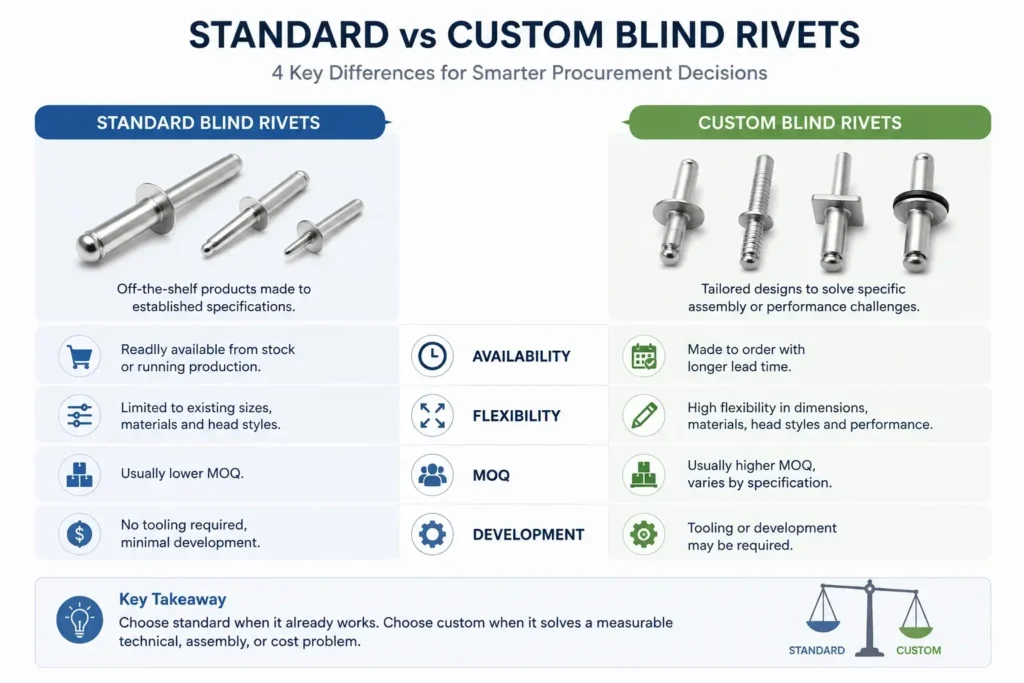
Standard vs Custom Blind Rivets: What Is the Difference?
What Are Standard Blind Rivets?
Standard blind rivets follow established specifications: common diameters, lengths and grip ranges; standard head styles (dome, countersunk, large flange); common material combinations such as aluminum/steel and stainless/stainless; and standard finishes. They offer lower MOQs, faster availability, lower development cost and easier repeat ordering.
What Are Custom Blind Rivets?
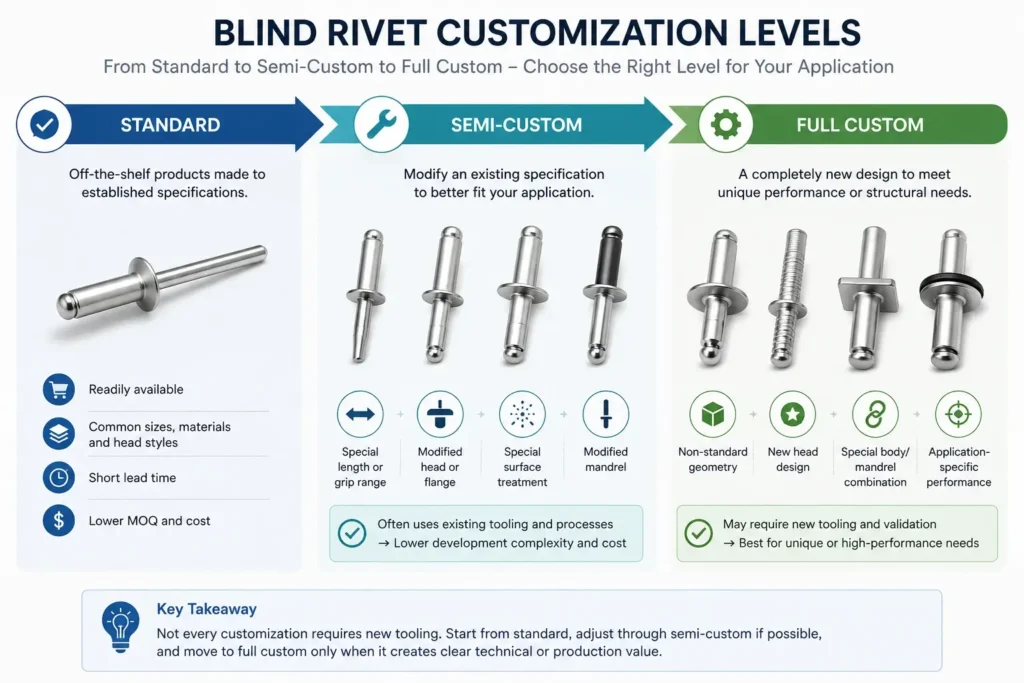
Custom does not mean designing from zero. It spans two levels:
- Semi-custom — modifying an existing specification: special length or grip range, modified head or flange, special surface treatment, or a modified mandrel.
- Full custom — a new design: non-standard geometry, a new head design, a special body/mandrel combination, or application-specific performance requirements.
Not every customization requires new tooling. Semi-custom modifications can often use an existing production process, reducing development complexity and cost.
Common customization options and where each matters:
| Customization | When It Matters | Typical Development Impact |
|---|---|---|
| Diameter | Hole compatibility | Low–Medium |
| Length | Material stack | Low–Medium |
| Grip range | Variable thickness | Medium |
| Head / flange | Pull-through / geometry | Medium |
| Material | Strength / corrosion | Medium |
| Mandrel | Retention / installation | Medium–High |
| Surface treatment | Corrosion / appearance | Low–Medium |
| Special geometry | Unique application | High |
Note: changing rivet diameter is not always the solution to a hole-fit issue; hole size, clearance and joint design also affect fit.
Before developing a custom rivet, check whether an existing type already meets the application requirements — see our blind rivet type selection guide.
When Standard Blind Rivets Are the Better Choice
Your Application Fits Existing Specifications
If a standard rivet satisfies your diameter, length, grip range, head style, material, strength and surface requirements, there is little technical reason to customize — sourcing stays simple and replacement predictable. For material options, see our blind rivet material selection guide.
You Need Fast Delivery or Have Low / Uncertain Volume
Standard products are often easier to source from existing production schedules or stock. That suits maintenance and replacement orders, short-lead-time projects, and programs with low or uncertain annual volume.
Do not take on a custom MOQ for a small-batch project. If annual demand sits well below the custom MOQ, standard is likely more economical.
Buyer Action: Before requesting a custom quote, verify whether a standard specification already meets your dimensional, mechanical and environmental requirements.
When a Custom Blind Rivet Is Worth the MOQ
The Standard Rivet Does Not Fit the Material Stack
When the standard grip range is too narrow, too short or too long, the hole fit is unsuitable, or the head geometry interferes with assembly, a standard rivet may lead to rework, difficult installation or additional processing — customization may be worthwhile if these costs are measurable.
Customization Eliminates Secondary Processing
One of the strongest procurement arguments for customization is eliminating secondary processing:
- Standard rivet → you cut, modify or rework it → then install
- Custom rivet → install directly
This removes hidden costs: labor, processing time, scrap, handling and quality variation.
The Application Requires Special Performance
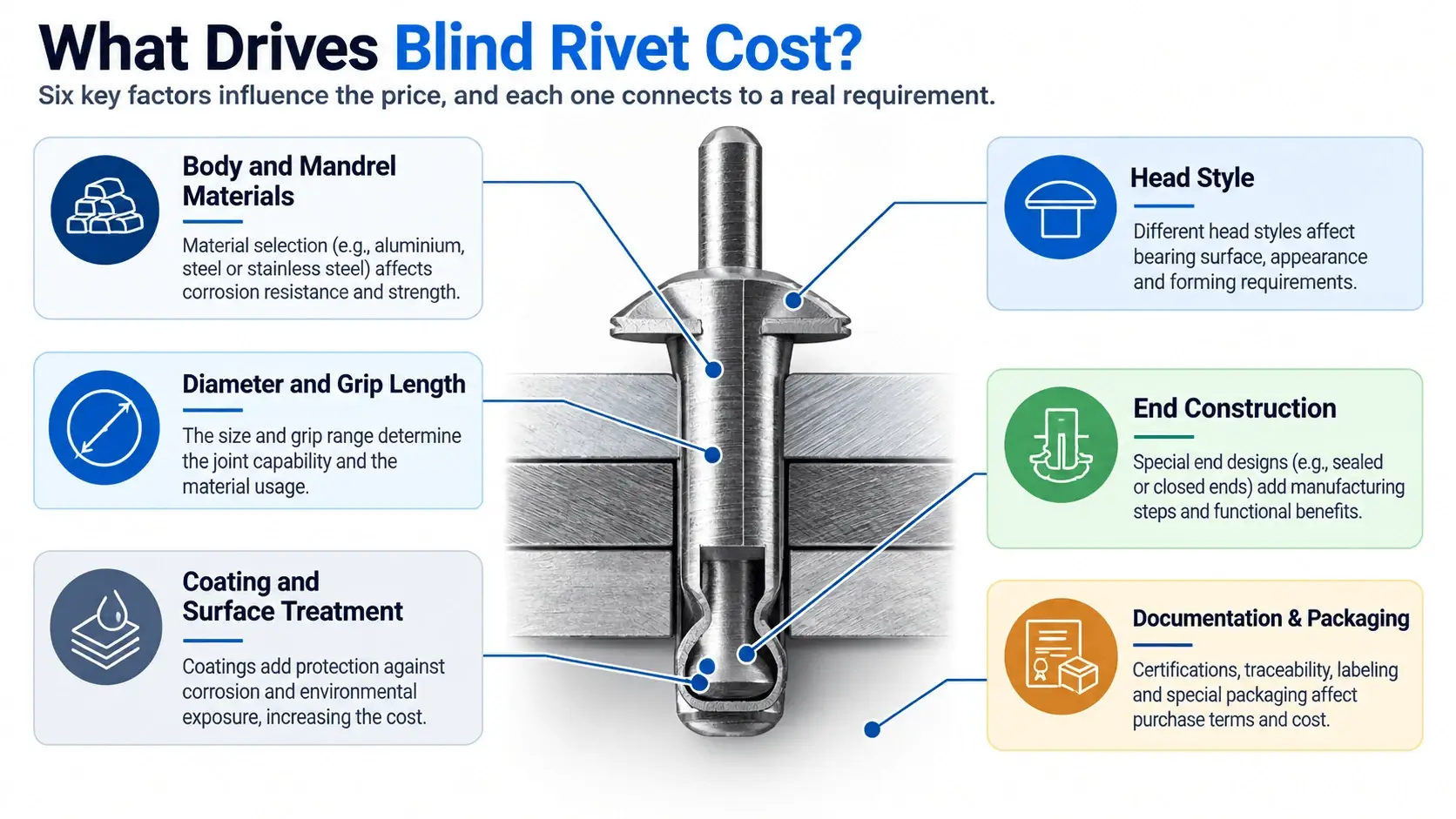
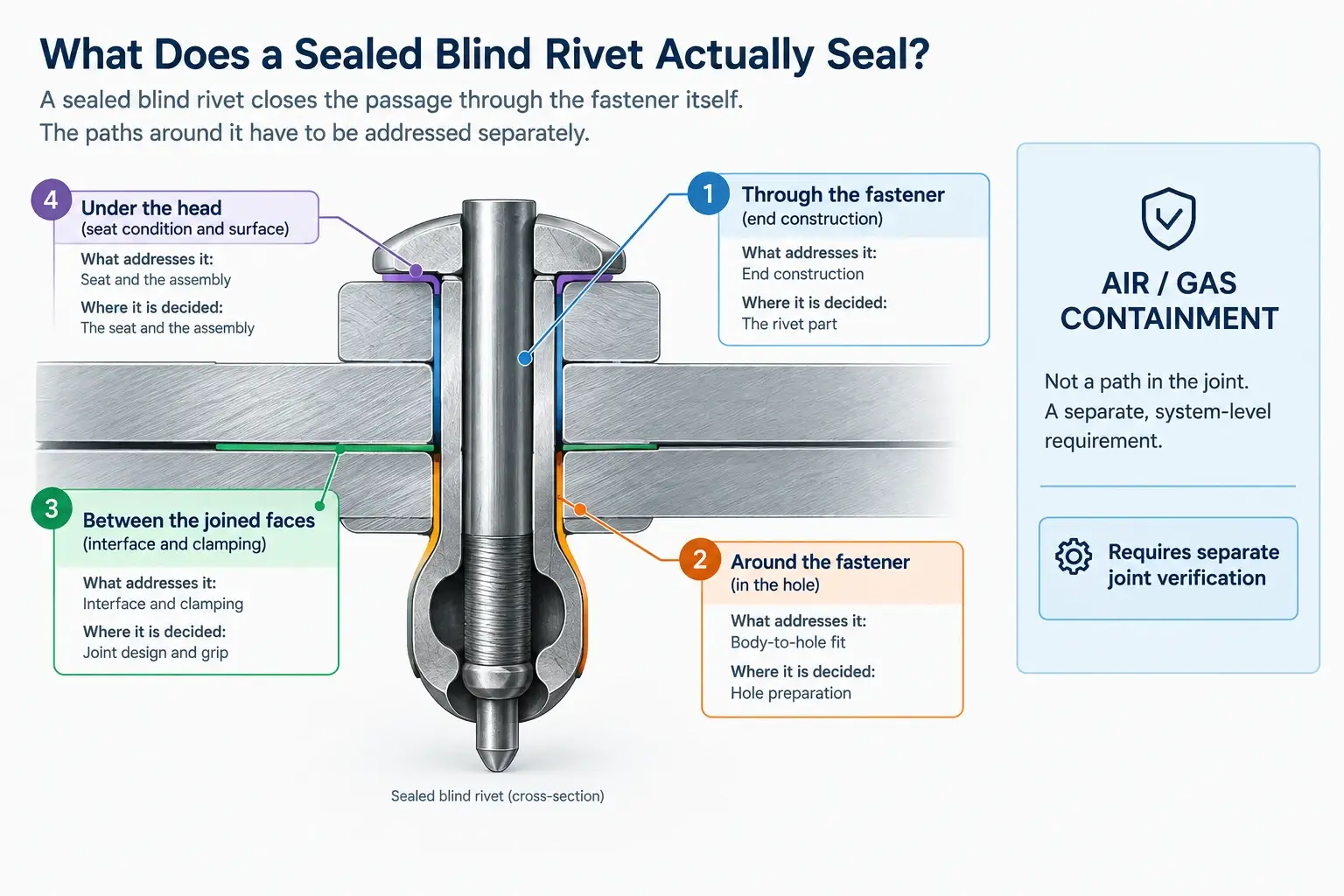
Customization is justified when the joint requires higher tensile or shear performance, improved vibration resistance, sealing capability, corrosion resistance, temperature resistance, or specific mandrel retention, depending on the application.
Customization should solve a specific performance requirement, not simply make the rivet different.
High Recurring Volume Makes the MOQ Economical
For example, an OEM product using 8 rivets per unit at 100,000 units per year needs 800,000 rivets annually — a custom MOQ may equal only weeks of normal consumption.
MOQ should be evaluated against annual consumption, not just one purchase order.
Buyer Action: Calculate annual consumption before dismissing a custom MOQ. For stable OEM demand, one-time development cost amortizes across large volumes.
How MOQ Changes the Economics of Custom Blind Rivets
The Main Cost Components
Beyond unit price, a custom project also involves:
- Unit price per piece
- Tooling and setup
- Sample development
- Testing
- Inventory carrying cost (include when MOQ creates excess stock or ties up working capital)
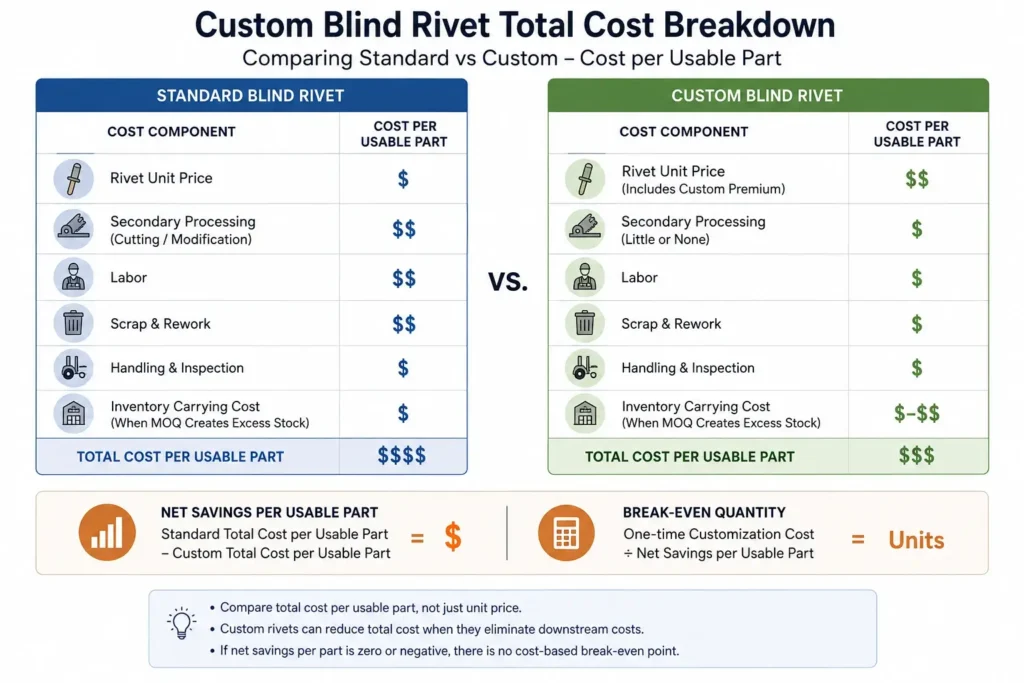
Compare Total Cost, Not Unit Price
Standard: lower unit price → secondary processing → labor → scrap → HIGHER usable-part cost
Custom: higher unit price → little or no secondary processing → lower scrap → lower downstream labor → potentially LOWER total cost
MOQ Break-Even Thinking
Compare per usable part:
Net savings per part = Standard total cost per usable part − Custom recurring cost per usable part
Break-even quantity = One-time customization cost ÷ Net savings per part
Custom recurring cost includes the custom unit-price premium and any remaining processing, scrap, labor or handling costs. One-time customization cost covers tooling, development, sampling and testing. If net savings per part is zero or negative, there is no cost-based break-even point. Customization may still be justified by technical or production requirements even when there is no cost-based break-even point.
Customization does not automatically reduce unit cost. It can reduce total cost when it eliminates downstream costs.
Buyer Action: Do not compare only unit prices. Calculate total cost per usable part — including tooling, secondary processing, scrap and inventory — before deciding.
For a deeper look at minimum order quantities and trial orders, see our blind rivet MOQ and trial order guide.
Standard vs Custom: Side-by-Side Comparison
| Factor | Standard | Custom |
|---|---|---|
| Initial cost | Lower | Higher initially |
| MOQ | Usually lower | Usually higher |
| Tooling | Usually none | May be required |
| Lead time | Usually shorter | Usually longer |
| Design flexibility | Limited | High |
| Replacement | Easier | Specification-dependent |
| Performance optimization | Limited | High |
| Best for | Standard applications | Specialized / high-volume applications |
MOQ should be confirmed case by case. The next section helps you decide.
Decision Framework: Standard or Custom?
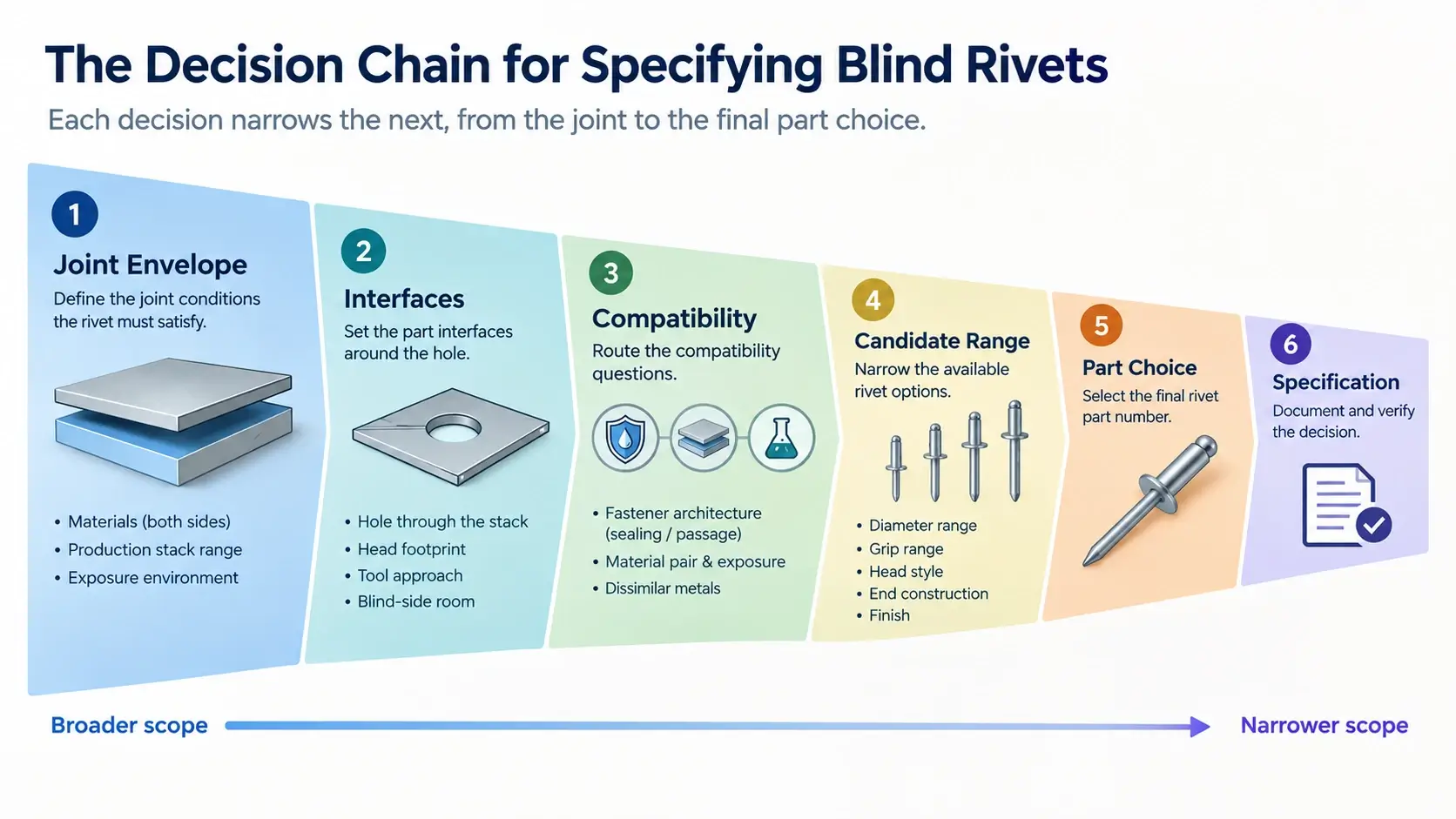
- Does an existing standard rivet fit the joint dimensions and grip requirements? → Yes → Step 2 · No → Check another standard type or a semi-custom option
- Does it meet the required strength and environmental conditions? → Yes → Step 3 · No → Consider custom
- Does the standard option create secondary processing or measurable downstream cost? → Yes → Calculate total cost · No → Step 4
- Is demand high and recurring enough to justify the MOQ and development cost? → No → Standard · Yes → Step 5
- Does customization create measurable production, performance or procurement value? → Yes → Custom may be worthwhile · No → Standard
| Situation | Choice |
|---|---|
| Standard specification works | Standard |
| Minor modification solves the issue | Semi-custom |
| Technical requirement cannot be met | Custom |
| High-volume recurring application | Custom may be worthwhile |
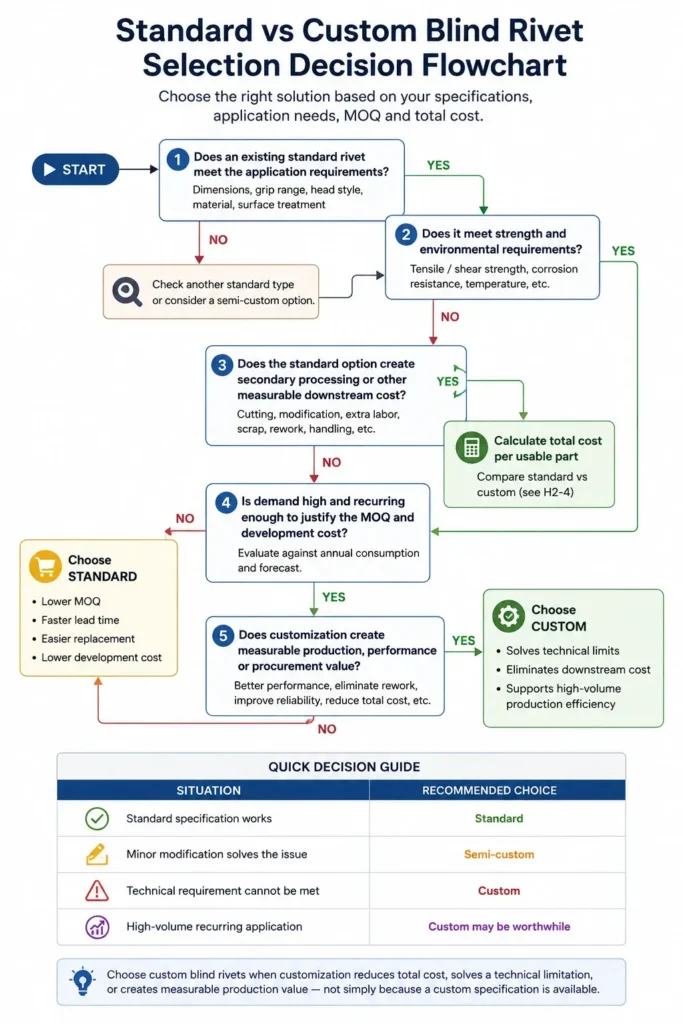
Choose custom blind rivets when customization reduces total cost, solves a technical limitation, or creates measurable production value — not simply because a custom specification is available.
Save this decision framework as your standard-vs-custom evaluation checklist.
Key Checks Before Placing a Custom Blind Rivet Order
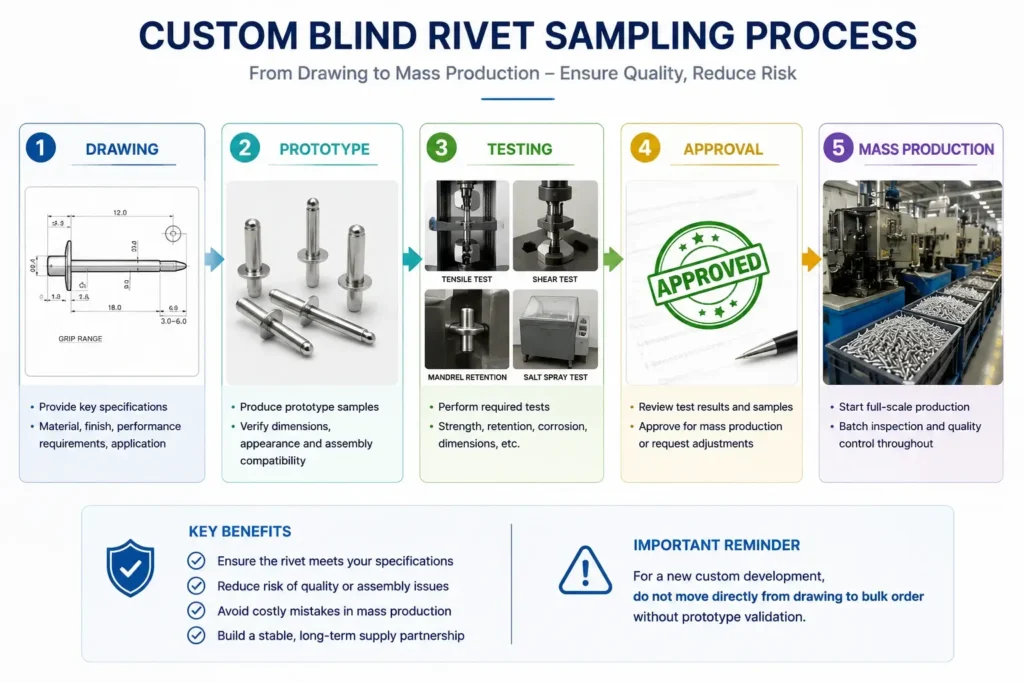
Start With a Drawing or Sample
Provide the supplier with key technical inputs: diameter, length, grip range, head dimensions, body and mandrel materials, surface treatment, application conditions, and required performance.
Request a Prototype Before Mass Production
Drawing → Prototype → Testing → Approval → Mass Production
For a new custom development, do not move directly from a drawing to a bulk order without prototype validation.
Confirm MOQ, Tooling and Quality Before Production
- MOQ — per size, material, finish and design; whether different items can be mixed toward one MOQ
- Tooling — cost, ownership, storage, reuse for future orders, and replacement responsibility
- Quality — dimensional inspection, tensile/shear testing, mandrel retention, coating or surface-treatment verification, salt spray testing where applicable, and batch inspection reports
For details, see our guides on blind rivet quality testing reports and the blind rivet manufacturing process.
Buyer Action: For new custom developments, validate the prototype, confirm tooling ownership, and lock the quality requirements in the PO before bulk production.
5 Common Mistakes When Ordering Custom Blind Rivets
- Customizing without a clear problem. “Custom” itself is not value — it must solve a measurable assembly, performance or procurement problem.
- Comparing only unit price. Ignoring tooling, labor, secondary processing, inventory and scrap hides the real cost.
- Choosing a MOQ that is too large. A MOQ exceeding actual annual demand increases inventory and ties up capital.
- Skipping sample approval. Discovering an incorrect grip range, head dimension or finish after mass production is expensive.
- Not planning repeat orders. Without sustained demand, one-time development cost may never amortize.
How RivetFast Supports Standard and Custom Orders
Here is how these capabilities align with the checks above:
| Buyer Should Verify | RivetFast Capability |
|---|---|
| Standard product availability | Common sizes, materials and head styles |
| Customization capability | Drawing-based customization for dimensions, grip range, head, material and finish |
| Production capacity | 200+ automated machines and annual production capacity of up to 2 billion pieces |
| Quality capability | ISO 9001 quality system and in-house testing |
| Sample / trial process | Available based on product and order requirements |
For the full development workflow, see our custom blind rivets OEM guide.
Conclusion
The decision between standard and custom blind rivets is not about which is better — it is about which solves your problem at the lowest total cost.
Standard if it already works. Semi-custom if a small modification solves the problem. Custom if it creates measurable technical or production value.
Use the five-step framework and compare total cost per usable part — not just unit price — before committing to a custom MOQ.
FAQ
Are custom blind rivets more expensive than standard blind rivets?
- Usually, yes at the unit-price level — custom rivets carry additional development, tooling or setup costs. However, total cost may be lower when customization eliminates secondary processing, reduces scrap, or improves assembly efficiency. Compare total cost per usable part, not just unit price.
What is the typical MOQ for custom blind rivets?
- MOQ for custom blind rivets depends on the rivet size, material, tooling, surface treatment, production process and supplier. MOQ should be confirmed for each specification and supplier rather than relying on a general industry number.
Can I customize a standard blind rivet instead of designing a completely new one?
- In some cases, yes. A semi-custom solution may modify an existing specification, such as length, grip range, head style or surface treatment, without requiring a completely new product design. The supplier should confirm whether existing tooling can be reused.
When should I choose standard blind rivets?
- When the standard specification already meets your dimensional, mechanical and environmental requirements, and you need fast delivery or have low or uncertain annual volume.
When is a custom blind rivet worth the MOQ?
- When it solves a measurable problem: assembly difficulty, secondary processing cost, special performance requirements, or high-volume production efficiency. Evaluate MOQ against annual consumption, not just one purchase order.
Can I request samples before placing a custom production order?
- Sample availability depends on the product and development requirements. Buyers should confirm whether prototypes are available, what testing is required, and how sample approval will be handled before mass production.