Many industrial buyers face MOQ questions when sourcing blind rivets:
- Is the supplier’s MOQ too high for my first order?
- Can I order small quantities for testing?
- Why do custom rivets require higher MOQ?
- How can I reduce inventory risk without sacrificing supply stability?
MOQ — Minimum Order Quantity — is not just about a number on a quote. It reflects production process efficiency, tooling availability, raw material procurement, and supply chain planning. Understanding how MOQ works helps buyers select the right supplier strategy before placing orders, rather than discovering problems after bulk delivery.
On one side, MOQ that is too high ties up capital in inventory and creates shelf-life concerns — particularly for aluminum-steel blind rivets, where long-term storage can affect surface finish and mandrel performance. On the other side, extremely low MOQ can be attractive for first-time buyers, but it should be evaluated together with production capability, quality control systems, and long-term supply reliability.
This guide breaks down MOQ requirements across three order types — standard, custom, and trial — with reference ranges, key influencing factors, negotiation strategies, and a supplier question checklist to help you plan your next procurement.
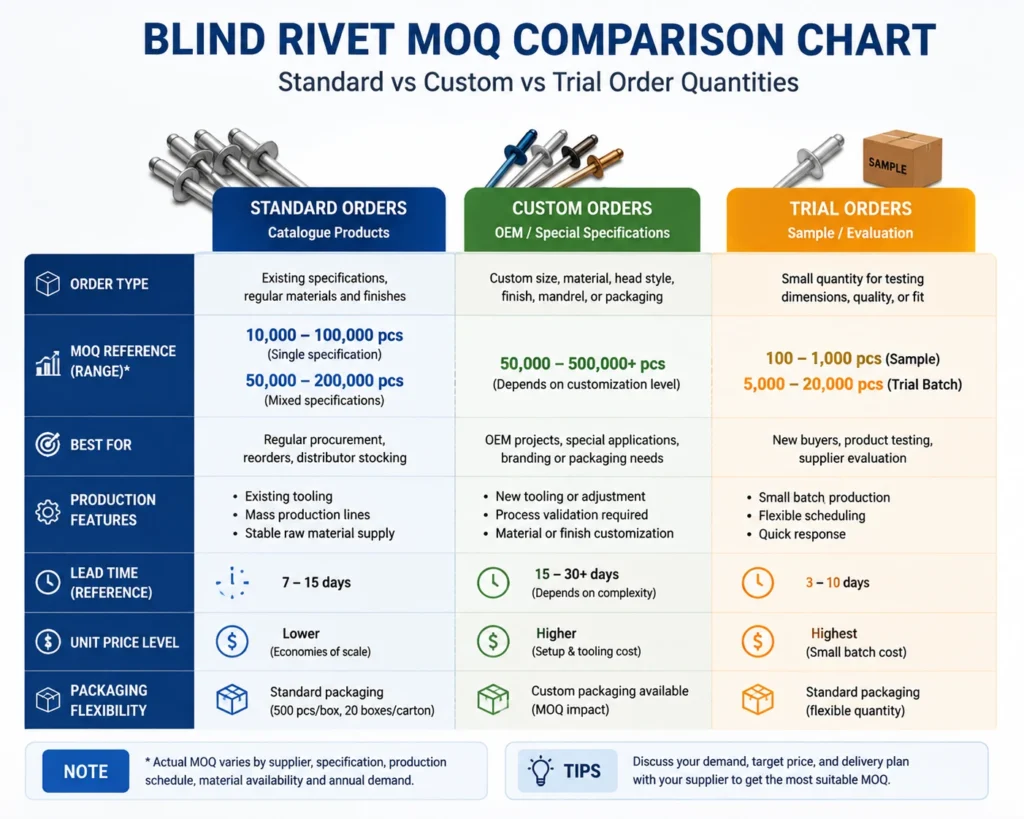
Quick MOQ Reference Table
| Order Type | Common MOQ Reference | Best For |
| Sample | Around 100–1,000 pcs* | Testing dimensions, material, appearance |
| Trial | Around 5,000–20,000 pcs* | Supplier verification before bulk |
| Standard | Around 10,000–100,000 pcs* | Regular procurement, reorders |
| Custom | Around 50,000–500,000 pcs* | OEM projects, special specs |
*Actual MOQ varies by supplier, specification, production schedule, material availability and annual demand. Detailed breakdown in sections below.
What Is MOQ in Blind Rivet Sourcing?
MOQ Definition and Why Suppliers Set MOQ
In B2B fastener sourcing, MOQ is the minimum quantity a supplier will accept for a production order. It is not a retail threshold — it is a production economic batch size. Below this quantity, the cost of machine changeover, tooling setup, and quality inspection becomes disproportionate to the material value, making the unit price unreasonable.
An important distinction: MOQ typically applies per specification (each combination of diameter × length × material combination counts as one specification), not to the total order across multiple specs.
Suppliers set MOQ for three core reasons:
- Changeover cost: Each specification change requires stopping the machine, swapping dies, adjusting parameters, and conducting first-article inspection. For small-batch orders, changeover cost can exceed material cost.
- Raw material procurement: Wire and tube materials are purchased by the ton. Small orders cannot match the supplier’s raw material minimums.
- Quality consistency: Products manufactured in a continuous batch are more dimensionally consistent. Frequent changeovers increase the risk of batch-to-batch variation.
MOQ vs Production Quantity vs Packaging Quantity
Buyers often confuse three related terms. Understanding the difference helps avoid miscommunication during procurement:
| Term | Meaning | Example |
| MOQ | Minimum order quantity the supplier accepts | 10,000 pcs per specification |
| Production quantity | Actual manufacturing batch size (may exceed MOQ) | 50,000 pcs per production run |
| Packaging quantity | Units per box / carton | 500 pcs/box, 20 boxes/carton |
Buyers should also confirm whether the supplier sets a MOV (Minimum Order Value) in addition to MOQ. Some suppliers apply both. For high-unit-price specifications (e.g., all-stainless steel), the MOQ may be lower than for low-unit-price specifications (e.g., aluminum-steel), because the value threshold is reached with fewer pieces.
Standard Blind Rivet MOQ
Common MOQ Ranges for Standard Sizes
Standard blind rivets — catalogue products with common diameters (2.4mm–6.4mm), standard material combinations, and no custom tooling — carry the lowest MOQ in the industry:
| Order Type | Common MOQ Reference | Best For |
| Standard sizes (single spec) | Around 10,000 – 100,000 pcs* | Regular procurement, reorders |
| Standard sizes (mixed specs) | Around 50,000 – 200,000 pcs total* | Distributors stocking multiple sizes |
| Standard sizes (full container) | Around 500,000+ pcs* | Large distributors, annual contracts |
*Actual MOQ varies by supplier, specification, production schedule, material availability and annual demand. Always confirm MOQ with the supplier before placing an order.
Why Standard Sizes Have Lower MOQ and Shorter Lead Time
Three factors keep standard rivet MOQ low:
- Stocked raw materials: Wire and tube for standard diameters (2.4–6.4mm) are regularly stocked — no special procurement needed.
- Universal tooling: Standard diameters use existing dies. No custom mold development required.
- Frequent production scheduling: Standard specs run frequently on production lines, allowing batch consolidation (multiple orders for the same spec produced in one run), which reduces per-order changeover cost.
Typical lead time for standard rivets: 7–15 working days at MOQ level; 15–25 working days for medium-to-large volumes exceeding MOQ. Batch consolidation (multiple standard specs produced in one scheduling window) may shorten lead time but requires coordination with the supplier.
For the complete range of standard diameters and specifications, see our Blind Rivet Size Chart.
MOQ Differences Between Buyer Types
MOQ logic varies depending on who is placing the order. RivetFast serves both industrial OEM factories and distribution partners — each with different ordering patterns:
| Buyer Type | Typical Ordering Pattern | MOQ Consideration |
| Industrial OEM | Repeat purchase, fixed specifications, scheduled deliveries | Stable MOQ; annual contract may lower unit price |
| Distributor | Multiple sizes, mixed-spec orders, stock replenishment | Total quantity MOQ across specs; flexible per-spec minimum |
| New buyer | Trial + evaluation orders before commitment | Sample/trial MOQ first, then standard MOQ after approval |
Understanding your buyer type helps determine which MOQ negotiation strategy will be most effective — and which supplier is best suited to your ordering pattern.
Custom Blind Rivet MOQ
Common MOQ Ranges for Custom Specifications
Custom blind rivets — non-standard dimensions, special materials, unique head styles, or OEM packaging — require higher MOQ because of tooling, material procurement, and setup costs:
| Customization Level | Common MOQ Reference | What’s Included |
| Standard size + custom material | Around 50,000 – 100,000 pcs* | Non-standard material combination (e.g., Monel/steel) |
| Custom size (non-standard dia/length) | Around 100,000 – 200,000 pcs* | Non-standard diameter or length requiring custom tooling |
| Custom head style / structural type | Around 100,000 – 300,000 pcs* | Countersunk, large flange, structural variants |
| Full OEM (custom + packaging + labeling) | Around 200,000 – 500,000 pcs* | Custom spec + custom packaging + brand labeling |
*Actual MOQ varies by supplier, specification, production schedule, material availability and annual demand. Always confirm with the supplier based on your specific drawings.
How to Reduce Custom Blind Rivet MOQ
If the standard custom MOQ feels high, four practical strategies can help bring it down:
- Use existing head styles: Choose from the supplier’s existing head styles (dome, countersunk, large flange) rather than designing a new one. This avoids new mold development entirely.
- Select standard materials: Aluminum/steel and aluminum/stainless steel are commonly stocked material combinations. Special alloys (Monel, copper) require dedicated raw material procurement, which pushes MOQ higher.
- Consolidate orders: If you need multiple custom specifications, combine them into one order. When the total quantity meets the threshold, the supplier can arrange continuous production scheduling.
- Simplify packaging customization: OEM labeling and retail packaging have their own minimums. Standard bulk packaging with in-house labeling can significantly lower the entry barrier.
For the complete custom development process — from drawing review to sample approval to mold development to bulk production — see our Custom Blind Rivets OEM Guide.
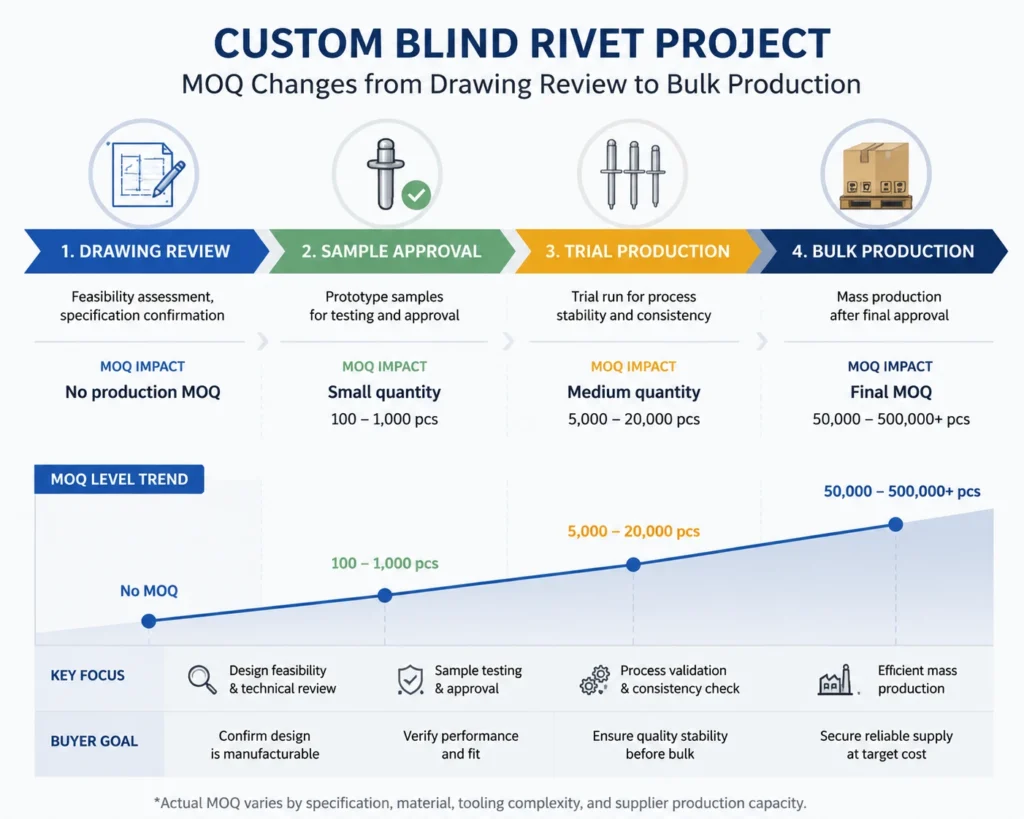
How MOQ Changes During Custom Projects
Custom rivet MOQ is not a single number agreed upfront. It evolves through project stages:
| Stage | MOQ Impact |
| Drawing review & feasibility | No production MOQ — technical communication phase |
| Sample approval | Small quantity (around 100–1,000 pcs) |
| Trial production | Medium quantity (around 5,000–20,000 pcs) |
| Bulk production | Final MOQ per customization level (see table above) |
This staged approach allows both parties to validate feasibility before committing to production-scale MOQ. Detailed development workflows — tooling design, sample iteration, pilot production validation — are covered in the Custom Blind Rivets OEM Guide.
Trial Orders and Sample Orders
Trial orders are not only product verification — they are also supplier performance verification. For buyers sourcing blind rivets from a new supplier — especially overseas — sample and trial orders reduce risk before committing to bulk quantities.
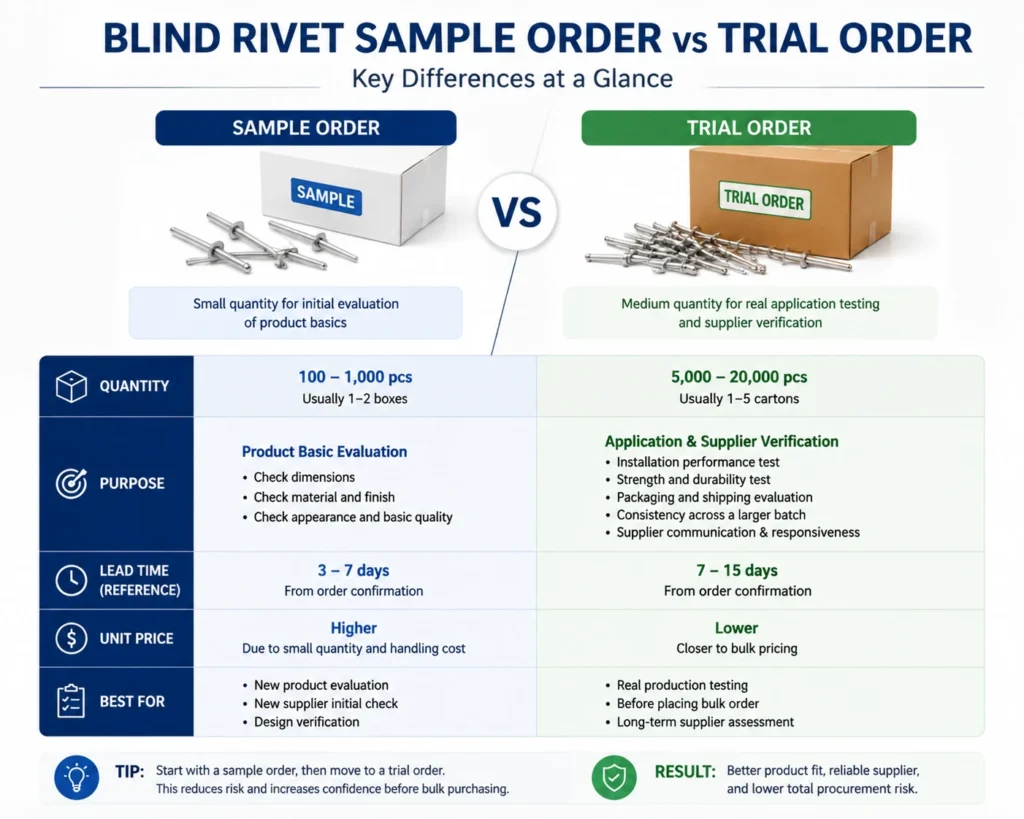
Sample Orders vs Trial Orders: Key Differences
| Sample Order | Trial Order | |
| Quantity | Around 100 – 1,000 pcs* | Around 5,000 – 20,000 pcs* |
| Purpose | Verify dimensions, material, appearance | Verify batch consistency, production capability |
| Cost | Free or cost-price (shipping may apply) | Standard unit price (no volume discount) |
| Lead Time | 3–7 days (standard) / 10–15 days (custom) | 7–15 days (standard) / 15–25 days (custom) |
| When to Use | Before first order, or when changing supplier | Before bulk order, or when switching from sample to production |
*Typical ranges, actual depends on supplier and specification.
What to Test Before Bulk Ordering
A sample or trial order only has value if you know what to verify. Use this 5-point checklist:
- ✓ Dimensions — Measure diameter, length, and grip range across 20–50 pieces. Confirm consistency against specification.
- ✓ Material — Verify the material combination (e.g., aluminum body / steel mandrel) using a spectrometer or supplier-provided material certificate.
- ✓ Strength — Conduct pull/tensile testing to confirm the rivet achieves the required joint strength for your application.
- ✓ Surface finish — Inspect coating appearance, uniformity, and adhesion. For zinc-plated or Dacromet-coated rivets, verify no visible defects.
- ✓ Packaging — Confirm packaging meets specifications, labels are legible, and quantities per box match the agreement.
Beyond product quality, a trial order also verifies four supplier performance dimensions:
- Delivery accuracy — Was the promised 10-day lead time met? If delayed, was the explanation reasonable and communicated proactively?
- Batch consistency — Sample 50–100 pcs from the trial batch. Are diameter, length, and grip range consistent across the sample?
- Packaging compliance — Is packaging executed as agreed? Are labels and markings clear and accurate?
- Communication responsiveness — How quickly does the supplier respond to production issues or post-delivery questions?
For a comprehensive supplier verification framework — including production capacity audit, quality system documentation, and trial order stress testing — see our guide on How to Verify a Blind Rivet Manufacturer’s Production Capacity.
MOQ Comparison Summary & Key Factors
Standard vs Custom vs Trial MOQ Comparison
| Order Type | Common MOQ Reference | Best For | Key Consideration |
| Standard rivets | Around 10,000 – 100,000 pcs* | Regular purchasing, reorders | Lowest MOQ, fastest lead time |
| Custom rivets | Around 50,000 – 500,000 pcs* | OEM projects, special specs | Tooling cost amortized over volume |
| Trial orders | Around 5,000 – 20,000 pcs* | New suppliers, quality testing | No volume discount, verify before bulk |
| Sample orders | Around 100 – 1,000 pcs* | Dimension/material confirmation | May be free (shipping applies) |
*Actual MOQ varies by supplier, specification, production schedule, material availability and annual demand.
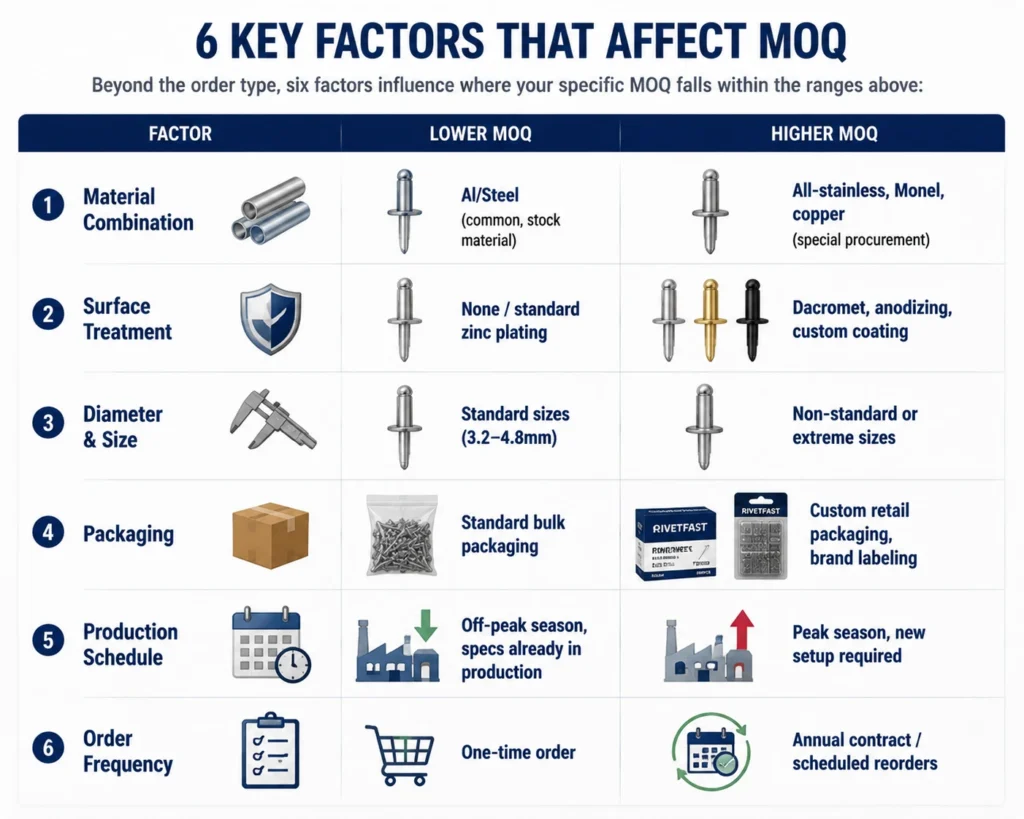
6 Key Factors That Affect MOQ
Beyond the order type, six factors influence where your specific MOQ falls within the ranges above:
| Factor | Lower MOQ | Higher MOQ |
| Material combination | Al/Steel (common, stock material) | All-stainless, Monel, copper (special procurement) |
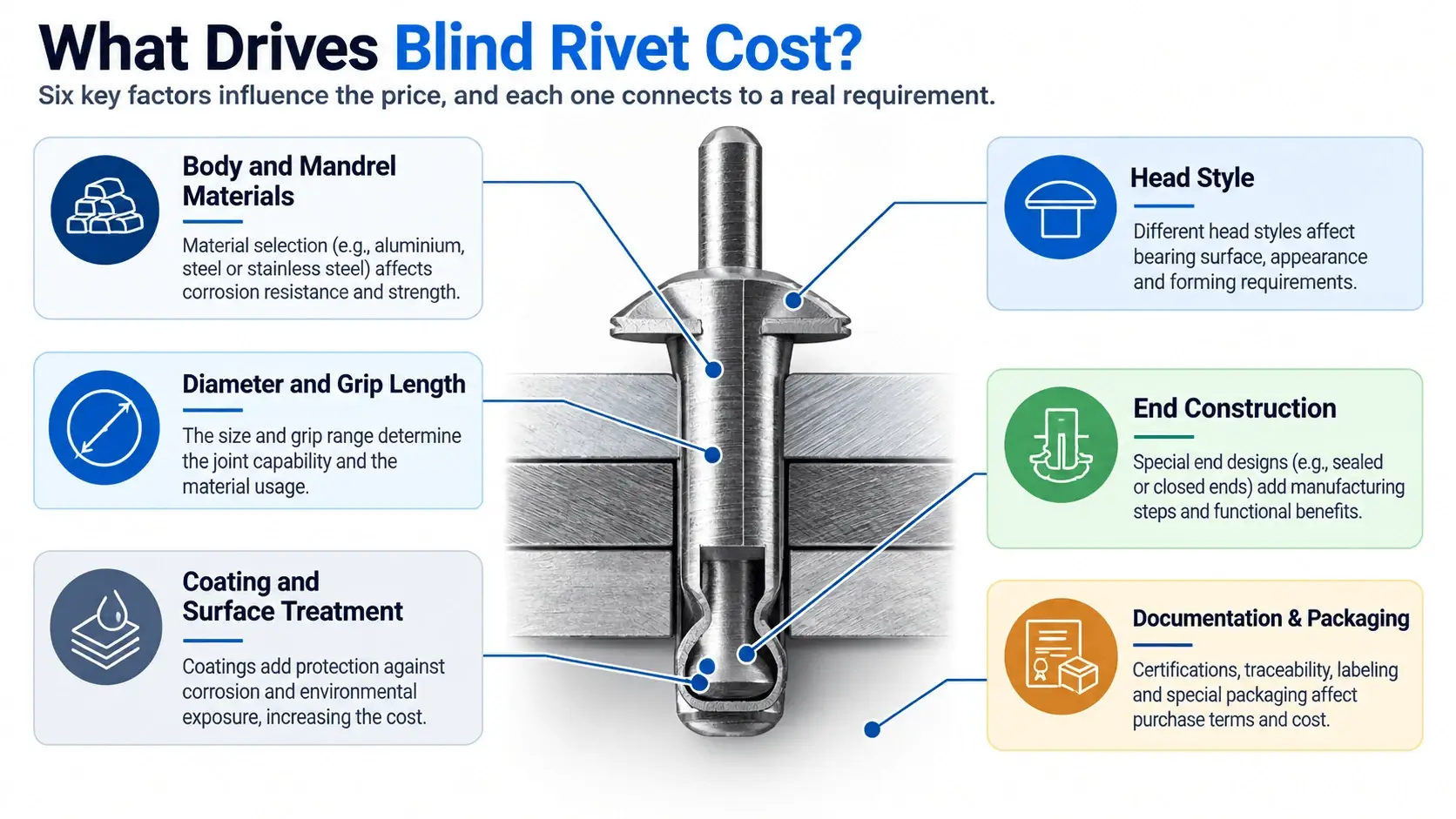
| Surface treatment | None / standard zinc plating | Dacromet, anodizing, custom coating |
| Diameter & size | Standard sizes (3.2–4.8mm) | Non-standard or extreme sizes |
| Packaging | Standard bulk packaging | Custom retail packaging, brand labeling |
| Production schedule | Off-peak season, specs already in production | Peak season, new setup required |
| Order frequency | One-time order | Annual contract / scheduled reorders |
For material combination details, see Aluminum vs Steel vs Stainless Steel Blind Rivets. For surface treatment options, see Blind Rivet Surface Finishes & Coatings.
Quick MOQ Self-Assessment:
- Is it a standard size (2.4–6.4mm)? → Standard MOQ range
- Is the material Al/Steel? → Lower end of range
- Is the surface treatment standard? → Lower end of range
- Is packaging standard bulk? → Lower end of range
- Any “No” → MOQ moves to higher end or custom range
This self-assessment helps form realistic expectations before sending an inquiry, avoiding surprises when the quote comes back.
MOQ and Pricing: Understanding the Trade-off
How MOQ Affects Unit Price
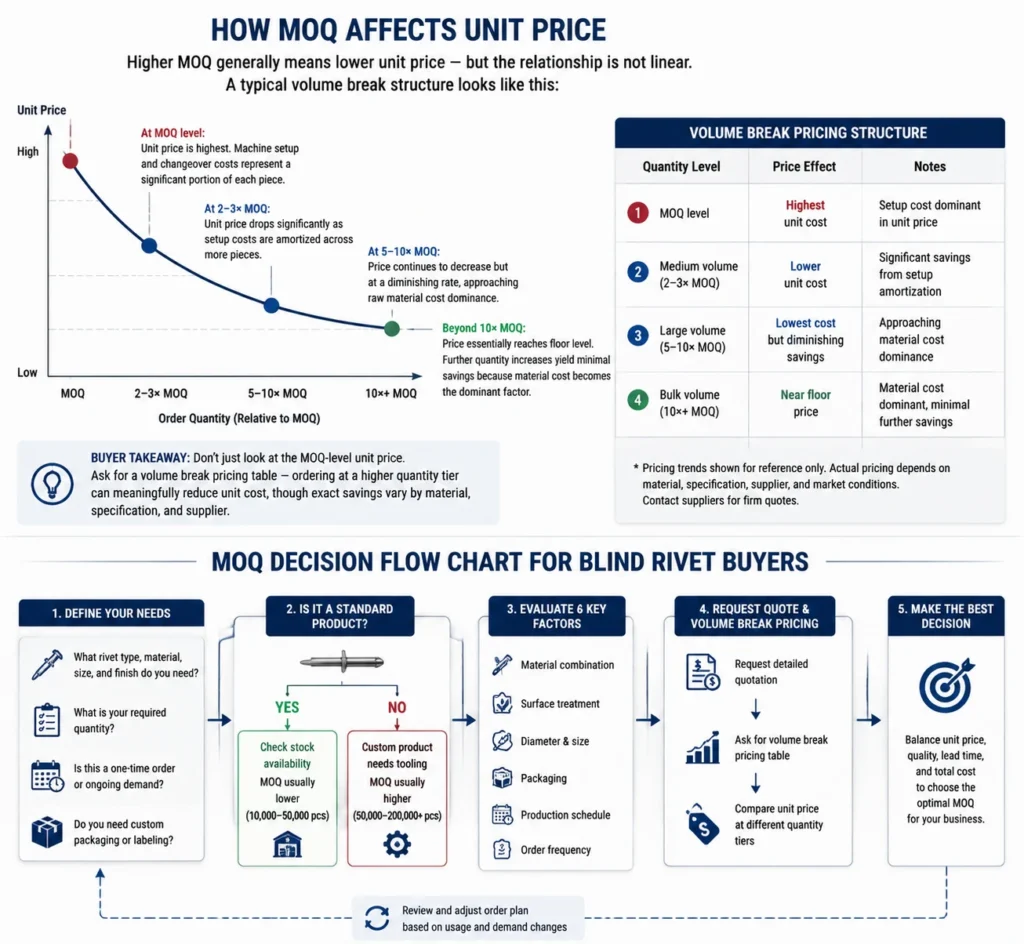
Higher MOQ generally means lower unit price — but the relationship is not linear. A typical volume break structure looks like this:
- At MOQ level: Unit price is highest. Machine setup and changeover costs represent a significant portion of each piece.
- At 2–3× MOQ: Unit price drops significantly as setup costs are amortized across more pieces.
- At 5–10× MOQ: Price continues to decrease but at a diminishing rate, approaching raw material cost dominance.
- Beyond 10× MOQ: Price essentially reaches floor level. Further quantity increases yield minimal savings because material cost becomes the dominant factor.
Buyer takeaway: Don’t just look at the MOQ-level unit price. Ask for a volume break pricing table — ordering at a higher quantity tier can meaningfully reduce unit cost, though exact savings vary by material, specification, and supplier.
Volume Break Pricing Structure
| Quantity Level | Price Effect | Notes |
| MOQ level | Highest unit cost | Setup cost dominant in unit price |
| Medium volume (2–3× MOQ) | Lower unit cost | Significant savings from setup amortization |
| Large volume (5–10× MOQ) | Lowest cost but diminishing savings | Approaching material cost dominance |
| Bulk volume (10×+ MOQ) | Near floor price | Material cost dominant, minimal further savings |
*Pricing trends shown for reference only. Actual pricing depends on material, specification, supplier, and market conditions. Contact suppliers for firm quotes.
MOQ Negotiation & Supplier Questions
How to Negotiate MOQ Without Sacrificing Quality
Five legitimate strategies for negotiating MOQ with blind rivet suppliers:
- Combine specifications: Multiple standard specs in one order — total quantity meets the threshold while individual spec quantities stay manageable. The supplier can arrange continuous production scheduling.
- Commit to an annual procurement plan: Provide a 12-month demand forecast. Suppliers may lower the first-order MOQ when they can see recurring demand.
- Accept longer lead time: If delivery is not urgent, ask to schedule the order during the supplier’s off-peak period in exchange for a lower MOQ.
- Start with a trial order: Place a trial quantity (5,000–20,000 pcs) first. After confirming quality, commit to a bulk order at standard MOQ.
- Split deliveries: Keep the MOQ unchanged but request 2–3 partial shipments. This reduces warehouse pressure while maintaining the supplier’s production economics.
⚠ Important: Extremely low MOQ can be attractive for first-time buyers, but it should be evaluated together with production capability, quality control systems, and long-term supply reliability. For more on identifying supplier warning signs, see 5 Red Flags When Sourcing Blind Rivets.
Questions to Ask Suppliers About MOQ
Before placing an order, confirm these key questions:
Standard Products
- What is your MOQ for catalogue rivets?
- Can you support trial orders or sample quantities?
- Do you offer volume break pricing? At what quantities?
Custom Products
- Is new tooling required for my specification?
- What MOQ is needed after sample approval?
- Can existing tooling or materials be used to reduce MOQ?
Production & Supply
- What is your monthly production capacity?
- How long is lead time for standard vs custom orders?
- Can you provide inspection reports per batch?
When Higher MOQ Makes Sense & RivetFast MOQ Approach
In three situations, accepting a higher MOQ is economically rational:
- Long-term stable demand: When annual usage is predictable, a single higher-MOQ order locks in a lower unit price and reduces reorder frequency.
- Custom specifications: Tooling cost is fixed regardless of quantity. Higher MOQ means lower per-piece tooling cost amortization.
- High shipping cost ratio: For overseas buyers, small-quantity air freight vs large-quantity sea freight — the total landed cost of a larger sea-freight order may be lower despite higher inventory.
For a complete decision framework on when standard vs custom makes economic sense, see Standard vs Custom Blind Rivets.
RivetFast MOQ Approach
Because RivetFast focuses on manufacturing rather than trading, MOQ recommendations are based on production efficiency, material availability and customer demand — allowing buyers to receive recommendations based on actual production efficiency rather than trading limitations.
RivetFast offers flexible MOQ options across three order types:
- Standard sizes: Low MOQ starting from around 10,000 pcs per specification, covering the full range of standard diameters (2.4–6.4mm) and common material combinations (Al/Steel, Al/Stainless, All-Stainless).
- Custom specifications: MOQ based on customization level — from custom material combinations (around 50,000 pcs) to full OEM with custom packaging (around 200,000+ pcs). Drawing review and sample development are available before committing to production MOQ.
- Trial orders: 5,000–20,000 pcs available for new customers to verify quality and batch consistency before bulk commitment.
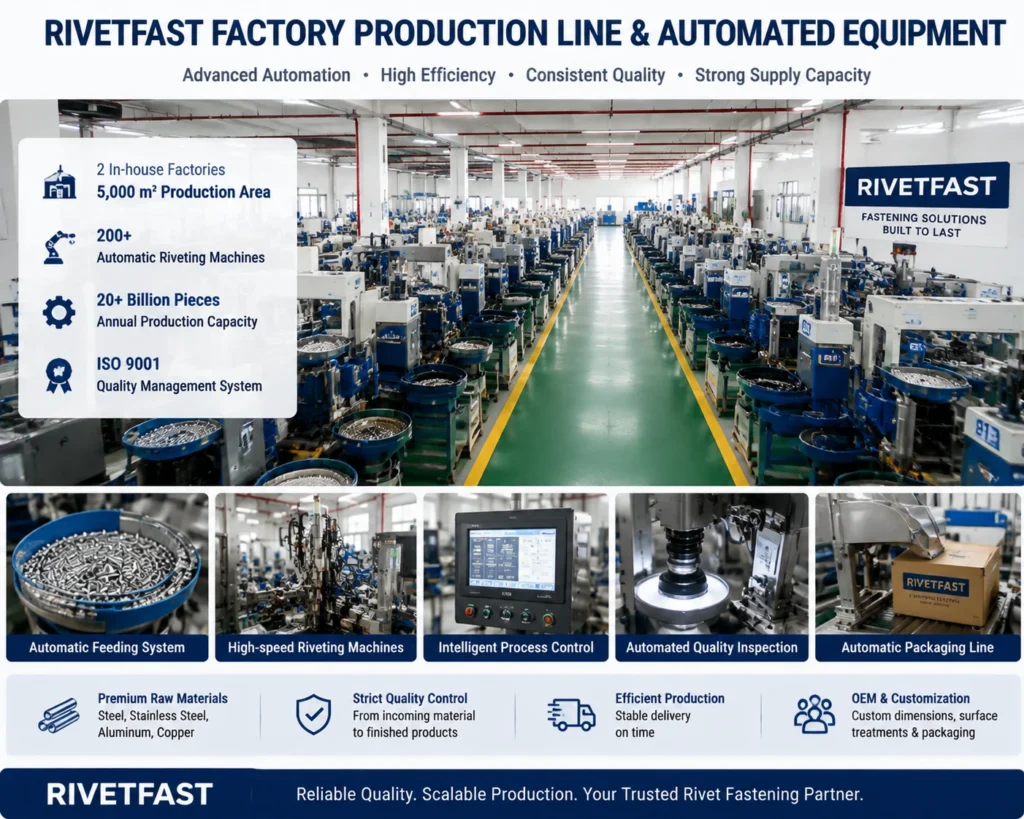
Supported by 200+ production machines and a 5,000㎡ manufacturing facility with an annual capacity of 2 billion pieces, RivetFast provides stable batch production for both standard and custom orders. Production follows ISO 9001 quality management, with inspection reports available per batch.
Common MOQ Mistakes to Avoid
Mistake 1: Choosing Suppliers Only by Lowest MOQ
An unusually low MOQ is not inherently a red flag — many quality manufacturers support sample and trial orders. But extremely low MOQ should be evaluated together with production capability, quality control systems, and long-term supply reliability. Evaluate the supplier’s actual production scale, quality inspection capability, and batch consistency alongside the MOQ number. For a comprehensive supplier risk assessment framework, see 5 Red Flags When Sourcing Blind Rivets.
Mistake 2: Ignoring Total Procurement Cost
MOQ is only one component of cost. Total procurement cost = product price + shipping + inventory holding cost + quality risk cost. A low-MOQ supplier with high unit price and air-freight-only shipping may cost more than a higher-MOQ supplier with lower unit price and sea freight options. Always calculate total landed cost, not just unit price. For Southeast Asian buyers, see our Blind Rivet Sourcing Guide for Southeast Asian Buyers for a landed cost calculation framework that includes MOQ factors.
Mistake 3: Ordering Custom Rivets Without Sample Approval
Once custom specifications enter bulk production, modification costs are extremely high — retooling, machine readjustment, and scrapped material. Skipping the sample approval stage and going directly to a large custom order risks an entire batch being unusable if dimensions or performance don’t match expectations. Always follow the four-stage process: Drawing Review → Sample → Trial → Bulk.
Conclusion
Blind rivet MOQ is not a single number — it depends on order type (standard, custom, trial), specification details (material, size, surface treatment, packaging), supplier production capacity, and your procurement pattern. Use the self-assessment framework and reference tables in this guide to form realistic expectations before inquiry. Confirm MOQ, MOV, volume break pricing, trial order options, and the supplier’s production capacity — and avoid the three common mistakes of chasing the lowest MOQ, ignoring total cost, and skipping sample approval for custom orders.
FAQ
Q1: What is the typical MOQ for standard blind rivets?
Typical MOQ for standard blind rivet sizes (2.4mm–6.4mm diameter, standard material combinations like Al/Steel) ranges from around 10,000 to 100,000 pieces per specification. Standard sizes have lower MOQ because raw materials are in regular stock and tooling is universal. Actual MOQ varies by supplier, specification, production schedule, material availability and annual demand. For mixed-spec orders (multiple sizes in one order), the total quantity MOQ may be higher but individual spec MOQ can be lower.
Q2: What is the MOQ for custom blind rivets?
Custom blind rivet MOQ varies by customization level. Custom material combinations typically require around 50,000–100,000 pcs, custom sizes (non-standard diameter or length) require around 100,000–200,000 pcs, and full OEM with custom packaging and labeling may require around 200,000–500,000 pcs. The higher MOQ covers tooling costs, special raw material procurement, and setup time. Sample development (100–1,000 pcs) is usually available before committing to production MOQ. Actual MOQ varies by supplier and specific requirements.
Q3: Can I order a sample or trial quantity before bulk?
Yes. Most blind rivet manufacturers offer two pre-bulk options. Sample orders (100–1,000 pcs) verify dimensions, material, and appearance — standard samples may be free (shipping applies), custom samples may incur a fee. Trial orders (5,000–20,000 pcs) verify batch consistency and production capability at a standard unit price without volume discount. A trial order is often the most practical bridge between supplier evaluation and full-scale procurement.
Q4: How does MOQ affect blind rivet unit price?
Higher MOQ generally means lower unit price, but with diminishing returns. At MOQ level, setup and tooling costs are a significant portion of the unit price. At 2–3 times MOQ, unit price typically drops significantly as setup costs are amortized. Beyond 5–10 times MOQ, price reductions become marginal as material cost dominates. Always request a volume break pricing table from the supplier to find the optimal order quantity.
Q5: Can blind rivet MOQ be reduced for first orders?
Yes. For first orders, several approaches can help reduce the effective MOQ: start with a sample order (100–1,000 pcs) to verify specifications, then place a trial order (5,000–20,000 pcs) before committing to standard or custom MOQ. For custom specifications, choosing existing head styles, standard material combinations, and simplified packaging can lower the entry quantity. Some suppliers also accept lower first-order MOQ when backed by an annual procurement plan. Always discuss first-order flexibility with the supplier before finalizing specifications.
Q6: What information should I provide when inquiring about MOQ?
To get an accurate MOQ and pricing response, include: rivet diameter and length (or grip range), material combination (e.g., Al/Steel, Al/Stainless, All-Stainless), surface treatment (if any), head style (dome, countersunk, large flange), packaging requirements (bulk or custom), target quantity, and whether this is a one-time order or recurring procurement. The more specific your inquiry, the more accurate the MOQ and pricing will be.