Does the same blind rivet behave the same way in a dry indoor cabinet and on equipment a salt breeze reaches? Usually not — and the rivet alone rarely explains the difference.
A blind rivet does not corrode simply because of what it is made of. It corrodes because of what it touches, what reaches it, and the environment around the joint.
What follows is a compatibility judgement for galvanic corrosion in blind rivet joints: which combinations raise concern, where the attack starts, which measures reduce it, and what to verify before you specify.
Why Do Blind Rivet Joints Corrode?
Three things have to be present before galvanic corrosion can proceed. Two metals, one electrolyte and a path between them. Remove any one of the three and the couple is not active.
A riveted joint lines all three up without trying. Body and sheets are often different metals. The hole and the sheet interface hold moisture where it drains slowly. And the rivet can contain a second dissimilar-metal combination inside itself.
Where the joint lives decides how much develops. In a dry, humidity-controlled interior the couple stays close to idle. Persistent damp, salt-carrying air, industrial contamination and wash-down all raise the risk. The test is what the joint goes through, not where it sits.
One distinction comes before everything else: speed and direction are separate questions. The environment affects the rate. The couple decides the direction.
Where corrosion is one suspect among several, the guide to the common causes of blind rivet failure covers the wider diagnosis.
Which Metal Combinations Are Most at Risk?
The same pairing can read differently in two places: quiet in a mild interior, a main concern under wet exposure.
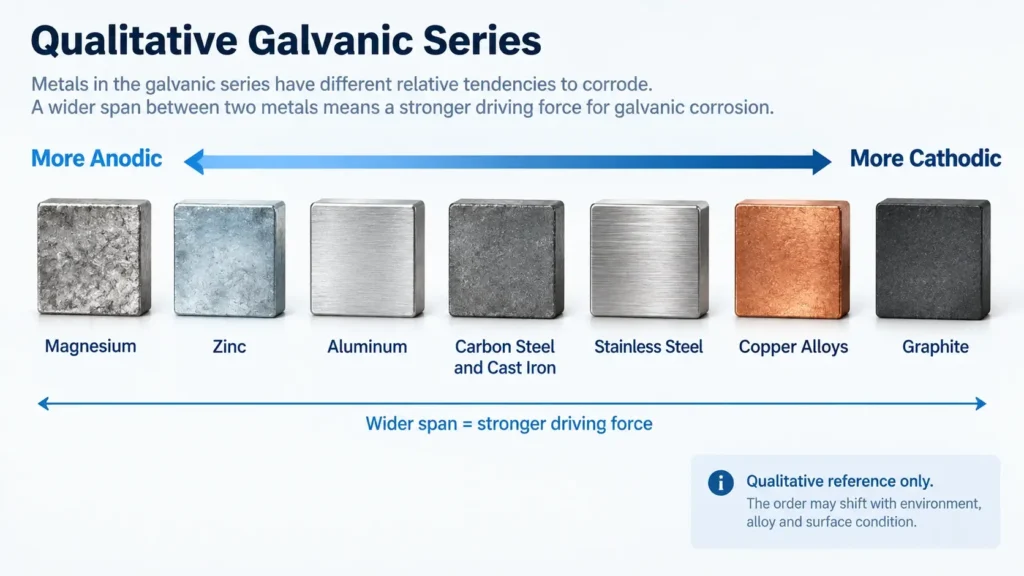
Aluminum is frequently the anodic side in common dissimilar-metal joints. Stainless steel can act as the more cathodic member in a wet aluminum joint, and attack can concentrate in the aluminum around the contact. Zinc-coated steel behaves differently from bare steel because zinc sits near aluminum in the galvanic series and the coating changes which metal is exposed; once the coating is damaged or consumed, the underlying steel becomes exposed.
Table 1 — Common Rivet and Sheet Combinations
| Rivet body | Sheet material | Likely anodic side | Conditions that raise concern |
|---|---|---|---|
| Aluminum | Aluminum | None between these two metals | Retained electrolyte and crevices |
| Aluminum | Zinc-coated steel | Depends on the coating condition | Coating consumed or damaged |
| Aluminum | Stainless steel | The aluminum side | Wet, salt or chemical exposure |
| Zinc-coated steel | Steel | The zinc coating initially | Coating damage and cut edges |
| Stainless steel | Aluminum | The aluminum side | Thin sheet, wet exposure |
| Stainless steel | Stainless steel | None between these two metals | Stagnant moisture in crevices |
The anodic side is the metal that is more susceptible to attack; its location in the joint depends on which component uses that material.
Material compatibility is an environment question, not a chart lookup. Adding stainless steel does not remove the couple. It changes which side of it is attacked.
Where the combination goes into a specification, how to read a blind rivet datasheet covers the fields to check.
Where Does Galvanic Corrosion Start in a Riveted Joint?
Galvanic corrosion in a riveted joint can start where it cannot be seen.
Table 2 — Where the Attack Starts
| Starting point | Why it starts there | Where it becomes visible | What addresses it |
|---|---|---|---|
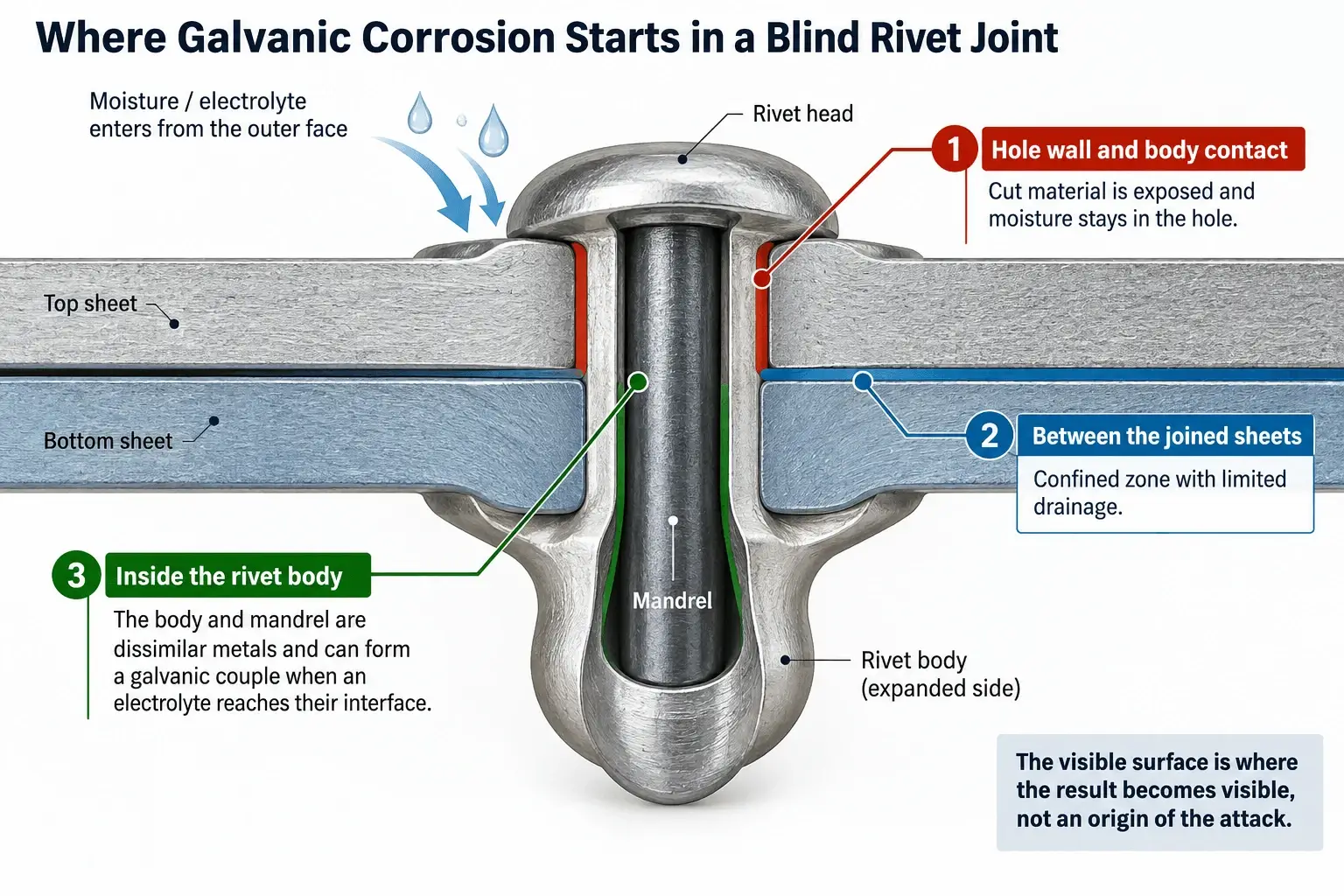
| Hole wall and body contact | Cut material is exposed; moisture stays | Inside the hole, out of sight | Hole preparation and isolation |
| Between the joined sheets | Confined zone with limited drainage | Along the interface, at the edge | Sealing the interface and joint design |
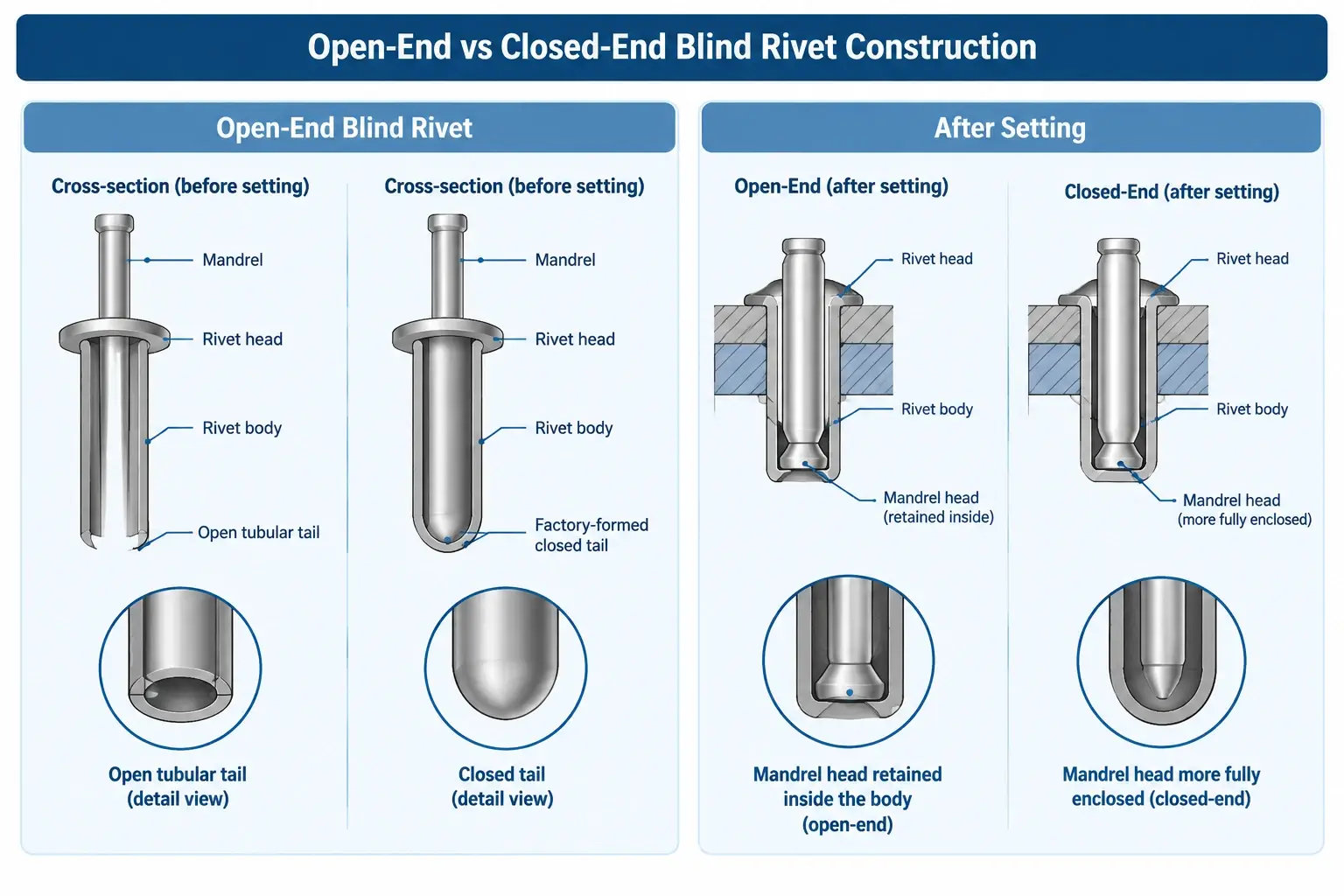
| Inside the rivet body | The body and mandrel are already dissimilar | Between body and mandrel | End construction and sealing |
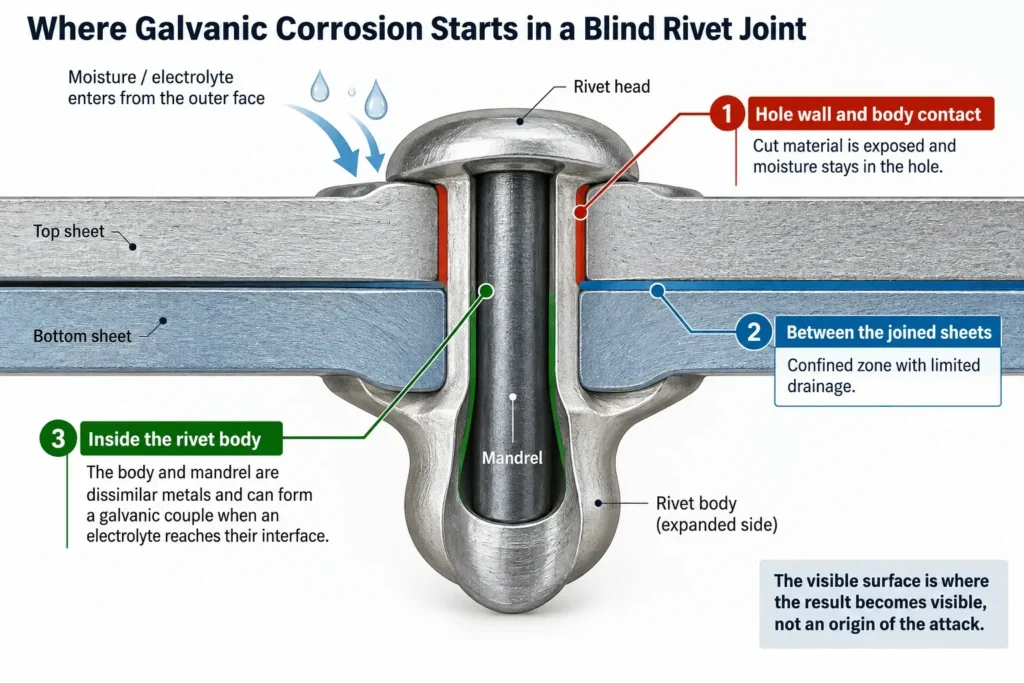
The visible surface around the head is not a fourth starting point — it is where the result becomes visible.
In a riveted joint, three starting points matter. The hole wall, where machining leaves base material exposed and moisture settles. The interface between the joined sheets, a confined gap with limited drainage. And the rivet interior. The rivet is already a dissimilar metal combination before it touches the joint. The body and mandrel can form an internal galvanic couple when an electrolyte reaches their interface; whether that happens depends on the end construction and on what sealing keeps out.
These locations cannot be inspected from outside, they hold moisture longer than a face that dries, and the section loss lands on load-carrying geometry — the hole wall and the sheet thickness.
Where the hole side of this is decided, our guide to blind rivet hole size covers the fit.
How Do You Prevent Galvanic Corrosion in a Riveted Joint?
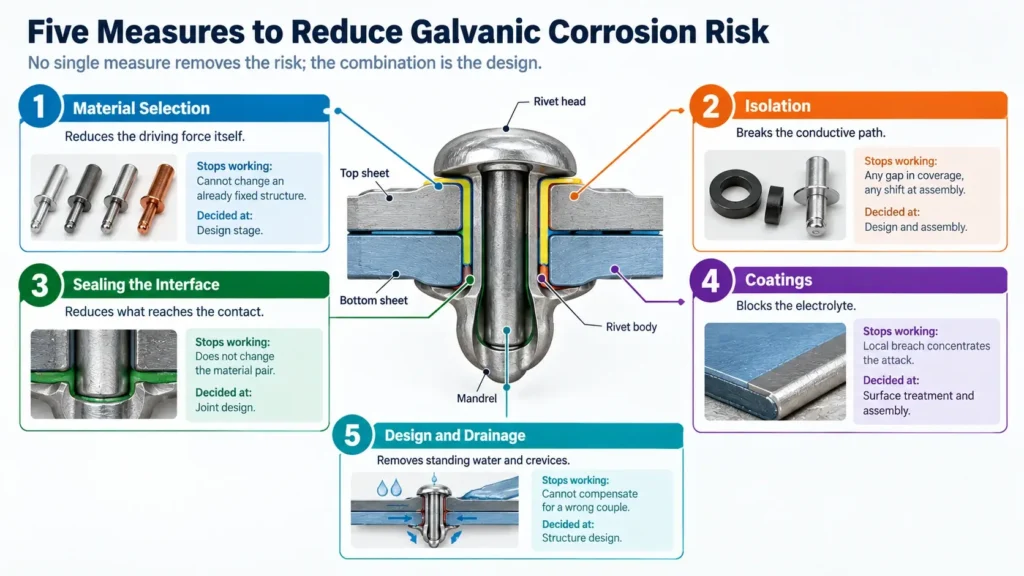
Preventing galvanic corrosion in blind rivet joints is a stack of choices, each aimed at one of the three conditions above. No single measure removes the risk; the combination is the design. The five measures:
Table 3 — Measures and Their Limits
| Measure | What it does | Where it stops working | Decided at |
|---|---|---|---|
| Material selection | Reduces the driving force itself | Cannot change an already fixed structure | Design stage |
| Isolation | Breaks the conductive path | Any gap in coverage, any shift at assembly | Design and assembly |
| Sealing the interface | Reduces what reaches the contact | Does not change the material pair | Joint design |
| Coatings | Blocks the electrolyte | Local breach concentrates the attack | Surface treatment and assembly |
| Design and drainage | Removes standing water and crevices | Cannot compensate for a wrong couple | Structure design |
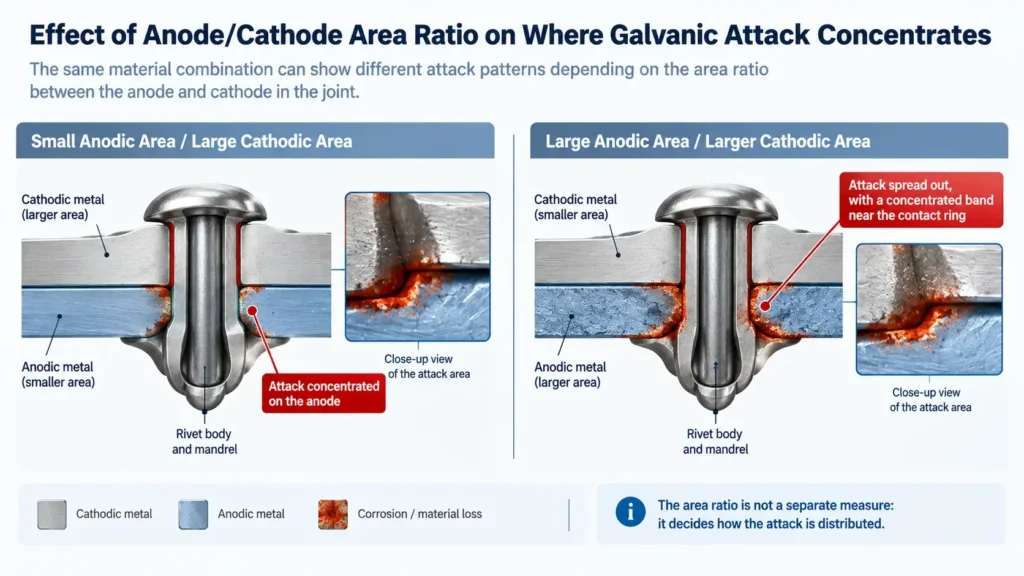
The area ratio is not a separate measure: it decides how the attack is distributed.
Material selection can reduce the galvanic driving force between the materials. Isolation with non-metallic washers, sleeves or tapes breaks the conductive path — but only where coverage is complete and nothing shifts at assembly. Sealing the interface and coatings limit how much of the electrolyte reaches the contact; a coating is only as good as its continuity, because a local breach on the anodic side concentrates the attack. Design and drainage keep water moving.
A small anodic face against a large cathodic one concentrates the attack, and riveted sheets are usually thin — the loss gathers in a ring around the contact, a large share of a thin local cross-section. Moving the fastener to the cathodic side is therefore not automatically better for the joint: attack may concentrate in the surrounding anodic sheet.
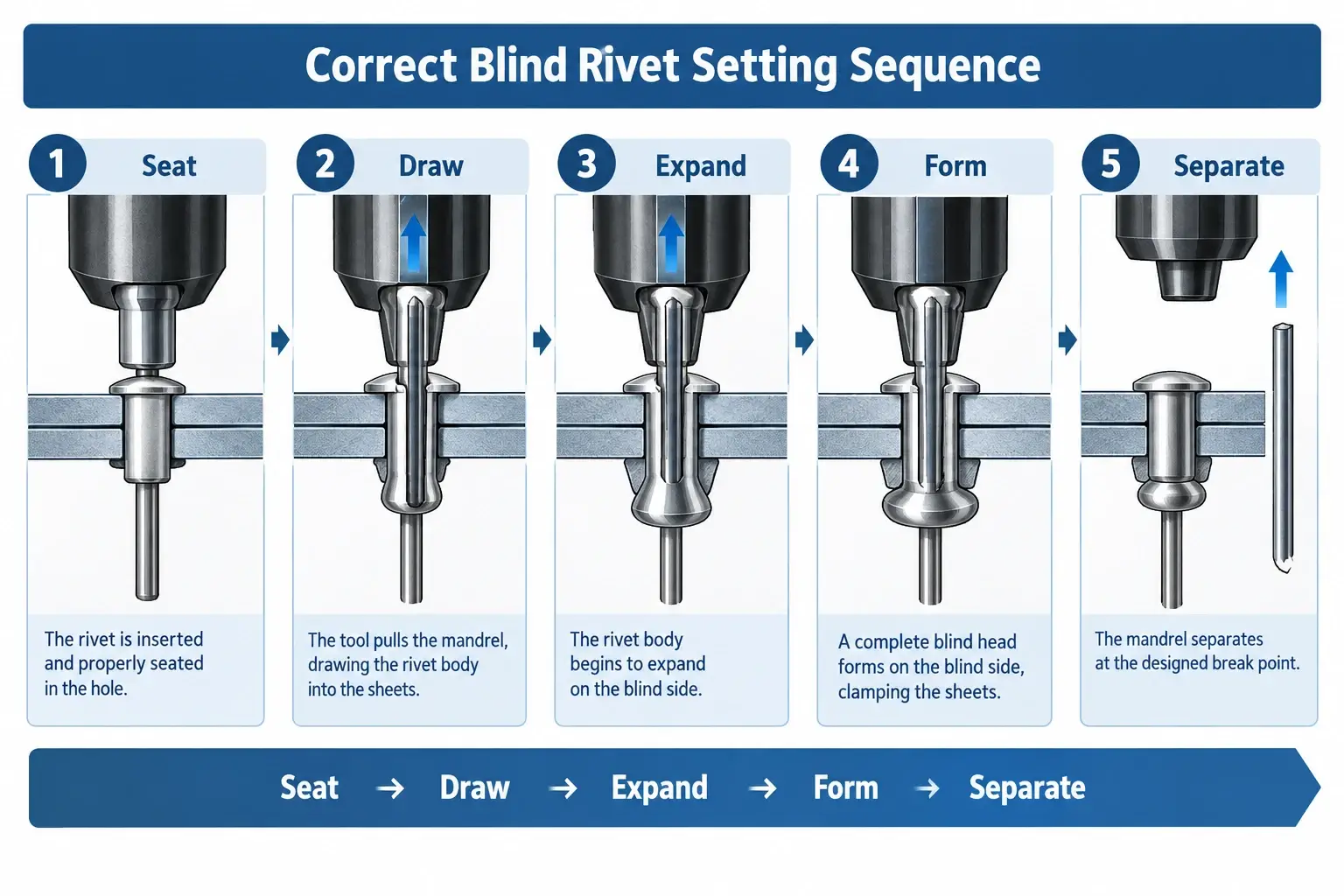
Where assembly decides whether isolation stays put, our guide to blind rivet setting problems covers what goes wrong.
Does a Sealed or Coated Rivet Stop Galvanic Corrosion?
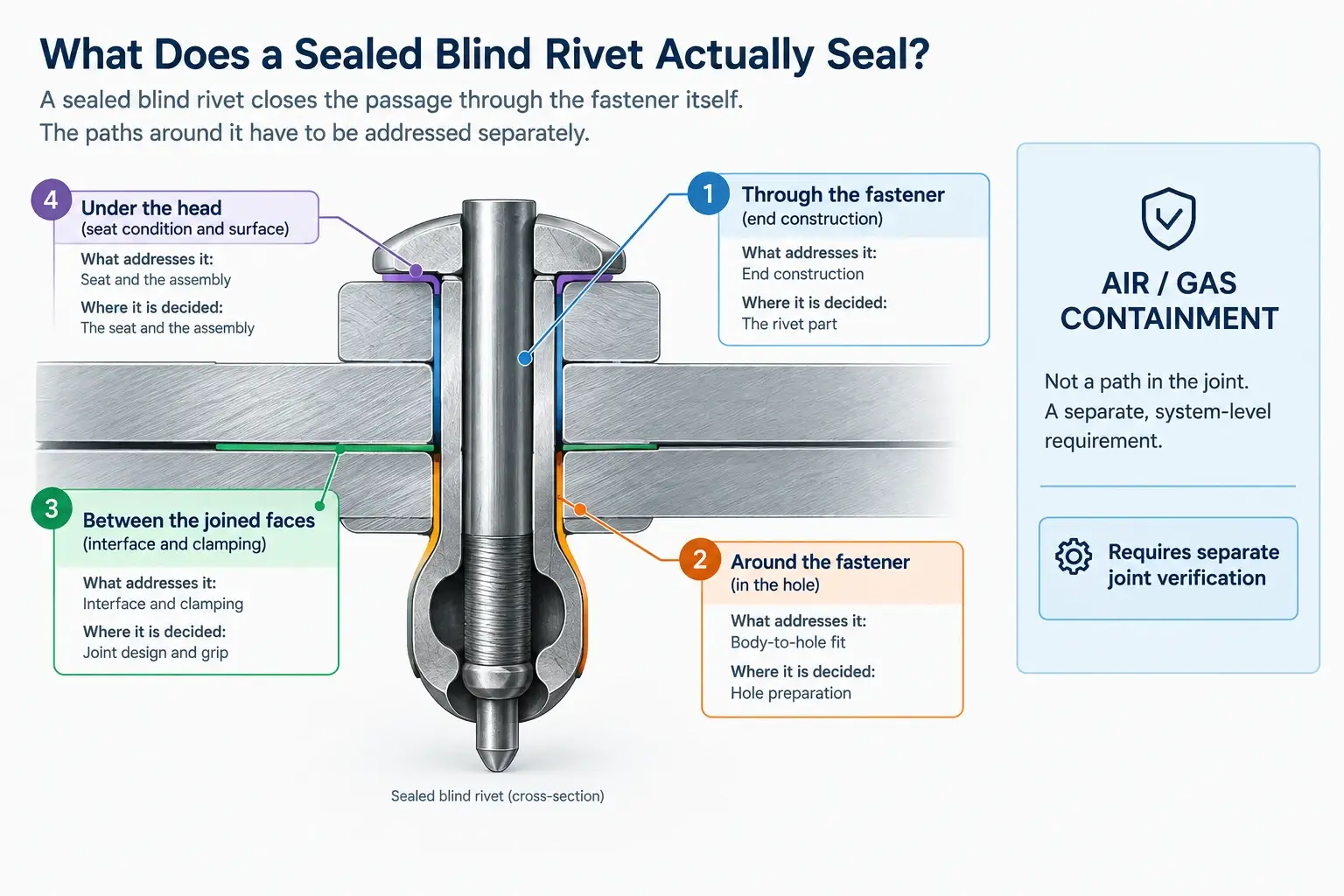
Not by itself. Sealing and coating both change the conditions around the couple; neither changes the couple.
Sealing changes what reaches the joint. It does not change what the joint is made of. A sealed configuration limits how much electrolyte enters the fastener’s own passage, but the hole wall and the sheet interface sit outside what it closes.
A coating protects the joint until it is breached, and the breach is usually local. Local coating damage on the anodic member can concentrate attack at the exposed area, so coating integrity matters on both sides of the joint.
A sealed stainless-steel option combines reduced electrolyte access with a different material pairing, but it does not eliminate galvanic corrosion risk. Its effectiveness still depends on the environment and the geometry.
Choosing a sealed configuration is its own decision; our guide to when to use sealed blind rivets covers it. For corrosion the point is narrower: sealing reduces what arrives; it is not an answer to the material pair.
What Should You Verify Before You Specify?
A combination that looks tidy in a catalog still has to survive the real joint. The exposure decides the risk. The sample shows it.
Six checks, each answerable on the real part:
1. Which metals are in the joint — the sheets, the rivet body, the mandrel, and any coating or metallic layer, which counts as a metal.
2. Which faces are exposed, and for how long — one side exposed and both sides exposed are not the same joint.
3. How the electrolyte arrives and whether it can leave — pooling, trapped gaps, how often the area is washed.
4. Which side becomes the anode — settle this before choosing measures, because it decides where the cost lands.
5. The geometry of the contact zone — thin or thick sheets, contact area, whether the interface is enclosed.
6. Whether the sample reflects the actual materials, the joint geometry, the coatings and the exposure conditions — a sample built for convenience tests the convenience, not the joint.
A combination that has not been through the last check is still a hypothesis.
Where Does Galvanic Corrosion Matter Most?
Rank the risk by how long moisture and electrolytes stay with the joint, not by industry or region. The demanding end: long wet or condensing periods, salt-carrying air, industrial and chemical contamination, frequent cleaning, and layered joints that hold water. The mild end: dry, humidity-controlled interiors with surfaces that stay inspectable. Most joints sit between — so the judgement is made on the real joint, in its real exposure.
FAQ
Short answers to the questions this topic raises most.
1. What causes galvanic corrosion in a riveted joint?
Galvanic corrosion in blind rivet joints needs three things at once: two dissimilar metals, an electrolyte that reaches both, and a conductive path between them. A riveted joint lines them up easily; the environment sets how far it develops.
2. Can you use steel rivets in aluminum sheet?
It depends on the environment and the coating condition. Zinc-coated steel can behave differently from bare steel while the zinc coating remains intact; once the coating is damaged or consumed, the underlying steel becomes exposed. Confirm the pairing on a sample.
3. Do stainless steel rivets corrode aluminum?
In many wet joints the aluminum side becomes the anodic one and the stainless side the more cathodic member. With thin sheet, the loss concentrates in a band around the contact — usually where the damage shows.
4. Does a sealed rivet prevent galvanic corrosion?
Not by itself. Sealing reduces how much electrolyte reaches the joint; it does not change the material pair or close the paths outside the fastener. One measure among several.
5. Do you need isolation washers with blind rivets?
Not automatically. Isolation works where it completely separates the contact faces and stays in place through assembly; whether the effort is worth making follows from the material pair and the exposure.
6. Which rivet material is safest in a coastal or marine environment?
There is no single-material answer. The couple, the exposure and the geometry decide the risk together. Define the exposure first, choose a pairing that fits it, and verify on a sample.
7. Can galvanic corrosion be predicted before specifying?
Not with a number, but it can be judged: direction from the material pair, rate from the exposure, concentration from the geometry — then confirmed on a real sample.
8. Can galvanic corrosion happen between the rivet body and the mandrel?
The two are dissimilar metals in one part: the body and mandrel can form an internal galvanic couple when an electrolyte reaches their interface. Whether it does depends on the end construction and on what sealing keeps out.
Start From the Environment, Finish on a Sample
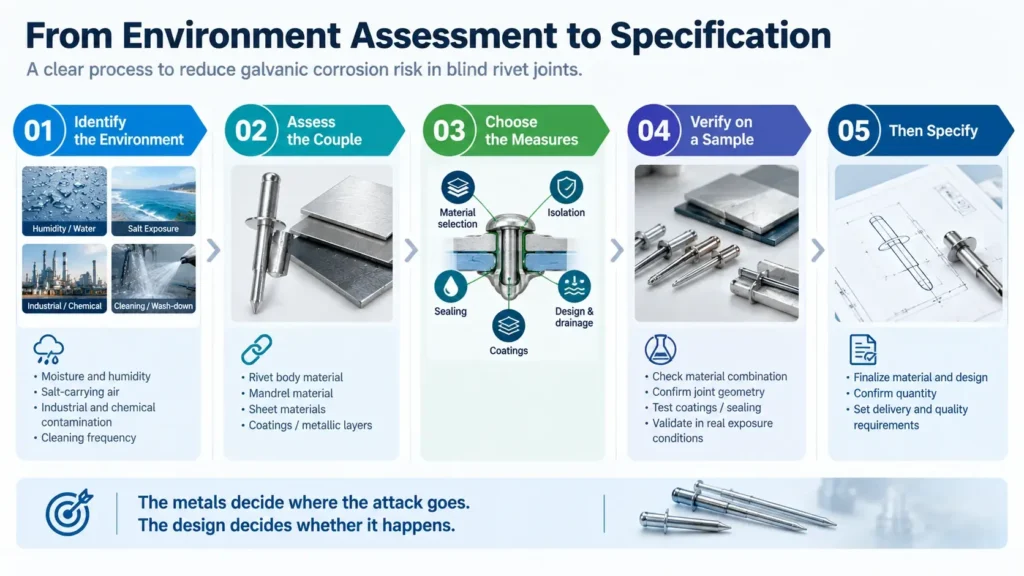
Identify the environment → assess the couple → choose the measures → verify on a sample → then specify.
The metals decide where the attack goes. The design decides whether it happens.
Send us your application, the joint materials and thickness, the expected quantity, and the service environment. We can help review the material combination, recommend a suitable configuration, and verify it on a sample before you specify.