The first piece passes. The sample passes. Then, a few weeks into production, some joints begin to show inconsistent results, but the inspection records reveal no obvious change.
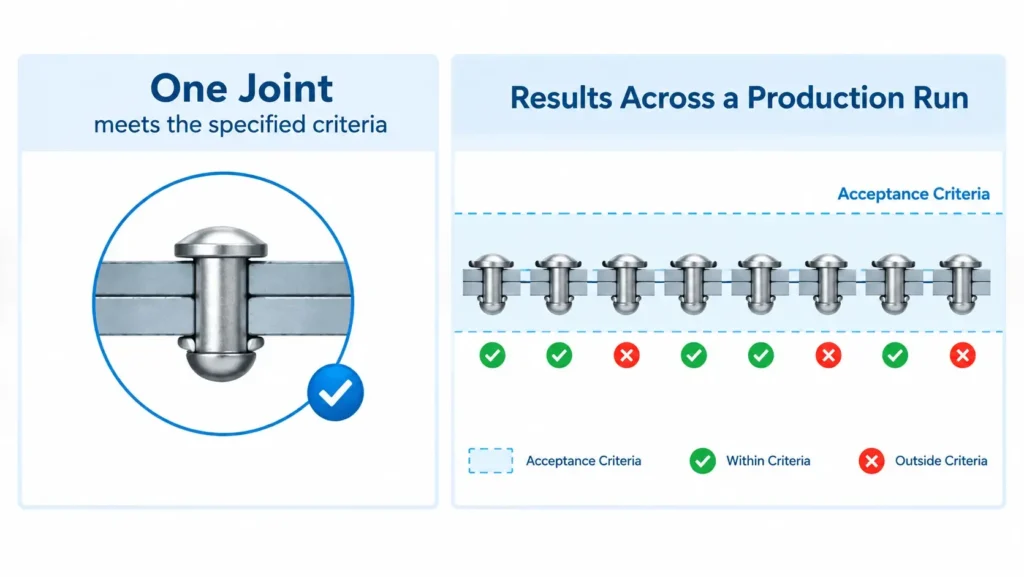
Consistency is not the absence of variation; it is variation that stays inside the requirement. That does not mean every joint has to be identical. It means the spread that reaches the customer has to stay inside a limit the joint requires.
Reading the run instead of the part changes the questions: where the variation comes from, what the checks in place can establish, the order a line tightens itself in, and where the limit comes from.
What Does Assembly Consistency Mean at Volume?
Assembly consistency describes what the line produces across many joints, not what a single joint can do on its best day. At volume, a joint is judged as one of many, not on its own. What matters is not how good a joint can be, but how far it can move and still meet the requirement.
A single joint can be checked; a production run can only be constrained. The reason is not that the line is careless. It is that the evidence sits on the far side of the joint: In blind riveting, the joints that decide your quality level are the ones the line cannot see. The visible head and joint fit still provide evidence; they do not provide all of it.
Quality and consistency are not the same claim. Quality is the result — the joints that come off the line fall inside the limit. Consistency is the mechanism — the same conditions produce the same result again.
Variation is the real difference that exists in the joint, the fastener and the process: a fact about the inputs. Consistency is how closely the same conditions repeat: a property of the mechanism, neither good nor bad on its own. Conformity is the decision — whether the result falls inside the limit set for it. That decision needs a limit, someone to apply it, and a record. A stable process can still miss the limit; a passing sample does not settle the next shipment.
Where that spread comes from is the next question.
Where Does Variation Enter a Blind Rivet Joint?
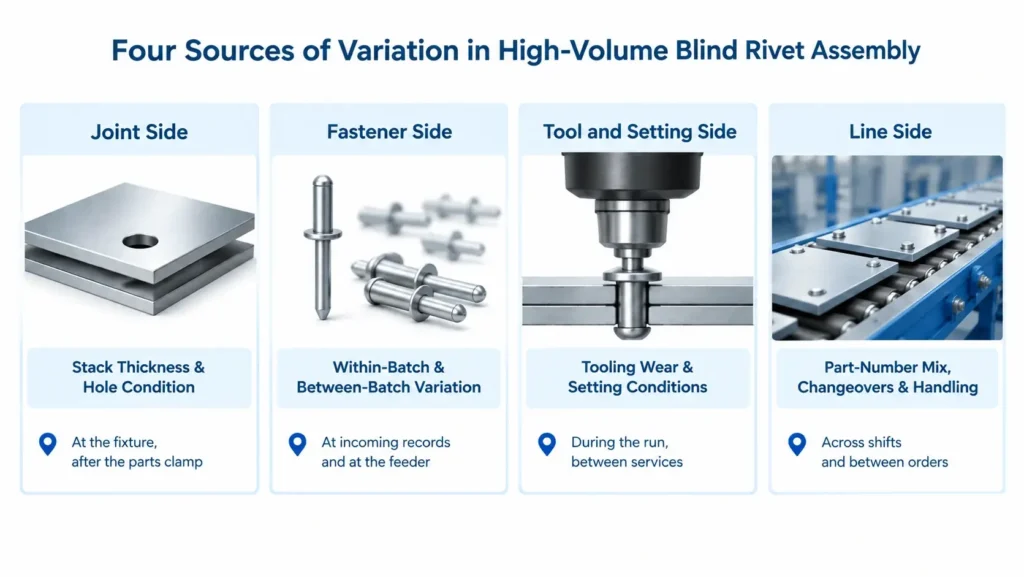
Variation at volume is rarely one bad part; it is several small distributions arriving together. A rivet that meets its own tolerances can still produce joints that differ, because the joint is set by more than the rivet.
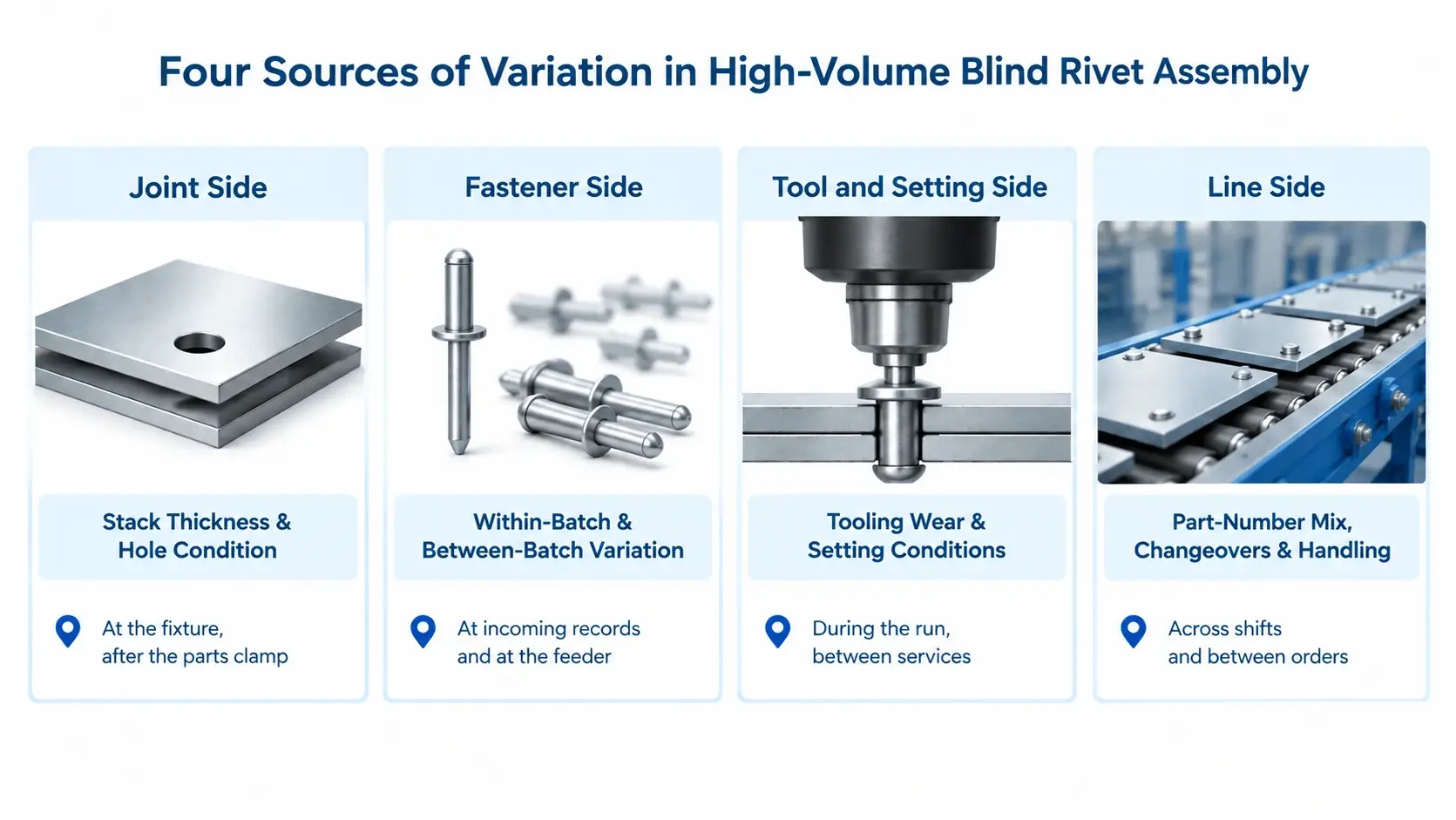
On the joint side, what varies is the stack as built: layer thicknesses inside their own tolerances, and a hole condition set by the drilling or punching step. On the fastener side, the spread inside a batch and the spread between batches are different questions, and what an incoming check establishes depends on its scope. On the tool and setting side, nose equipment wears and a setting that held early in a run moves by the end. On the line side, changeovers and feeding recombine the other three.
Table 1 — Where Variation Enters
| Source of variation | What actually varies | Where a line usually meets it |
|---|---|---|
| Joint side | Stack thickness and hole condition as built | At the fixture, after the parts clamp |
| Fastener side | Spread inside a batch, and between batches | At incoming records and at the feeder |
| Tool and setting side | Tooling wear and the tool–rivet combination | During the run, between services |
| Line side | Part-number mix, changeovers and handling | Across shifts and between orders |
A missing limit is not a further source of variation; it removes the basis for judging what comes off the line. Where no limit is written down, a difference is detectable, but nothing decides whether it needs action.
The four sources are not ranked; they are listed in the order a line usually meets them. A replaced rivet that fixes one line does not prove the rivet was the cause. A swap changes the batch, the feed and the setting at once.
Where the hole condition itself has to be pinned down, how a hole is specified and checked is covered separately.
What Can Inspection Prove at Volume?
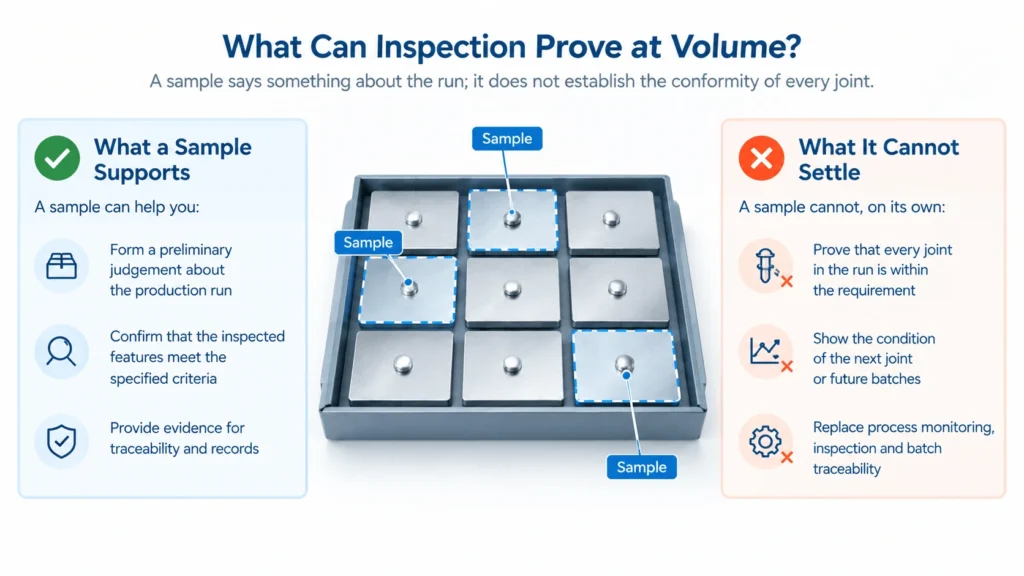
A sample says something about the run; it does not establish the conformity of the joint in your hand. Monitoring shows that the process moved; it does not show that the joint meets the requirement. Neither argues against inspecting; both describe what a method can answer.
Table 2 — What Each Control Can Answer
| Control | What it can establish | What it cannot establish on its own |
|---|---|---|
| First-piece check | Whether the inspected features of the first piece are inside the limit | Whether the rest of the run stays inside it |
| In-process sample | Whether the sample was inside the limit when it was taken | Whether the next joint is inside the limit |
| Process monitoring | Whether the process moved away from its own baseline | Whether the finished joint meets the requirement |
| Incoming batch records | Whether a shipment can be traced to its batch and records | Whether that batch suits this joint |
| Traceability | Which batch a joint came from, and which records cover it | Whether the joint was good when it was set |
What each control can answer is narrower than the confidence usually placed in it; its value depends on the question it is asked to answer. What a sample supports depends on the sampling plan, set before the run. Traceability places a joint in a batch afterwards, not in a limit. The two tables are not read row against row; a source of variation is not a control.
Where a setting-side symptom has to be placed, what the setting-side symptoms point to is covered separately.
How Do You Keep the Line Inside the Requirement?
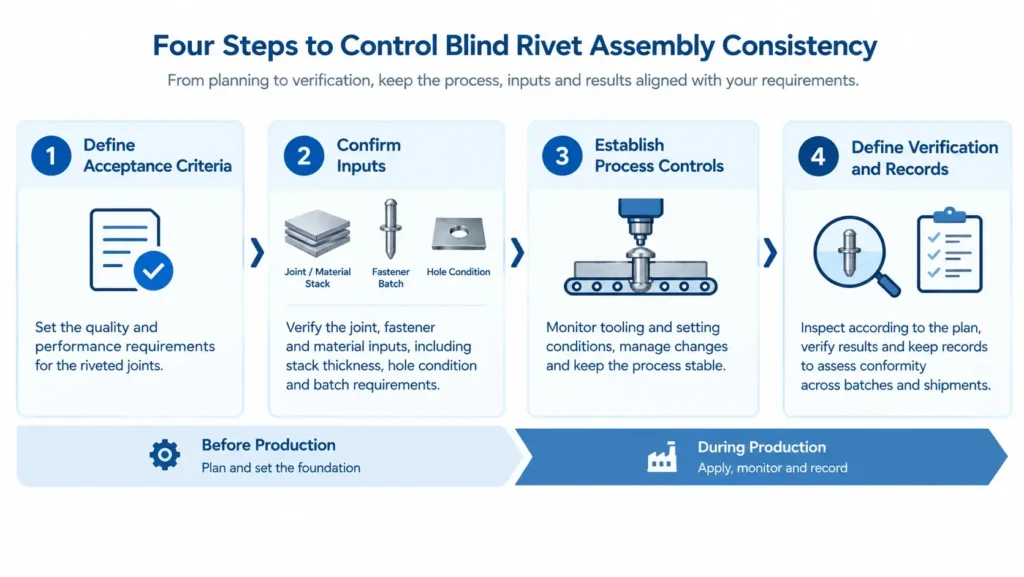
The order of the actions matters more than the number of them. The sequence below is an order of work, not a list of options.
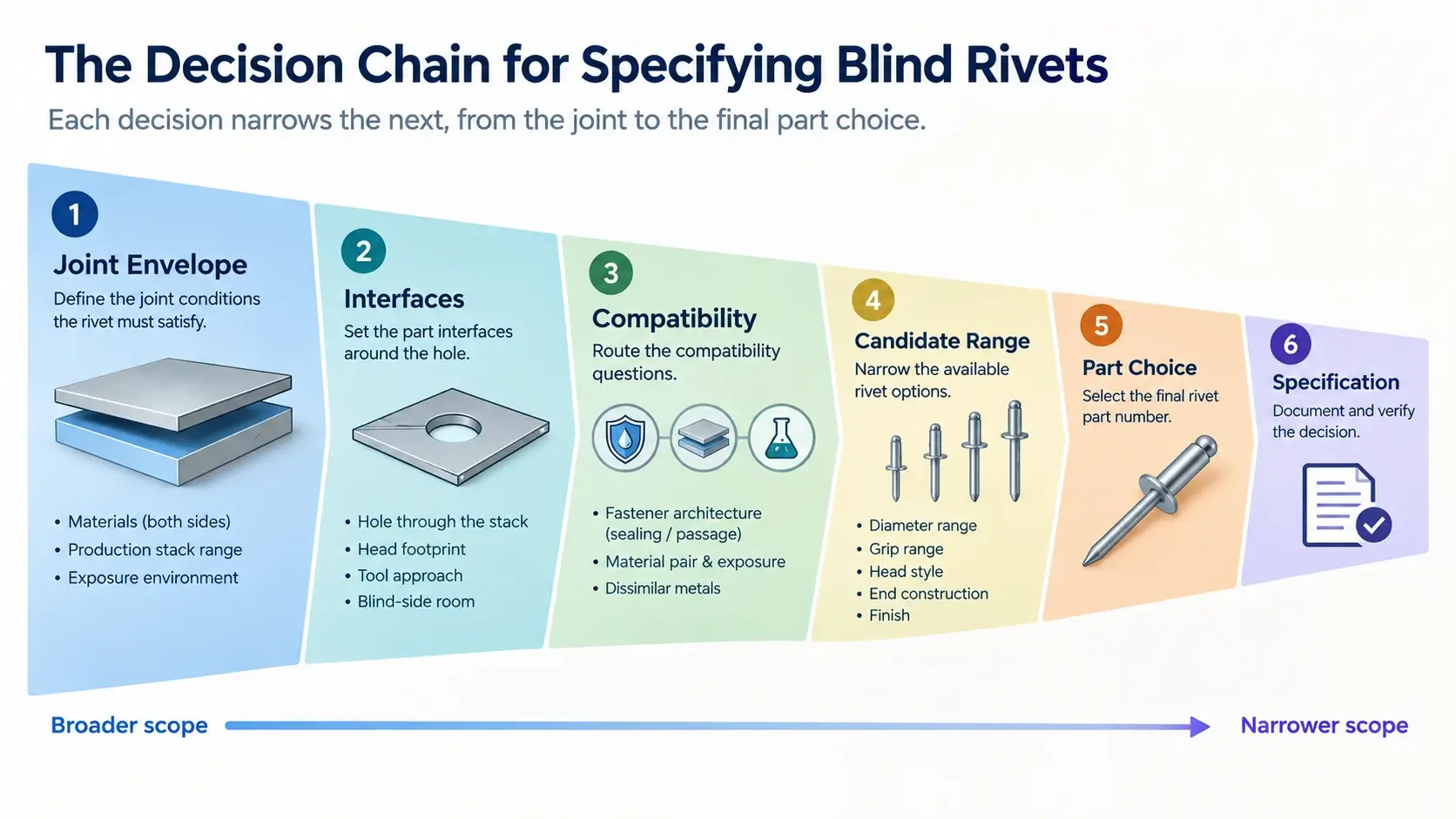
All four are defined before the run starts and applied as the line runs; the order says which is decided first. Write the limit down first. Until it exists, none of the other actions can be judged as working or not. Tighten the inputs second: the joint side, where the stack and the hole are what the line actually builds, and the fastener side, where the spread inside a batch matters as much as the shipment matching its label. Hold the process third: tooling and setting become an object of scheduled attention rather than a component replaced after it fails. Define the evidence fourth: sampling and the records it produces take their meaning from the limit agreed before the run, not from the number of joints checked.
A batch swap, a feeder adjustment or a change of stack all land on the input side, and each can move the conditions the run was set up on. A change on the line is a new variable until it is compared against the baseline. Record what the line ran before the change; without that record there is nothing to compare against.
Each action above points at the same thing: a limit written down first.
What Has to Be Written Down Before the Line Runs?
Consistency can only be judged against a limit that was written down before the run. What the limit should contain belongs to the specification; this section only asks whether a limit exists.
The limit is not the only thing that has to exist: which joints are judged, what counts as acceptable, which method is used to check them, who has the authority to call a deviation, and what is recorded when one occurs. A drawing may fix nominal dimensions without saying how a joint is judged. A process record is less useful when no agreed trigger says when a deviation is reviewed.
Without them, a deviation is only a difference.
Where the specification itself has to be built, how a specification for a new product is built and what it locks is covered separately.
What Happens When Variation Reaches the Customer?
Variation that the line accepts is passed on to whoever uses the joint. The first place this usually shows up is not the assembly station. Where variation is discovered is not necessarily where it entered.
On the line it shows up as sorting, rework or a stop-and-inspect check; downstream, as a part dismantled or scrapped after more value has been added; at the customer, as a complaint or a shipment traced after it has gone out.
Leaving the variation to whoever finds it hands the judgement to the step with the least information about its origin.
Where the cost of that rework and interruption has to be worked out, what rework, replacement and line interruption cost in total is covered separately.
How Do You Move From a Good Sample to a Stable Supply?
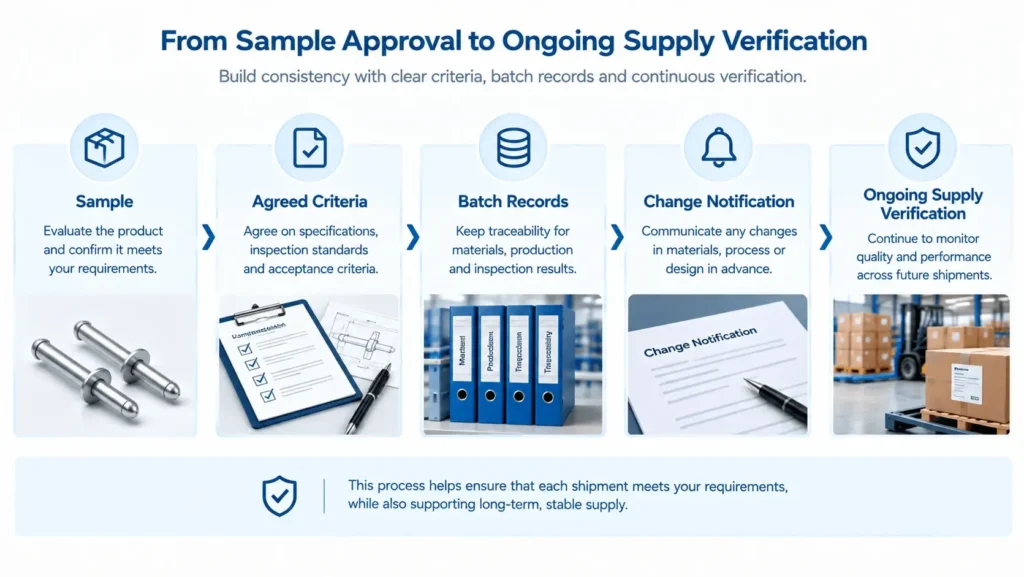
A supplier is held to a limit, not to a promise. A passing sample is a starting point, not a basis for later shipments. Ask for the records that show the limit was held, not for a statement that it was.
Table 3 — From a Good Sample to a Stable Supply
| What to agree | What it holds steady | Where the answer comes from |
|---|---|---|
| One agreed acceptance limit | The acceptance basis for every shipment | The joint requirement, written before the RFQ |
| Batch records across shipments | The evidence that the limit was held | The supplier’s records, requested as a series |
| Change notification | Whether the part you qualified is still the part you get | The supplier’s process control |
| Sample-to-production comparison | Whether the first article and the run agree | The qualification and the first shipments |
| Who decides on a deviation | Whether a deviation is a reject or a decision | The acceptance process you agreed with the supplier |
A single accepted part shows what the process could do once. What these arrangements ask is whether that still holds later, and who finds out when it does not.
None of this needs a new tool — only the acceptance basis turned into something a supplier can be asked for before the order.
Where the parameters a datasheet actually states have to be read, which parameters a datasheet states is covered separately.
FAQ
1. How can blind rivet assembly consistency be improved at volume?
Write the limit down first, tighten the inputs second, hold the process third, and define the evidence last. The order does more work than the length of the list.
2. Why does joint quality change between production batches?
More than one side can move: the spread inside a fastener batch, the stack and hole the line builds, tooling wear, a changeover. Which one moved is for the records.
3. Can tighter rivet tolerances improve assembly consistency?
Tighter rivet tolerances narrow the spread on the fastener side only. The joint side and the tool and setting side also move the result, so the benefit depends on which side moves most.
4. How many joints should I inspect in a high-volume run?
No single count fits every run. The plan follows from the acceptance limit, the consequence of a nonconforming joint and the process history, and it belongs before the run starts. A sample speaks for the run, not for one joint.
5. Can process monitoring replace inspection?
Monitoring answers whether the process moved away from its own baseline. Whether the finished joint meets the requirement is separate, and needs a limit agreed before the monitoring went in.
6. What do I ask a supplier for when consistency matters?
A limit that applies across suppliers, records that run shipment after shipment, notification before a material, process or location change, first article against production, and a named owner for deviations.
Start With the Limit, and the Run Follows
Requirements → limits → process control → records → a run that can be repeated.
Every link in that sequence points at the same object: a spread that stays inside a limit, and a limit that belongs to the joint.
A run that stays inside a limit is not a promise about any single joint; it is a statement about what the line holds.
Send us your application, the joint materials, the expected quantity, and the limit your line has to hold. We can review the joint requirements and discuss standard products or drawing-based parts for the application.