Introduction
Standard blind rivets cover many applications, but OEM assemblies sometimes require non-standard dimensions, head geometry, grip ranges, materials or performance characteristics. That is where custom blind rivets become necessary.
A successful custom rivet project is not simply “making a rivet to a drawing.” It requires translating application requirements into a design that can be manufactured, tested and reproduced consistently at production volume.
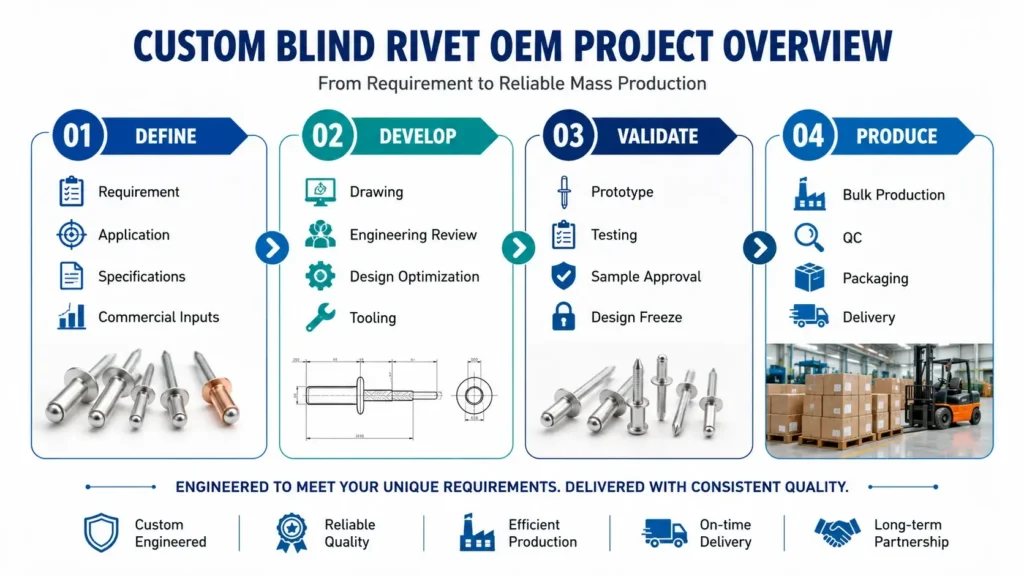
This guide walks through the full OEM development path — from defining the requirement and preparing information, through drawing development, engineering review, sample approval, tooling, cost and MOQ, production, quality control and delivery. Whether you are a purchasing manager, mechanical engineer or OEM manufacturer, the goal is the same: understand what happens after you send your drawing to a custom blind rivet manufacturer, and how to ensure the supplier can take it all the way to reliable mass production.
1. When Do You Need Custom Blind Rivets?
Custom blind rivets are needed when a standard or semi-custom product cannot fully meet the application. Common scenarios include:
- Non-standard dimensions (diameter, length or grip range outside standard ranges)
- Special head geometry (large flange, countersunk, custom shape)
- Extended or unusual grip range
- Specific body/mandrel material combination for corrosion resistance or strength
- Special surface treatment or coating
- Specific break-load or mandrel retention requirements
- OEM packaging, labeling or identification requirements
Before committing to full custom development, check whether a standard or semi-custom product can meet the requirement. Not every OEM requirement needs a completely new rivet.
| Option | Typical Change | Development Complexity |
|---|---|---|
| Standard | Existing specification, no modification | Low |
| Semi-custom | Modified length, finish or minor dimensional change | Low–Medium |
| Fully custom | New geometry, materials or performance requirements | Medium–High |
For a detailed comparison of standard vs custom blind rivets and when customization is worth the MOQ, see our article on standard vs custom blind rivets.
Buyer Action: Before contacting a manufacturer, identify which specific requirement cannot be met by a standard rivet, and whether the change is minor enough for a semi-custom approach.
2. What Information Should You Provide for Custom Blind Rivets?
Providing complete information upfront reduces engineering review time and improves quote accuracy. Organize your inputs into three categories.
Product Definition
Diameter, length, head style, grip range, body and mandrel materials, and surface treatment. These define the physical rivet.
Application Definition
Material being joined, total material thickness, hole size, required joint strength (static or dynamic), vibration exposure, corrosion environment, and installation direction and access. These define what the rivet needs to do.
Commercial Definition
Estimated annual volume, initial order quantity, packaging requirements, and project stage where relevant — such as new product development, existing product replacement, cost-down project or production transfer. Annual volume, initial order quantity and project stage are different inputs; clarify whether a figure represents a trial batch, monthly demand or an annual estimate.
Minimum Information for an Initial Quote
If you cannot provide a full drawing, prepare at least the following for a meaningful initial quotation:
| Information | Example |
|---|---|
| Diameter | 4.8 mm |
| Length | 16 mm |
| Grip range | 6–10 mm |
| Hole size | 5.0 mm |
| Head type | Dome |
| Body material | Aluminum |
| Mandrel material | Steel |
| Finish | Zinc plated |
| Application | Sheet metal assembly |
| Estimated quantity | 50,000 pcs / year |
The values above are examples only and should not be treated as recommended specifications.
No Formal Drawing?
If no technical drawing exists, provide an existing rivet sample, photos with measurements, a CAD model, or a hand sketch with dimensions. The manufacturer can convert these into a production drawing.
Buyer Action: Prepare product, application and commercial information before requesting a quote — this reduces engineering review time and improves quote accuracy.
3. How Is a Custom Blind Rivet Designed?
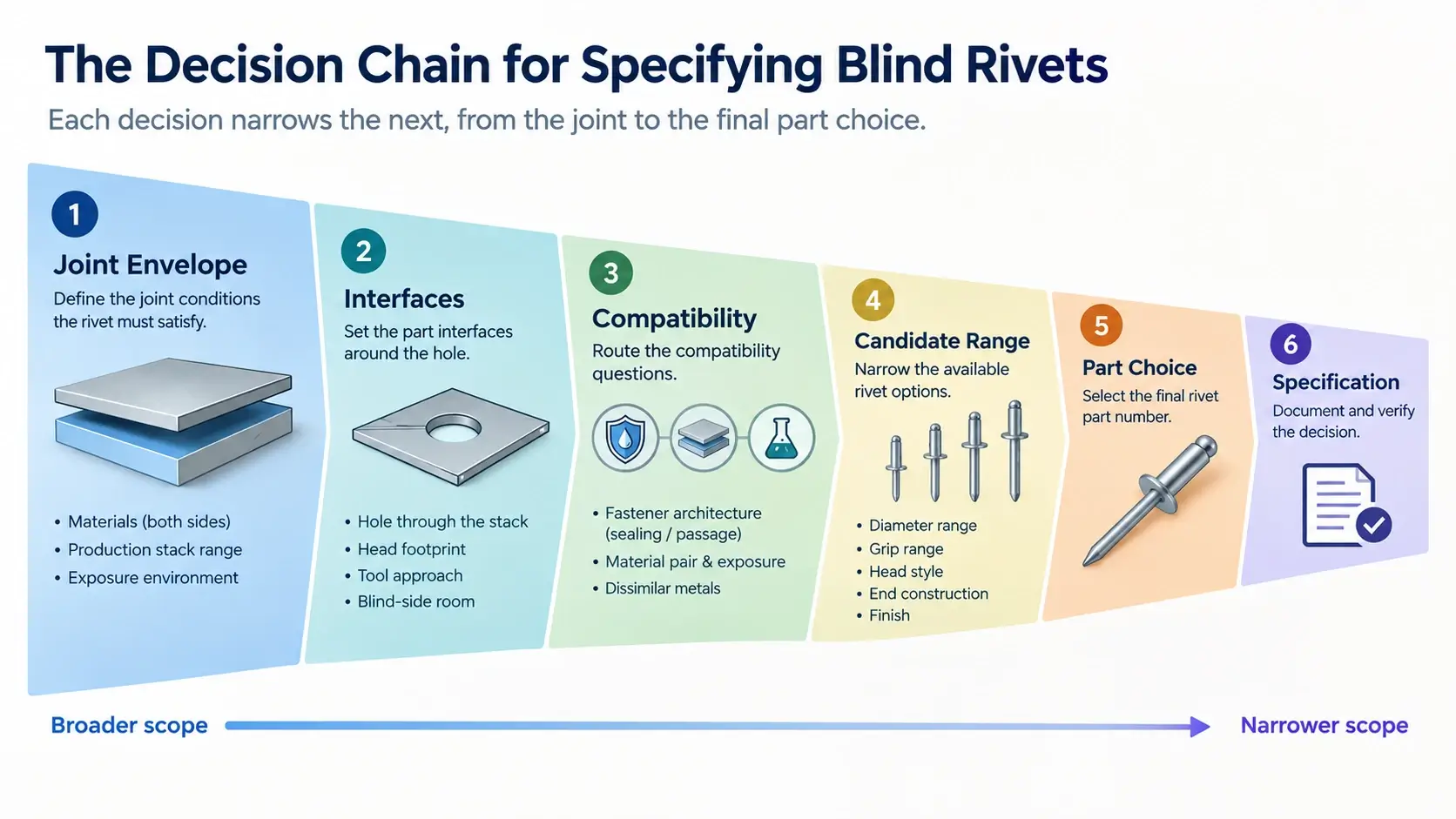
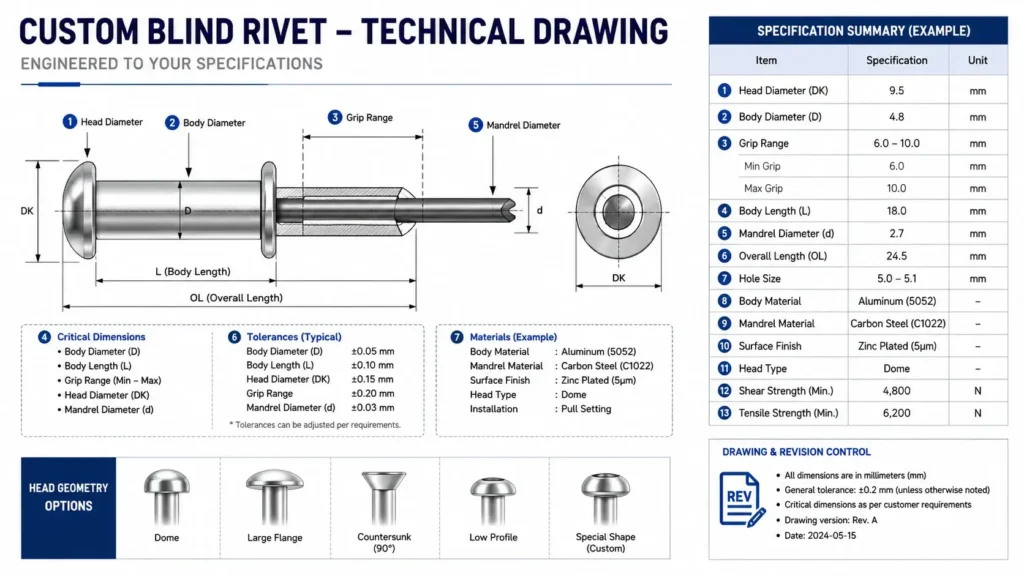
The drawing is the engineering translation of application requirements into a manufacturable specification. The focus is not on explaining what each parameter is, but on how engineers convert requirements into a defined design.
Start With the Application
Engineers first ask what the rivet needs to do: what thickness range it must accommodate, what load it must withstand, what hole size is available, and what environment it will operate in. Before developing a custom design, check whether an existing rivet type already meets the application requirements — see our blind rivet types selection guide.
Body Geometry
Engineers define body diameter, length, wall thickness and grip range based on the application and forming requirements. Material selection affects expansion characteristics and strength — see our blind rivet material selection guide.
Head Geometry
Engineers select head style — dome, countersunk, large flange or special — based on bearing area, load distribution, flushness and appearance requirements. Head geometry directly affects installation behavior and load distribution.
Mandrel Design
Engineers define mandrel material, diameter, break point and head configuration based on the required break-load and retention performance.
From Application Requirement to Design Decision
The core of custom rivet design is translating what the application needs into specific engineering decisions:
| Application Requirement | Design Decision |
|---|---|
| Material thickness | Rivet length and grip range |
| Hole diameter | Rivet body diameter |
| Flush installation needed | Head geometry (e.g., countersunk) |
| Joint load requirement | Body and mandrel design |
| Corrosive environment | Material and surface treatment |
| Installation access and tool | Mandrel break-load design |
Critical Dimensions and Tolerances
Critical dimensions should be clearly identified instead of applying unnecessarily tight tolerances to every feature.
Tight tolerances can increase tooling complexity, inspection requirements and production cost. Instead of specifying the tightest possible tolerance for every dimension, identify the dimensions that directly affect fit, installation or joint performance. This reduces tooling complexity and production cost without compromising the application.
Applicable Standards
Custom does not automatically mean “without standards.” A custom design may use an applicable industry standard as a reference where relevant, while customer-specific dimensions or performance requirements may also define the final specification.
Drawing Revision Control
Every design change should be identified by a drawing revision. Buyers should avoid approving samples against one revision while placing production orders against another. The drawing revision should be included in the quotation, sample approval and purchase order.
Buyer Action: Identify which dimensions are truly critical and communicate them to the manufacturer — this reduces tooling complexity and cost.
4. Engineering Feasibility: Can the Design Be Manufactured?
Before samples are produced, the manufacturer should review whether the design can be manufactured consistently — not just once, but at the required volume. This involves three levels of judgment:
| Feasibility Level | Key Question | What the Manufacturer Checks |
|---|---|---|
| Engineering | Can it be designed? | Material availability, dimensional feasibility, tolerance achievability |
| Manufacturing | Can it be made? | Cold-heading, body forming, mandrel forming, piercing/boring, assembly, surface treatment |
| Volume Production | Can it be made consistently at volume? | Tooling requirements, process stability, capacity vs. expected volume |
Making a single sample is not the same as producing the rivet consistently at the required volume.
Identify High-Risk Features
Features that may require special attention include extremely tight tolerances, unusual head geometry, very thin wall sections, long grip range, special break-load requirements, unusual material combinations and special coating requirements.
Design Optimization Before Sampling
The manufacturer may recommend adjusting a dimension, relaxing a non-critical tolerance, changing material, modifying the head, adjusting the mandrel or using an existing production process. The goal is to make the rivet manufacturable without compromising the application. This is where OEM engineering value differs from simple drawing-to-part production.
5. Prototype, Testing and Sample Approval
The drawing confirms design intent, but samples verify whether the physical rivet actually performs as expected.
Why Samples Are Necessary
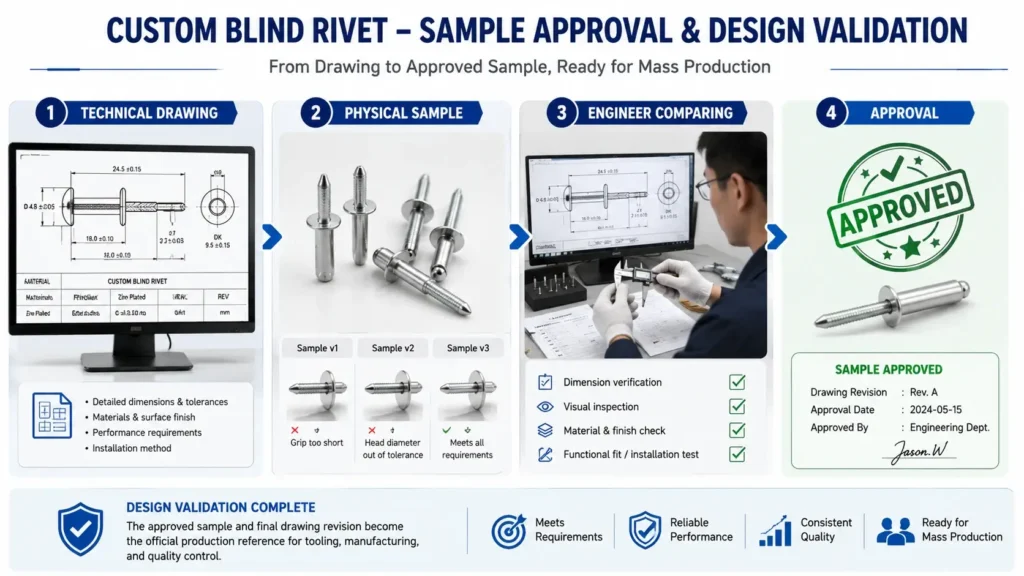
The typical sample process: Drawing → Engineering Review → Prototype → Dimensional Inspection → Setting Test → Performance Test → Customer Approval.
Testing Selection
Depending on the application, samples may be checked for dimensions, grip range, head appearance, mandrel retention, setting performance, break load, tensile strength, shear strength, corrosion resistance and joint appearance. Where applicable, testing requirements may reference relevant industry standards, such as ISO 14589, depending on the rivet type and customer requirements. For detailed test methods and inspection approaches, see our guide to detailed rivet testing methods.
Sample Approval and Design Freeze
The most common issue in OEM projects is not a defective sample — it is a sample approved as revision A while the production drawing later changes to revision B. Approval should cover both the physical sample and the final drawing revision.
Sample + Drawing Revision + Inspection Criteria = Production Reference.
Before bulk production, confirm: final drawing revision, material, finish, performance requirements, packaging, inspection requirements and the approved sample. The approved drawing and sample should become the reference for mass production.
Sample Validation vs Production Validation
A sample that passes testing does not automatically prove that the production process is stable. Sample validation is the first step; first-article inspection, batch inspection and ongoing quality control confirm that the production process remains consistent over time. This connects directly to the quality control plan in Section 7.
Buyer Action: Do not approve bulk production until the sample, final drawing revision and inspection criteria are all confirmed in writing.
6. Tooling, Cost and MOQ
Once the design is approved, the project moves into tooling, cost evaluation and production setup. For most OEM buyers, this is the most commercially critical stage.
When New Tooling May Be Needed
New tooling may be required for special head geometry, non-standard body shape, new mandrel configuration, unusual dimensions or special forming requirements. A minor modification — such as a different length or finish — may not require new tooling at all.
What Affects Custom Blind Rivet Cost?
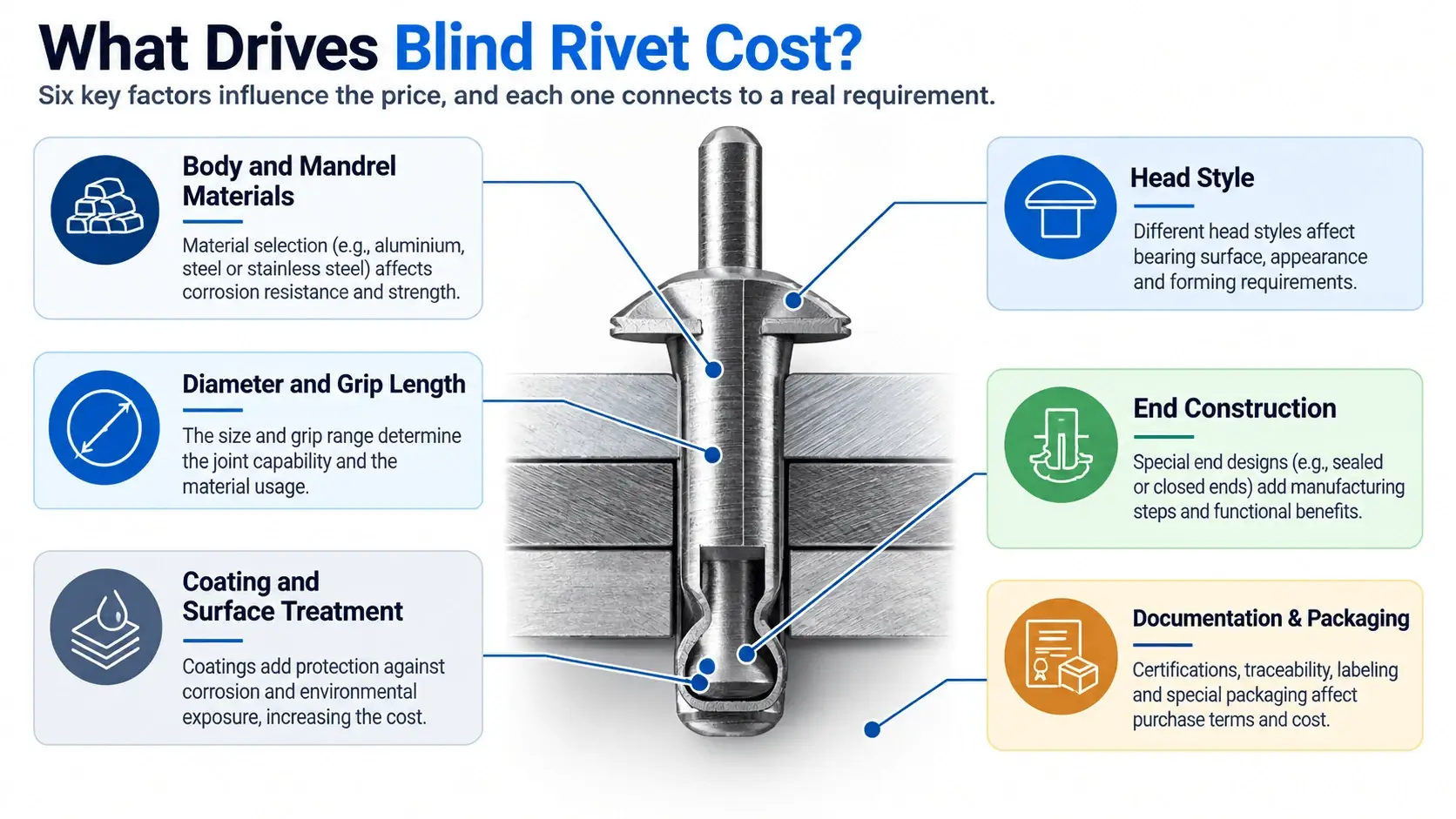
Custom blind rivet cost is influenced by several factors:
- Tooling requirements
- Material and material grade
- Rivet dimensions and geometry
- Surface treatment
- Testing and qualification requirements
- Order quantity
- Packaging requirements
- Production complexity
A custom rivet with a new head shape may have very different development costs from a rivet that only requires a different length or finish. A supplier should evaluate the drawing or sample before providing a development quotation. Depending on the supplier’s commercial terms, tooling may be charged separately or incorporated into the overall project cost for higher-volume programs.
Total project cost is not the same as unit price. Buyers should evaluate tooling, development, testing, unit price and MOQ together when comparing suppliers.
How Does MOQ Work for Custom Blind Rivets?
Custom blind rivet MOQ is usually determined by tooling, raw material purchasing, production setup, testing requirements and expected annual demand. A trial quantity may be possible for development, while regular production MOQ may be higher. MOQ should be evaluated together with tooling and unit cost, rather than as a standalone number. For more on this topic, see our blind rivet MOQ and trial order guide.
What Should Buyers Confirm About Tooling?
For OEM projects, tooling ownership is a key commercial question. Before development begins, confirm:
- Whether new tooling is required
- Tooling cost and whether it is included in the quotation
- Tooling ownership
- Tooling storage and maintenance
- What happens if the design changes after tooling is made
- Whether existing tooling can be reused for future orders
Tooling ownership and custody are separate questions. A buyer may own the tooling while the manufacturer stores and maintains it for production. These terms should be defined in the OEM agreement or quotation.
Production Setup
Before bulk production, confirm tooling, raw material, process parameters, inspection standards, packaging requirements and production schedule.
Confirm tooling, cost, MOQ and ownership terms before production setup.
7. Bulk Production and Quality Control
When the approved custom design enters production, the focus shifts from development to consistency. The production flow and quality control plan work together to ensure repeatable results.
From Approved Design to Bulk Production
Raw Material → Body Forming → Mandrel Forming → Piercing/Boring → Assembly → Surface Treatment → Inspection → Packaging
For a full explanation of each manufacturing step, see our blind rivet manufacturing process guide.
Define a Quality Control Plan Before Production
Quality control during custom rivet production is about when, where and what is controlled — not how individual tests are performed. A quality control plan should cover:
- Incoming material inspection
- First-piece inspection
- In-process dimensional inspection
- Final inspection
- Performance testing
- Surface treatment inspection
- Batch traceability
Incoming Material Control
Material certificates, spectrometer verification and hardness testing where applicable.
In-Process Dimensional Control
Body diameter, length and head dimensions are monitored during forming, along with mandrel dimensions and assembly verification.
Final Performance Verification
Tensile, shear and break-load testing against the approved sample, plus surface treatment inspection for coating appearance, thickness and corrosion resistance. Inspection frequency and acceptance criteria should be defined before production. For test methods and standards, see our blind rivet quality testing guide.
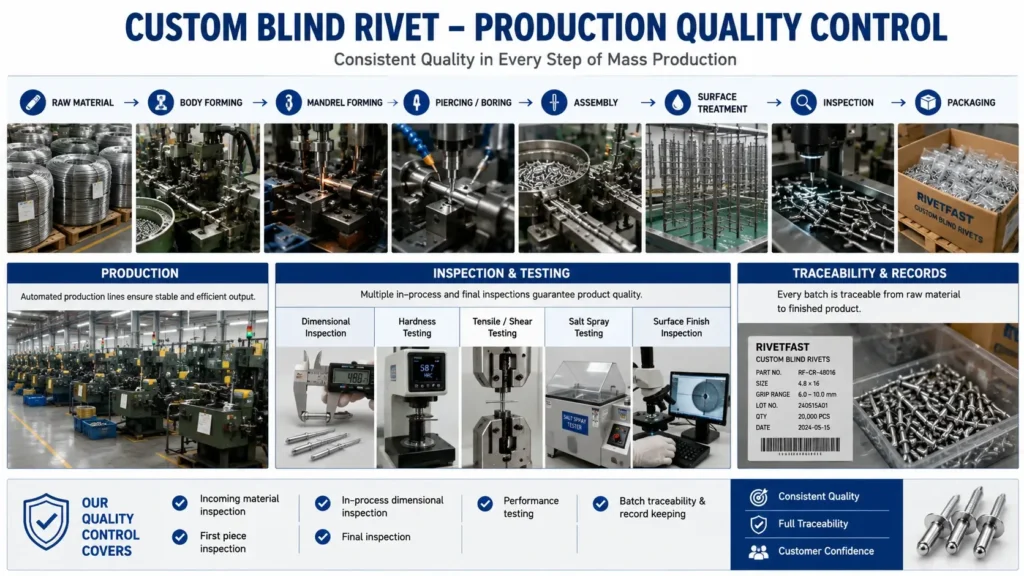
Batch Traceability and Inspection Records
Buyers should request batch or lot identification, inspection reports, test reports, material certificates where applicable, and traceability from raw material to finished product. These records support repeat orders and production consistency.
8. Packaging, Delivery and OEM Lead Time
Packaging Options
Customization extends to packaging: bulk cartons, small boxes, OEM-labeled packaging, custom quantities per box, and barcode or label requirements.
Before Shipment, Confirm
Part number, quantity, batch number, packaging specification, label information, shipping marks and inspection documents.
Development Lead Time vs Production Lead Time
Custom development lead time should not be confused with standard production lead time. Development lead time covers drawing review, tooling, prototype, testing and approval. Production lead time covers raw material, production, surface treatment, QC and packaging. Understanding this distinction helps set realistic expectations for the first order vs repeat orders.
First-order lead time is typically longer because it may include engineering review, tooling, sampling and approval. Repeat orders usually follow the standard production cycle once the design and tooling are established.
For OEM projects, ask the supplier to quote development lead time and production lead time separately. This prevents confusion when a single “lead time” figure does not clarify whether it covers tooling, sampling, production or the full project timeline.
What Affects OEM Lead Time?
| Stage | Main Lead-Time Factors |
|---|---|
| Drawing review | Design complexity |
| Engineering | Feasibility and revisions |
| Tooling | New tooling requirements |
| Samples | Prototype complexity |
| Testing | Required performance tests |
| Production | Order quantity and capacity |
| Surface treatment | Finish and supplier schedule |
| Packaging | OEM packaging requirements |
A simple dimensional modification may move much faster than a completely new rivet design requiring tooling and qualification testing.
9. Custom Blind Rivet OEM Workflow and Buyer Checklist
Quick Reference: The following workflow and checklist summarize the entire OEM process. Detailed explanations are in Sections 1–8 above.
1. Requirement ↓
2. Drawing / Sample ↓
3. Engineering Review ↓
4. Design Optimization ↓
5. Prototype / Sample ↓
6. Testing ↓
7. Customer Approval ↓
8. Tooling & Production Setup ↓
9. Bulk Production ↓
10. Final QC & Packaging ↓
11. Shipment
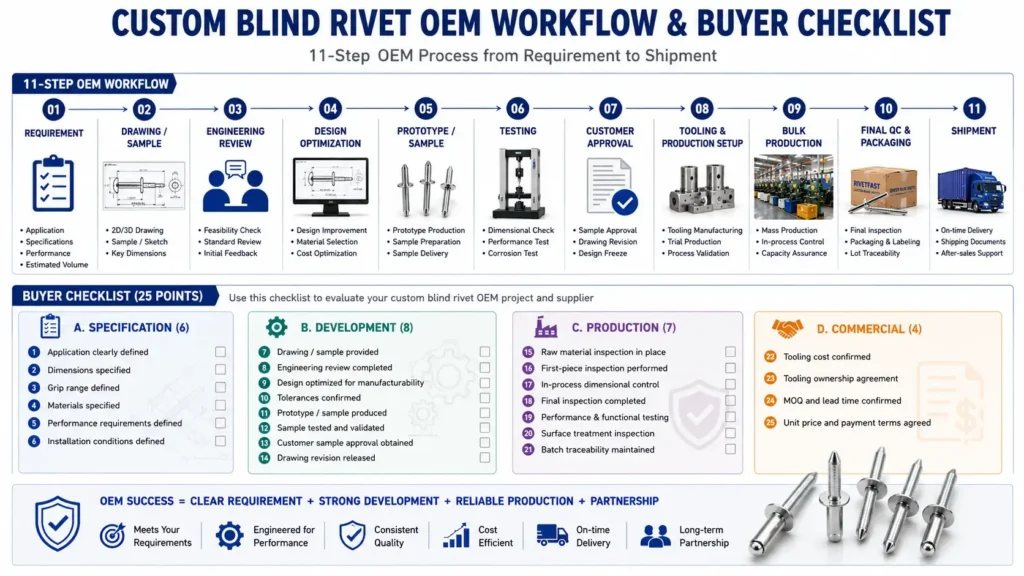
Buyer Checklist
Specification
- ☐ Application and joining materials confirmed
- ☐ Diameter, length and grip range confirmed
- ☐ Head and mandrel design confirmed
- ☐ Body / mandrel materials confirmed
- ☐ Surface treatment confirmed
- ☐ Critical tolerances identified
- ☐ Performance requirements defined
Development
- ☐ Drawing reviewed by manufacturer
- ☐ Manufacturability confirmed
- ☐ Tooling requirements confirmed
- ☐ Testing requirements confirmed
- ☐ Sample approved
- ☐ Final drawing revision approved
Production
- ☐ Raw material requirements confirmed
- ☐ Inspection criteria confirmed
- ☐ Packaging specification confirmed
- ☐ Batch traceability confirmed
- ☐ Production schedule confirmed
- ☐ Final inspection documents agreed
Commercial
- ☐ Tooling cost confirmed
- ☐ Tooling ownership confirmed
- ☐ Tooling storage and maintenance terms confirmed
- ☐ MOQ confirmed
- ☐ Unit pricing confirmed
- ☐ Development / sample charges confirmed
10. How to Choose a Custom Blind Rivet Manufacturer
Choosing the right custom blind rivet manufacturer is a critical procurement decision. Evaluate potential suppliers across seven dimensions:
1. Engineering Capability
Can they review drawings and recommend design changes? A capable manufacturer should offer manufacturability feedback, not just accept the drawing as-is.
2. Manufacturing Capability
Can they produce the required geometry consistently? Look for experience with similar custom designs and the ability to maintain tolerances at production volume.
3. Tooling Capability
Can they develop and maintain custom tooling? Ask whether tooling is made in-house or outsourced, and how tooling maintenance is handled between production runs.
4. Testing Capability
Can they verify dimensions and performance? Check whether they have in-house testing equipment for tensile, shear, break-load, hardness and corrosion resistance testing.
5. Quality System
Look for ISO 9001 or equivalent quality system, documented inspection records, batch traceability and a clear quality control plan.
6. Production Capacity
Can they support both prototype and mass production? Verify that their capacity can handle your annual volume, including potential growth.
7. OEM Communication
Can they manage drawing revisions, packaging specifications and documentation? Effective communication during development prevents costly production errors.
Red Flags When Evaluating a Custom Rivet Supplier
During supplier evaluation, the following may indicate a lack of OEM engineering capability:
- Accepts drawings without any manufacturability review
- Cannot explain tooling requirements or whether new tooling is needed
- Cannot provide sample inspection data or test reports
- Cannot define a drawing revision control process
- Cannot provide batch traceability for production orders
For a broader supplier risk perspective, see our guide to 5 red flags when sourcing blind rivets from overseas suppliers.
11. How RivetFast Supports Custom Blind Rivet OEM Projects
When evaluating a custom blind rivet supplier, buyers should verify specific capabilities. Here is how these capabilities align with the checks above:
| Buyer Should Verify | RivetFast Capability |
|---|---|
| Drawing-based development | Drawing, sample and CAD-based customization |
| Engineering support | Design review and manufacturability assessment |
| Prototype & testing | Sample development and in-house dimensional, mechanical and material testing |
| Production capacity | 200+ automated machines / up to 2 billion pieces annually |
| Quality system | ISO 9001 quality system + batch inspection + production traceability |
Conclusion
Custom blind rivet OEM is a structured process — from requirement definition through drawing development, engineering review, sample approval, tooling, cost and MOQ, production, quality control and delivery. The goal is not just making a rivet to a drawing, but translating application requirements into a repeatable manufactured product. Use the workflow and checklist above to guide your project from initial requirement to reliable bulk delivery.
FAQ
What information do I need to provide for custom blind rivets?
- Provide product definition (diameter, length, head, grip, material, finish), application definition (joined materials, thickness, hole size, load, environment), and commercial definition (annual volume, initial order quantity, packaging, project stage). A technical drawing is preferred but not the only starting point.
Can I order custom blind rivets without a technical drawing?
- Yes. A sample, sketch, photos with measurements, or a CAD model can serve as the starting point. The manufacturer can convert these into a production drawing.
What should I include in a custom blind rivet drawing?
- Include rivet diameter, body length, head diameter and style, grip range, critical dimensions with tolerances, body and mandrel materials, surface treatment, and any special performance requirements. Clearly identify which dimensions are critical.
Do custom blind rivets require new tooling?
- It depends on how different the design is from existing production capabilities. A minor modification may not require new tooling; a completely new body geometry or head shape likely will.
What is the MOQ for custom blind rivets?
- MOQ depends on tooling, material, production setup and annual demand. A trial quantity may be possible for development, while regular production MOQ may be higher. MOQ should be confirmed for each specification and supplier.
How long does custom blind rivet development take?
- Development time depends on drawing complexity, tooling, samples and testing requirements. A simple dimensional modification may move much faster than a completely new design requiring tooling and qualification testing.
Can a manufacturer develop custom blind rivets from an existing sample?
- Yes. If you have an existing rivet sample — including a failed or competing product — the manufacturer can inspect the sample, measure its key dimensions and, where appropriate, use material or coating testing to help develop a production specification. A sample is one of the most useful starting points for custom development.
How much does it cost to develop custom blind rivets?
- Development cost depends on tooling, design complexity, material, testing and order volume. A semi-custom modification (such as a different length or finish) typically costs less than a fully custom design requiring new tooling. A supplier should evaluate the drawing or sample before providing a development quotation.
Can an existing blind rivet be modified instead of developing a completely new one?
- Yes. Customization ranges from a minor modification of an existing rivet to a completely new design. If only the length, head diameter, mandrel or coating needs to change, a semi-custom approach may avoid the cost and lead time of full custom development. Discuss with the manufacturer which level of customization your application requires.