Introduction
Choosing the right blind rivet manufacturer is an important decision for OEM manufacturers, industrial distributors, and bulk buyers sourcing fastening solutions.
For many purchasing teams, the challenge is not finding a supplier that can produce blind rivets. The real challenge is finding a manufacturer that can consistently deliver the same quality, reliable lead times, and technical support throughout long-term cooperation.
Many buyers experience similar situations:
Initial samples meet expectations, but mass production quality becomes inconsistent.
A supplier offers competitive pricing, but delivery reliability becomes a problem.
A manufacturer can produce standard products but lacks the engineering support required for OEM projects.
These issues can increase production risks, create additional inspection costs, and affect the reputation of the final product.
A reliable blind rivet manufacturer should do more than simply provide fasteners. The right partner should help buyers achieve:
Stable product quality across repeated orders
Predictable production and delivery schedules
Effective OEM customization support
Lower total sourcing risks
This guide explains the key factors global buyers should evaluate before selecting a blind rivet manufacturer for OEM projects and bulk orders, including quality management, manufacturing capability, customization support, delivery reliability, and long-term cooperation.
Based on practical experience in blind rivet manufacturing, this article provides a structured evaluation framework to help purchasing and engineering teams make better supplier decisions.
Why Choosing the Right Blind Rivet Manufacturer Matters for OEM & Bulk Orders
For standard low-volume or retail purchases, supplier selection may focus mainly on availability and price. However, OEM projects and bulk orders require a much higher level of supplier evaluation.
In OEM and industrial environments, the blind rivet manufacturer you choose can directly affect production efficiency, product reliability, and customer satisfaction.
Product Quality Directly Affects Your Brand Reputation
Even though blind rivets are small components, they play a critical role in overall product performance and safety. A single weak or inconsistent rivet can lead to loose fastening, assembly problems, or even field failures.
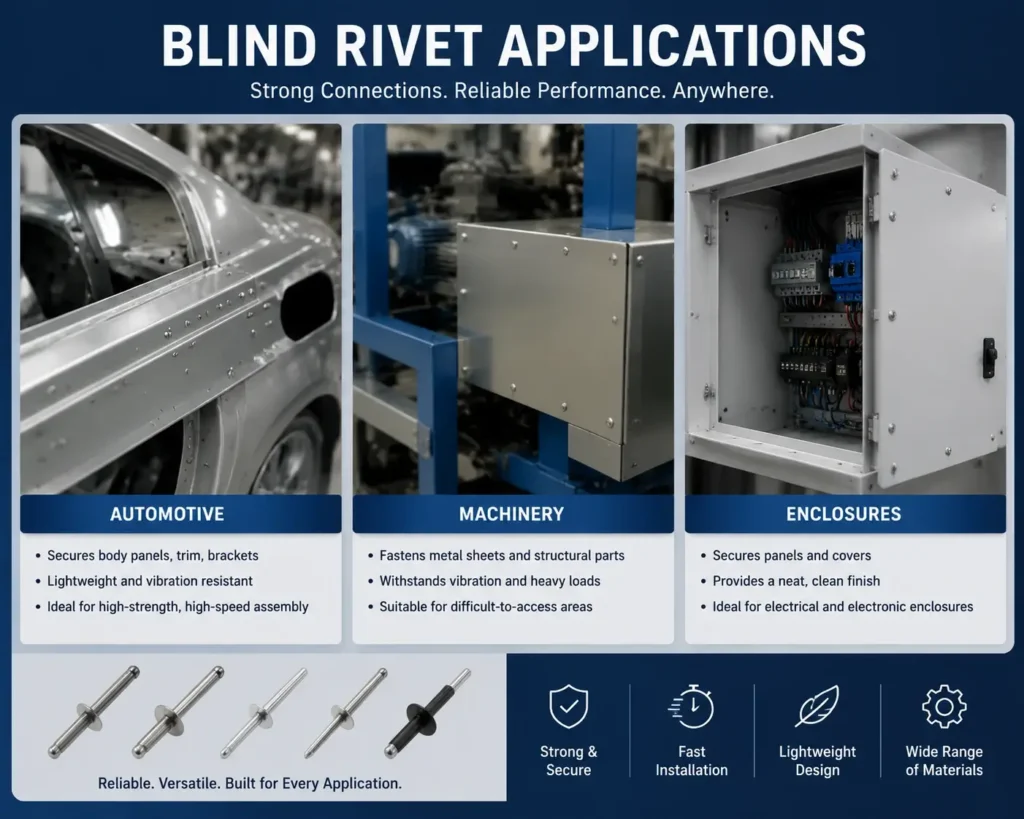
Blind rivets are widely used in applications such as:
Automotive components
Sheet metal and industrial machinery
HVAC systems and electrical enclosures
Appliances
Construction products
In these applications, fastening failure can create serious consequences. The problem is not only the cost of replacing a defective rivet. A quality issue may lead to:
Assembly problems
Production interruptions
Field failures
Customer complaints
Damage to brand reputation
For OEM manufacturers, rivet failures quickly turn into customer complaints, warranty claims, and damage to brand reputation. Batch consistency is crucial: it is not enough that “most” rivets are good; every shipment must perform the same way as approved samples.
Reliable Supply Prevents Production Delays and Line Stops
For OEM manufacturers and industrial plants, a delayed rivet shipment can interrupt an entire production schedule. A missing or late fastener can cause line stops, forced rescheduling, overtime labor, or expensive air shipments to catch up.
Reliable supply is not only about promised lead times, but also about real production capacity, inventory planning, and the ability to support demand growth. Low-price suppliers may appear attractive at first, but if they struggle with delivery consistency or sudden material changes, the hidden cost to your production can be significant.
Total Cost Matters More Than Unit Price
In industrial purchasing, focusing only on price per piece is a common mistake. True cost includes all the consequences of a poor-quality or unreliable supplier.
For example, saving 5% on unit price may look attractive, but if defect rates increase from 0.5% to 3%, the additional inspection, replacement, rework, and production disruption costs can quickly exceed the initial savings. In OEM projects, the cost of a failure is measured at the full product level, not just at the rivet level.
Choosing a reliable blind rivet manufacturer is ultimately about reducing long-term total cost, not about winning the lowest quote in a single RFQ.
What Makes a Blind Rivet Manufacturer Reliable for Global OEM Buyers?
Reliability for global buyers is not only about domestic production; it also includes understanding OEM project workflows and export requirements. A reliable blind rivet manufacturer is more than a production facility—it is a partner with the manufacturing capability, quality systems, technical knowledge, and export experience required for long-term cooperation.
Factory-Direct Manufacturing vs Trading Companies
There is a clear difference between working with a factory-direct manufacturer and working with a trading-only company. For standard blind rivets and small orders, distributors or trading companies can be suitable. They typically provide flexible small-volume supply and mixed product ranges.
However, for OEM projects, repeat bulk orders, and customized blind rivets, direct cooperation with a manufacturer often provides better quality control, faster technical communication, and more stable production planning. Factory-direct manufacturers own the production process, control materials and testing, and can adjust tooling or processes to meet project needs.
A specialized blind rivet manufacturer focuses on one category of products and builds systems around stable quality and repeat supply, which is precisely what OEM and bulk buyers need.
Experience with OEM Projects and International Markets
A blind rivet manufacturer experienced with international OEM customers typically follows a clear process:
Technical requirement review
Sample development
Sample approval
Pilot production
Mass production
Continuous supply and periodic review
In addition, they are familiar with export documentation, packaging standards, labeling, and communication practices across different regions. For buyers, working with a manufacturer that already serves international markets reduces risk and shortens the learning curve on both sides.
Global buyers should ask:
Does the manufacturer regularly serve overseas customers?
Can they understand technical drawings and specifications?
Can they provide engineering support for joint design and product selection?
Do they have experience with repeat production programs and forecasts?
A manufacturer that only “exports products” may meet basic delivery needs, but a manufacturer that truly understands OEM workflows is far more likely to meet global buyers’ expectations for quality, traceability, and communication.
10 Key Factors Buyers Should Evaluate Before Selecting a Blind Rivet Manufacturer
To make evaluation more practical, these 10 factors can be grouped into four logical sections: quality foundation, manufacturing capability, OEM & supply capability, and long-term partnership. Together, they give OEM buyers and bulk purchasers a practical checklist for identifying a qualified blind rivet manufacturing partner.
Evaluation Weight Table

Section 1: Quality Foundation
1. Quality Management System and Certifications
A reliable blind rivet manufacturer should operate under a documented quality management system, ideally certified to standards such as ISO 9001. This includes clear procedures for incoming inspection, in-process inspection, and final inspection.
Buyers should look for:
Valid ISO certificates
Written quality procedures
Traceable inspection records and test reports
This shows that quality is managed systematically, not just checked occasionally.
Questions to ask
Do you have ISO 9001 certification or other quality certifications?
How do you control product consistency between different production batches?
Can you provide inspection reports for bulk orders?
How do you handle quality issues and corrective actions?
2. Raw Material Control and Traceability
Blind rivet performance depends heavily on the consistency of materials such as aluminum, steel, and stainless steel. A reliable manufacturer should use stable material suppliers, control batch-to-batch variation, and maintain material certificates.
Key points to evaluate:
Stable long-term material sources
Batch tracking and identification
Availability of material certificates and test data
Material consistency directly affects strength, corrosion resistance, and overall reliability of blind rivets. Poor material control is one of the most common roots of quality problems.
Questions to ask
What materials do you commonly use for blind rivets?
Can you provide material certificates?
How do you track material batches?
What happens if raw material specifications change?
3. Inspection Process and Performance Testing
Quality is not created at final inspection; it is controlled throughout the entire process. Buyers should confirm how the manufacturer tests and validates rivet performance.
Typical tests include:
Tensile strength tests
Shear strength tests
Grip range verification
Salt spray corrosion testing
Consistent performance testing helps ensure that every batch meets the required specifications, not just the initial samples sent for approval.
Questions to ask
What tests do you perform before shipment?
Can you provide test reports?
Are inspection standards based on customer requirements?
Can you support third-party inspection if required?
Section 2: Manufacturing Capability
4. Manufacturing Capability and Production Stability
Beyond quality, a reliable manufacturer must have enough capacity and process stability to support bulk orders and repeat deliveries. Buyers should evaluate:
Factory size and layout
Key production equipment and automation level
Monthly capacity for specific rivet types
Ability to repeat identical production over time
At RivetFast, blind rivet production is organized around stable bulk manufacturing processes with documented quality controls to minimize batch variation and support long-term supply for OEM and industrial buyers.
Questions to ask
What is your monthly production capacity?
How do you manage large-volume orders?
Can you support repeat annual supply programs?
How do you maintain quality during high-volume production?
5. Product Range and Technical Capability
A strong blind rivet manufacturer does more than offer a few standard sizes. They provide a comprehensive product range and technical guidance to help buyers select the right solution.
Common blind rivet types include:
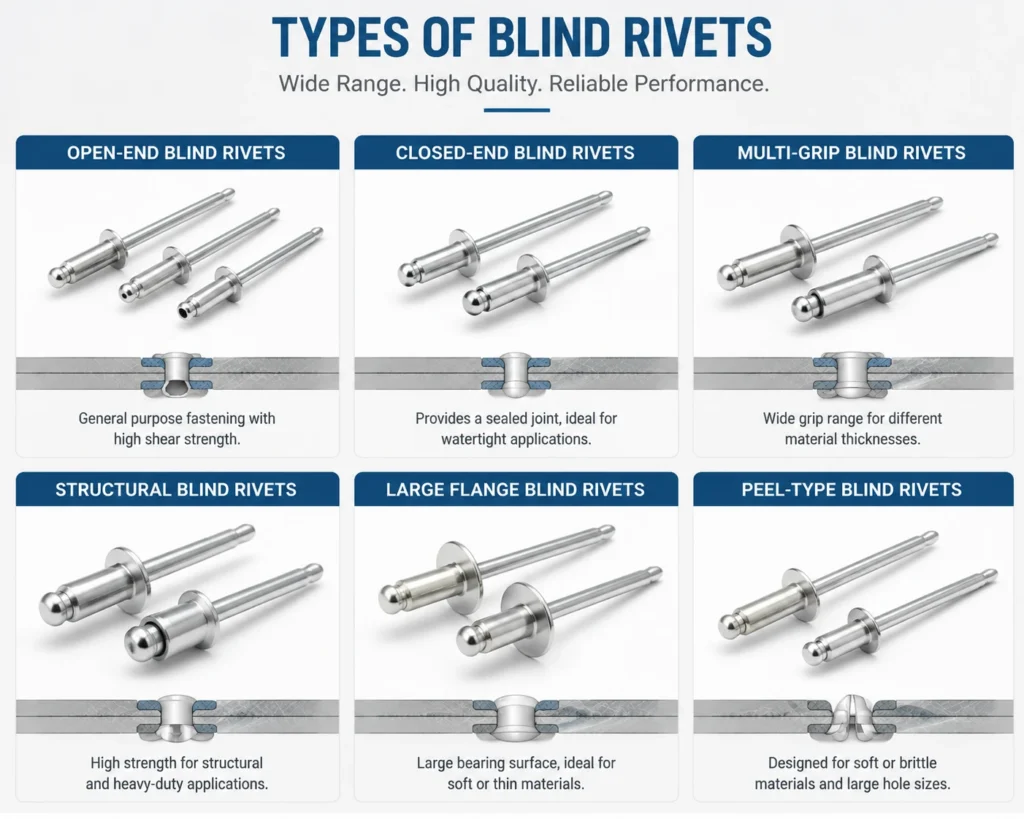
In addition to product breadth, technical capability is key. The manufacturer should be able to advise on suitable types, materials, and grip ranges for applications in automotive, construction, electrical enclosures, HVAC, and general industrial equipment.
Questions to ask
What types of blind rivets do you manufacture?
Can you recommend suitable rivets based on application requirements?
Do you support custom specifications?
Can you provide technical drawings and product data?
Section 3: OEM & Supply Capability
6. OEM Customization and Engineering Support
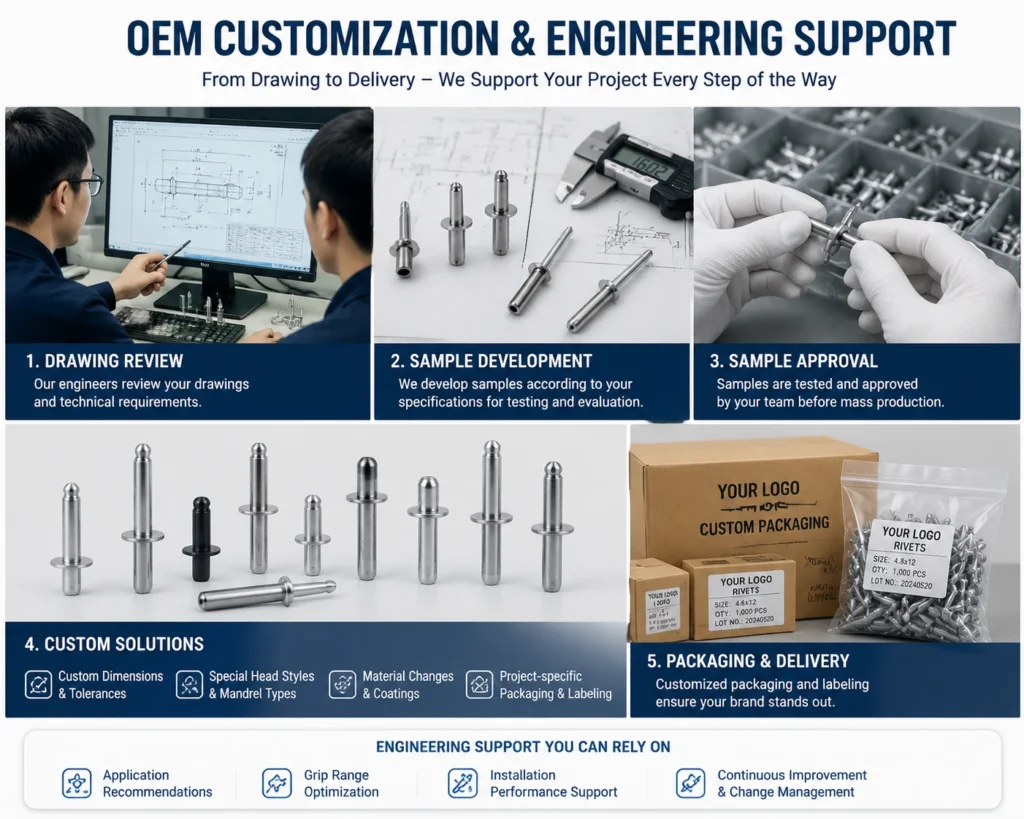
OEM projects often require more than catalogue standards. Buyers should confirm whether the manufacturer can support:
Custom dimensions and tolerances
Special head styles or mandrel types
Material changes and coatings
Project-specific packaging and labeling
Equally important is engineering support: drawing review, sample development, and application recommendations. A manufacturer with active engineering support can help buyers optimize joint design, grip range selection, and installation performance.
Questions to ask
Can you manufacture blind rivets according to drawings?
Do you support new product development?
Can your engineers recommend suitable rivet specifications?
What is your sample development process?
How do you manage changes after sample approval?
7. Lead Time and Delivery Reliability
Stable supply is critical for bulk orders and regular schedules. Buyers should evaluate:
Typical lead times for samples and mass production
Capacity planning during peak seasons
Ability to support forecasts and safety stock
On-time delivery record
Reliable production schedules reduce line-stop risk and help buyers plan production and inventory more confidently.
Questions to ask
What is your typical lead time for samples?
What is your production lead time for bulk orders?
How do you handle urgent orders?
Can you support forecast-based purchasing?
How do you communicate possible delays?
8. Export Experience and Global Customer Support
For international buyers, export experience and global support matter. A manufacturer familiar with shipping to Europe, the USA, Southeast Asia, and other regions will better handle:
Export documentation and compliance
Packaging standards for long-distance transport
Coordination with forwarders and logistics partners
Communication across time zones
Manufacturers with established global customers tend to have more robust processes and faster responses to overseas requirements.
Questions to ask
Which countries do you currently export to?
Do you have experience serving OEM customers?
Can you provide export documents?
How do you handle international communication?
Who will support technical questions after order placement?
Section 4: Long-Term Partnership
9. Pricing Structure and Long-Term Cost Value
Reliable manufacturers understand that buyers care about total cost, not just unit price. Instead of focusing purely on low prices, buyers should evaluate:
Pricing transparency for different volumes and specifications
Willingness to discuss cost optimization through design or process improvements
Impact of defect rates and delivery reliability on overall project cost
Value-based purchasing compares the full picture: cheap suppliers often bring higher defect rates, more hidden costs, and more management time. Reliable suppliers focus on stable quality and predictable long-term cost.
Questions to ask
How is your pricing calculated?
Do you offer volume-based pricing?
Can you suggest cost optimization options?
How do you maintain quality while controlling cost?
Can pricing remain stable for long-term cooperation?
10. After-Sales Service and Continuous Improvement
A professional blind rivet manufacturer should continue supporting customers after delivery. Long-term cooperation inevitably requires problem-solving, whether related to product improvement, application changes, quality feedback, or new requirements.
The difference between average suppliers and reliable partners is often reflected in how they handle problems. A responsible manufacturer should:
Identify the problem
Analyze the root cause
Provide corrective action
Prevent similar issues in future production
Questions to ask
How do you handle quality complaints?
How quickly can you provide feedback?
Do you provide corrective action reports?
How do you prevent repeated issues?
Do you support continuous improvement projects?
A supplier that takes responsibility after delivery demonstrates stronger commitment to customer success.
Red Flags to Avoid When Choosing a Blind Rivet Manufacturer
Selecting a blind rivet manufacturer is a long-term supply chain decision. While many suppliers can provide competitive quotations, not every supplier has the manufacturing capability, quality control systems, or technical support required for OEM and bulk orders.
1. Inconsistent Quality Between Samples and Mass Production
One of the most common challenges when sourcing industrial fasteners is the difference between approved samples and actual mass production. A supplier may provide high-quality samples during the quotation stage, but the production quality may change due to:
Different raw materials
Different production conditions
Lack of process control
Inconsistent inspection standards
For OEM buyers, sample approval is only the beginning. The real test is whether the manufacturer can maintain the same quality across repeated production batches.
How buyers can avoid this risk
Compare samples with production batches
Confirm inspection standards in advance
Request quality records
Define product specifications clearly
Consider pilot orders before full production
2. No Clear Quality Documentation or Testing Records
Professional industrial buyers need more than verbal quality promises. A manufacturer should be able to provide appropriate documentation to support product reliability.
Important documents may include:
Material certificates
Inspection reports
Test records
Product specifications
Batch information
For OEM applications, these records may also be required for customer audits, internal approval processes, and quality verification.
How buyers can avoid this risk
Ask what quality documents can be provided
Confirm whether inspection records are maintained
Ask whether products can be traced by production batch
Check whether customer quality audits are supported
3. Extremely Low Prices Without Clear Quality Control
A significantly lower quotation may appear attractive, but it can sometimes indicate differences in material selection, manufacturing processes, inspection standards, or production responsibility.
In industrial sourcing, the cheapest supplier is not always the most cost-effective supplier. A low purchase price can become expensive if it creates:
Higher defect rates
Production delays
Additional inspection costs
Customer complaints
How buyers can avoid this risk
Compare product specifications carefully
Confirm material requirements
Review testing standards
Check packaging details
Evaluate production capability
4. Poor Communication and Slow Problem Resolution
For overseas buyers, communication quality is an important part of supplier reliability. Technical misunderstandings can lead to incorrect product selection, production delays, specification errors, and project risks.
Warning signs include:
Slow responses
Unclear technical explanations
Avoiding responsibility
Lack of engineering support
How buyers can avoid this risk
Evaluate response speed
Check technical knowledge
Confirm the ability to understand drawings
Observe willingness to solve problems
A reliable supplier should act as a technical partner rather than simply process purchase orders.
How to Compare Multiple Blind Rivet Manufacturers Before Making a Decision
Choosing between multiple suppliers can be challenging. Many manufacturers may appear similar based on product range, price quotations, and basic certifications. However, long-term performance depends on deeper factors.
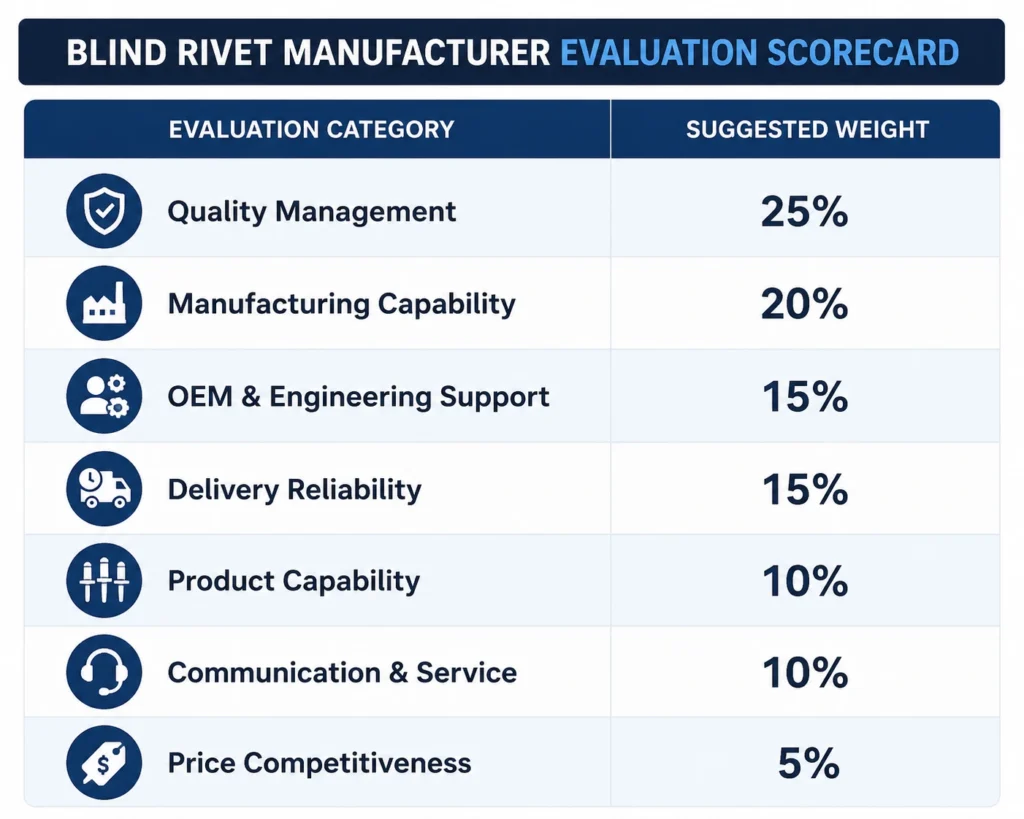
Build a Blind Rivet Manufacturer Evaluation Scorecard
A supplier scorecard allows purchasing and engineering teams to compare manufacturers using consistent criteria. Recommended evaluation categories:
Why quality should rank higher than price: for industrial fastening components, quality issues often create costs far beyond the original purchase price. A supplier evaluation system should prioritize product reliability, production stability, technical capability, and delivery performance.
Test Samples Before Large Orders
Sample evaluation is an essential step before establishing long-term cooperation. However, samples should be tested using the same standards expected for future production.
Recommended Supplier Qualification Process
Step 1: Define Requirements
Confirm:
Rivet type
Material
Diameter
Grip range
Application requirements
Performance expectations
Step 2: Evaluate Samples
Check:
Dimensions
Appearance
Assembly performance
Mechanical properties
Step 3: Verify Production Capability
Before moving to large-scale purchasing:
Review production capability
Confirm inspection procedures
Consider a pilot order
This approach reduces supplier selection risks and improves long-term cooperation success.
Involve Both Purchasing and Engineering Teams
Supplier selection should not be based only on purchasing factors. Different teams evaluate different risks.
Purchasing team focus
Price
Lead time
Payment terms
Supply stability
Engineering team focus
Product suitability
Performance requirements
Material selection
Application risks
Why cross-functional evaluation matters: a supplier that offers a low price but lacks technical capability may create problems later. The best supplier decisions come from combining commercial evaluation with engineering judgment.
Blind Rivet Manufacturer Evaluation Checklist: 10 Questions to Ask Before Buying
Choosing a reliable supplier becomes easier when buyers use a structured checklist. This checklist can be used for:
Supplier meetings
RFQ evaluation
Internal approval processes
Engineering reviews
Supplier comparison
Supplier Evaluation Checklist
Are you a direct blind rivet manufacturer or a trading company?
Understanding the supplier’s actual manufacturing capability helps buyers evaluate quality control and production responsibility.What quality certifications and inspection systems do you have?
Check certifications, inspection procedures, and testing capability.Can you provide material certificates and batch traceability?
This helps confirm material consistency, production control, and product reliability.What is your production capacity for bulk orders?
Evaluate whether the supplier can support current demand, future growth, and repeat purchasing programs.Can you support OEM customization based on drawings?
Confirm capability for custom sizes, special designs, and application requirements.What testing methods do you use for blind rivets?
Ask about tensile testing, shear testing, corrosion testing, and dimensional inspection.What are your typical sample and production lead times?
Understand development timelines, production schedules, and delivery reliability.How much experience do you have with international customers?
Evaluate export experience, documentation capability, and communication efficiency.How do you handle quality issues?
Understand response processes, root cause analysis, and corrective actions.Can you support long-term supply cooperation?
A suitable supplier should support repeat orders, product improvements, and demand changes.
Download Free Blind Rivet Manufacturer Evaluation Checklist
For purchasing teams comparing multiple suppliers, a structured evaluation template can save time and improve decision accuracy. The free checklist can include:
Supplier information sheet
Quality evaluation section
Manufacturing capability scoring
OEM capability assessment
Delivery performance review
Final supplier comparison score
 Need Help Evaluating a Blind Rivet Manufacturer?
Not sure how to compare suppliers for your OEM or bulk project? Download our free blind rivet manufacturer evaluation checklist or send your current specifications to our engineering team for professional feedback.
Send Your Drawing
https://www.rivetfast.com/contact-us/
FAQ: Common Questions About Choosing a Blind Rivet Manufacturer
Choosing a reliable blind rivet manufacturer requires careful evaluation of product quality, manufacturing capability, and supplier reliability. Below are some common questions from international buyers, OEM companies, and industrial distributors.
1. What should I look for when choosing a blind rivet manufacturer?
A reliable blind rivet manufacturer should be evaluated based on more than product price. Key factors include:
Quality management system
Manufacturing capability
Raw material control
Testing capability
OEM support
Delivery reliability
Export experience
After-sales service
For OEM and bulk orders, buyers should focus on long-term supply reliability rather than selecting suppliers based only on the lowest quotation.
2. What is the difference between a blind rivet manufacturer and a trading supplier?
A blind rivet manufacturer directly controls production processes, quality management, and manufacturing capability. A trading supplier may provide access to multiple factories but usually has less control over production consistency, manufacturing processes, technical support, and quality improvement.
For standard spot purchases, both options may work. However, for OEM projects, repeat orders, and customized requirements, working directly with a manufacturer often provides better communication, stronger quality control, and more reliable supply.
3. How can I verify whether a blind rivet supplier is a real manufacturer?
Before cooperation, buyers can check:
Factory location
Production equipment
Manufacturing processes
Quality certificates
Product testing capability
Production photos or videos
Previous export experience
A professional manufacturer should be able to clearly explain how products are produced, inspected, and delivered.
4. What information does a manufacturer need to recommend the right blind rivet?
To recommend a suitable blind rivet solution, manufacturers usually need information such as:
Material thickness
Required grip range
Joint requirements
Base material
Application environment
Required strength
Corrosion requirements
For OEM applications, drawings or existing product specifications can help engineers provide more accurate recommendations.
5. How do I avoid quality inconsistency when sourcing blind rivets from different factories?
To reduce quality risks:
Work with manufacturers that have documented quality systems
Confirm product specifications clearly
Request samples before bulk production
Use consistent inspection standards
Maintain communication about material or process changes
Long-term cooperation with one qualified manufacturer is often more effective than frequently changing suppliers.
6. Can a blind rivet manufacturer provide customized products?
Yes, many professional manufacturers can support customized blind rivet requirements. Customization may include:
Different dimensions
Special materials
Specific head styles
Customized packaging
Application-specific solutions
However, buyers should confirm the supplier’s engineering capability and production experience before starting customization projects.
7. What documents can blind rivet manufacturers provide for OEM projects?
Depending on customer requirements, manufacturers may provide:
Product specifications
Material certificates
Inspection reports
Test records
Quality documents
Shipping documentation
For industries with strict quality requirements, documentation capability is an important part of supplier evaluation.
Why Choose RivetFast as Your Blind Rivet Manufacturing Partner?
Selecting the right supplier is ultimately about finding a manufacturing partner that can support your business requirements over time. RivetFast focuses on providing industrial fastening solutions for global OEM buyers, distributors, and manufacturers.
Professional Blind Rivet Manufacturing Capability
Unlike general hardware suppliers, RivetFast focuses on blind rivets and related fastening products. This specialized approach allows deeper attention to:
Product consistency
Manufacturing processes
Application requirements
Customer-specific solutions
Stable Bulk Production for Industrial Buyers
For OEM and distribution customers, supply stability is essential. RivetFast supports bulk orders through:
Structured production processes
Quality control procedures
Production planning
Repeat order management
The goal is to help customers maintain reliable supply for long-term projects.
OEM and Custom Fastening Support
Different applications require different fastening solutions. RivetFast supports customers with:
Product selection assistance
Drawing evaluation
Customized requirements
Technical communication
From initial sample evaluation to mass production, the focus is on helping customers achieve reliable fastening performance.
Quality-Controlled Manufacturing Process
Reliable fastening starts with controlled manufacturing. RivetFast applies quality management practices throughout production, including:
Material inspection
Process monitoring
Product inspection
Performance verification
This helps ensure consistent product quality across repeated orders.
Global Export Experience
International customers require more than product supply. They need a supplier that understands:
Export procedures
Packaging requirements
Technical communication
International purchasing processes
RivetFast works with overseas customers by providing responsive communication and stable supply support.
Need Help Evaluating a Blind Rivet Manufacturer?
Finding the right supplier can be challenging, especially when comparing multiple factories for OEM or bulk orders. Whether you are:
Developing a new product
Replacing an existing supplier
Expanding your fastening supply chain
Looking for a reliable long-term partner
RivetFast can help evaluate your requirements.
You can send:
Product drawings
Current specifications
Application details
Estimated order volume
Our team can provide:
Product selection recommendations
OEM feasibility evaluation
Sample support
Bulk order quotation
https://www.rivetfast.com/contact-us/
Fast response for industrial buyers and customized fastening requirements.