Two blind rivets can sit on the same purchase list at visibly different prices. The quotation will not say where the difference comes from, or whether the joint needs it. A price list answers how much a rivet costs. It does not answer whether that money belongs here.
Performance the joint does not require is not value; it is cost.
That does not mean the lowest-priced rivet is the goal. It means every cost tier has to trace back to a reason — a requirement of the joint, or a condition of the purchase.
The useful comparison is therefore not price alone, but where the difference comes from, what the joint asks for, and what that difference represents.
What Makes One Blind Rivet More Expensive Than Another?
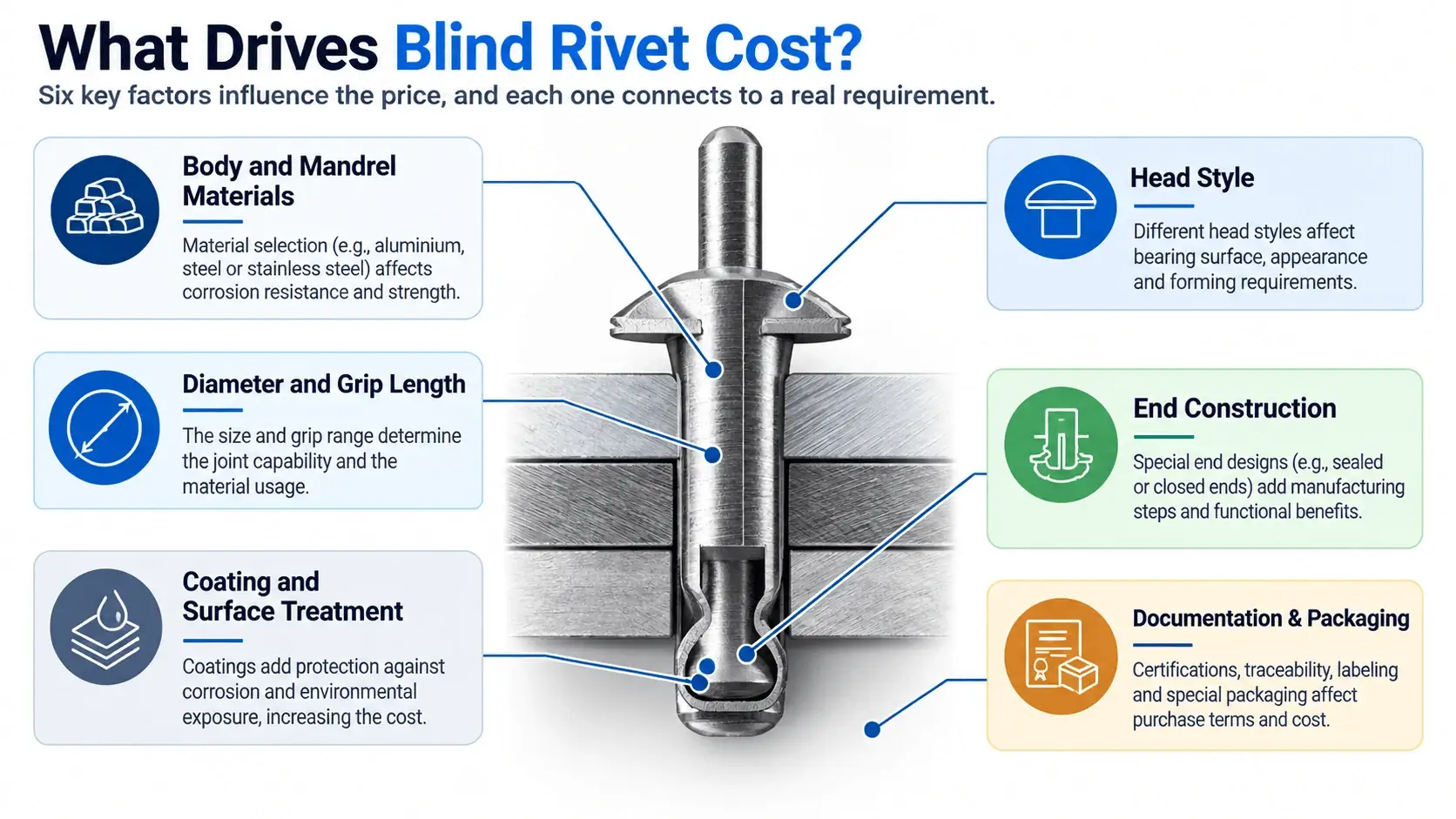
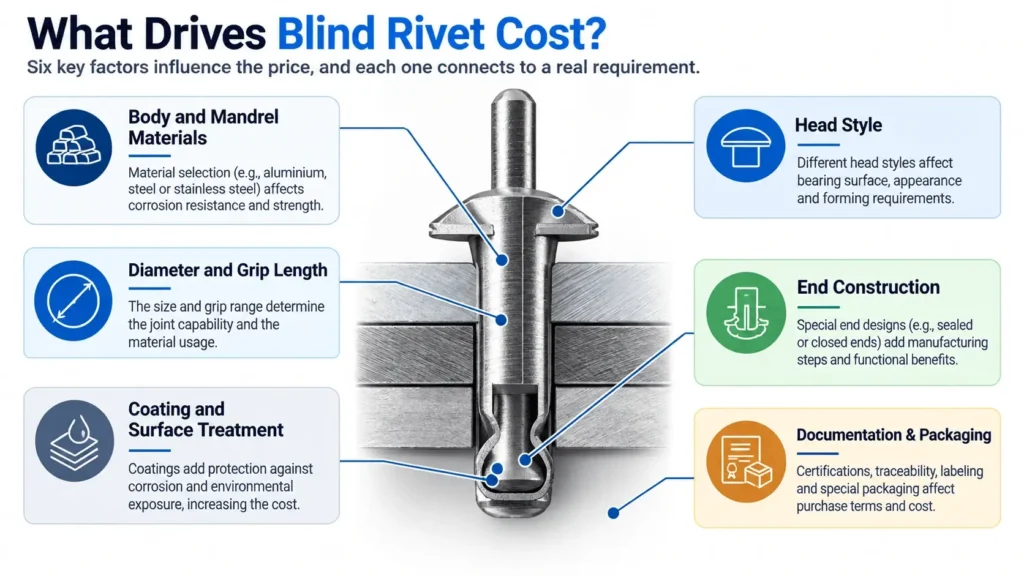
Most of the price difference between two blind rivets comes from a handful of cost drivers, and each driver is tied to material, geometry, construction or documentation.
Two rivets of the same diameter can still sit in different cost tiers, and not every part of that difference comes from the joint.
Six drivers carry that difference: the material family of the body and the mandrel, diameter and grip length, head style, end construction, coating, and documentation and packaging. Head style can affect material use, forming requirements and the finished joint configuration. End construction carries extra manufacturing and configuration requirements where a joint function calls for it. Coating adds a process step over the base material. Documentation and packaging can add certification, traceability, labeling or special packing requirements that do not change the rivet itself.
Table 1 — Where the Price Comes From
| Cost driver | What moves it | What the added cost represents |
|---|---|---|
| Body and mandrel materials | Exposure and load requirements | A joint requirement |
| Diameter and grip length | The joint stack and the load requirements | A joint requirement |
| Head style | Bearing surface and finish requirements | A joint requirement, where it exists |
| End construction | Containment or sealing requirements | A joint requirement, where it exists |
| Coating and surface treatment | Exposure beyond the base material | A joint requirement, where it exists |
| Documentation and packaging | Purchase terms, not the joint | A purchase requirement |
A cost driver either answers a requirement of the joint, or it follows the way the order is placed. A driver that does neither is a cost with no reason behind it.
Read the third column that way. One row in the table follows the purchase, not the joint. Not every legitimate cost is performance-driven. Some costs come from the way the product is purchased, packaged, documented or delivered.
Which of those tiers an application actually needs is decided further back, where the joint is described.
Which Performance Does Your Joint Actually Require?
Requirements are read from the joint, not from the catalogue.
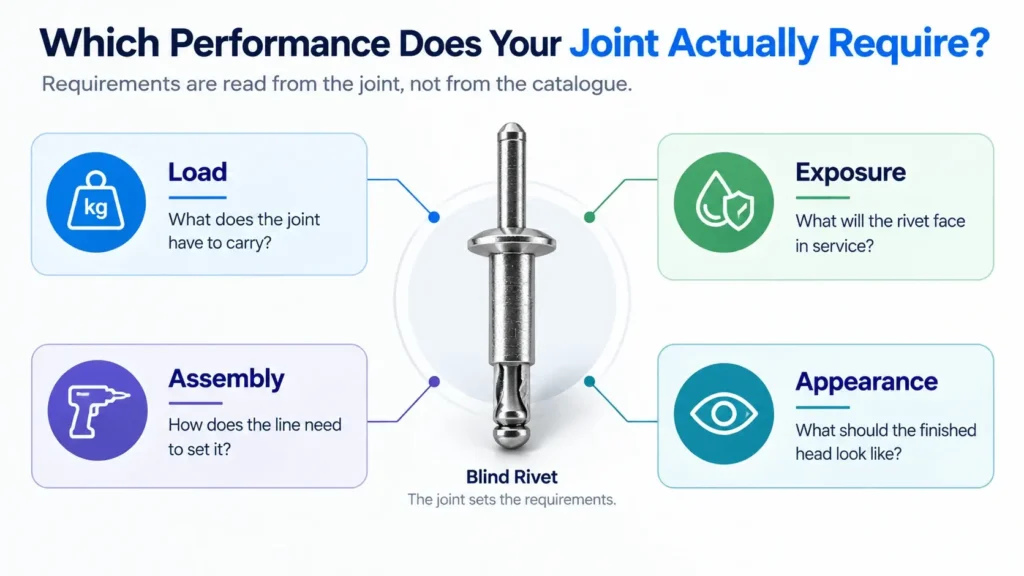
The requirements come from four directions. Load — what the joint has to carry. Exposure — whether moisture, contamination or a mixed-metal contact is actually present where the rivet sits. Assembly — single-side access, how the line has to set the rivet, and how many part numbers it can carry. Appearance — how flat and how visible the finished head is on the exposed face.
None of the four carries more weight than the others by default. Which one governs is a property of the application, not of the rivet.
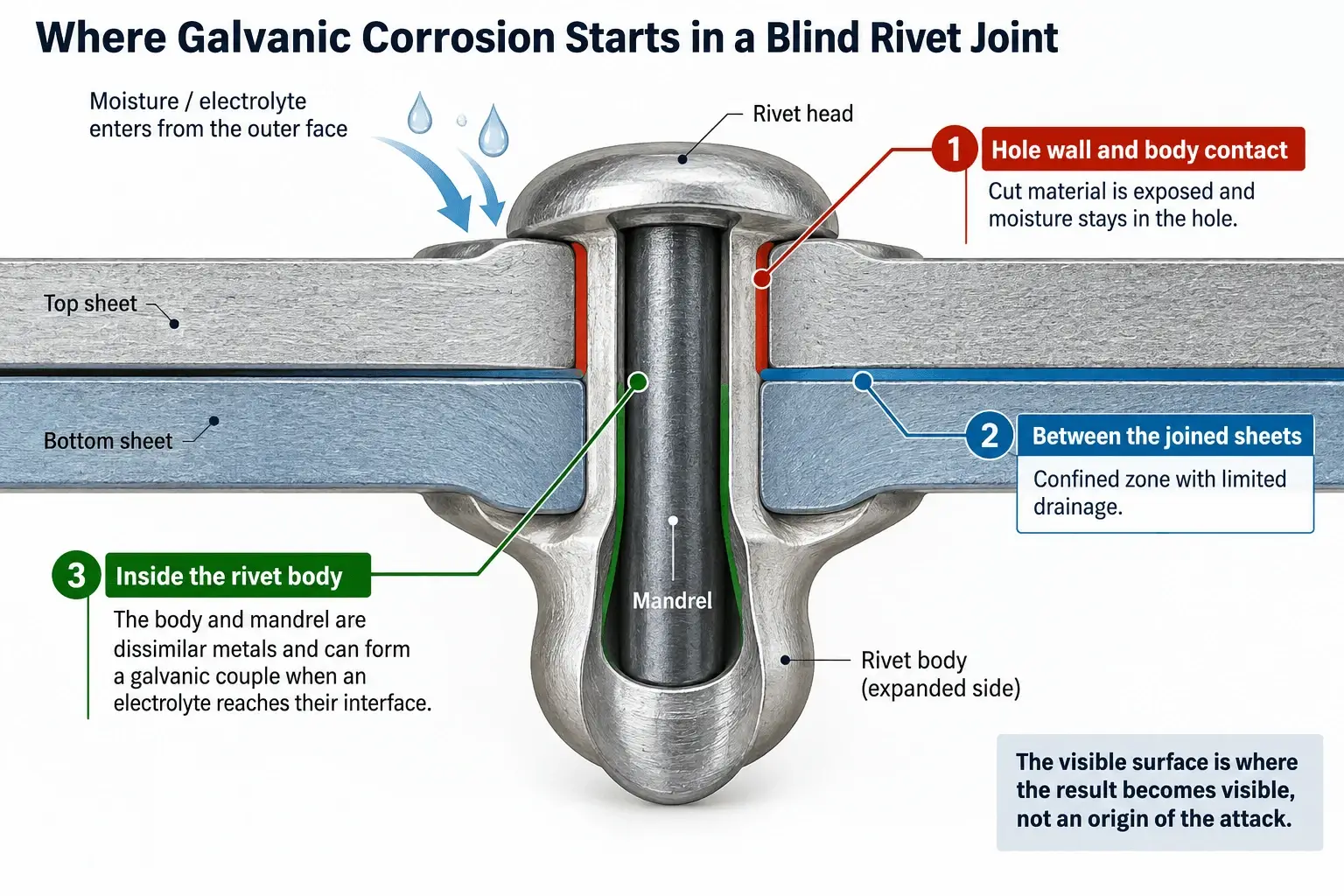
That is where a preference and a requirement part company. A stainless body may be specified on a part where nothing in service asks for the corresponding material characteristics — and the tier is still paid for. A preference without a requirement behind it can move the specification into a higher cost tier.
Once the requirements are listed, the price list becomes readable for the first time: each tier can be checked against something on the joint side.
Where the load requirement has to become a number for comparison, the strength values and what they mean are covered separately.
When Does Paying More Actually Buy More Performance?
Not every performance difference carries a price difference, and not every price difference carries a performance difference. The table reads the directions one tier at a time.
Table 2 — From Requirement to Cost Tier
| Joint requirement | What it asks of the rivet | Cost direction |
|---|---|---|
| Load transfer | Diameter, grip length and body material | Higher tiers where the requirement governs |
| Exposure and corrosion | Material tier, coating, end construction | Higher tiers where the requirement governs |
| Assembly conditions | Tool compatibility and part-number concentration | Mixed — driven by the line, not the invoice |
| Appearance and finish | Head style, surface treatment | Higher tiers where the requirement governs |
| No requirement behind the tier | — | Cost without a defined return |
Paying more is justified where the joint has a requirement; otherwise, the added cost has no defined job to do.
The table separates requirement-driven cost from line-driven cost. Load, exposure and appearance can move the specification into a different tier where the requirement calls for it, while assembly conditions land on the line as tooling, part-number concentration and installed cost rather than in the quoted tier. A small order quantity, a pack size or an expedited delivery can move the price as well, but those follow the way the order is placed rather than the joint.
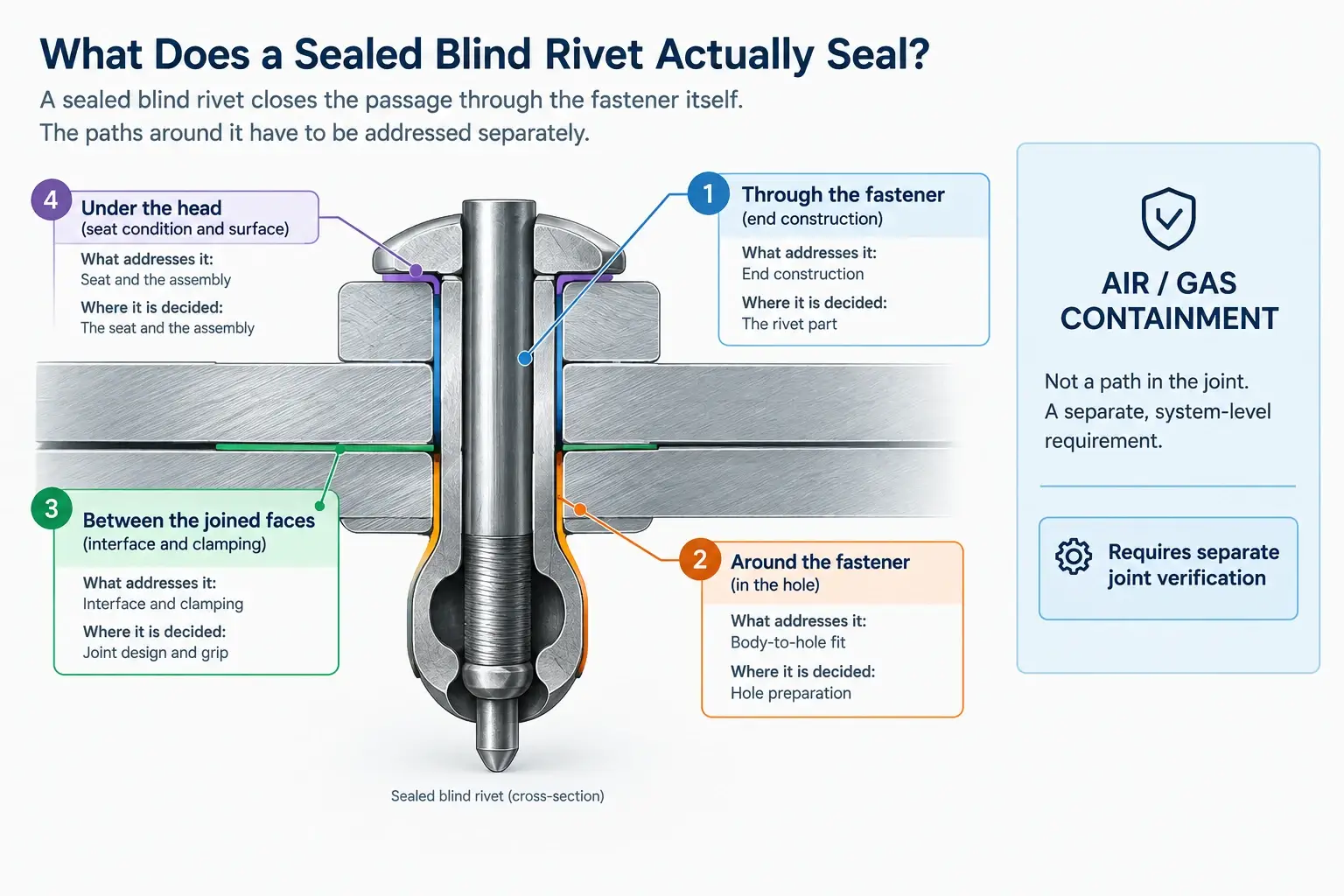
Where the exposure requirement points to a sealed configuration, the application conditions for that choice are covered separately.
What Does a Blind Rivet Really Cost Once It Is Installed?
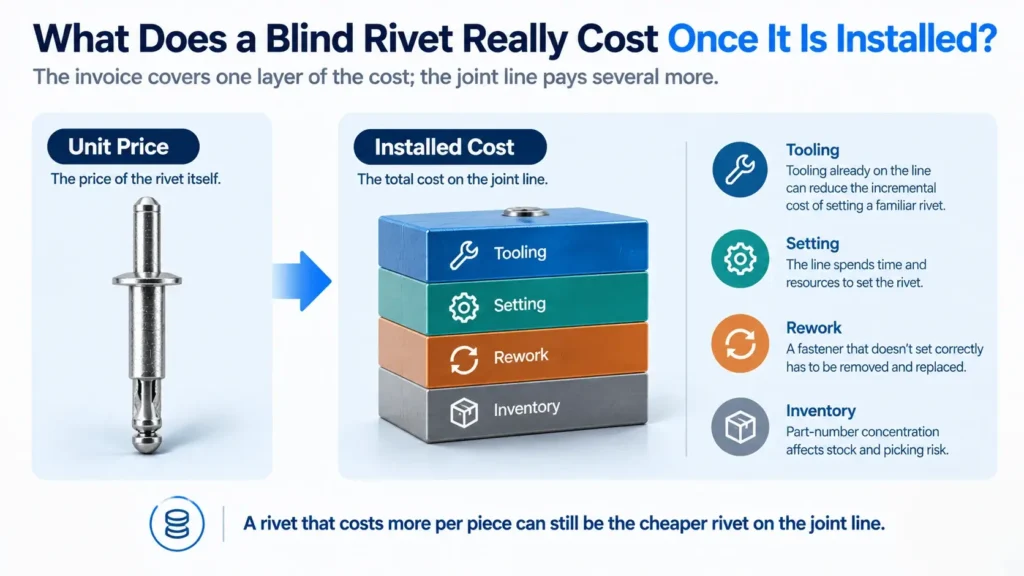
The invoice covers one layer of the cost; the joint line pays several more.
Beyond the unit price, the line carries its own cost of putting the rivet in. Tooling already in place can reduce the incremental cost of setting a familiar rivet, while a specification change may introduce additional tooling or handling requirements. Part-number concentration decides how much stock and how much picking risk the line carries. And a rivet that has to be removed and replaced carries a cost beyond its piece price.
A rivet that costs more per piece can still be the cheaper rivet on the joint line.
Both accounts have to be read before the question moves on to what happens when the specification is wrong.
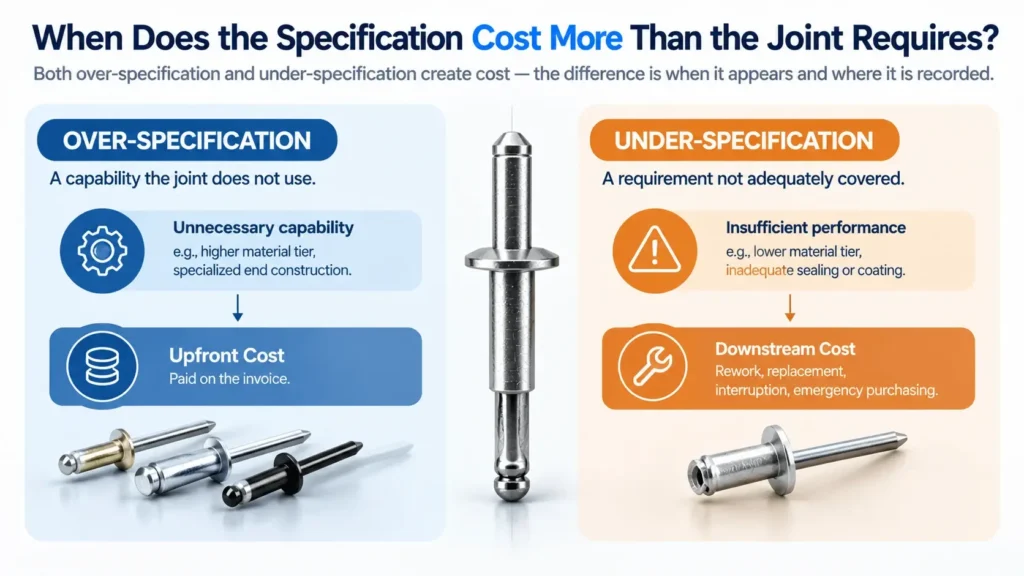
When Does the Specification Cost More Than the Joint Requires?
Over-specification often appears as an added cost on the invoice before anyone asks whether the joint actually requires it.
It appears in ordinary decisions. A higher material tier selected where nothing at the joint calls for it. A more specialized end construction may also add cost where the joint does not require the function it provides.
A capability the joint never requires still carries its cost into every order.
Higher tiers are not wrong; they are answers to requirements that have to exist first.
Where the end construction itself is the question, the differences between the two families and their applications are compared separately.
What Is the Cost of Being Wrong?
Both kinds of specification error create cost; the difference is when that cost becomes visible and where it is recorded.
On the under-specified side, an apparent unit-price saving can reappear as rework, replacement, line interruption or emergency purchasing. When a rivet falls short in service, the resulting cost can extend well beyond the rivet itself. Part of that bill never reaches the invoice at all; it is recorded on the line.
Over-specification is paid earlier rather than later: the tier is settled on the invoice, and nothing on the joint side ever asks for it.
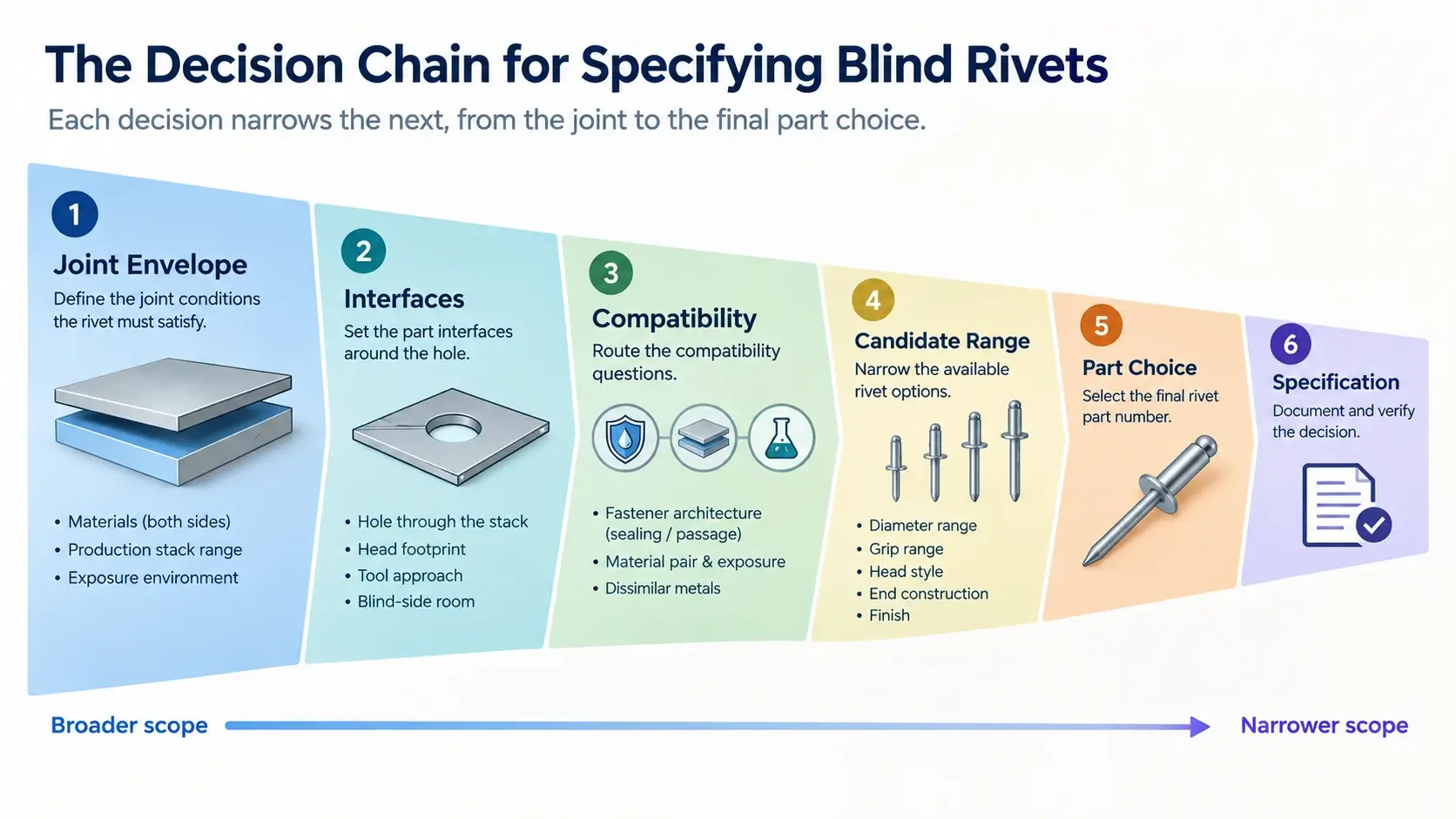
Cost decisions follow the same sequence as the specification: requirements first, part choice last.
The goal is to keep the costs that answer a real requirement and challenge the ones that answer nothing.
Where a joint does fail in service, the causes behind the failure are traced separately.
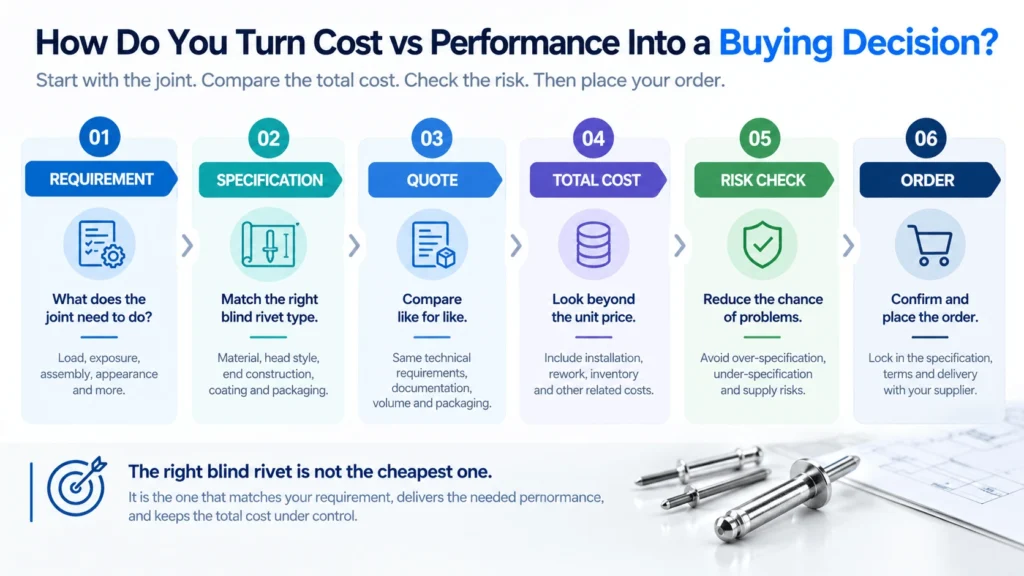
How Do You Turn Cost vs Performance Into a Buying Decision?
Quotes can only be compared when they answer the same joint.
A unit price is comparable only when the quotes are based on the same technical requirements, documentation requirements, volume breaks and packaging conditions. Where those differ, the lower number is not a cheaper rivet; it is a different offer.
A part number and a quantity leave gaps to be filled with assumptions, and the first round of prices is built on different joints. What the quote needs is the requirement behind the part: the application, the materials, the quantity and the environment.
Table 3 — What to Compare Between Quotes
| What to compare | Why unit price alone misses it | Where the answer comes from |
|---|---|---|
| Technical match to the joint | A lower-priced quote may not cover the same technical scope | The same joint requirements provided to every supplier |
| Documentation and traceability | Adds cost that only pays where the customer asks for it | Your customer’s or industry’s requirements |
| Quantity, volume breaks and lead time | Unit price moves with volume; the joint does not | The RFQ, stated once for all quotes |
| Packaging and labeling | Small packs cost more per piece and change line efficiency | How the line consumes the rivets |
| Consistency between batches | Batch variation can create downstream costs that are not visible in the unit price | Supplier process and sample verification |
A lower price does not correct a mismatch between the quote and the joint.
Blind rivet cost is settled where the requirement is written down — the price follows it, not the other way round.
Where the requirements turn into a specification a supplier can quote against, the sequence for building it is covered separately.
FAQ
1. Why do blind rivet prices vary so much between types?
Several drivers move at once: material tier, diameter and length, end construction, coating, and documentation or packaging. Two rivets that look alike can differ on any of them.
2. Are stainless steel blind rivets worth the extra cost?
The additional material cost can be justified when the application’s exposure requirements call for the relevant material characteristics. Where that exposure is absent, the tier is paid for without a requirement behind it.
3. Does a more expensive blind rivet mean a stronger joint?
A higher price does not automatically indicate a stronger joint. Strength is one dimension of the load requirement; it depends on the rivet specification and the joint requirements. Price can also reflect material, configuration, coating, documentation or packaging.
4. Is it cheaper to use one rivet type across the whole product?
Concentrating on fewer part numbers can simplify inventory, handling, picking and qualification. The same choice becomes over-specification where one tier is applied to joints that never ask for it, so concentration works best inside groups that share their requirements.
5. What should I compare besides unit price when I get quotes?
Technical match to the joint, documentation, quantity and lead time, packaging, and consistency between batches — all answered against the same requirement before the prices can be compared.
6. Can I cut cost by stepping down to a smaller rivet?
Diameter follows the joint’s requirements. Where they allow a smaller body, the unit-cost saving can be real; where they do not, the apparent saving can be offset by rework, replacement or other downstream costs.
Start With the Requirement, and the Price Follows
Requirements → matched specification → comparable quotes → total cost → a price that can be justified line by line.
Most of the difficulty in a cost comparison is not in the comparison itself but in what the quotes were built on. Once the requirement is written down, a line that does not answer it can be pointed at directly instead of argued about.
Balance is not found between cost and performance; it is found between the costs that have a reason behind them and the costs that do not.
Send us your application, joint materials, total material thickness, expected quantity, and service environment. We can review the requirement, narrow the cost tiers that apply, and support verification on a sample joint.