Introduction — The Cheapest Quote Can Become the Most Expensive Order
Two suppliers may quote what appears to be the same blind rivet, yet differ in material, specifications, performance, and quality control. A lower price is not automatically a red flag. The real risk is buying from a supplier whose product claims and capabilities cannot be verified.
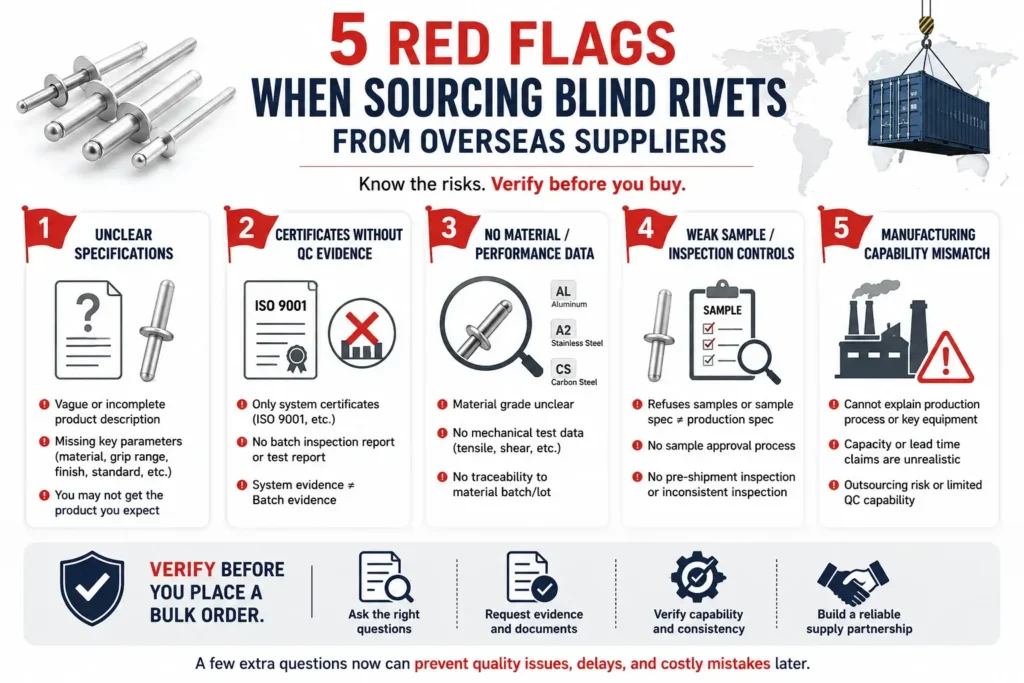
Before placing a bulk order when sourcing blind rivets from overseas suppliers, look for these five red flags and use the verification steps below to assess the supplier.
5 Red Flags to Watch For
- Unclear product specifications
- Certificates without quality evidence
- No clear material or performance data
- Weak sample and inspection controls
- Manufacturing capability mismatch
Red Flag #1 — The Supplier Cannot Clearly Explain What They Are Supplying
Vague Product Specifications
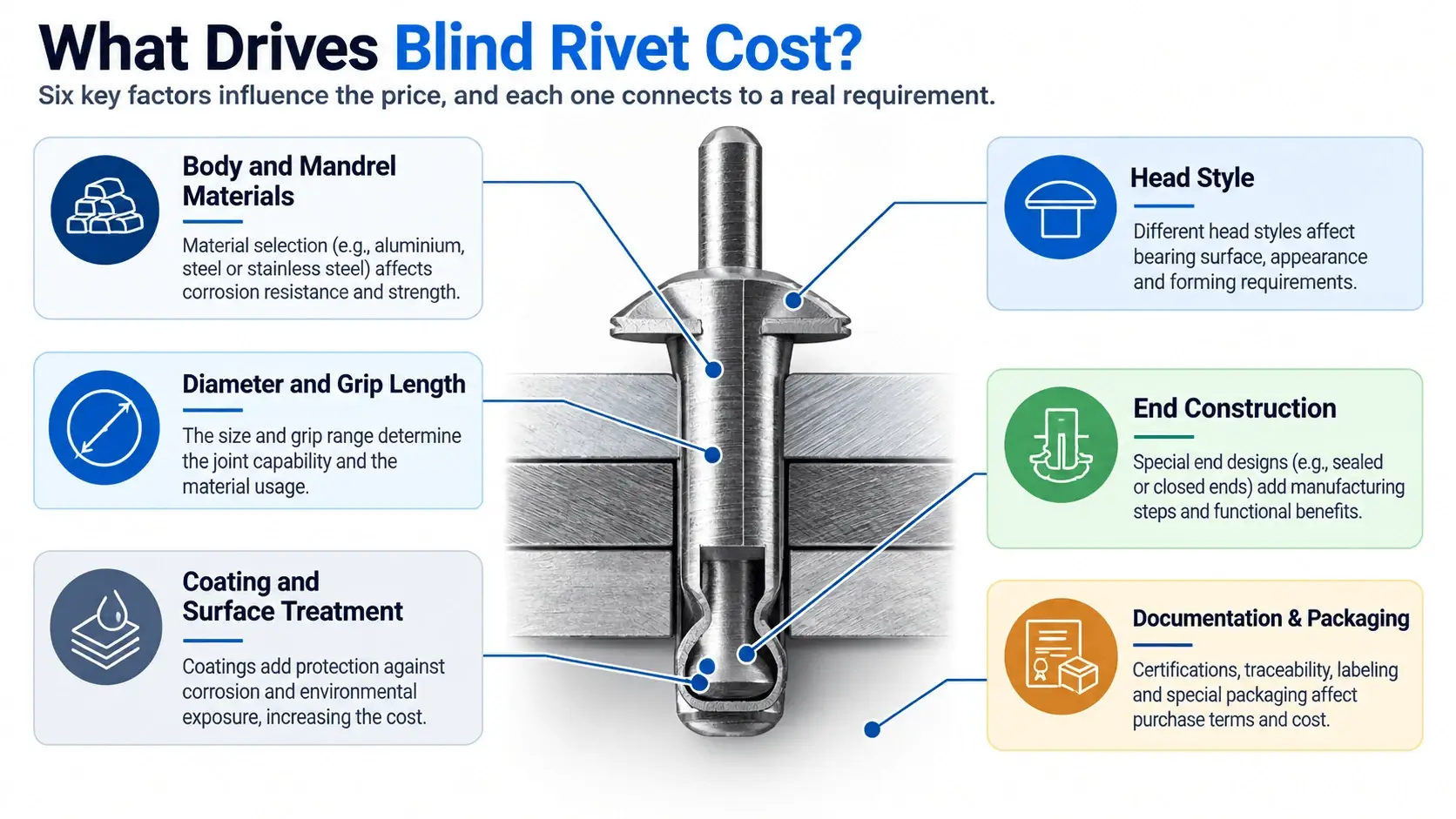
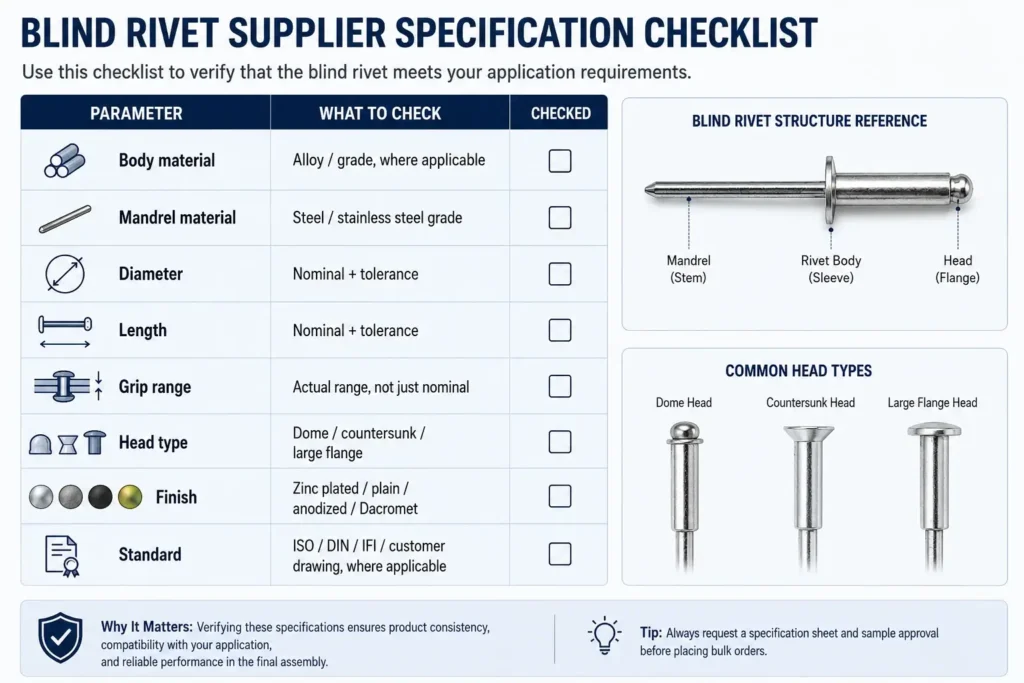
Some suppliers describe a rivet only as “3.2 × 8 mm blind rivet,” “Aluminum blind rivet,” or “Standard pop rivet.” That is not enough. You should be able to confirm the body and mandrel materials, diameter, length, grip range, head style, finish, and applicable standard before comparing suppliers.
Why This Matters
Two rivets with the same nominal size can perform differently. Where a standard is specified, ask the supplier to identify it and confirm that the supplied product meets its relevant requirements. For example, ISO 15973 covers dimensional characteristics, mechanical properties, and application data for closed-end blind rivets.
How to Verify
Request a complete Product Specification Sheet covering at least the following:
| Parameter | What to Check |
|---|---|
| Body material | Alloy / grade, where applicable |
| Mandrel material | Steel / stainless steel grade |
| Diameter | Nominal + tolerance |
| Length | Nominal + tolerance |
| Grip range | Actual range, not just nominal |
| Head type | Dome / countersunk / large flange |
| Finish | Zinc plated / plain / anodized / Dacromet |
| Standard | ISO / DIN / IFI / customer drawing, where applicable |
Our blind rivet material selection guide explains which specification parameters matter most for different applications.
Buyer Action: Don’t compare only the unit price — first confirm whether you are comparing the same specification. Comparing prices on different specifications is meaningless.
Red Flag #2 — The Supplier Has Certificates, But Cannot Prove Quality Control
A Certificate Alone Is Not Enough
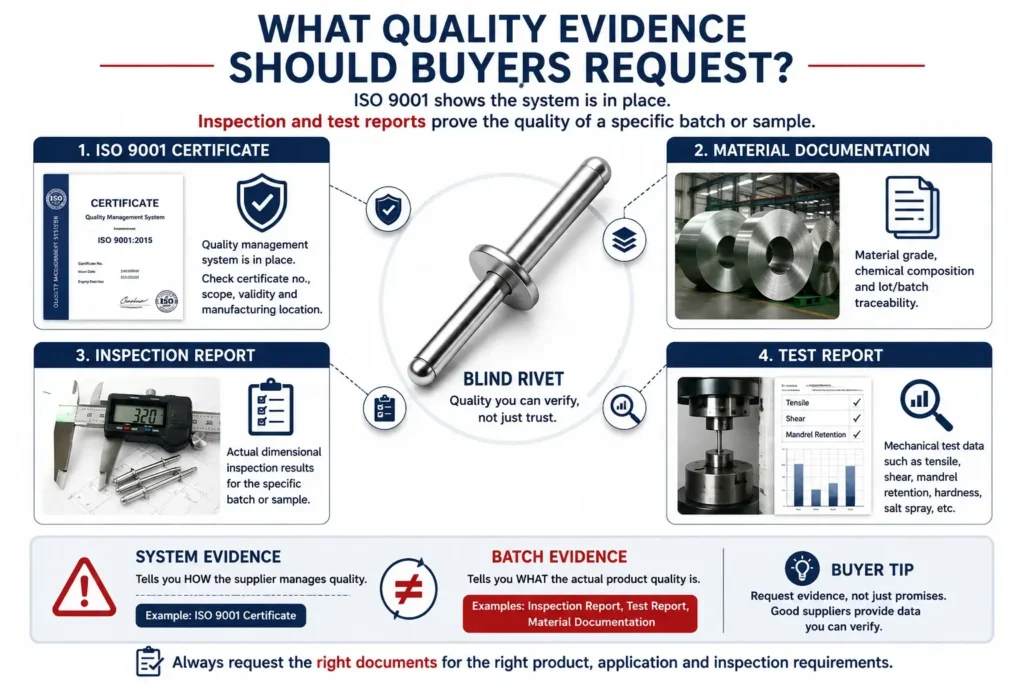
Certification is evidence of a quality management system — not proof that every batch of rivets is automatically good. When a supplier presents a certificate, check the certificate number, issuing body, scope, validity period, and whether the scope covers the relevant manufacturing activities.
Certificate vs Product Evidence
Buyers often confuse different types of quality documents. The table below distinguishes five common ones:
| Document | What It Tells You |
|---|---|
| ISO 9001 certificate | Quality management system is in place |
| Material certificate | Material identity and properties |
| Inspection report | Actual batch / product results |
| Test report | Specific test results (e.g., tensile, shear) |
| Certificate of conformity | Supplier’s conformity statement |
These documents are not interchangeable. ISO 9001 demonstrates a system, but inspection and test reports provide evidence of the measured quality or performance of a specific batch or sample.
What Quality Evidence Should You Request?
Ask how incoming materials, dimensions, mechanical performance and nonconforming products are controlled. Depending on the product and agreed inspection requirements, request relevant inspection reports, test reports, material documentation and, where appropriate, calibration records. For a full explanation of test methods and report interpretation, see our blind rivet quality testing reports guide.
Buyer Action: Don’t ask only “Do you have ISO 9001?” Ask “How do you control this rivet after production starts?”
Red Flag #3 — The Supplier Avoids Questions About Material and Mechanical Performance
Material Claims Are Too General
Claims like “Aluminum rivet,” “Stainless steel rivet,” or “High-strength rivet” are not enough for engineering procurement. You need to confirm the body material, mandrel material, material grade, hardness/mechanical properties where relevant, and surface treatment.
Material Traceability and Performance
Beyond simply stating a material, confirm whether it can be linked to a specific batch or lot — a claim without traceability cannot locate the cause if a quality problem occurs. For critical applications, material claims should be supported by traceability and relevant performance data. Depending on the product and application, buyers may need tensile, shear, mandrel retention, hardness or dimensional results. ISO 14589 covers mechanical testing of blind rivets.
What Buyers Should Request
| Ask the Supplier | Why It Matters |
|---|---|
| Material specification (grade) + batch/lot traceability | Confirms what you are buying and enables traceability |
| Mechanical test report | Confirms load performance |
| Dimensional inspection report | Confirms consistency |
| Sample testing | Validates before bulk order |
Buyer Action: For critical applications, follow the verification chain: dimension → material → mechanical performance → application fit.
Red Flag #4 — The Supplier Is Happy to Quote, But Weak on Samples and Pre-Shipment Inspection
Warning Signs
- Unwilling to send samples
- Sample and production product specifications do not match
- Unwilling to confirm a sample approval process
- Will not accept reasonable pre-shipment inspection
- Specifications change between sampling and mass production
Sample vs Pre-Shipment Inspection
A sample validates capability. Pre-shipment inspection verifies production consistency.
Sample validation answers: can this supplier make what I specified? Pre-shipment inspection answers: did the bulk order remain consistent with the approved specification? The two serve different purposes and cannot replace each other.
At the sampling stage, verify dimensions, grip range, material, finish and setting performance; test mechanical performance where required.
Recommended Pre-Order Process
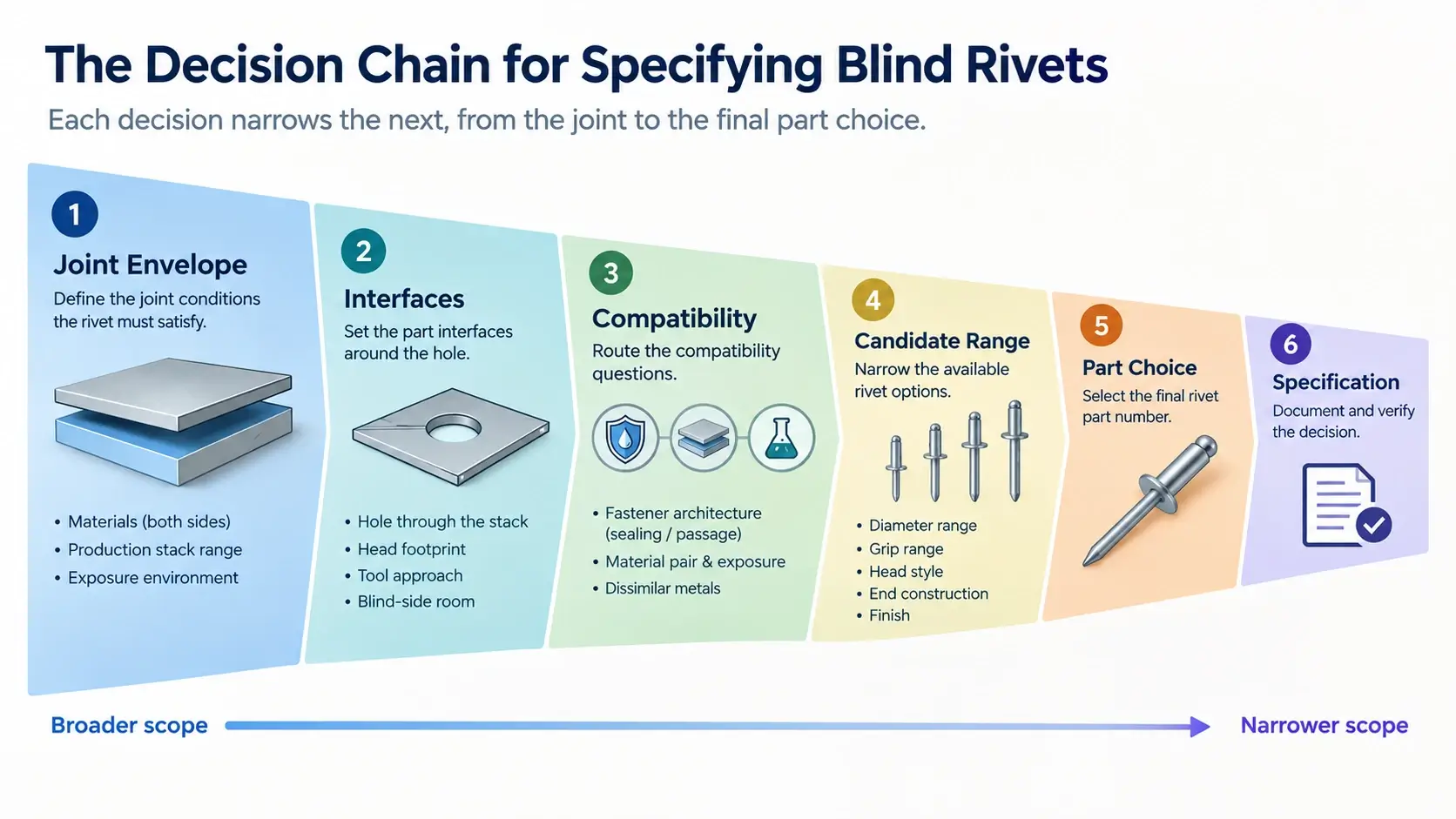
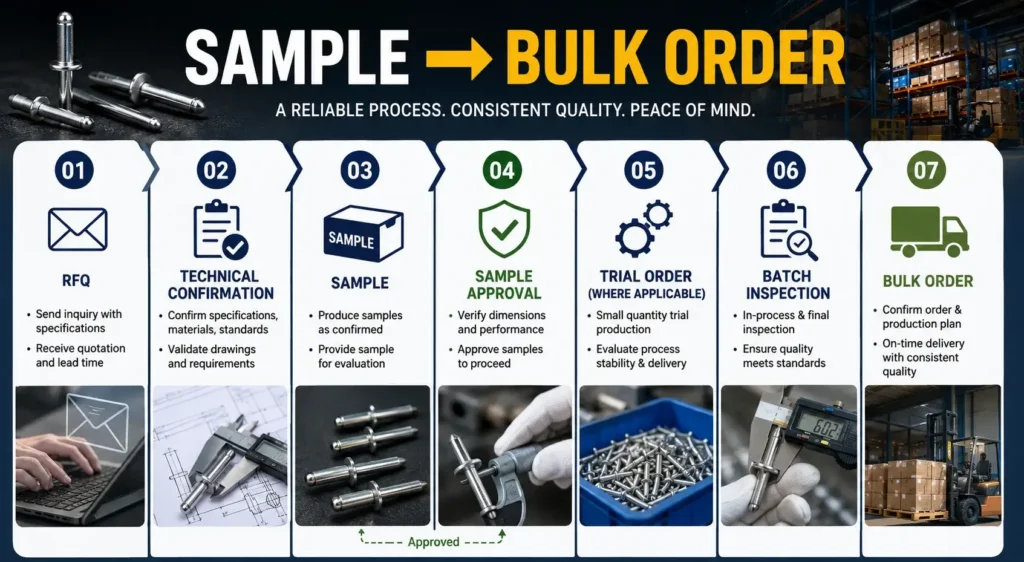
RFQ → Technical Confirmation → Sample → Sample Approval → Trial Order (where applicable) → Batch Inspection → Bulk Order
Buyer Action: Don’t move directly from RFQ to a large-volume PO. Validate the sample first, then confirm production consistency before shipment.
For MOQ and trial-order considerations, see our blind rivet MOQ and trial order guide.
Red Flag #5 — The Supplier’s Manufacturing Capability Does Not Match the Order
Signs of a Weak Manufacturing Setup
- Cannot explain the production process or key equipment
- Promises lead times that are clearly unrealistic
- Relies on subcontracting without disclosure
- QC equipment information is unclear
Ask About the Production Process
Raw Material → Cold Heading → Assembly → Surface Treatment → Inspection → Packaging
A supplier should be able to explain where the major manufacturing and inspection steps take place — and which processes are performed in-house versus outsourced. Our blind rivet manufacturing process guide covers the full production flow.
Check Capacity Against Your Order
The real sourcing risk is not “Is this a factory?” but “Can this supplier consistently produce and deliver your required volume and specification?”
- Production equipment (type, count, automation level)
- Monthly capacity for your specific rivet type and size
- Current lead time
- QC capacity (equipment + personnel)
Buyer Action: Ask the supplier to tie capacity data to your order volume — “Can you produce 500,000 pcs of this size within 4 weeks?” Ask how current workload affects the promised lead time. Capacity alone doesn’t guarantee delivery. For detailed capacity verification methods, see how to verify blind rivet production capacity.
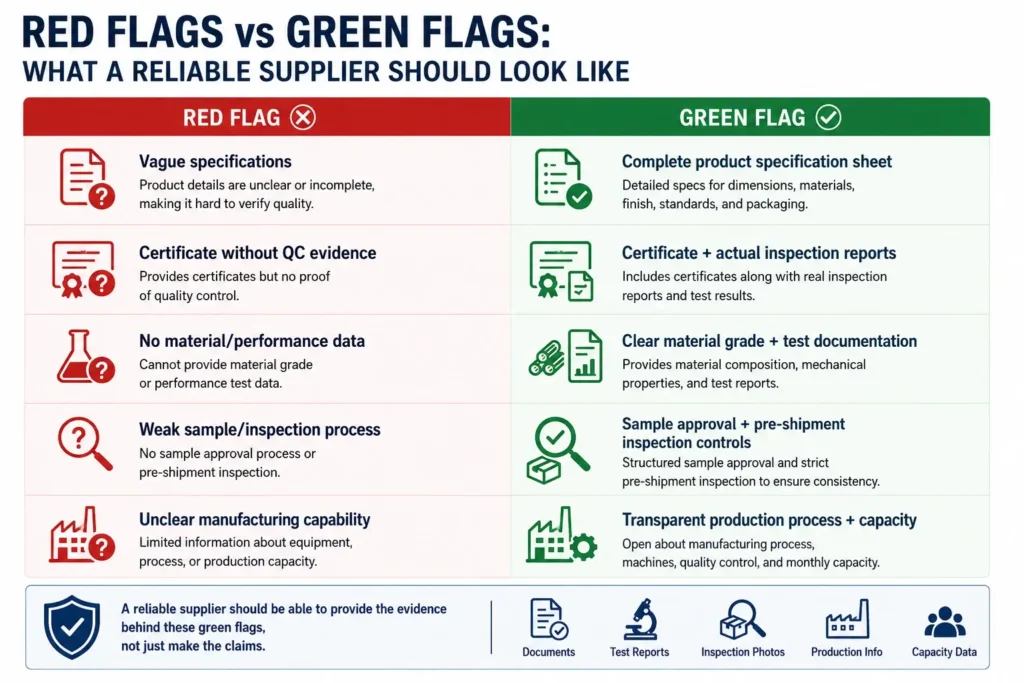
Red Flags vs Green Flags: What a Reliable Supplier Should Look Like
| Red Flag 🔴 | Green Flag 🟢 |
|---|---|
| Vague specifications | Complete product specification sheet |
| Certificate without QC evidence | Certificate + actual inspection reports |
| No material/performance data | Clear material grade + test documentation |
| Weak sample/inspection process | Sample approval + pre-shipment inspection controls |
| Unclear manufacturing capability | Transparent production process + capacity |
A reliable supplier should be able to provide the evidence behind these green flags, not just make the claims.
10 Questions to Ask a Blind Rivet Supplier Before Ordering
- What material are the rivet body and mandrel made from, and can you confirm the grade?
- What standard or specification does the rivet follow?
- What is the actual grip range for this size?
- What tolerances do you control on diameter and length?
- Can you provide dimensional inspection reports?
- What test data can you provide for this specific product and application?
- Which production processes are performed in-house, and which are outsourced?
- Can you provide samples before bulk production?
- How do you control batch-to-batch consistency?
- What inspection is performed before shipment?
Use these questions to collect evidence, not just answers.
Blind Rivet Supplier Verification Framework
- Verify the Company — Legal entity, manufacturing location and overall factory capability.
- Verify the Product — Complete specification sheet including material grade, dimensions, grip range, finish and applicable standard.
- Verify Quality — ISO 9001 certification scope, in-house inspection process, mechanical testing capability and batch-specific inspection reports.
- Verify Samples — Pre-production sample availability, sample approval process and performance testing results.
- Verify Bulk Order Controls — Approved specification locked in PO, batch identification, pre-shipment inspection and packaging requirements.
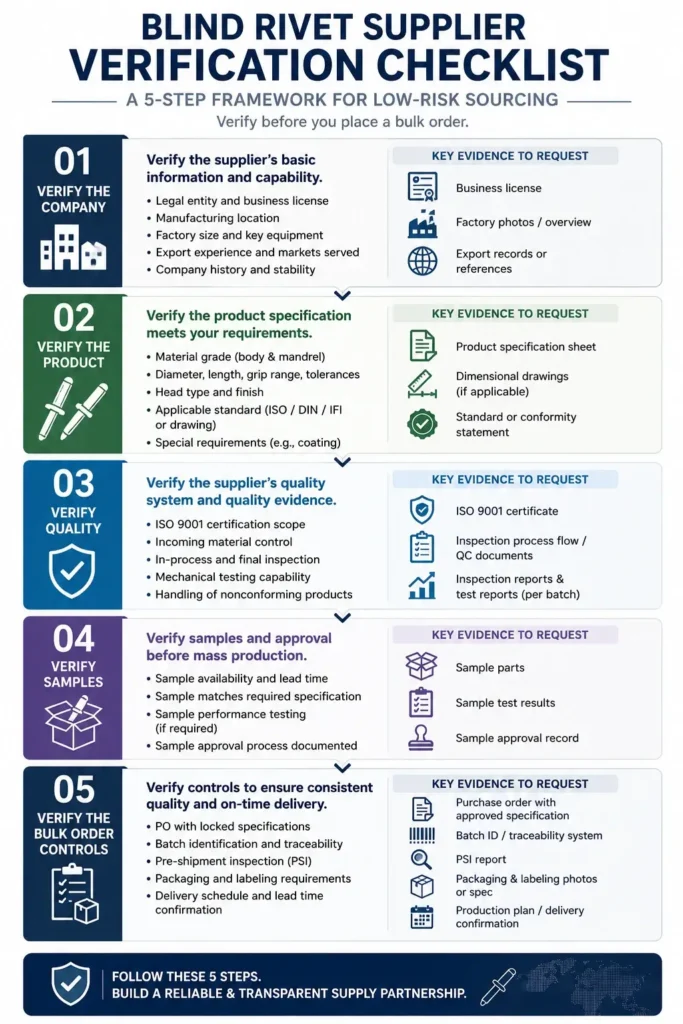
Save this five-step framework as your standard supplier evaluation checklist — each step maps to the questions and documents covered above.
How RivetFast Helps Buyers Reduce Sourcing Risk
Here is how RivetFast’s capabilities align with these verification criteria:
| Buyer Should Verify | RivetFast Capability |
|---|---|
| Product specification | Defined standard specifications and multiple material/head options |
| Quality evidence | ISO 9001 quality system and in-house testing capability |
| Material/performance data | Relevant documentation and test reports available according to requirements |
| Sample validation | Samples and trial orders can be discussed |
| Production capability | 5,000 m² facility, 200+ automated machines and 2 billion pcs annual capacity |
Learn more in our guides on how to verify blind rivet production capacity and custom blind rivets OEM guide for drawing-based requirements.
Conclusion
The biggest sourcing mistake is choosing a blind rivet supplier based on price before verifying capability.
Before placing a bulk order, confirm the product specification, quality evidence, material and performance data, sample validation process, and manufacturing capacity. Many sourcing failures happen because these requirements are not aligned before production begins.
Use the five-step verification framework before approving a new supplier, and request samples or test documentation when needed.
FAQ
Q1: How do I verify a blind rivet supplier overseas?
- A: Start with five areas: company capability, product specifications, quality evidence, sample validation and production controls. Request supporting documents rather than relying only on supplier claims.
Q2: What should I ask a blind rivet manufacturer before ordering?
- A: Ask about material grade, applicable standards, grip range, tolerances, testing data, sample availability, production controls and pre-shipment inspection.
Q3: How can I tell if a blind rivet supplier is a real manufacturer?
- A: Don’t rely only on a website or “factory” label. Ask the supplier to explain its manufacturing process, key equipment, production location, QC capability, capacity and which processes are performed in-house or outsourced.
Q4: Should I request samples before placing a bulk blind rivet order?
- A: Yes, especially for new suppliers, new specifications or critical applications. Samples help verify dimensions, materials, finish, grip range and setting performance before a bulk order.
Q5: What quality documents should I request from a blind rivet supplier?
- A: Specification sheet, inspection report, relevant test report, material documentation, surface-treatment documentation and certificate of conformity, depending on the project. ISO 9001 demonstrates the quality management system, not the conformity of a specific batch.
Q6: Is the lowest blind rivet price always the best option?
- A: A lower quote is not automatically a red flag. Ask what explains the difference—material, specification, production scale, finish, packaging, inspection requirements or commercial terms. If the supplier cannot explain the difference or confirm the specification, investigate further before ordering.