When sourcing blind rivets, buyers typically focus on material, diameter and length. However, understanding different blind rivet types is equally important because standard, multi-grip and structural blind rivets are designed for different strength, grip range and application requirements. Choosing the wrong type can lead to poor joint performance, installation issues, or unnecessary cost from over-specifying. The right blind rivet type can reduce installation problems, improve joint reliability, and optimize total fastening cost.
This guide covers the three most common blind rivet types — standard, multi-grip and structural — and helps you determine which type fits your application. For detailed size and grip range data, see our blind rivet size chart and specifications.
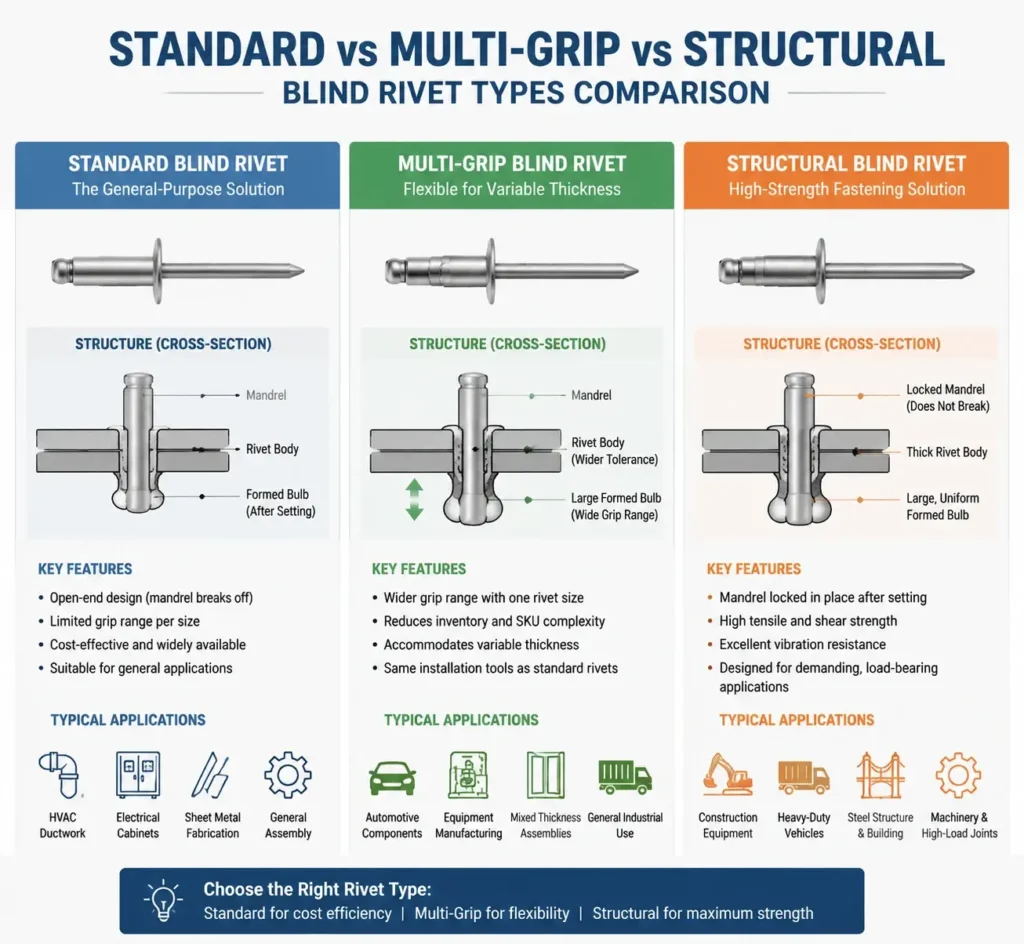
Why Choosing the Right Blind Rivet Type Matters
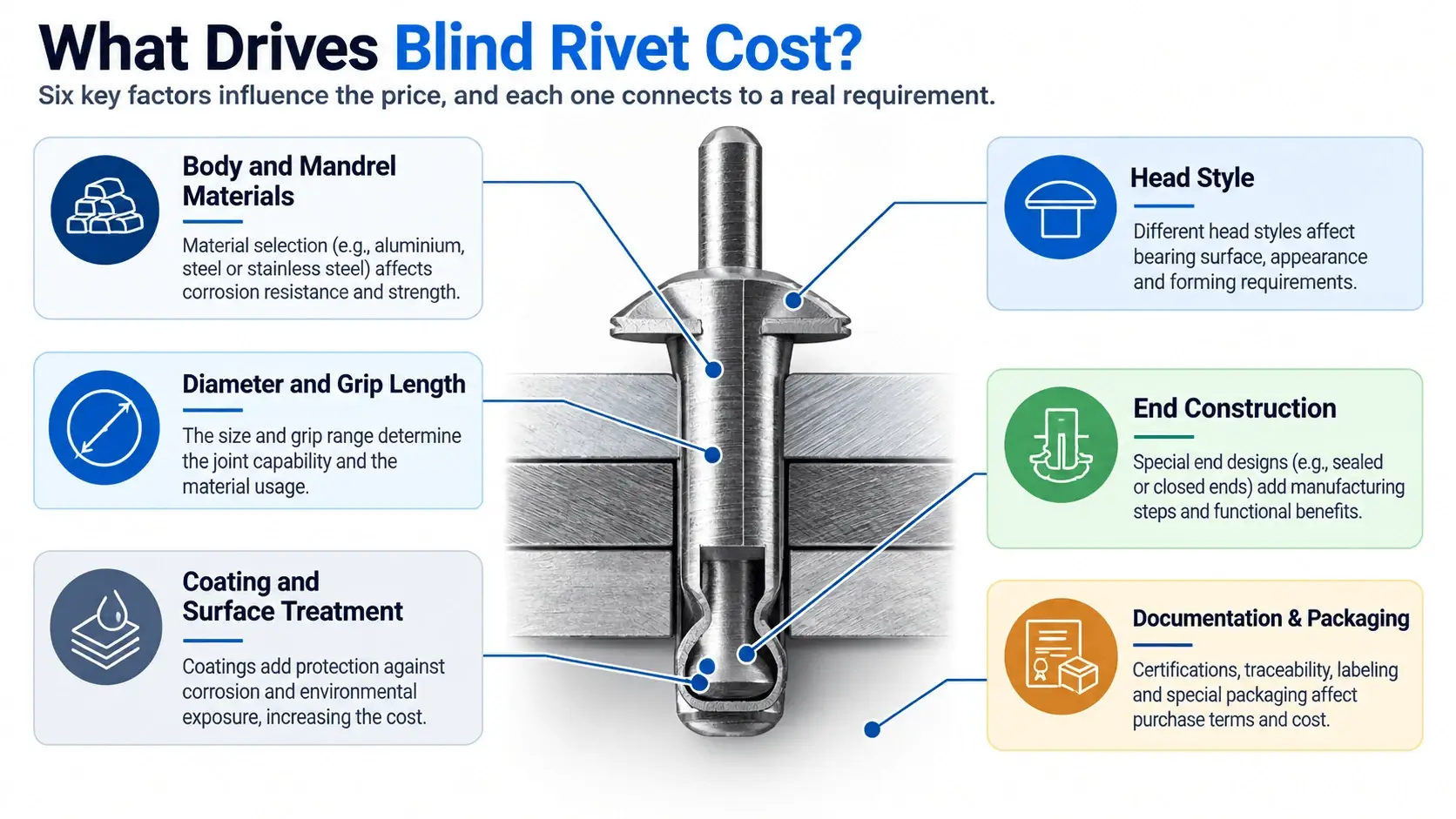
Blind rivet type directly affects joint reliability, installation success rate and cost efficiency. A common procurement mistake is focusing on material and size while overlooking how the rivet’s structural design influences real-world performance.
Three core factors should guide your type selection:
| Factor | Key Question |
|---|---|
| Strength | How much load does the joint carry? |
| Grip Range | Is material thickness consistent? |
| Environment | Indoor, outdoor, or vibration? |
Quick Decision Overview
If you need a fast reference before reading the full guide, use this table to narrow down your options:
| Your Requirement | Recommended Type |
|---|---|
| Lowest cost for general assembly | Standard blind rivets |
| Different material thicknesses | Multi-grip blind rivets |
| Maximum joint strength | Structural blind rivets |
A standard rivet used in a high-vibration joint may loosen over time. A structural rivet used in a light-duty sheet metal assembly adds cost without benefit. A multi-grip rivet used where thickness is consistent may be unnecessary when a standard rivet would suffice at lower cost. Matching the rivet type to your application requirements is the first step toward reliable, cost-effective fastening — and it prevents problems that are difficult to trace back to their root cause after installation.
Standard Blind Rivets: The General-Purpose Solution
Standard blind rivets are the most widely used type — and for good reason. They offer a simple structure, cost-effective pricing and easy installation with standard riveting tools.
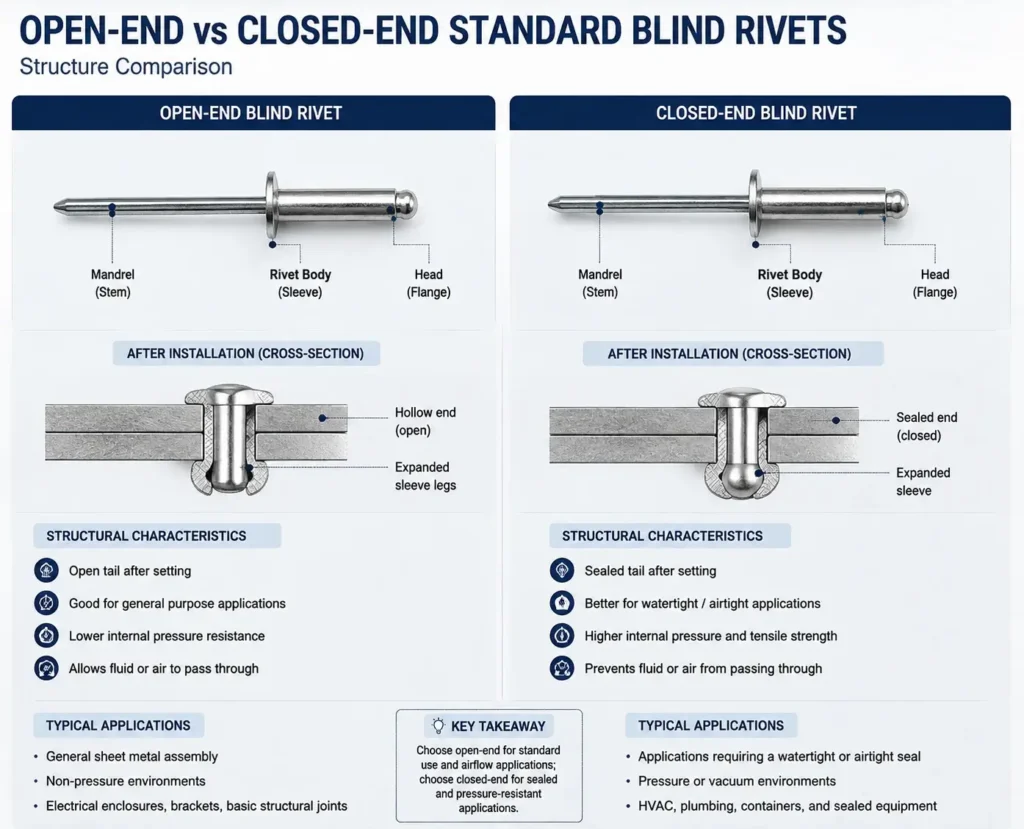
Open-End vs Closed-End Standard Rivets
Open-end blind rivets are the most common and economical variant. The rivet body is hollow, allowing the mandrel to pull through and expand the body during installation. After setting, the mandrel breaks off at the predetermined break point.
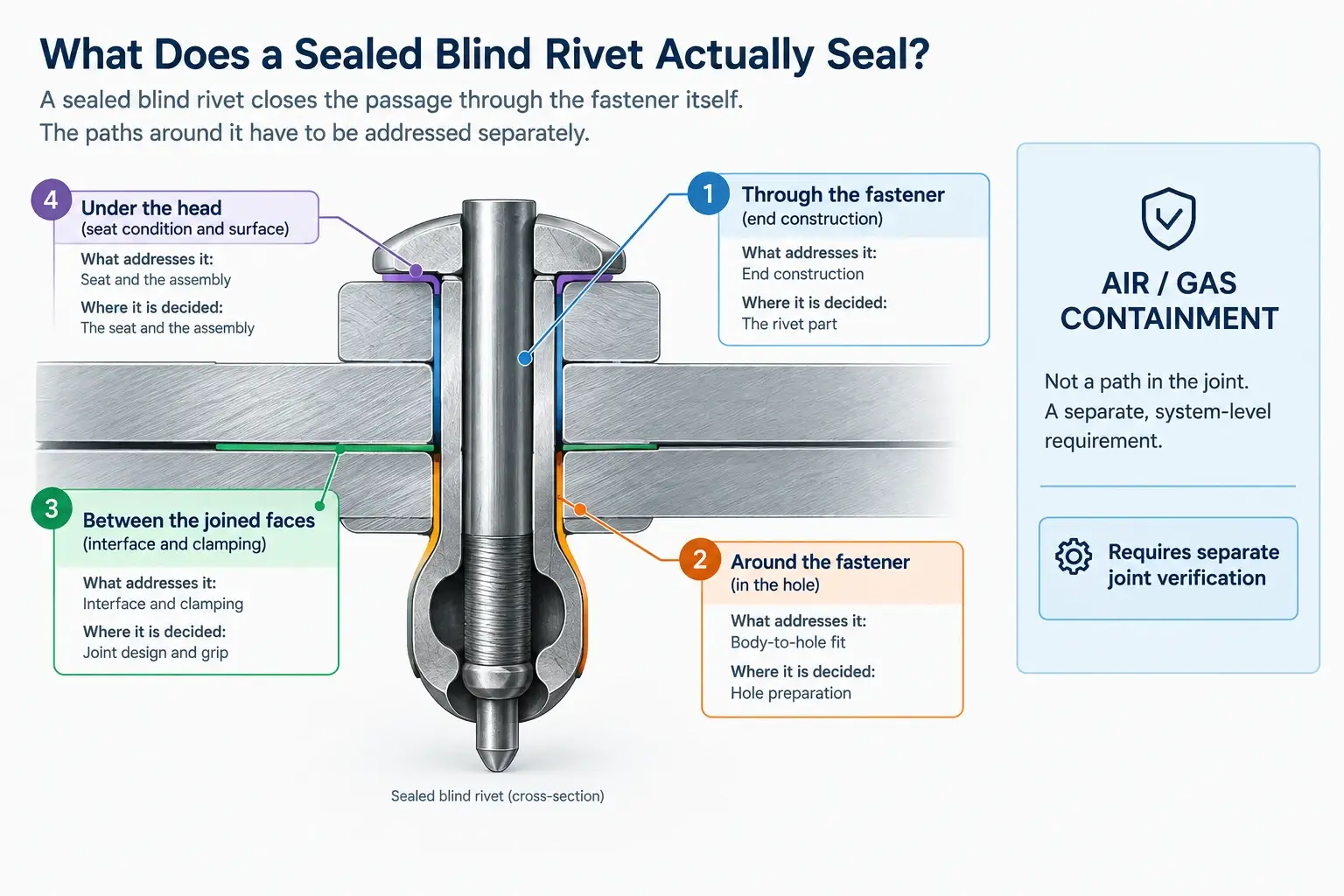
Closed-end blind rivets have a sealed body bottom, preventing the mandrel from passing through. This provides better sealing and moisture protection for applications such as electrical enclosures and automotive components.
For material options available with standard rivets, see our blind rivet material selection guide.
Advantages and Limitations
Advantages:
- Lowest cost across all blind rivet types
- Wide availability in standard sizes
- Suitable for high-volume production runs
Limitations:
- Limited grip range per size — each size covers a narrow thickness band
- Not designed for high-load or structural applications
Common Applications
Standard blind rivets are widely used in HVAC ductwork, sheet metal fabrication, electrical cabinets and general-purpose assembly where cost efficiency and reliable fastening are the primary requirements.
Multi-Grip Blind Rivets: Flexible Solution for Variable Thickness
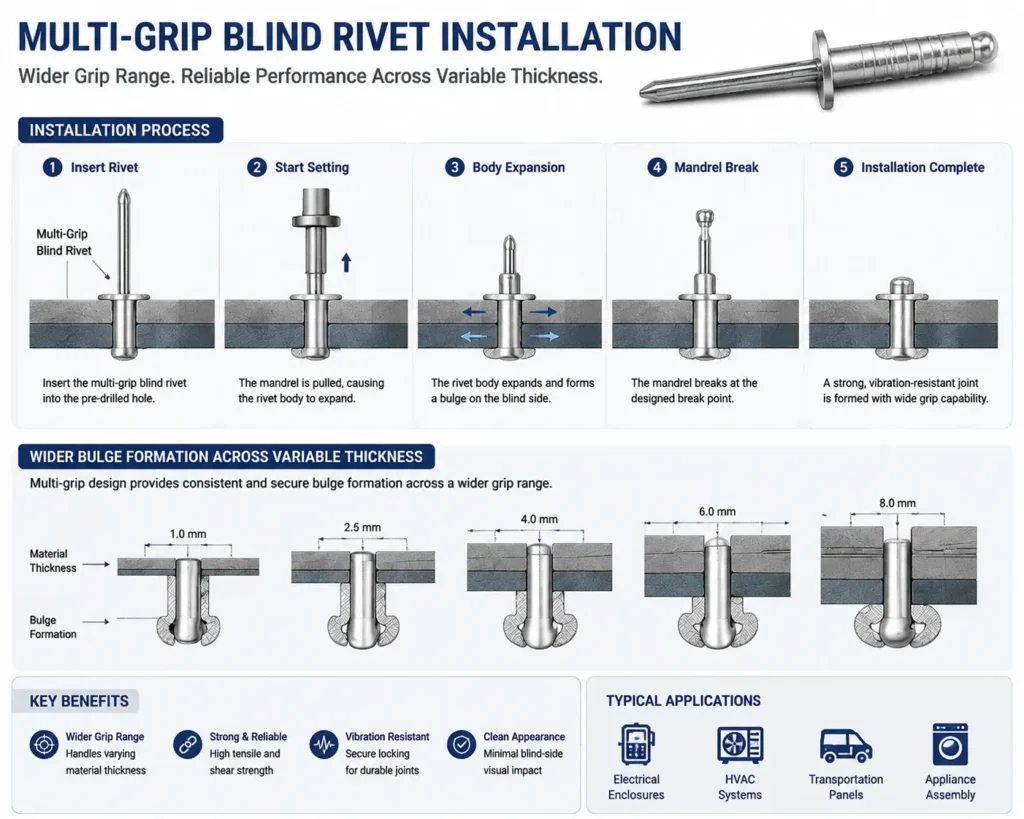
Multi-grip blind rivets solve a common procurement problem: when assembly points have varying material thicknesses, standard rivets require multiple sizes to cover the range. A single multi-grip rivet can often cover the thickness range that would normally require multiple standard rivet sizes.
How Multi-Grip Rivets Work
The rivet body is designed to form a larger blind-side bulge that accommodates a wider grip range, allowing the rivet to handle variable thickness assemblies. This means one multi-grip rivet size can securely fasten materials across a broader thickness range — without the need to switch rivet sizes for each assembly point.
Installation is identical to standard blind rivets. No special tools or procedures are required.
Key Advantages Over Standard Rivets
- Wider grip range — one size covers what would require multiple standard rivet sizes
- Reduced inventory — fewer SKUs to manage, store and reorder
- Easier installation — lower risk of selecting the wrong grip range for a given thickness
While the unit price of multi-grip rivets is slightly higher than standard rivets, the total procurement cost — factoring in inventory simplification and reduced installation errors — is often lower. This is particularly true for assembly lines that join materials of varying thicknesses, where the cost of managing multiple SKUs and the risk of grip range mismatch can exceed the unit price difference.
When to Choose Multi-Grip Rivets
Multi-grip rivets are ideal for variable-thickness assembly, automotive components and equipment manufacturing where multiple material thicknesses are joined in the same production line. They are not recommended for high-strength structural joints — for those applications, structural blind rivets are the appropriate choice.
Structural Blind Rivets: High-Strength Fastening Solution
Structural blind rivets are engineered for applications where joint strength and reliability are critical. They are among the highest-strength blind rivet solutions available, offering improved joint reliability compared with standard blind rivets while maintaining single-side installation capability.
What Makes Structural Rivets Different
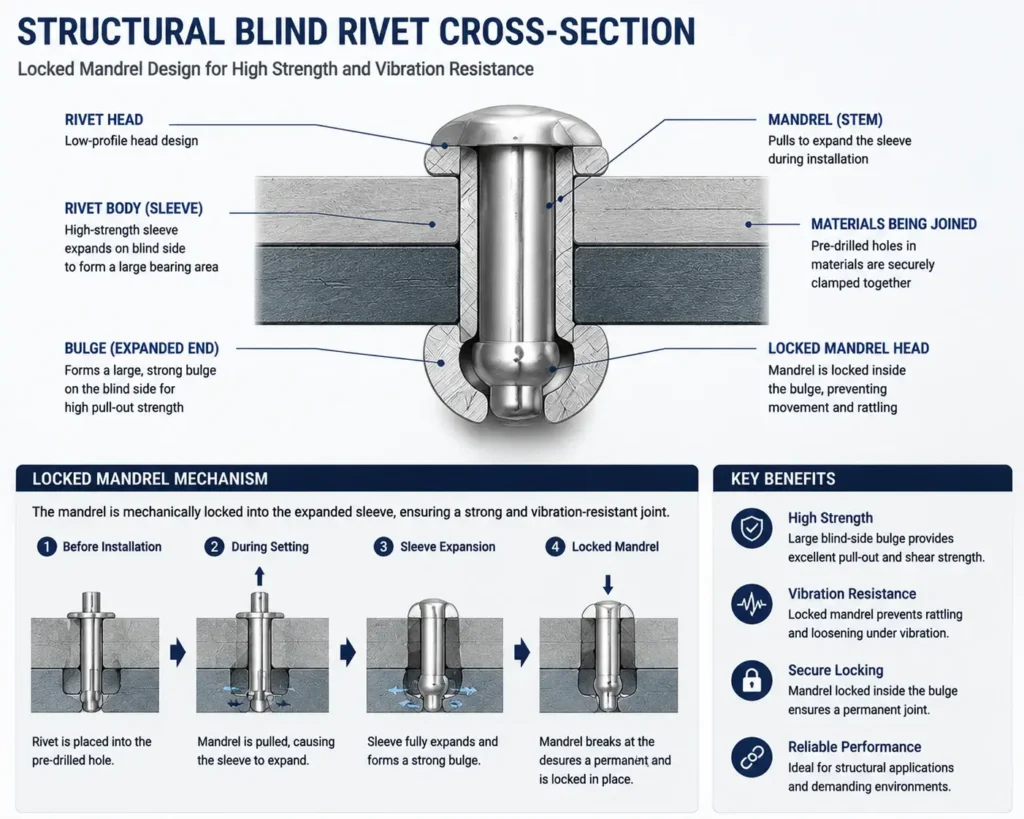
The core difference is the mandrel. In standard rivets, the mandrel breaks off and falls away after installation. In structural rivets, the mandrel remains locked inside the rivet body — providing additional tensile strength that standard rivets cannot achieve.
The rivet body wall is also thicker, and the blind-side expansion is more uniform, resulting in higher shear strength and better resistance to vibration.
Locked Mandrel Design and Strength Advantages
- Locked mandrel keeps the mandrel secured after installation
- Improves tensile strength compared with standard blind rivets
- Enhances vibration resistance for dynamic load applications
Different structural rivet designs use different locking mechanisms depending on manufacturer specifications and application requirements. For testing methods relevant to structural rivets, see our guide on blind rivet tensile strength test procedures.
Typical Applications
Structural blind rivets are used in automotive body panels, heavy equipment, construction and machinery — anywhere high vibration, high load or safety-critical joints are involved. In these applications, the locked mandrel ensures the joint maintains its integrity over the product’s service life, even under dynamic loads that would cause standard rivets to loosen or fail.
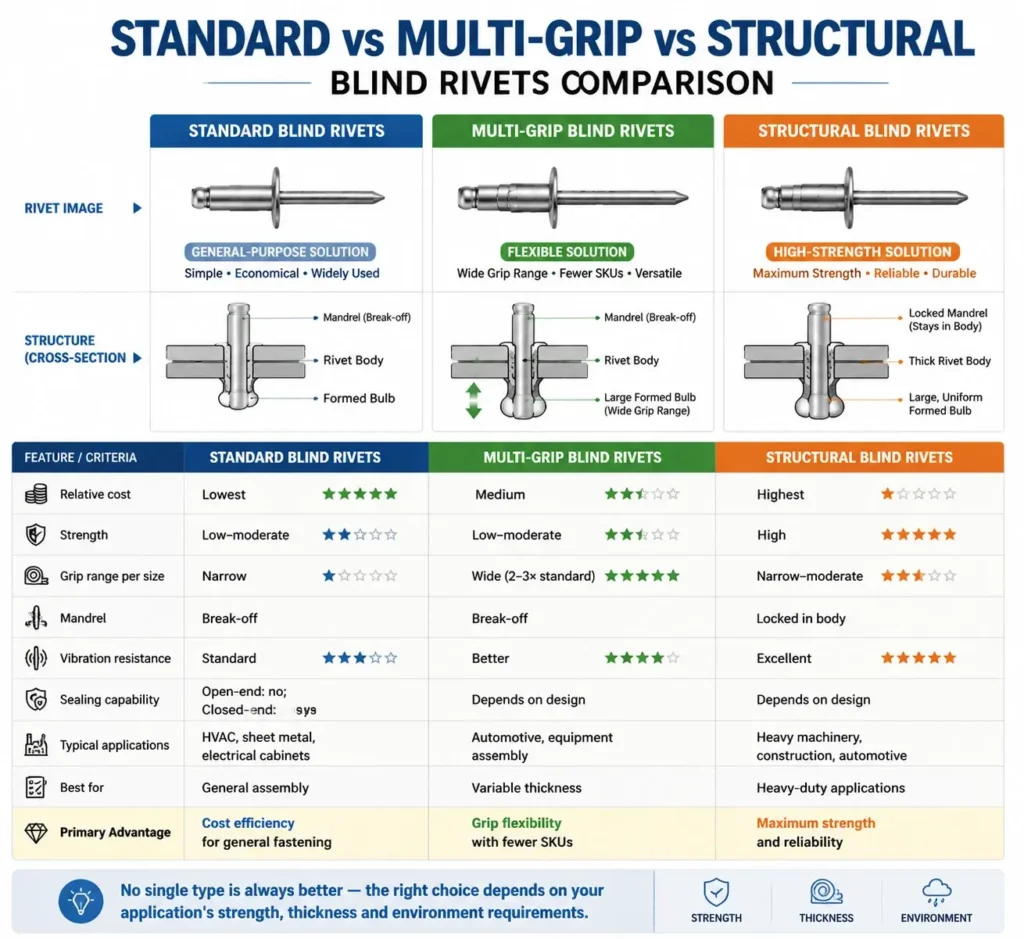
Standard vs Multi-Grip vs Structural Blind Rivets Comparison
The table below summarizes the key differences across all three types. Use it as a quick reference when evaluating which rivet type suits your application.
| Feature | Standard | Multi-Grip | Structural |
|---|---|---|---|
| Primary advantage | Cost efficiency | Grip flexibility | Maximum strength and reliability |
| Relative cost | Lowest | Medium | Highest |
| Strength | Low–moderate | Low–moderate | High |
| Grip range per size | Narrow | Wide (2–3× standard) | Narrow–moderate |
| Mandrel | Break-off | Break-off | Locked in body |
| Vibration resistance | Standard | Better | Excellent |
| Sealing capability | Open-end: no; Closed-end: yes | Depends on design | Depends on design |
| Typical applications | HVAC, sheet metal, electrical cabinets | Automotive, equipment assembly | Heavy machinery, construction, automotive |
| Best for | General assembly | Variable thickness | Heavy-duty applications |
| Installation complexity | Simple | Simple | Requires controlled installation |
How to Choose the Right Blind Rivet Type
The best blind rivet is not always the strongest one — it is the one that matches your application requirements.
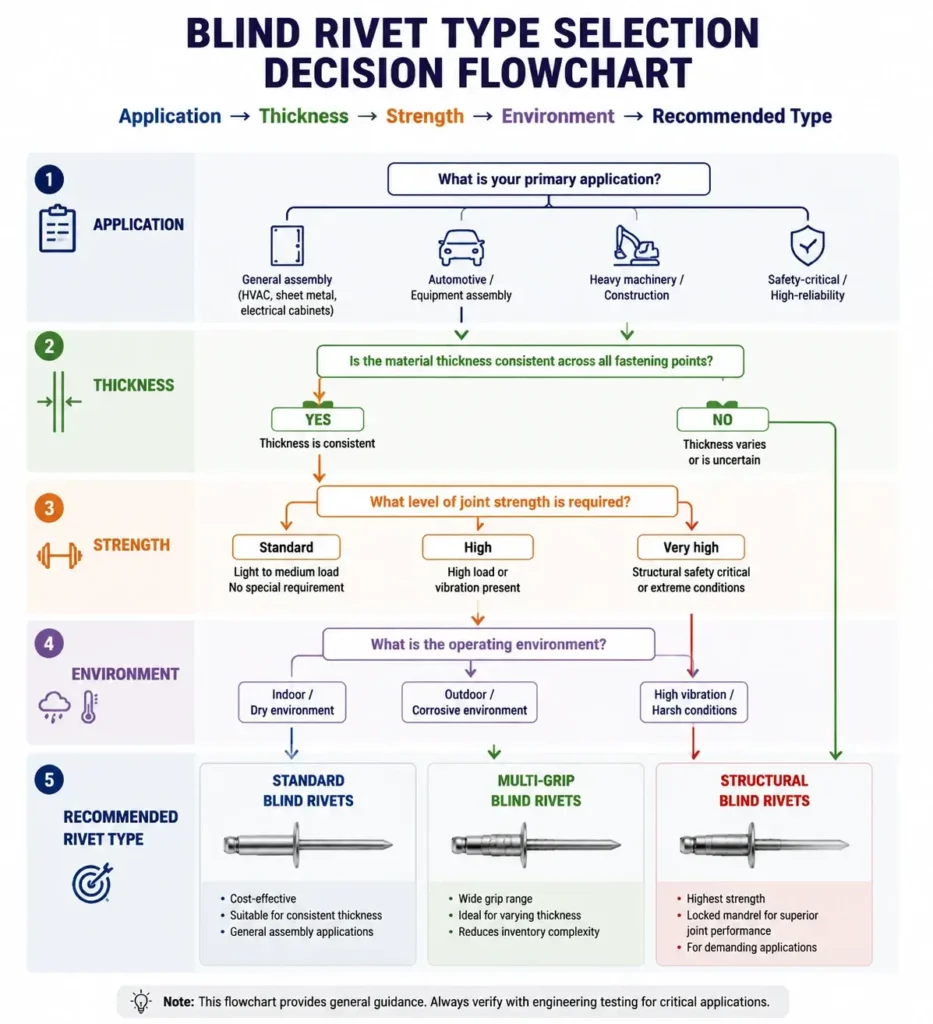
Selection Process Overview
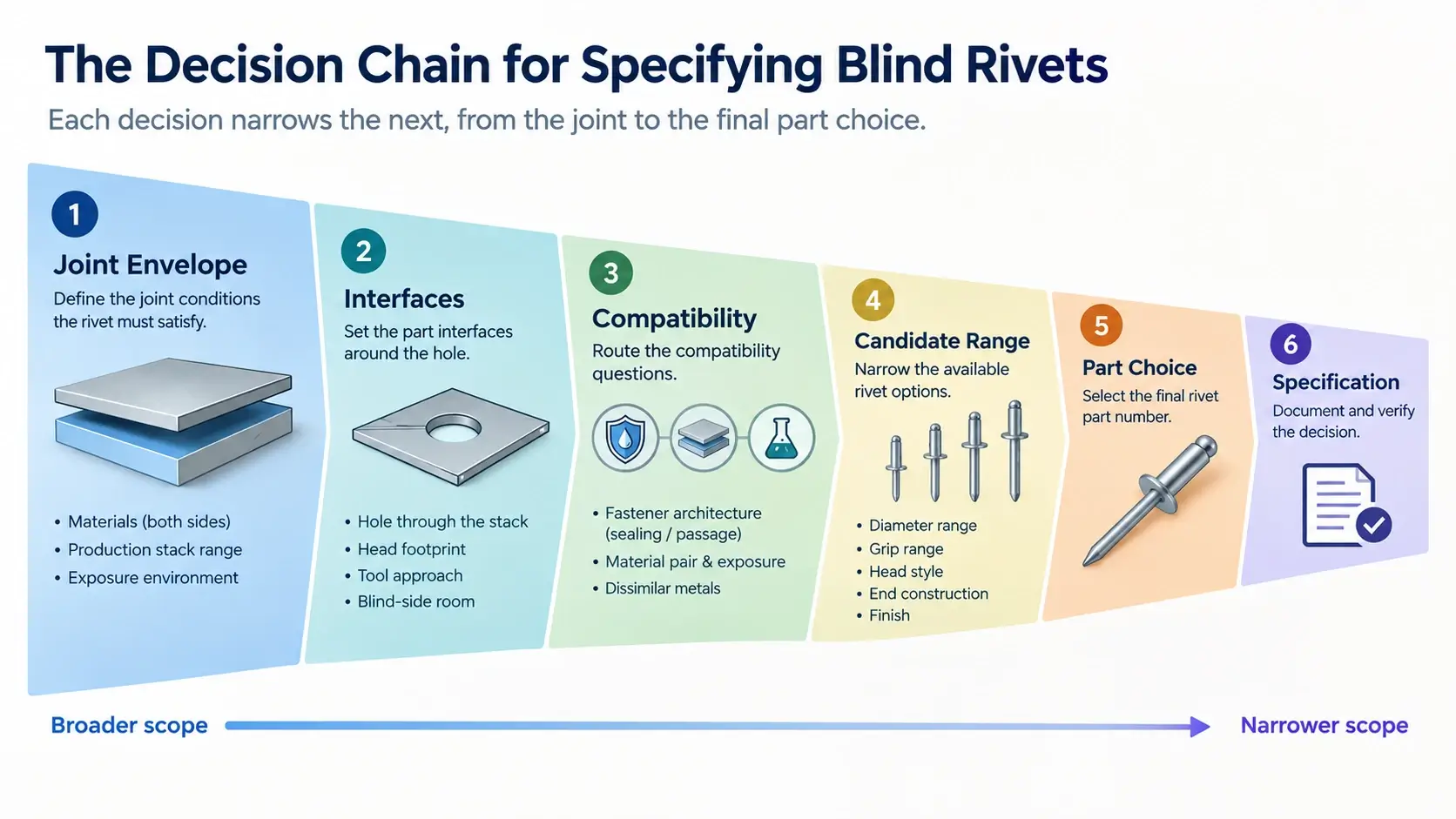
Before choosing a specific rivet type, work through these four steps:
- Check Application Requirement — What is being fastened? General assembly, variable thickness, or structural load?
- Check Thickness Variation — Is material thickness consistent (standard) or variable (multi-grip)?
- Check Strength Requirement — Does the joint carry load? Is vibration present? (structural if yes)
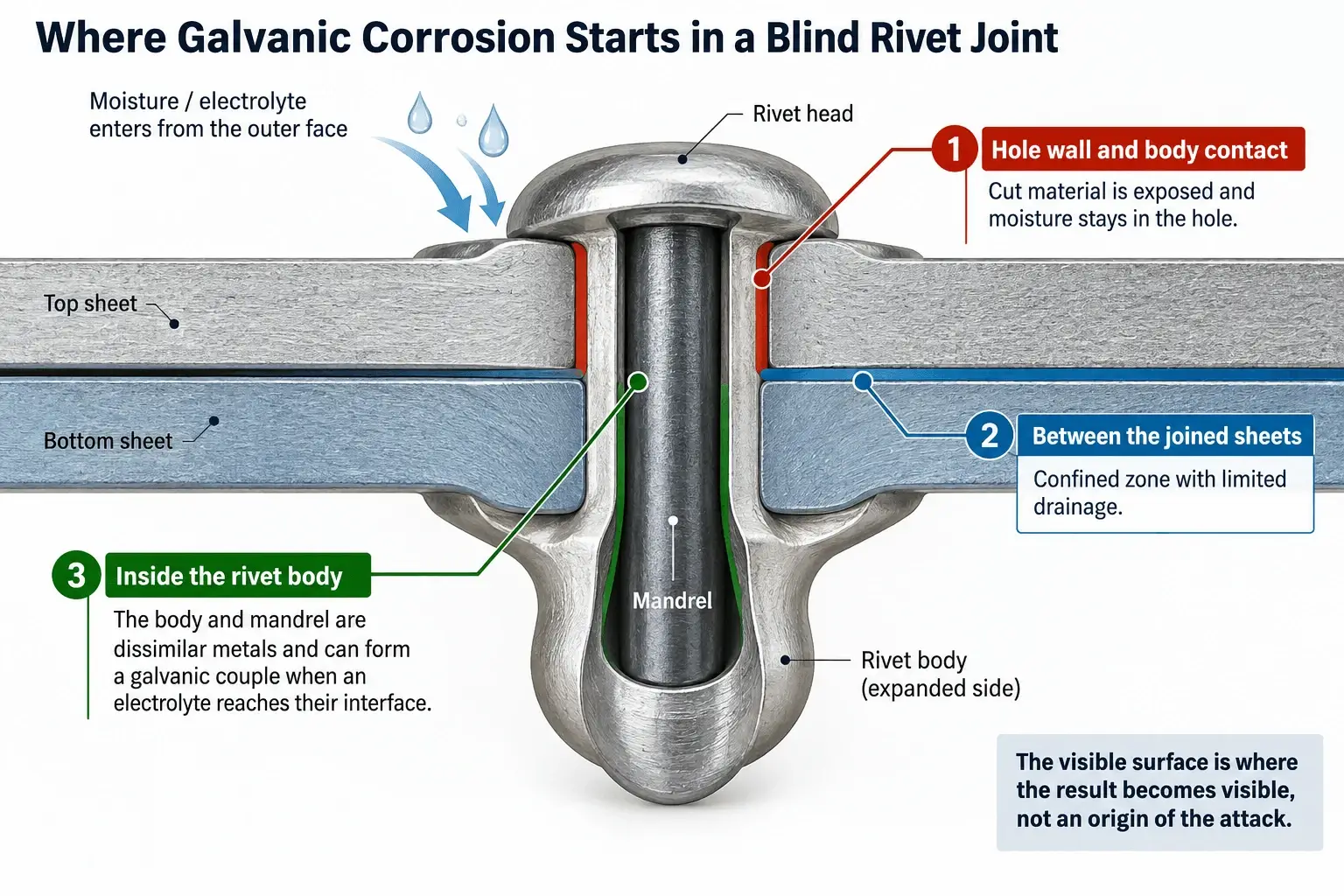
- Check Environment — Indoor, outdoor, coastal? This affects material and coating choice. See our blind rivet surface finishes guide for corrosion protection options.
Quick Decision Path
For a fast summary, follow this decision path:
Need the lowest cost solution? → Standard Blind Rivets
Need flexibility for different thicknesses? → Multi-Grip Blind Rivets
Need higher joint strength and vibration resistance? → Structural Blind Rivets
For a visual version of this decision process, see the decision flowchart below.
Quick Selection Guide by Type
Choose Standard Blind Rivets When:
- Cost efficiency matters for high-volume production
- Material thickness is consistent and measurable
- Application requires general-purpose fastening, not structural load
- Sealing is needed → choose closed-end standard rivets
Choose Multi-Grip Blind Rivets When:
- Material thickness varies across assembly points
- You need to reduce SKU count for inventory simplification
- Installation site makes precise thickness measurement difficult
Choose Structural Blind Rivets When:
- High tensile or shear strength is required
- Vibration or dynamic loads are present
- Joint failure could create safety risks
Quick Application Reference
| Application | Recommended Type |
|---|---|
| HVAC ductwork | Standard |
| Electrical enclosure | Standard (closed-end) |
| Automotive components | Multi-Grip / Structural (depending on load) |
| Heavy machinery | Structural |
| Outdoor equipment (tropical/coastal) | Structural (stainless steel) |
| Variable-thickness assembly | Multi-Grip |
For precise grip range values for each type, refer to our blind rivet size chart.
Common Blind Rivet Selection Mistakes and How to Avoid Them
Selecting the wrong rivet type is one of the most common — and most preventable — causes of fastening failure. The table below highlights five frequent mistakes and their solutions.
| Mistake | Result | Solution |
|---|---|---|
| Using standard rivets for heavy-load applications | Joint failure | Switch to structural rivets for load-bearing joints |
| Wrong grip range selection for standard rivets | Loose fastening, incomplete setting | Verify material thickness; consider multi-grip for variable thickness |
| Over-specifying structural rivets for non-structural use | Unnecessary cost increase | Match rivet type to actual load requirements |
| Using open-end rivets in sealed applications | Water/moisture ingress | Switch to closed-end rivets for sealing requirements |
| Ignoring vibration environment | Mandrel loosening, joint failure over time | Use structural rivets with locked mandrel for high-vibration applications |
These mistakes share a common root: selecting rivets based on availability or habit rather than application requirements. In many cases, the problem is not a defective product but a mismatch between rivet type and application. A structured selection process — like the one outlined above — helps avoid all five mistakes and ensures that the rivet type is matched to the joint’s actual demands.
Sourcing Standard, Multi-Grip and Structural Blind Rivets from One Manufacturer
Procuring different blind rivet types from multiple suppliers creates unnecessary complexity: inconsistent quality standards, uncoordinated delivery schedules and fragmented inventory management. Sourcing all three types from a single manufacturer simplifies procurement, ensures uniform quality standards and consolidates logistics.
For example, RivetFast supplies standard (open-end and closed-end), multi-grip and structural blind rivets — with aluminum, steel and stainless steel material options. With an annual production capacity of 2 billion pieces, RivetFast supports stable supply for high-volume industrial orders. In-house inspection capabilities — including tensile, shear and corrosion testing — support consistent quality across all rivet types. Production is supported by ISO 9001 quality management requirements. Custom specifications are also available, including special grip ranges, head styles and material combinations.
For background on evaluating supplier capacity, see our guide on how to verify blind rivet manufacturer production capacity. For custom development processes, refer to our custom blind rivets OEM guide.
Conclusion
Standard, multi-grip and structural blind rivets each serve distinct application requirements. Standard rivets offer cost efficiency for general assembly. Multi-grip rivets simplify inventory and handle variable thickness. Structural rivets deliver high strength and vibration resistance for demanding joints.
Choosing the right blind rivet types means matching strength, grip range and environmental factors to your specific application — not defaulting to the cheapest or strongest option. To learn how to evaluate a blind rivet manufacturer before placing a bulk order, see our procurement guide. When you need a reliable blind rivet supplier for all types, working with a manufacturer that understands these differences ensures consistent quality across your entire fastening program and supports long-term supply reliability.
FAQ
Q1: What are the main types of blind rivets?
A: The three most common types are standard blind rivets (including open-end and closed-end), multi-grip blind rivets and structural blind rivets. Each type is designed for different strength, grip range and application requirements.
Q2: What is the difference between standard and multi-grip blind rivets?
A: Standard blind rivets cover a specific, narrow grip range, while multi-grip blind rivets can accommodate a wider range of material thicknesses with a single rivet size. Multi-grip rivets form a larger blind-side bulge, reducing inventory complexity and the risk of grip range mismatch.
Q3: When should I use structural blind rivets?
A: Structural blind rivets are recommended for applications requiring high tensile and shear strength, vibration resistance, or where joint failure could create safety risks. They are commonly used in automotive, construction and heavy equipment assembly where the mandrel must remain locked in the rivet body.
Q4: Can multi-grip blind rivets replace standard blind rivets entirely?
A: While multi-grip rivets cover wider thickness ranges, they are not always a direct replacement. Standard rivets may be preferred for cost-sensitive applications with consistent material thickness, while multi-grip rivets are better for variable thicknesses or simplified inventory management.
Q5: What is the strongest type of blind rivet?
A: Structural blind rivets generally provide the highest strength among common blind rivet categories due to their locked mandrel design. For specific strength values, consult the manufacturer’s test data.
Q6: How do I choose the right blind rivet type for my application?
A: Consider the required strength, material thickness variation, environmental conditions and installation access. For general-purpose fastening, standard rivets suffice. For variable thicknesses, choose multi-grip. For high-strength structural joints or vibration environments, use structural blind rivets.