As humanoid robots and industrial automation systems move toward large-scale production, manufacturers face a practical challenge: how to create lightweight, reliable, and efficient assemblies at production volume.
Unlike traditional machines, robots contain lightweight frames, compact modules, moving joints, and electronic enclosures where conventional fastening methods are not always practical. Screws require two-side access that densely packed robot structures rarely allow. Welding adds heat distortion to thin panels. Adhesives need curing time and may degrade under vibration.
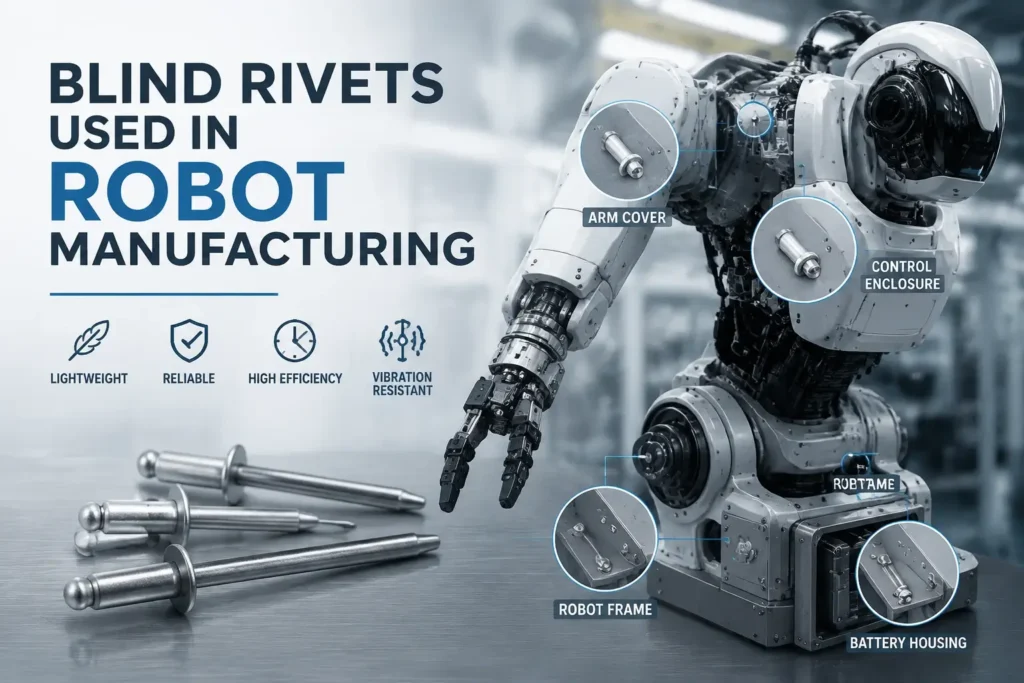
Blind rivets provide a practical solution for many robot components by offering one-side installation, consistent assembly performance, and compatibility with thin metal structures.
This guide explains where blind rivets are used in robot manufacturing, how they compare with screws and welding, and how engineers can select the right rivet type for different applications.
Quick Overview
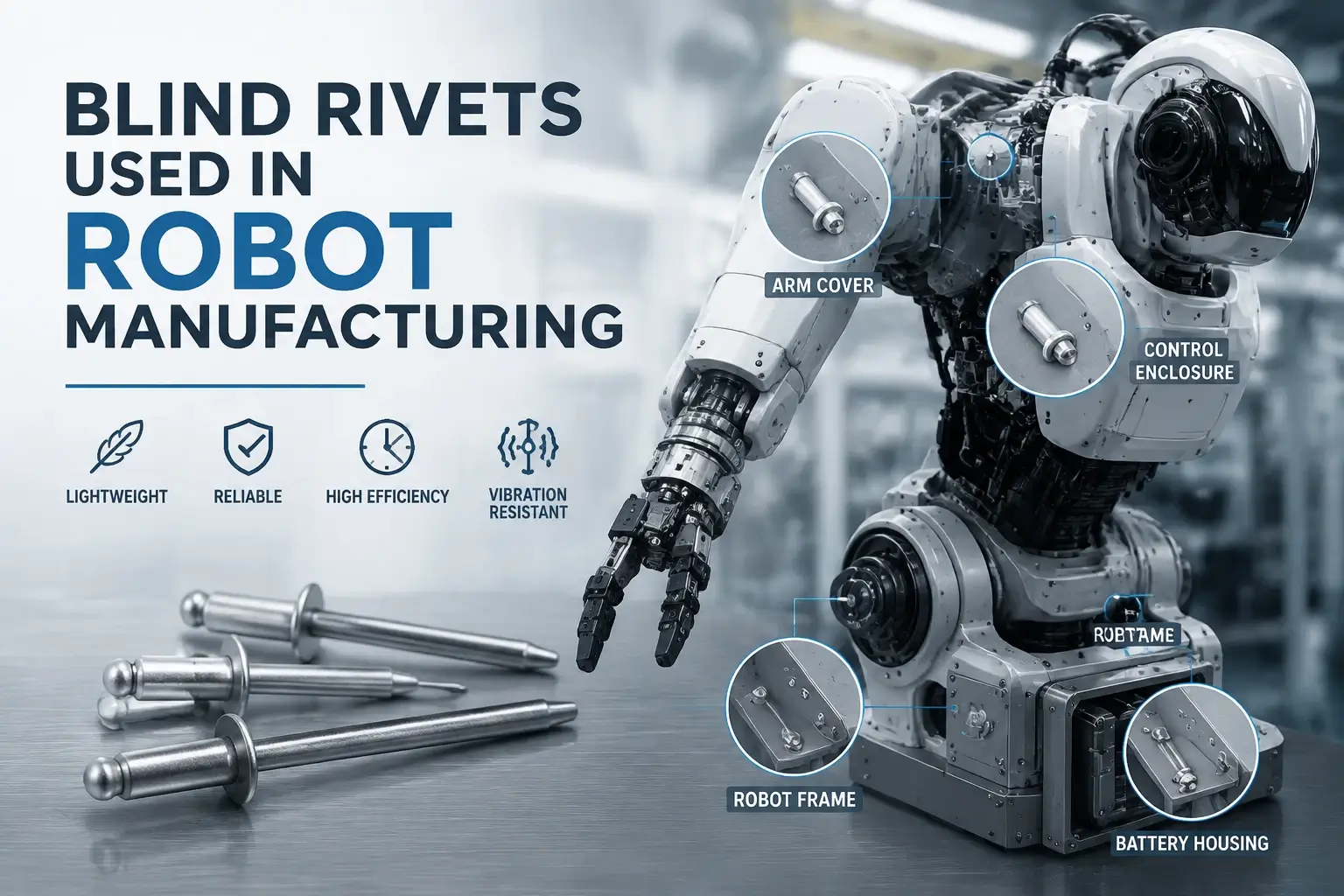
Blind rivets are commonly used in:
- Robot frames and structural components
- Covers and sheet metal panels
- Electrical enclosures and control systems
- Battery housings and power modules
- Automation equipment and peripheral modules
Why Robot Manufacturers Need Reliable Fastening Solutions
Modern robots share several structural characteristics that directly influence fastener selection:
- Lightweight structures: Robot frames and covers use thin-gauge sheet metal, aluminum extrusions, and composite panels to reduce moving mass and energy consumption.
- Compact design: Internal space is limited. Components are densely packed, restricting access to one side of many joints.
- High-cycle dynamic loading: Robot fastening joints must withstand repeated movement cycles, vibration from motors and actuators, impact loads during operation, and thermal expansion in enclosed modules.
- High-mix assembly: Robot manufacturers often produce multiple models on shared production lines, requiring flexible and fast assembly methods.
These characteristics create specific fastening challenges. Traditional screws need access to both sides of a joint and may loosen under cyclic loading. Welding adds heat distortion and weight. Adhesives require curing time and may degrade under vibration and thermal cycling.
Blind rivets address several of these challenges simultaneously. They install from one side only, accommodate thin materials, resist vibration when properly specified, and support automated assembly processes. For robot manufacturers scaling toward mass production, these properties make blind rivets a practical choice for many non-structural and semi-structural joints.
Where Blind Rivets Are Used in Robot Manufacturing
Blind rivets appear across multiple areas of robot assembly. The following sections outline the most common applications and explain why blind rivets fit each use case.
Robot Frames and Structural Components

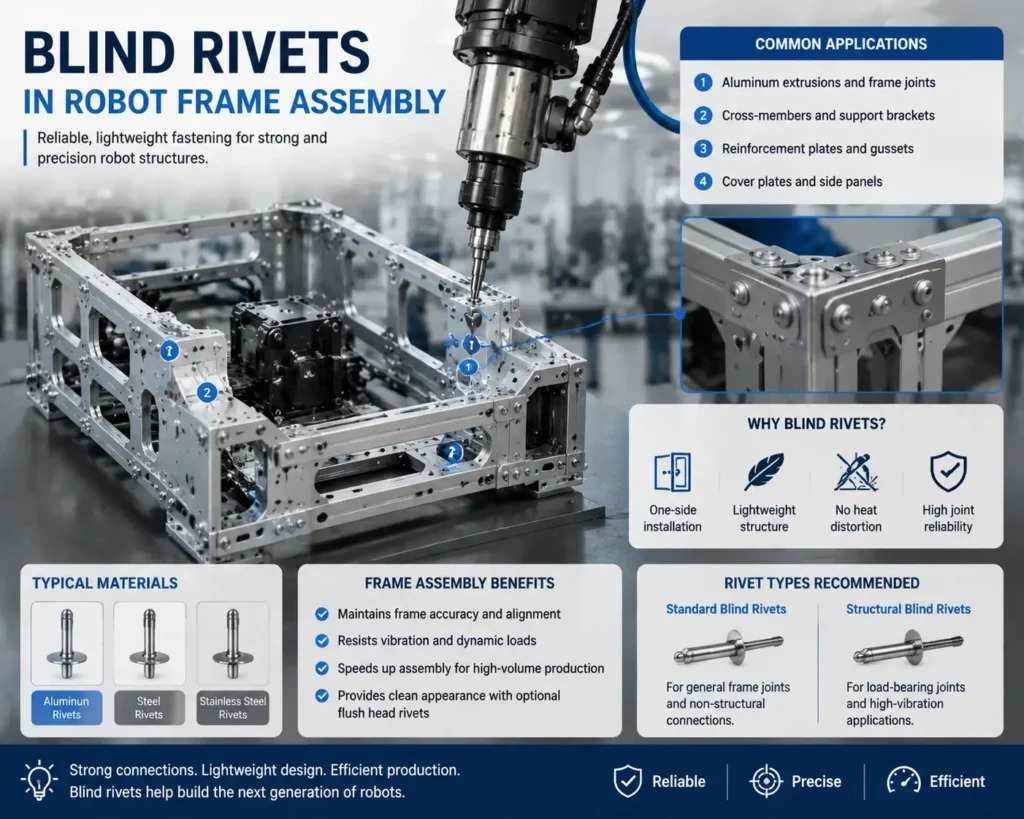
Typical applications: Aluminum frame extrusions, cross-members, brackets, support plates, and reinforcement panels.
Why blind rivets are used: Robot frames increasingly use thin-gauge aluminum to reduce weight. Welding thin aluminum risks distortion and burn-through, while screws require rear-side access that compact frame designs rarely allow. Blind rivets provide one-side installation without heat input, and aluminum rivets match the base material to avoid galvanic corrosion.
Robot Covers and Sheet Metal Panels
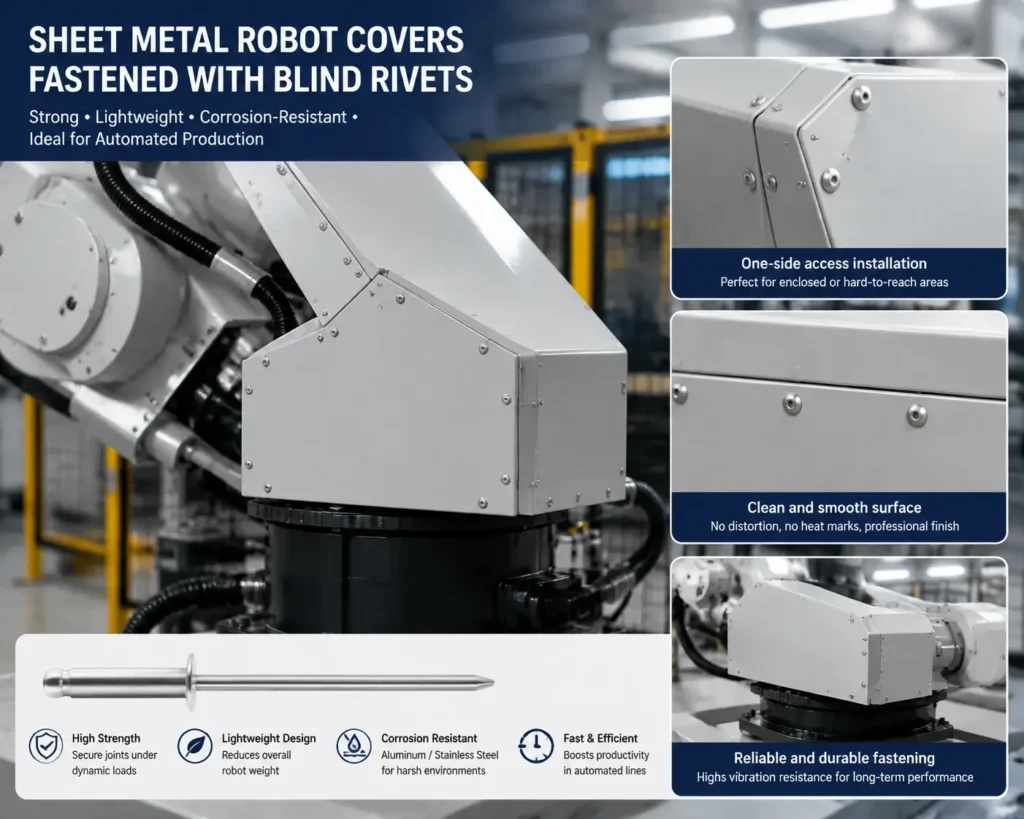
Typical applications: Exterior covers, access panels, sheet metal housings, and cosmetic enclosures on both industrial and humanoid robots.
Why blind rivets are used: Covers and panels require secure attachment without visible fasteners on the exterior surface. Blind rivets install from the interior side, leaving a clean exterior finish. Their low profile and flush-set option make them suitable for cosmetic panels where appearance and aerodynamics matter.
Electrical Enclosures and Control Systems
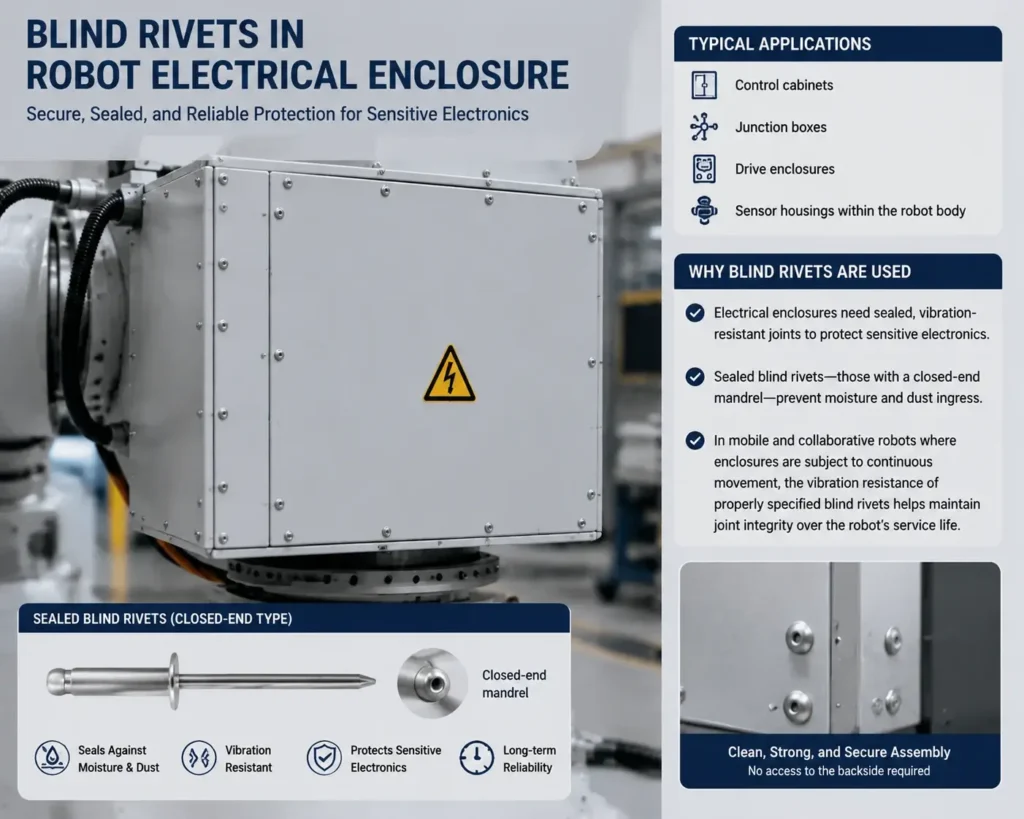
Typical applications: Control cabinets, junction boxes, drive enclosures, and sensor housings within the robot body.
Why blind rivets are used: Electrical enclosures need sealed, vibration-resistant joints to protect sensitive electronics. Sealed blind rivets — those with a closed-end mandrel — prevent moisture and dust ingress. In mobile and collaborative robots where enclosures are subject to continuous movement, the vibration resistance of properly specified blind rivets helps maintain joint integrity over the robot’s service life.
Battery Housing and Modules
Typical applications: Battery compartments, power module housings, and energy system enclosures in mobile and humanoid robots.
Why blind rivets are used: Battery systems require fasteners that balance structural integrity with material compatibility. Aluminum, stainless steel, or coated blind rivets may be selected depending on structural requirements, corrosion exposure, thermal management needs, and compatibility with surrounding materials. One-side installation is particularly valuable in sealed battery compartments where interior access is limited after assembly.
Automation Equipment and Peripheral Modules
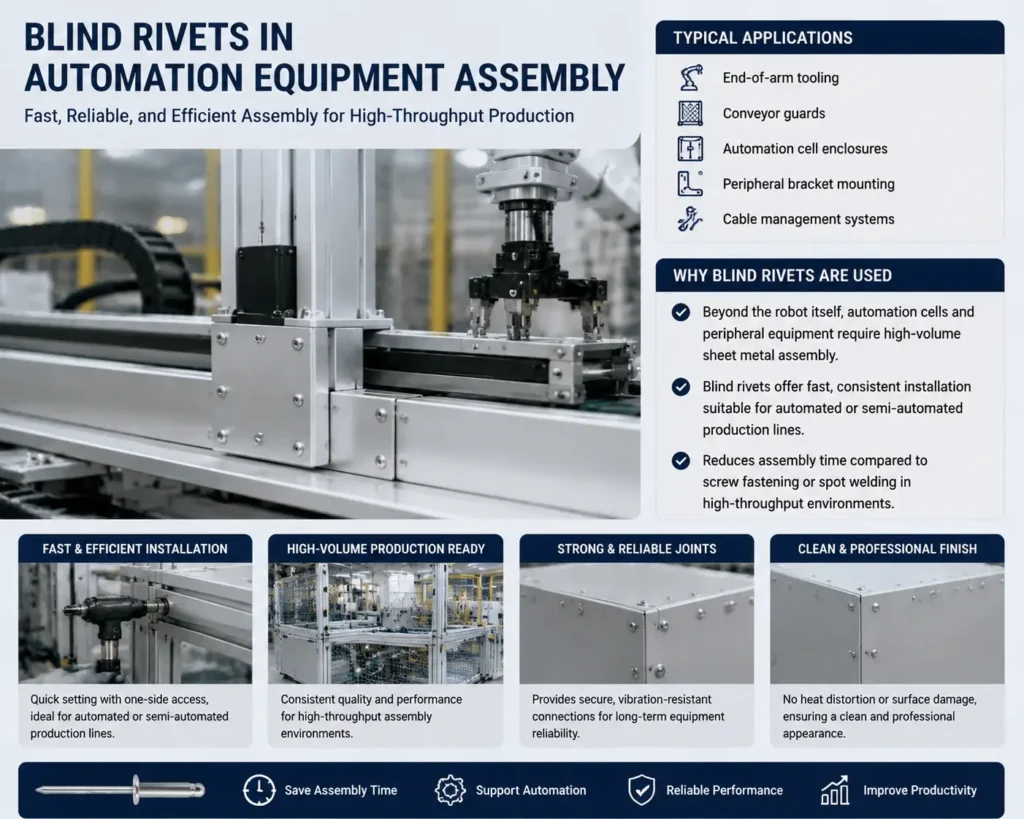
Typical applications: End-of-arm tooling, conveyor guards, automation cell enclosures, peripheral bracket mounting, and cable management systems.
Why blind rivets are used: Beyond the robot itself, automation cells and peripheral equipment require high-volume sheet metal assembly. Blind rivets offer fast, consistent installation suitable for automated or semi-automated production lines, reducing assembly time compared to screw fastening or spot welding in high-throughput environments.
Blind Rivets vs. Screws vs. Welding in Robot Assembly
Engineers often evaluate blind rivets alongside threaded fasteners and welding when designing robot assemblies. Each method has distinct trade-offs:
| Factor | Blind Rivets | Screws | Welding |
| One-side access | Excellent | Limited | Limited |
| Assembly speed | High | Medium | Medium |
| Weight | Low | Medium | High |
| Automation suitability | High | Medium | Low |
| Vibration resistance | High | Medium | High |
| Disassembly | Low | High | Low |
| Material distortion | Low | Low | High |
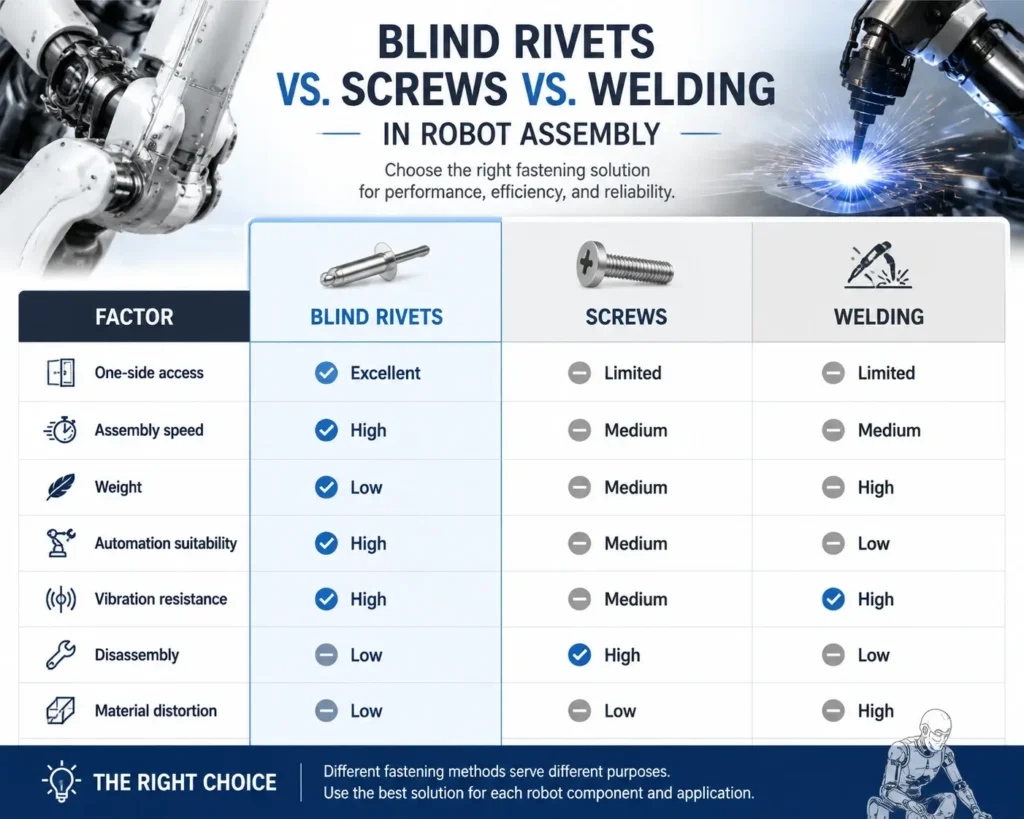
Blind rivets excel in applications requiring one-side access, low weight, and fast assembly. They are particularly suitable for the thin sheet metal and aluminum structures common in robot covers and enclosures.
Screws offer the advantage of disassembly, making them preferable for service-access panels and components requiring regular maintenance.
Welding provides the highest joint strength and is often used for primary structural frames. However, it adds weight through filler material, introduces heat distortion in thin panels, and is difficult to automate for high-mix production.
For joints requiring higher vibration resistance than standard blind rivets, structural blind rivets — such as monobolt or interlock types — offer improved mandrel retention and clamp force.
The choice is not about replacing one fastening method with another, but selecting the right solution for each robot component. In practice, these methods are often combined: a typical robot may feature a welded main frame for primary structural integrity, riveted covers and enclosures for lightweight panel assembly, and screwed service panels for components requiring maintenance access.
How to Select Blind Rivets for Robotics Applications
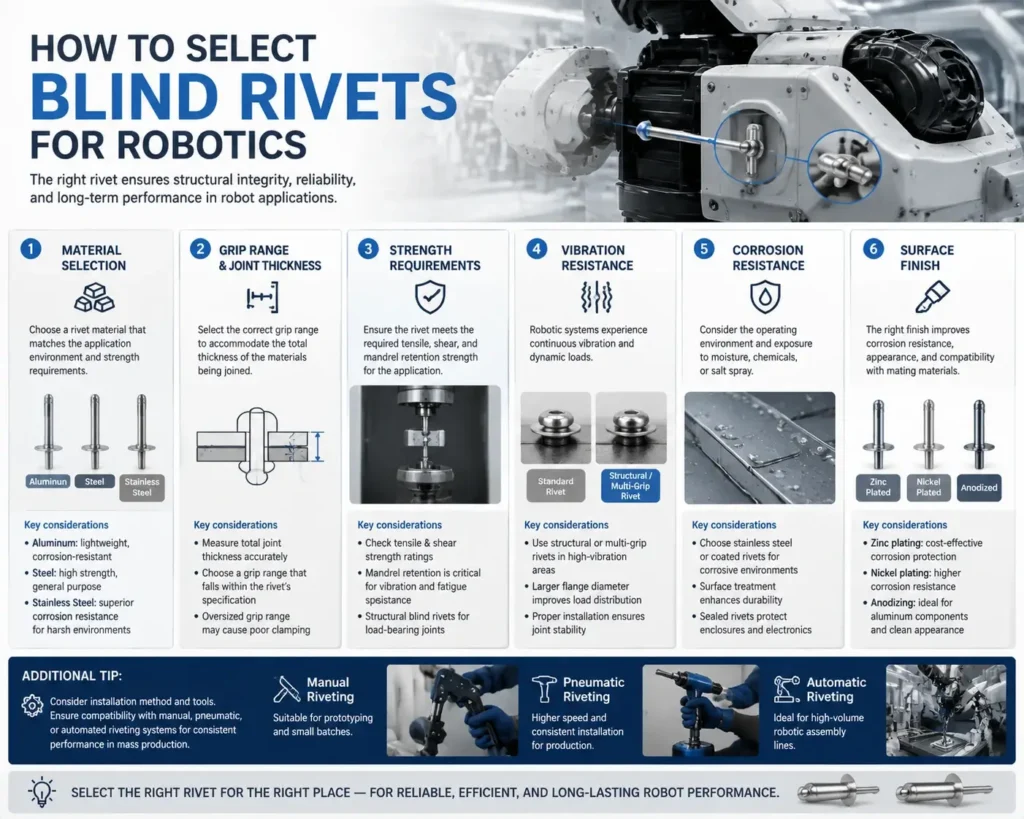
Selecting the right blind rivet for a robotics application involves evaluating several factors.
Rivet Type: Standard vs. Structural
The first decision is whether a standard or structural blind rivet is needed:
- Standard blind rivets are suitable for covers, panels, enclosures, and other non-load-bearing applications where vibration is moderate.
- Structural blind rivets — including monobolt, interlock, and multi-grip types — are designed for load-bearing joints, high-vibration areas, and moving assemblies where mandrel retention and clamp force are critical.
Choosing the correct rivet type at the design stage prevents joint failure during the robot’s service life.
Material Selection
Material choice affects weight, strength, and corrosion resistance. Material selection should match the joined materials and operating environment:
- Aluminum rivets offer high strength-to-weight ratio and are commonly used in aluminum robot frames and covers.
- Steel rivets provide higher shear and tensile strength for load-bearing brackets and structural joints.
- Stainless steel rivets deliver corrosion resistance for outdoor robots, collaborative robots in humid environments, and battery housings.
Size and Grip Range
Rivet diameter and grip range must match the total thickness of the joined materials. An undersized grip range results in poor clamping; an oversized grip range wastes material and may not set properly. Refer to a blind rivet size chart to match specifications to joint thickness.
Strength Requirements
Robot joints are subject to dynamic loads — vibration, impact, and repeated motion. Key parameters include:
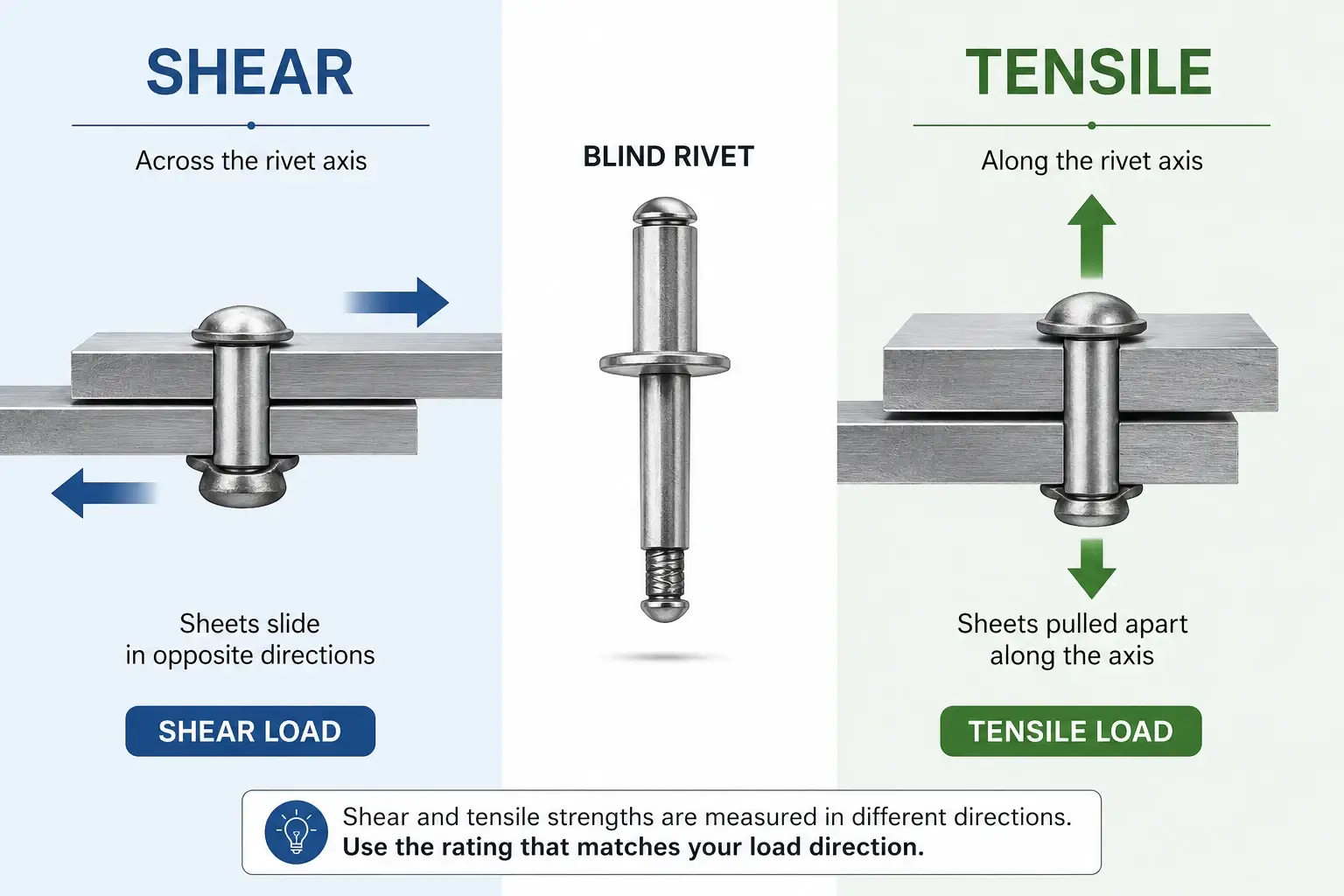
- Tensile strength: Resistance to pulling forces along the rivet axis.
- Shear strength: Resistance to forces perpendicular to the rivet.
- Mandrel retention: Whether the mandrel remains locked after installation, affecting long-term joint reliability.
- Dynamic load performance: How the rivet performs under repeated vibration and load cycling — a primary concern in robotics.
For applications where joint integrity is safety-related, quality testing protocols should verify strength specifications.
Vibration Resistance
Standard blind rivets perform well under moderate vibration. For high-vibration environments — such as robot joints near motors or moving actuators — structural blind rivets or multi-grip rivets provide better resistance to loosening. Locked-mandrel designs prevent the mandrel from backing out under cyclic loading.
Surface Treatment
Surface treatment affects corrosion resistance, appearance, and electrical conductivity. Options include zinc plating for general corrosion protection, anodizing for aluminum rivets, and specialized coatings for conductive or chemical-resistant applications.
Installation Method
For high-volume robot production, installation consistency is also important. Rivets should be compatible with the intended installation tools — whether hand riveting tools for prototype builds, pneumatic riveting tools for standard production, or automated riveting systems for high-throughput lines. Consistent rivet dimensions and predictable setting behavior reduce installation variation and support stable assembly quality.
Custom Blind Rivets for Robotics OEM Production
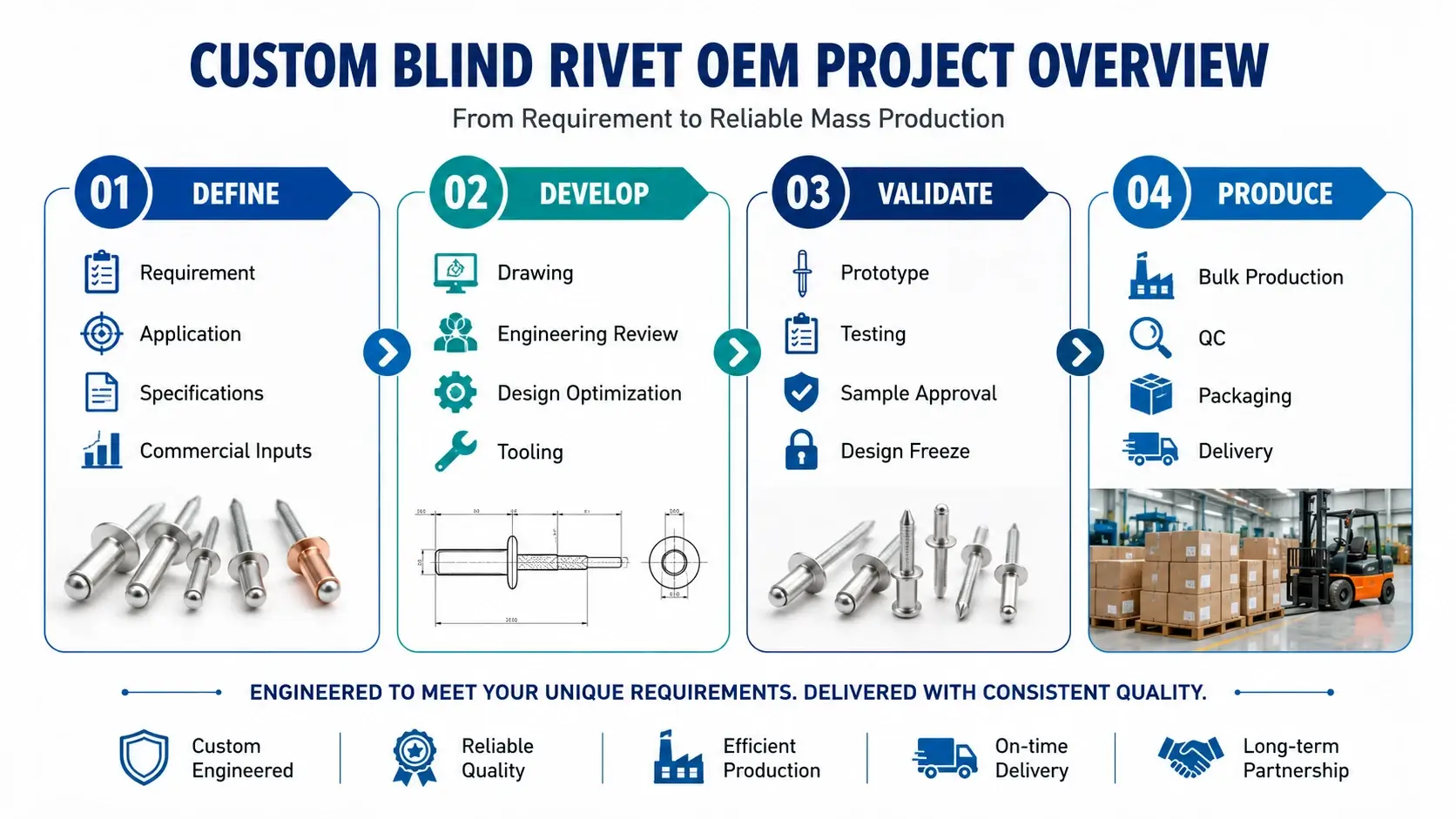
For robotics manufacturers, choosing a supplier with stable production capability is important for long-term projects. Robot OEMs often require customized rivet specifications rather than off-the-shelf standard parts.
RivetFast supports robotics OEMs with:
- ISO 9001 quality system: Certified manufacturing processes ensuring consistent product quality across production batches.
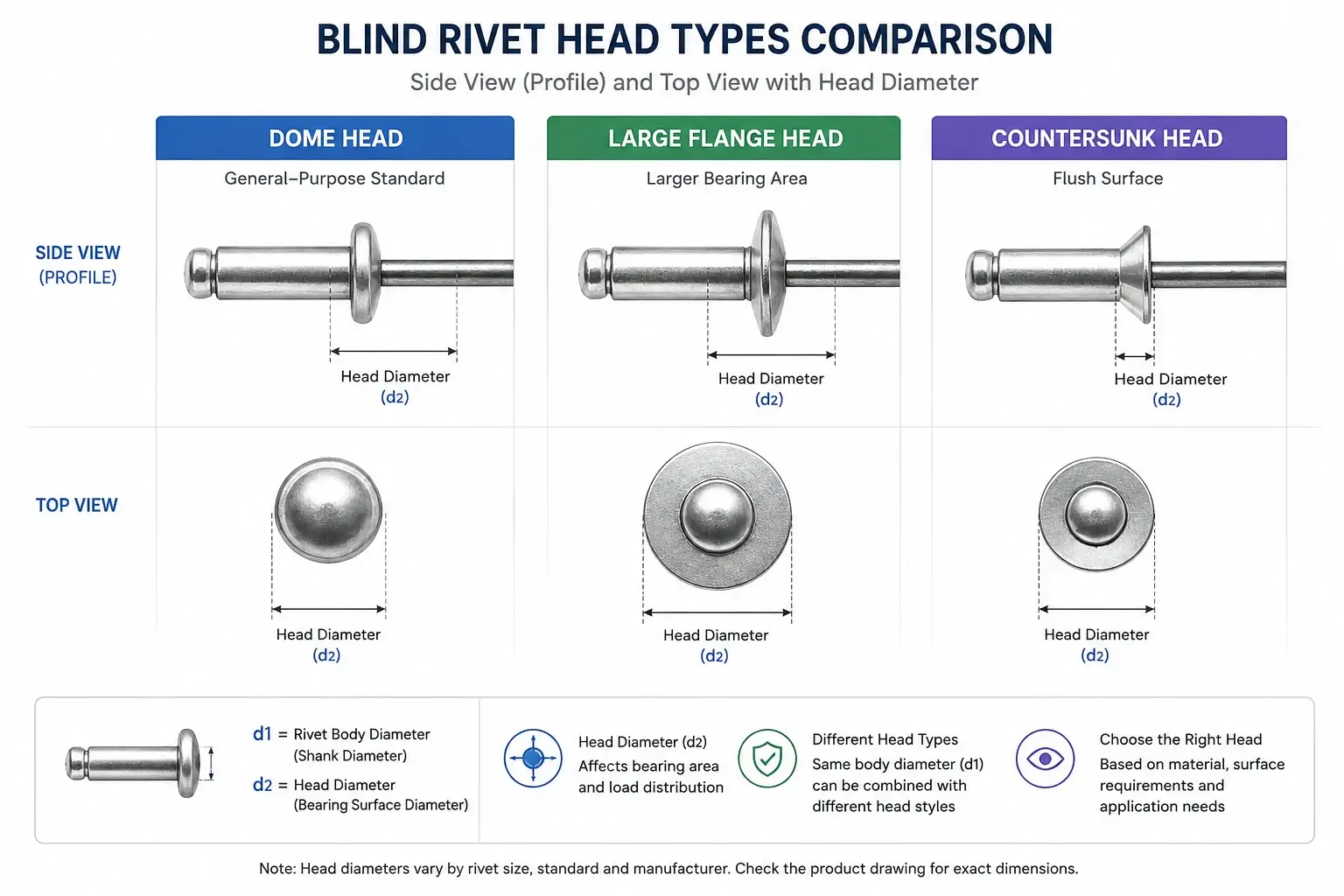
- Full OEM customization: Drawing development, custom head styles (dome, countersunk, large flange), material selection (aluminum, steel, stainless steel, copper alloys), surface treatment (zinc plating, anodizing, black oxide, custom coatings), and OEM packaging (custom labeling, barcoding, kitting for production-line integration).
- High-volume production capability: Over 200 production machines and 2 billion annual rivet capacity, providing the scale and consistency that robotics mass production demands.
Flexible MOQ options accommodate both prototype development and mass production scaling.
Future Trends: Fasteners in Next-Generation Robot Manufacturing
As robot production scales toward mass manufacturing, several trends are shaping fastener requirements.
First, supply chain standardization is becoming a priority. Robot OEMs are moving away from custom one-off fasteners toward standardized specifications that multiple suppliers can produce, reducing lead times and supply risk.
Second, lightweighting continues to drive demand for aluminum and structural blind rivets that reduce overall robot weight without sacrificing joint reliability under dynamic load.
Third, automated riveting is gaining traction. As robot factories move toward higher automation levels, fasteners with consistent dimensions and predictable installation performance become increasingly important. Automated rivet placement systems require rivets that set reliably without operator adjustment, making dimensional consistency and quality stability key supplier criteria.
These trends are increasing the demand for reliable, standardized fastening solutions in robot manufacturing.
FAQ
Q1:Where are blind rivets used in robot manufacturing?
Blind rivets are used across industrial robots, humanoid robots, collaborative robots, and mobile robots. Common application areas include frames, covers, electrical enclosures, battery housings, and peripheral equipment. Their one-side installation and vibration resistance make them suitable for lightweight robot structures across multiple robot categories.
Q2:Why are aluminum blind rivets suitable for robotics?
Aluminum rivets offer a high strength-to-weight ratio, natural corrosion resistance, and compatibility with aluminum robot frames and covers. They reduce overall weight while maintaining reliable joint performance under typical robotic operating conditions.
Q3:Can blind rivets be customized for robot OEM production?
Yes. Custom options include material, head style, diameter, grip range, mandrel type, and surface treatment. OEM suppliers like RivetFast support drawing development, prototyping, and mass production with custom packaging for production-line integration.
Q4:Blind rivets vs welding in robot assembly: which is better?
It depends on the application. Blind rivets are preferred for lightweight, one-side-access, and field-serviceable joints. Welding suits permanent, high-strength structural joints but adds heat distortion and weight. Many robot designs use both methods in different areas.
Q5:What blind rivet types are suitable for high-vibration robot applications?
For high-vibration environments such as robot joints near motors or actuators, structural blind rivets — including monobolt, interlock, and multi-grip types — provide superior mandrel retention and vibration resistance compared to standard blind rivets. Locked-mandrel designs prevent loosening under cyclic loading.
Explore our full range of blind rivets for industrial applications →