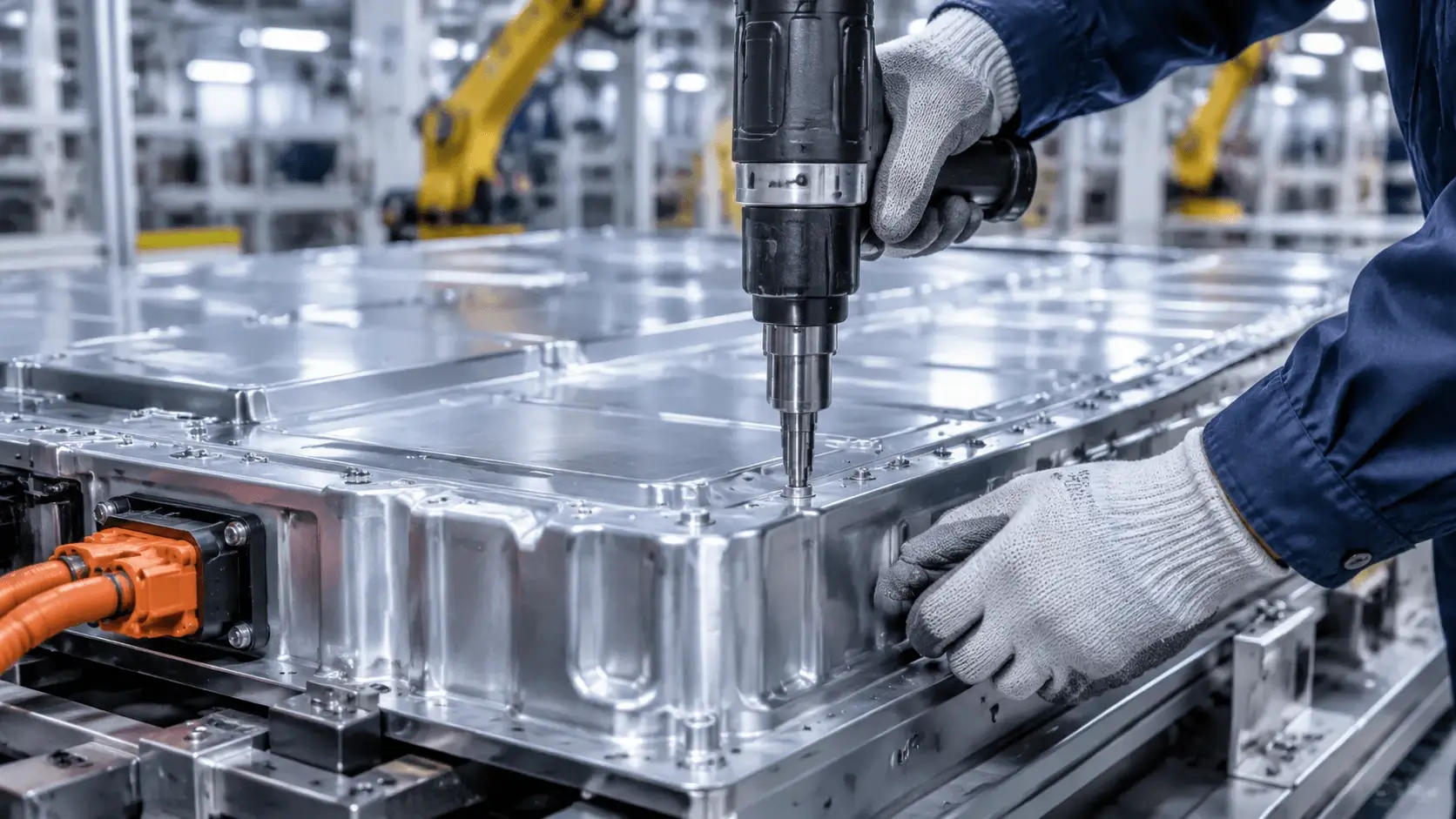
A practical comparison of the four ways to join sheet metal — by strength, accessibility, disassembly, production speed and cost factors — with a decision matrix for common applications.
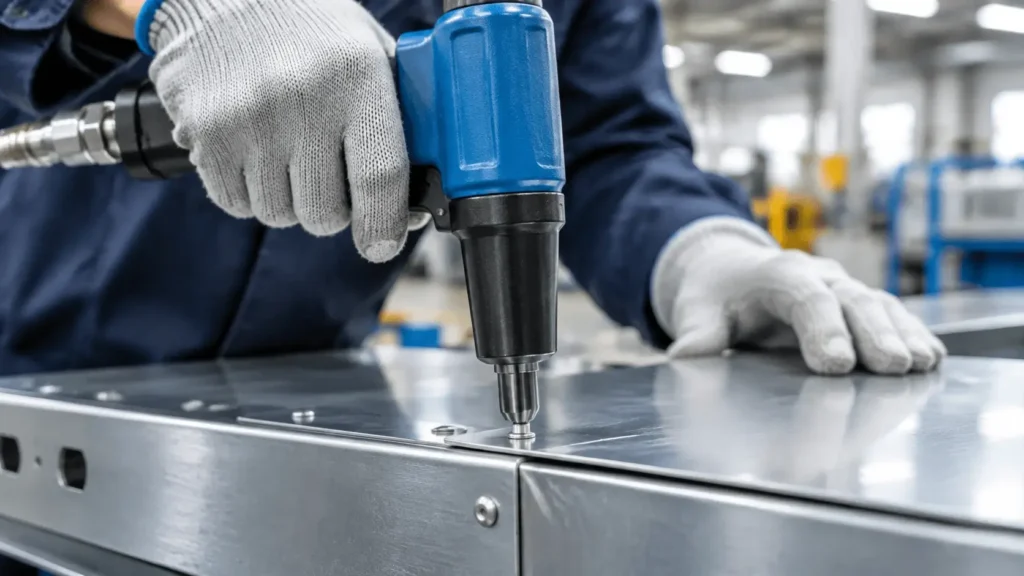
Choosing the right fastening method for sheet metal is not a matter of finding the strongest joint. Welding can deliver excellent structural strength, screws give serviceability, and adhesives produce smooth, sealed surfaces. Blind rivets offer a different advantage: a fast, repeatable joint installed from the accessible side alone. No single method wins on all counts — the answer depends on joint strength, accessibility, disassembly requirements, production volume and operating conditions.
The four sheet metal fastening methods below are compared on exactly those terms, with a decision matrix at the end for common applications. Within the rivet family there is a separate comparison — blind rivet vs pop rivet — covered elsewhere; here the question is bigger: when does a riveted joint beat a welded, bolted or bonded one, and when does it not?
The Four Sheet Metal Fastening Methods Compared
The table below is the anchor for everything that follows. Each method is rated per joint condition; where a rating depends heavily on the specific process or equipment, it says so rather than pretending.
| Dimension | Blind Rivets | Welding | Screws / Bolts | Structural Adhesives |
|---|---|---|---|---|
| Joint permanence | Permanent | Permanent | Removable | Usually permanent — removal often damages the bond or the substrate |
| Disassembly | Difficult — removal is destructive | Very difficult — cutting required | Excellent — fully reversible | Very difficult — heat or chemicals, panel usually scrap |
| One-side installation | Excellent | Process-dependent | Possible with a pre-existing threaded feature; otherwise access or extra hardware is needed* | Process-dependent |
| Installation speed | Fast — seconds per joint, one cycle | Process-dependent — jigging, welding, dressing | Moderate — multiple components per joint | Cure time required — fixtures hold the joint |
| Joint strength | Depends on rivet design, material and joint configuration | Can provide very high structural strength | High — depends on thread engagement | Depends on adhesive, surface preparation and joint design; peel loading needs design attention |
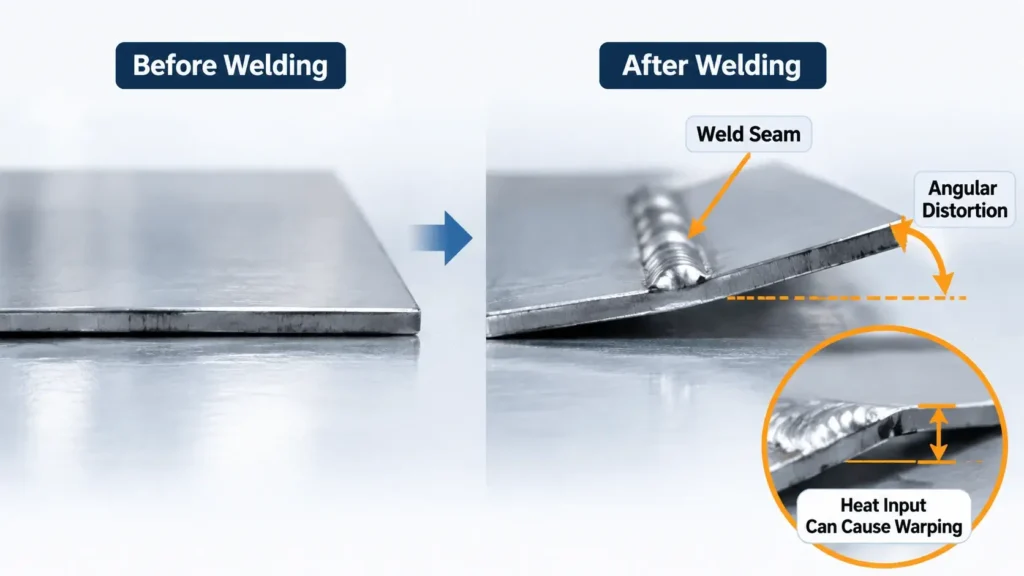
| Heat impact | Minimal — no significant heat input | High — heat input can distort thin sheet | Minimal — no significant installation heat | Usually low during application; some systems need heated curing |
| Surface preparation | Hole preparation | Joint prep plus post-weld cleaning and coating repair | Hole and thread preparation | Critical — cleanliness defines bond strength |
| Production cost factors | One part per joint, simple tool, low labor per cycle | Skilled labor, equipment, rework of coatings | Several parts per joint, drilling and assembly time | Material, cure fixtures, surface-prep labor |
| Typical applications | Enclosures, panels, brackets, closed sections | Structural frames, permanent fabrication | Serviceable assemblies, access panels | Bonded panels, dissimilar materials, visible surfaces |
*Standard screws need a threaded feature — a tapped hole, a nut or a threaded insert. Whether installation requires access to both sides depends on the joint design; see below.
Welding on Sheet Metal: Strong Joints with Heat and Process Considerations
Advantages of Welding
Welding can produce very strong permanent joints when the joint design, weld quality and base materials are properly matched. Load is transferred through the fused joint rather than through a separate component, there is no protruding fastener head, and a properly designed and executed continuous weld can also seal the joint. That is why welding is the default for permanent joining in structural fabrication — frames, load-bearing brackets, anything where the connection is the product.
Limitations of Welding Thin Sheet Metal
The same heat that makes a weld strong is what makes it awkward on thin sheet. Thin material — around 0.8 to 2 mm depending on alloy and process — needs careful control of heat input: too much and the panel warps, burns through or moves dimensionally. Where the risk actually starts depends on material thickness, joint design, welding method and fixturing, so it is a range to plan around rather than a fixed limit. On thin panels, warping and burn-through are the failure modes to manage, not rare accidents.
Access is the second constraint. Many welding processes assume the joint can be reached from both sides, and closed sections or fully assembled boxes often cannot offer that. It is not an absolute rule — some processes work one-sided — but the workable options narrow quickly as the geometry closes up.
Coatings are the third. Paint, galvanizing and anodizing do not survive the arc: the joint area has to be prepared back to bare metal and re-coated afterwards — an extra process step and, on galvanized or anodized parts, a corrosion weak point if the repair is poor. Dissimilar metals can be welded in some combinations, but compatibility and process control limit the practical choices, a constraint that grows as products mix aluminum and steel.
When Welding Is the Right Choice
Welding earns its place on load-bearing frames, structural supports and permanent metal construction, where joint strength dominates and the sheets are thick enough to absorb the heat. If the part never comes apart, has reachable surfaces and carries real load, welding is usually the right answer — a rivet is not a substitute for it.
Screws and Bolts: Strong, Removable, and Serviceable Connections
Advantages of Mechanical Threaded Fasteners
Threaded fasteners are the only fully reversible method here. Clamp load can be specified and verified, strength spans a huge range through diameter and grade, and the joint opens for service without destroying anything. For anything a technician is expected to open — access panels, mounted components, adjustables — screws are the default.
Installation and Cost Considerations
The cost of a screw joint is not the price of the screw. Each joint needs a hole plus a threaded feature to receive it — a tapped hole, a nut or an insert — and any of those adds machining, hardware or a second-side operation. Add washers, a locking feature for vibration and the time to align and drive it, and the total per joint climbs well above the component price. Automated screwdriving changes that equation — which is why the comparison belongs per process, not per catalog price.
Three things get lumped together as “screws”: a standard screw needs a threaded partner feature, which may sit on the far side or be formed into the sheet itself; a self-clinching fastener presses into ductile sheet to create a permanent thread; a rivet nut sets blind from one side and leaves a reusable thread. The last two blur the one-sidedness line above — mechanical fastening does not always mean two-sided access.
When Screws Are the Better Choice
Screws win wherever the joint will be opened during the product’s life: service panels, mounted electronics, wear parts, anything with a maintenance schedule. Removable fastening is their whole point — the ability to rework a joint without scrapping the panel is often worth more than cycle time, especially on prototype and low-volume builds.
Structural Adhesives: Seamless Bonding Without Drilling
Advantages of Adhesive Bonding
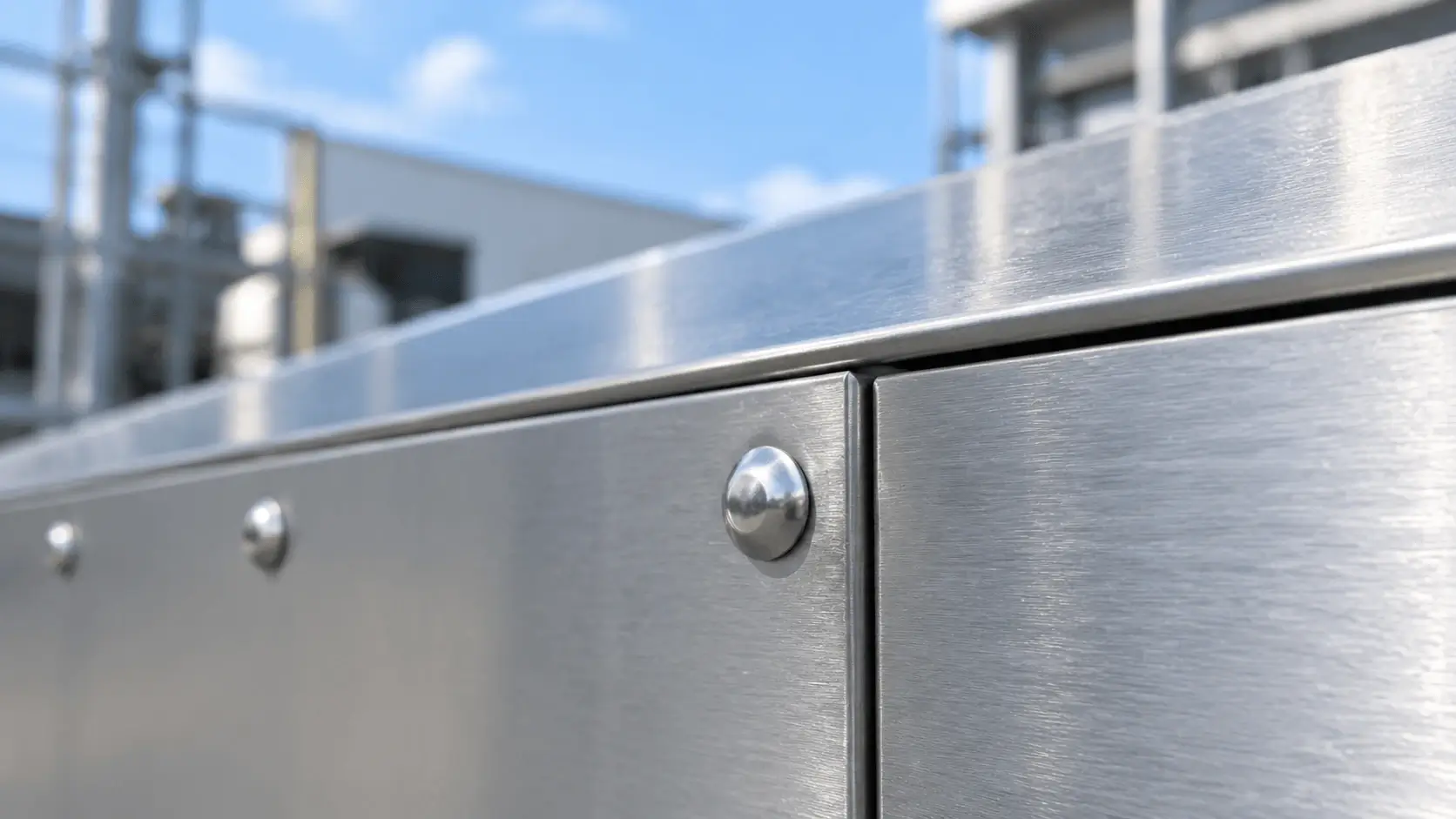
An adhesive joint requires no fastener hole, so there is no local material removal to weaken the panel. Load is transferred across the bonded area rather than concentrated at discrete fastener points, the surface stays visually uninterrupted, and a properly designed bond line can also seal the joint. For thin or soft materials that resist welding, or materials that should not be mixed metallurgically, adhesives open options the others do not. A well-designed bonded joint is not inherently weaker than a mechanical one — it fails differently, and it asks more of the process around it.
Limitations in Industrial Assembly
What the adhesive asks for is discipline. Surface preparation is critical — cleanliness and activation define the bond more than the chemistry. Cure takes time and fixtures, adding work-in-progress to the line, and every adhesive has a temperature ceiling and its own peel behavior, so joint design generally keeps loads in shear. Bond quality is also not always visible from outside: unlike a mechanical fastener, there is no head to inspect. Reliable production therefore rests on controlled preparation, mixing and application, curing conditions, documented records and appropriate inspection methods — and a disbonded panel comes apart only destructively. These are process constraints rather than weaknesses, but they need an owner.
When Adhesives Are the Better Choice
Adhesives earn their place on visible panels where no fastener head is acceptable, on dissimilar-material assemblies, and on joints that must seal. In production they usually appear alongside mechanical fasteners — the fasteners locate and hold the joint while the bond cures, then the adhesive takes the distributed load. On a specific panel, the deciding questions are inspection capability and whether the joint will ever see peel.
Why Blind Rivets Are a Practical Choice for Sheet Metal Assembly
None of the four methods wins everywhere — the honest case for blind rivets is a specific set of conditions where they outperform the alternatives, and those conditions are common in sheet metal products.
One-Side Installation for Hard-to-Reach Joints
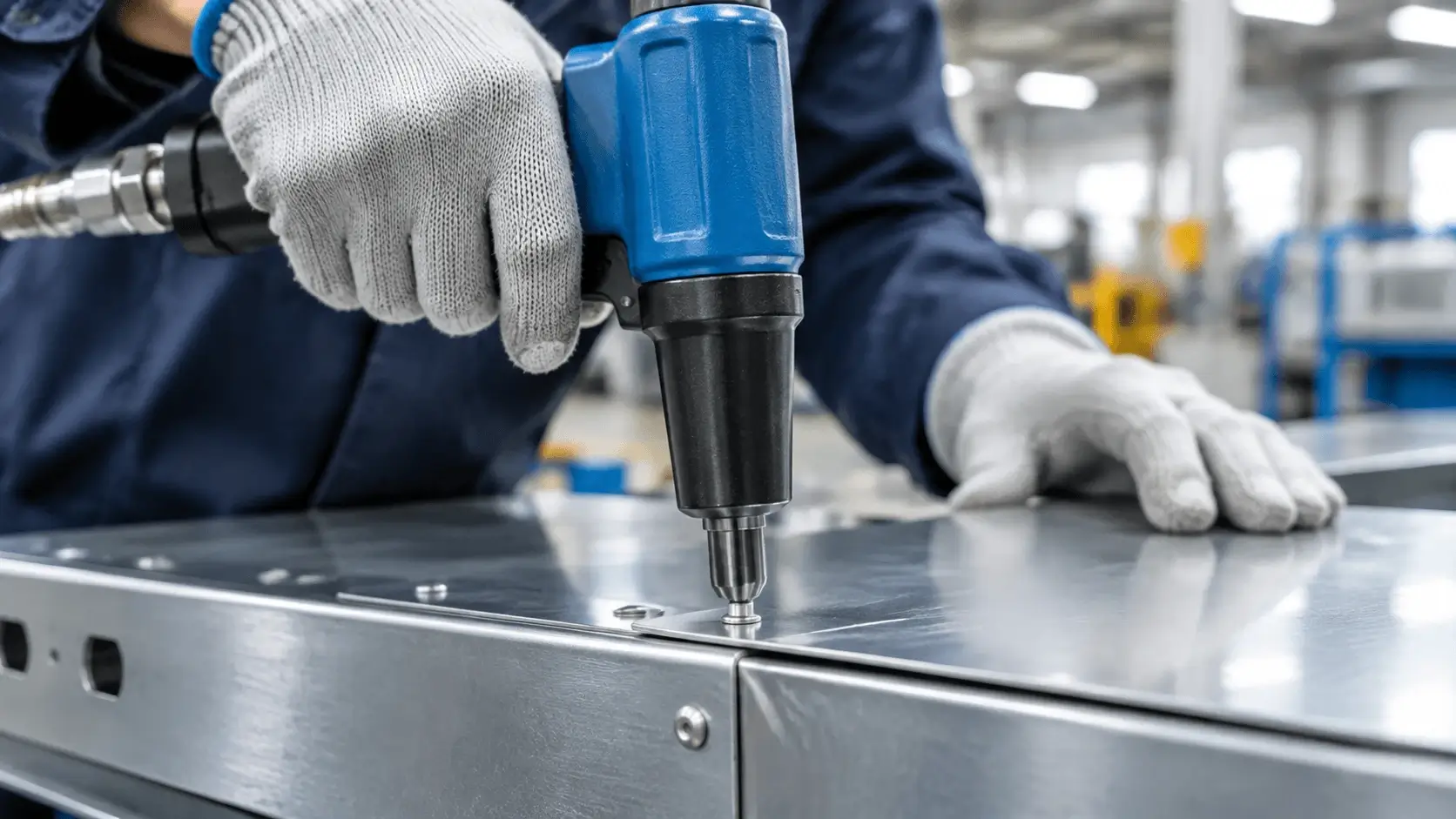
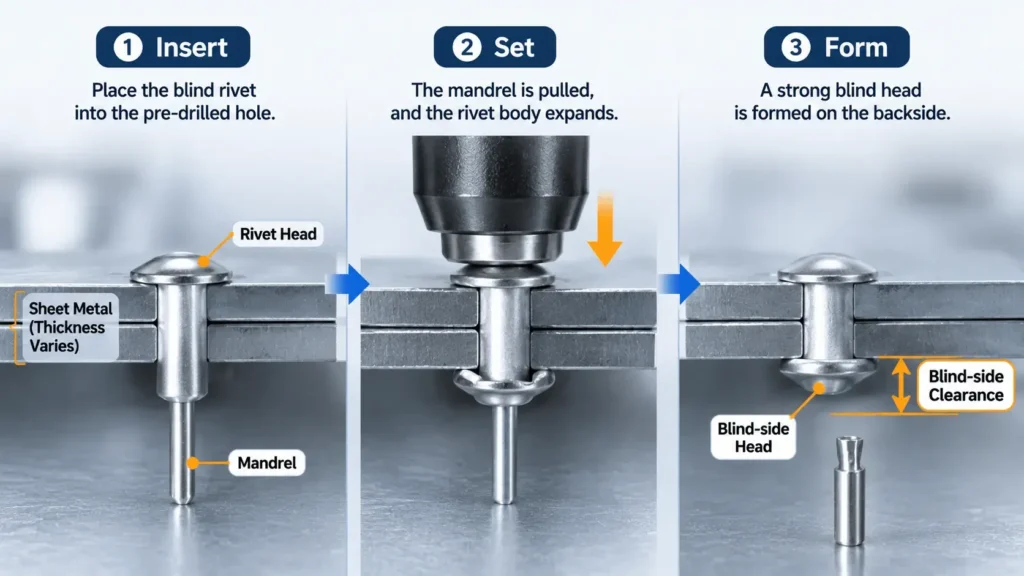
Blind rivets are particularly effective when the joint must be installed from one side and no pre-installed fastening feature is available on the inaccessible side. The operator never needs to reach the back — but the joint still has to give the rivet room. During setting the body deforms to form its blind-side head, so the far side needs clearance for that head to develop. Set a rivet against solid backing, or into a cavity too shallow for the tail, and the joint is incomplete however well the front side was prepared.
This is not a niche case: covers, housings and panels attached to structures they cannot reach behind are the normal condition of sheet metal assembly. Among the methods in this comparison, blind riveting is the one that closes such a joint in a single operation — no blind-side feature required, no second visit from the other side.
Fast Installation for Production Lines
Each riveted joint is one part and one trigger cycle with a matched rivet tool — hand-held, cordless or pneumatic. Speed comparisons across methods depend on automation and fixturing, so no absolute claim survives scrutiny; what does survive is the shape of the cycle itself. Where holes are pre-punched, as they usually are in volume production, it is insert, set, done. Where the hole still has to be drilled, that is one more step in the same single-side sequence. There is no cure wait, no second operation from the other side and no post-weld dressing to schedule.
Consistent Assembly Quality
A riveted joint’s quality depends on a short list of controllable factors: the rivet specification, the grip range match, the hole diameter and condition, and a properly matched installation tool. When those are standardized and monitored, blind riveting delivers repeatable results across production batches — the value is that the variables are measurable and auditable, unlike an operator’s technique on each weld. Repeatability is a property of the process, not a promise about any single joint.
Flexible Material and Size Options
Blind rivets come in aluminum, steel and stainless bodies, with body and mandrel material combinations selected for strength, corrosion resistance and application requirements. The range runs from 2.4 mm to 6.4 mm; which body and mandrel combinations are available at a given diameter is confirmed on the datasheet. That matching has to respect galvanic compatibility; our guide to aluminum vs steel vs stainless steel blind rivets covers it.
Practical Cost Efficiency for Repetitive Assembly
Economically, a blind rivet uses one integrated fastener rather than a separate screw-and-nut pair: a shorter bill of materials, no second part number to stock or lose on the line, and assembly that collapses into a single step. Whether that makes it the cheapest option depends on rivet pricing, cycle time, tooling requirements and production volume. The comparison that matters is total cost per completed joint — parts, hole making, installation, inspection and rework — not fastener price alone.
Explore our range of blind rivets to compare available types, materials, diameters and grip ranges for your sheet metal assembly.
Where rivets are not the answer: joints that must come apart repeatedly (removal is destructive — see how to remove and replace a blind rivet); primary structural connections, where welding or bolting belongs; and joints outside the rivet’s grip range, which has to cover the real stack-up including coatings. Strength also depends on rivet design, material and installation — “rivet” is a family, not a strength number.
How to Choose the Right Fastening Method for Your Application
The matrix below compresses all of the above into the ten situations we are asked about most. The answers deliberately do not all point one way — that is what a real engineering decision looks like.
| Application | Recommended Method | Main Reason |
|---|---|---|
| Sheet metal enclosures and covers | Blind rivets | Permanent panel assembly where fast installation and one-side access matter |
| Closed box sections and ducts | Blind rivets | Back inaccessible, no pre-installed feature, and clearance for the blind head to form |
| Removable access panels | Screws | Full reversibility for maintenance |
| Structural frames | Welding | Permanent joints carrying primary load |
| Decorative visible panels | Adhesives | Uninterrupted external appearance |
| High-vibration assemblies | Application-dependent | Requires joint-specific validation of fastener design, locking features and fatigue performance |
| Dissimilar metal panels | Adhesives or electrically isolated mechanical fasteners | Reduces direct metal-to-metal contact; galvanic compatibility still has to be checked |
| Prototype and rework builds | Screws or rivets | Depends on how often the design will change |
| High-volume production | Application-dependent | Evaluate total assembly cost per joint in the actual process |
| Field assembly and repair | Blind rivets or screws | Depends on access and whether the joint opens again |
Why Many Industrial Products Combine Multiple Fastening Methods
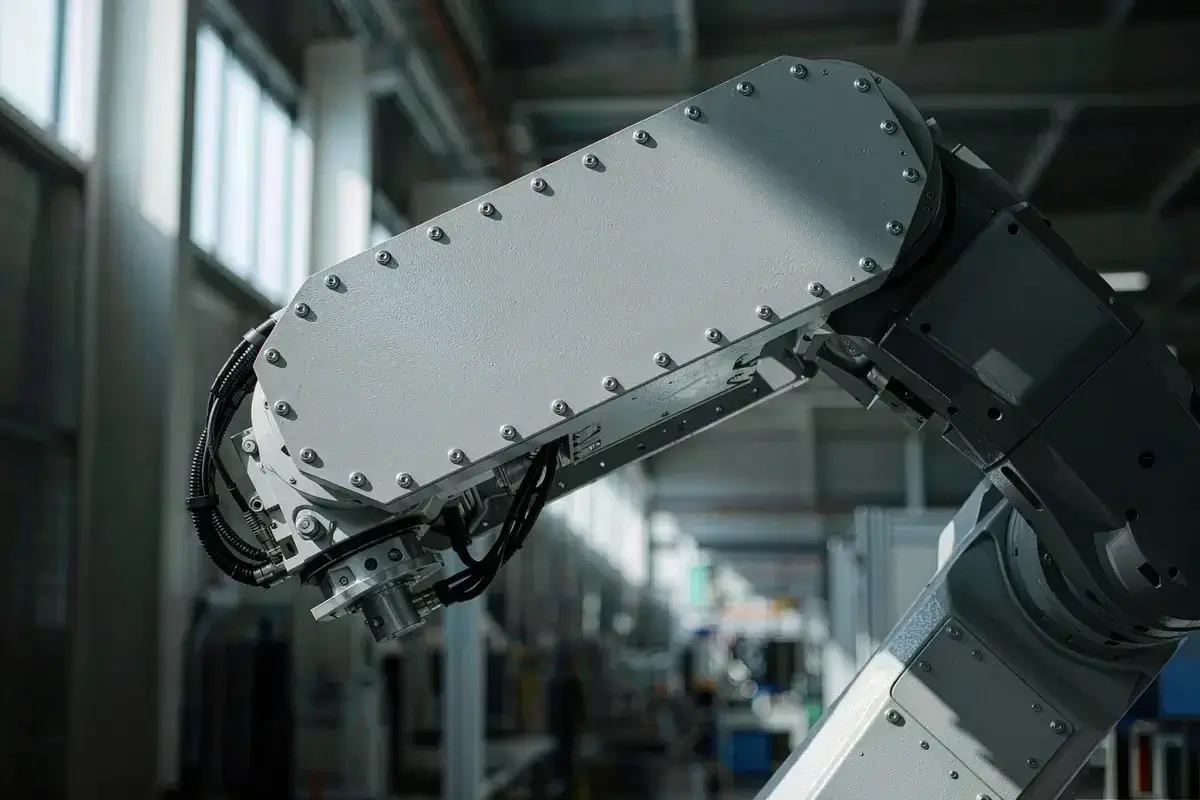
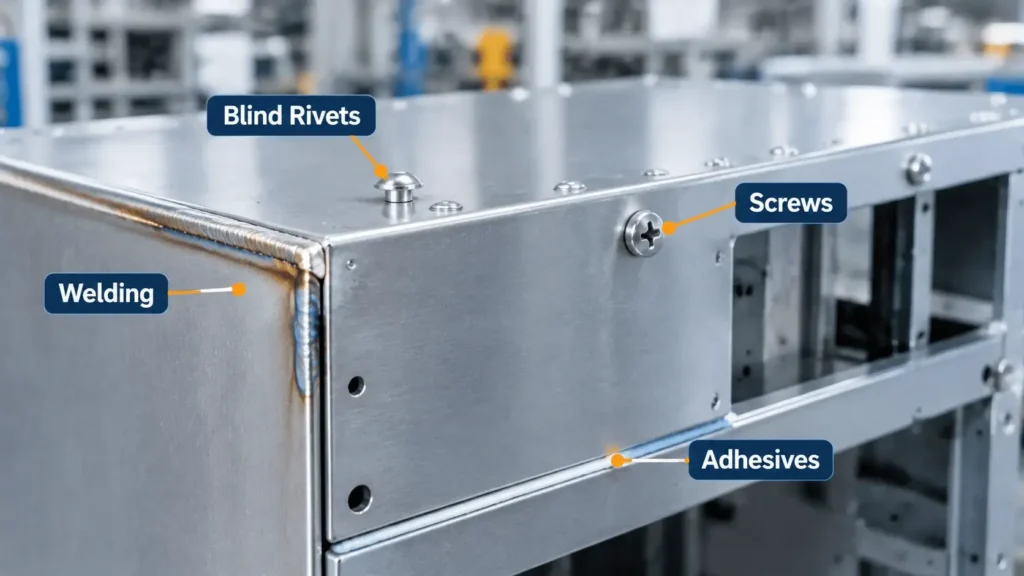
Open up any industrial cabinet, machine enclosure or robot body and you will find all four methods doing different jobs on the same product. That is not indecision — it is each joint getting the method its own conditions call for.
Welding for structural frames. Base frames and load paths are welded: permanent, rigid, and thick enough not to fear the heat. Blind rivets for sheet metal panels. Covers, guards and housings mount from outside — one side accessible, no service requirement, thousands of joints handled cheaply. Screws for removable components. Anything a technician opens — controller plates, filters, wear parts — sits on threaded fasteners. Adhesives for bonded surfaces. Visible or dissimilar panels are bonded where a fastener head would show.
A robot body is the cleanest example: welded base, riveted covers, screwed controller panels — three methods, one product, and no contradiction in that.
5 Common Mistakes When Choosing a Sheet Metal Fastening Method
- Choosing on strength alone. Specifying the method with the biggest strength number before analyzing what the joint actually carries. Most thin-sheet joints are limited by access, cost or distortion long before strength becomes the deciding factor.
- Ignoring installation space. Discovering at the prototype stage that the tool cannot reach the joint, or that the blind side has no room for the rivet tail to form. Check reach and clearance on the drawing, not on the assembly floor.
- Overlooking heat distortion on thin sheet metal. Welding thin panels without planning for jigging and sequencing turns a strong joint into a warped panel that needs rework.
- Ignoring vibration and service requirements. A joint that opens for service needs threads; a joint that shakes for its whole life needs a locked, validated solution — not whatever was fastest to install.
- Underestimating installation and maintenance costs. Judge methods by total cost per joint across the product’s life — parts, labor, tooling, rework and service. For riveted joints that includes matching grip range to the real stack-up: the wrong grip range sets incompletely and clamps insufficiently, a silent failure until the field finds it. Our guide to blind rivet grip range covers the calculation.
FAQ
Are blind rivets as strong as welds?
- Not in the same joint configuration. A welded joint generally carries more load than a blind rivet set into the same sheet, because the connection is continuous rather than a series of discrete points. That comparison only matters where the joint is loaded near its limit — and most sheet metal joints, such as covers, panels and brackets, are not. There the deciding factors are access, distortion, coating damage and cost. For a thin-sheet enclosure or bracket, a correctly selected rivet is strong enough, and welding adds distortion risk without a functional benefit.
Can screws be installed when only one side of the sheet metal is accessible?
- Yes, if the sheet already provides something for the screw to engage. A standard screw needs a threaded feature — a tapped hole, a nut or a threaded insert. Where a pre-tapped hole or an installed insert already exists, the screw is driven from the accessible side without reaching behind. Where it does not, single-side options include rivet nuts, which set blind and leave a reusable thread, and self-clinching fasteners, which press into ductile sheet to create a permanent one. Both are worth considering when access and serviceability requirements collide.
Which fastening method is most cost-effective for high-volume production?
- It depends on the joint, not the price list. Blind rivets usually win on repetitive thin-sheet assembly because each joint is one part and one fast cycle. But automated screw driving or robotic welding can be cheaper where the process is already in place. Compare the total cost per joint — parts, labor, tooling and rework — rather than component prices.
Can structural adhesives replace mechanical fasteners?
- Sometimes, but rarely as a total replacement. Adhesives distribute load evenly and seal the joint, yet they need disciplined surface preparation, controlled cure, documented process control and appropriate inspection, and they can be sensitive to peel loading depending on the adhesive and joint design. In production, adhesives most often work alongside mechanical fasteners, which hold the joint while the bond cures and provide a defined failure path.
Do blind rivets loosen under vibration?
- Blind rivets do not loosen through thread rotation, because they form a mechanically deformed joint rather than a threaded connection. Repeated vibration and cyclic loading can still cause joint movement, hole wear or fatigue failure if the rivet is wrongly selected or badly installed. For high-vibration applications, select a rivet design with suitable mechanical performance and mandrel retention, and get the hole size, grip range and installation quality right — then validate the completed joint under the actual operating conditions. Structural rivets with mandrel retention are a sensible starting point, not a guarantee.
Need Help Choosing the Right Blind Rivet?
Choosing the right fastening method depends on your sheet metal material, thickness, joint accessibility and application requirements.
If blind rivets are a suitable option for your assembly, RivetFast can help you evaluate the appropriate rivet type, material, diameter and grip range for the joint in question.
Send us your drawing or applcation details for a technical review and product recommendation. Sample arrangements can also be discussed against your project requirements.