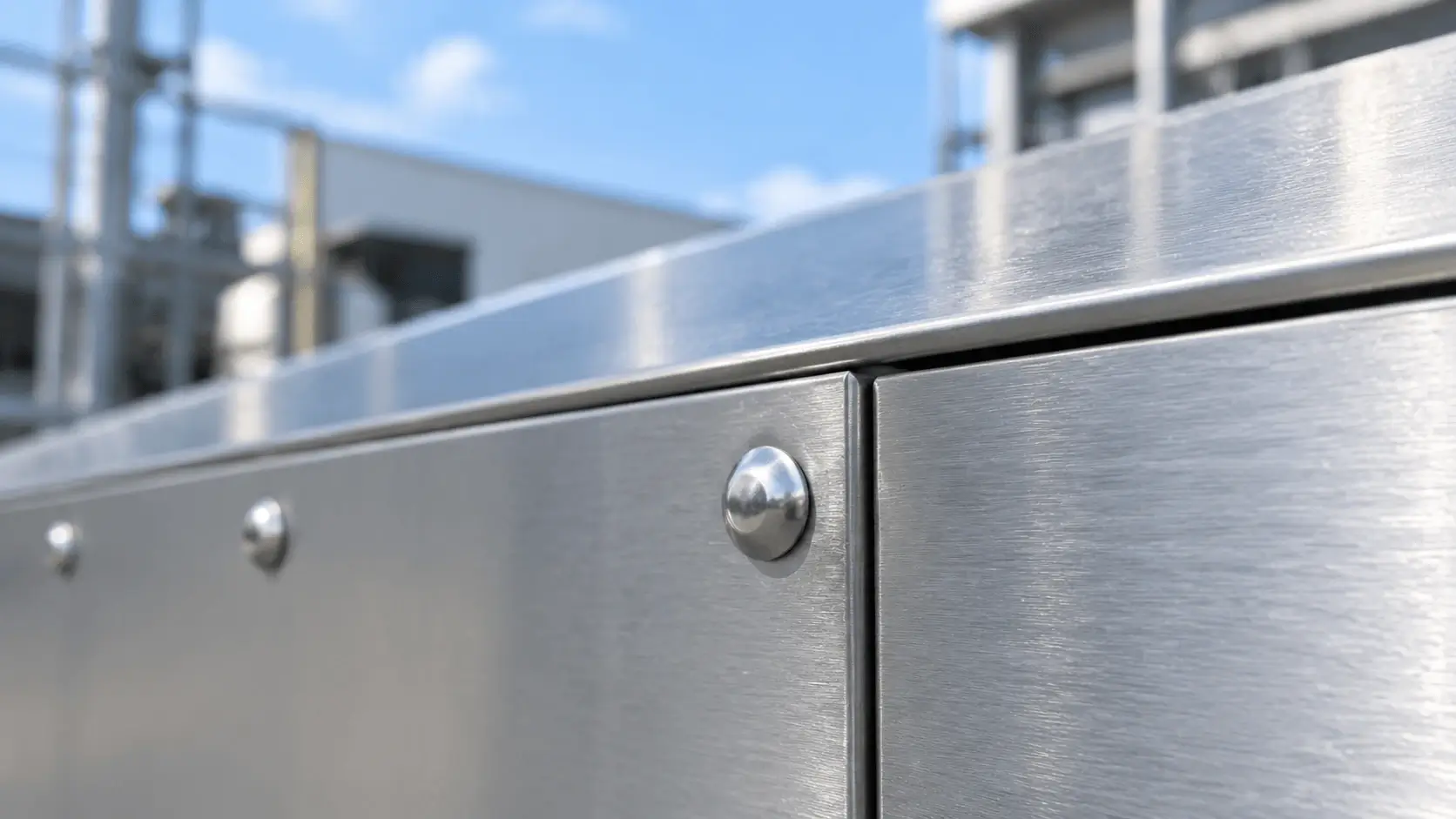
One-sided installation, mixed materials and production volume — three practical reasons blind rivets are used in EV assemblies. What this guide adds is the other side of the ledger: the checks that decide whether they hold up there.

Blind rivets may appear in the bill of materials for a battery tray or a charging cabinet — joining panels to frames, brackets to trays, clips to thin sheet. What separates a specification that lasts from one that comes back is whether the rivets were chosen for what an EV enclosure actually demands, at production volume, in joints where access becomes limited after assembly. This guide works through those demands — and the checks that answer whether blind rivets for EV battery enclosures are the right call for your assembly.
The wider picture — where blind rivets earn their place, from humanoid robots to industrial automation — belongs to our applications overview. This guide stays narrow: what battery enclosures and charging equipment demand from a rivet.
Why Blind Rivets Are Used in EV Battery Enclosures
Three practical advantages help explain why blind rivets are used in EV assemblies. None of them is simply convenience.
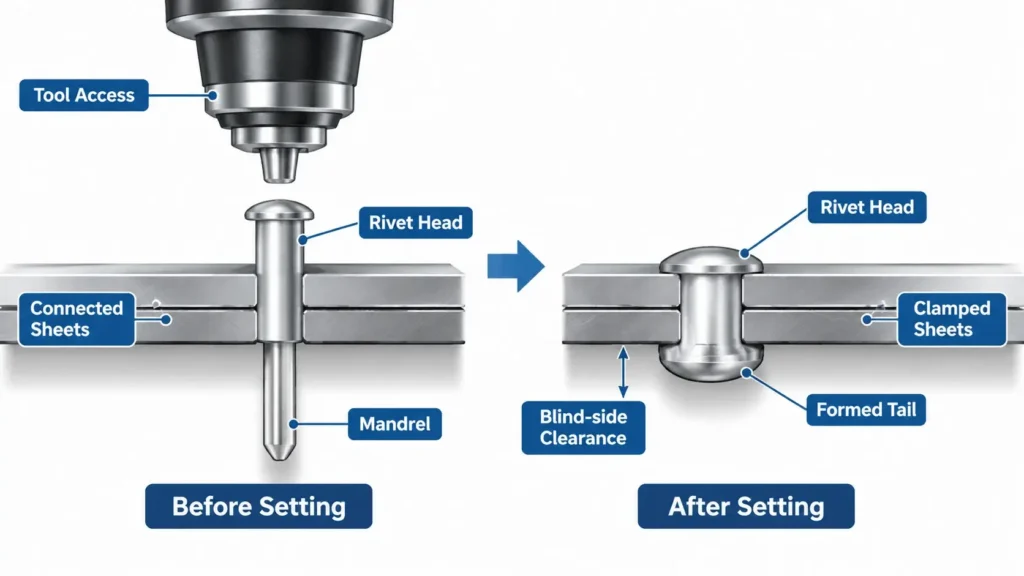
One-side installation access, with blind-side clearance. In sealed enclosure assemblies the back of the joint sits behind panels, seals and components no installer can reach from outside. Blind rivets are set entirely from one side, which removes the two-sided coordination that through-bolts require. The qualification matters as much as the advantage: the rivet tail still needs room to form behind the sheet. Where a harness, a structural member or an internal module sits close behind the joint line, tail formation can be blocked. The blind-side clearance is a design check, not an assumption.
No welding heat input. Compared with welding, riveting adds no heat-affected zone to thin aluminum sheet — relevant for distortion control and for joints near seals and electronics. The advantage is deliberately narrow: it is relative to the heat welding introduces. Drilling, hole deburring and the setting operation still touch the coating and the surrounding joint, and those steps carry their own quality requirements.
Production consistency. Standardized rivet dimensions feed automatic systems reliably; installation force and stroke can be controlled by the setting equipment; thousands of identical joints reward standardization. That consistency is a property of the process — rivet, hole, fixture, equipment and parameters together — not of the rivet alone.
None of this makes blind rivets a default choice for every enclosure joint. Joints carrying critical structural loads require specific fastener qualification and joint-level validation — standard blind rivets should not be assumed suitable without that assessment, even though structural rivet designs exist. Openings designed for repeated access may need removable fastening systems, while interfaces with demanding ingress protection requirements need a complete sealing design rather than relying on the rivet alone. Blind rivets should be selected joint by joint, against the actual design requirements.
What Battery Enclosure Duty Demands from a Rivet
Five requirements do most of the selection work in an enclosure joint. Table 1 maps each one to what it means for the rivet decision.
Table 1 — Enclosure requirements and what they mean for rivet selection
| Enclosure requirement | What it means for rivet selection |
|---|---|
| Corrosion resistance | Evaluate the rivet body, mandrel and enclosure materials together |
| Sealing / ingress protection | Consider closed-end designs and the complete joint sealing system |
| Vibration and fatigue | Evaluate joint geometry, load direction, spacing and long-term joint integrity |
| Temperature variation | Review material compatibility and differential thermal expansion |
| Weight | Consider fastener material and total assembly weight |
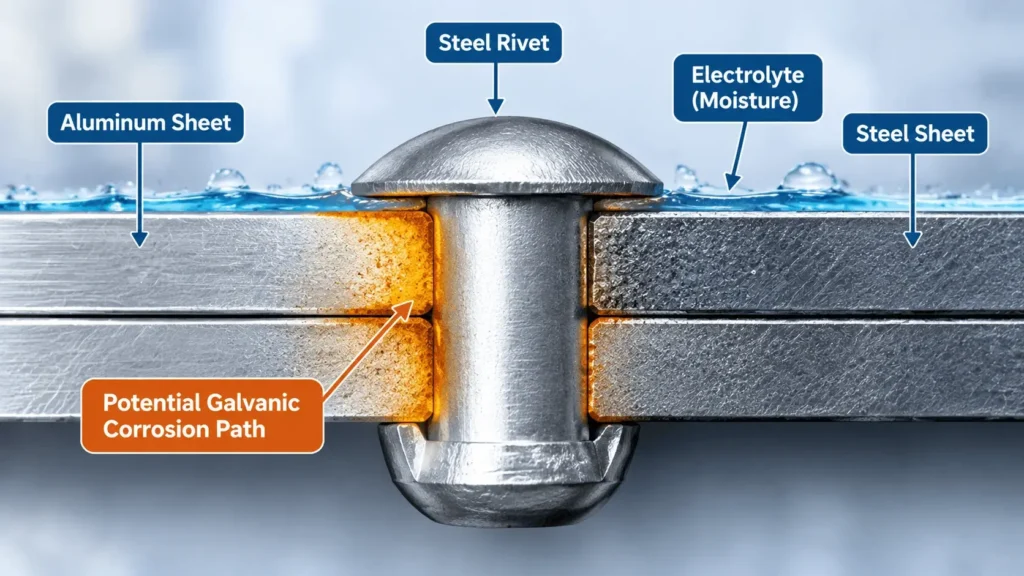
Corrosion is a circuit, not a component. In a battery pack the enclosure material is frequently aluminum, and the fastener is frequently not. When dissimilar metals are in electrical contact and exposed to an electrolyte such as moisture, galvanic corrosion may occur; in many aluminum-to-steel and aluminum-to-stainless combinations, aluminum may act as the anode, but the actual risk depends on the specific materials, surface conditions, contact points and exposure. That is why “aluminum shells always take aluminum rivets” is not the answer: the rivet body, mandrel and connected sheets represent different material positions, and their actual electrical contact relationships depend on the rivet design; the combination — plus the moisture path along the joint gap — decides the risk.
Sealing is a joint property. Closed-end blind rivets can help reduce the potential ingress path through the rivet body, depending on the specific rivet design and its sealing performance — the structure of a closed-end body is not, by itself, a validated watertight system. They do not automatically seal the interface between the connected sheets, and no rivet establishes an IP rating for the assembly on its own. Where ingress protection matters, the gasket, the lap joint, the sealant and the fastener have to be evaluated as one complete sealing system.
Vibration and fatigue live in the joint. A vehicle enclosure spends its life under road inputs. Riveted joints have no threaded interface to rotate loose, but cyclic loading is not thereby neutralized: fretting at the hole wall, sheet deformation and fatigue behavior depend on joint geometry — load direction, spacing, edge distance, the sheet stack. The rivet datasheet does not decide how the joint ages. Rivet strength is not joint strength, and neither is fatigue life.
Temperature and weight round out the list. Mixed-material joints see differential thermal expansion across their temperature range — a compatibility question to review, not a number to quote here. And the fastener population in a large enclosure is a weight line item worth counting, which can favor aluminum bodies where strength, corrosion compatibility and joint requirements permit them.
One boundary belongs at the end of this section. Fastener selection is one part of enclosure design. Overall battery pack safety and performance must be established through system-level validation — of which thermal-event performance is one aspect among several. A rivet specification supports that design; it cannot substitute for it.
Material Combinations: Body, Mandrel and Enclosure
With the duty requirements on the table, material selection becomes a three-position question — body, mandrel, and the materials being joined. Table 2 gives the direction for the combinations that come up most often in enclosure work, as direction rather than fixed correspondence.
Table 2 — Common joint material combinations and the selection direction
| Enclosure / joint materials | Rivet selection direction | Key consideration |
|---|---|---|
| Aluminum-to-aluminum | Aluminum blind rivets may be considered | Body and mandrel compatibility |
| Aluminum-to-steel | Evaluate compatible material combinations and isolation strategies | Galvanic corrosion risk |
| Coated steel panels | Consider compatible coated steel or corrosion-resistant options | Protection of exposed hole edges |
| Stainless steel components | Consider 304 or 316 options based on exposure | Corrosion environment and maintenance |
The principle underneath the table is worth stating on its own: do not select a rivet based on body material alone. Four items have to agree before a combination is settled:
- Rivet body material — what the installed joint mostly sees
- Mandrel material — what stays inside the joint after setting
- Connected sheet materials — the other side of every galvanic circuit
- Environmental exposure — moisture, cleaning chemistry, temperature
Two cautions keep the table honest. “Common” is not “verified”: an aluminum rivet is not automatically compatible with every aluminum alloy and mandrel pairing — the specific combination still has to be confirmed. And the broken mandrel stays in the joint after setting, aging with it; where it ends up and how much is exposed depends on the rivet design, so it is part of the assessment rather than a footnote.
Charging Infrastructure: A Different Exposure Profile
Charging equipment shares the thin-sheet, mixed-material, high-volume profile of enclosure work, and diverges in exposure and service. Cabinet panels, covers and internal sheet-metal parts see a duty that depends on where the unit is installed — indoor wall boxes and outdoor cabinets are different environments, and the material decision follows the installation, not the category.
Table 3 — Battery enclosure vs. charging infrastructure
| Aspect | Battery enclosure | Charging infrastructure |
|---|---|---|
| Typical joints | Housing panels, brackets and internal supports | Cabinet panels, covers and internal sheet-metal components |
| Exposure | Enclosure environment and localized moisture exposure | Indoor or outdoor exposure, depending on installation |
| Service requirements | Depends on pack architecture and repair strategy | Panel access and maintenance requirements vary by design |
| Material selection | Joint compatibility, corrosion and sealing | Atmospheric exposure, coatings and maintenance |
For outdoor installations, the material question runs on four variables rather than a distance rule: the surface treatment and coating integrity of the panels, the crevice design of the joints, the cleaning and maintenance frequency the site actually delivers, and — where stainless components enter the joint — the grade. Charging station enclosures may combine powder-coated steel panels, stainless fittings, aluminum brackets and plated hardware, so the coating condition around drilled or punched holes also matters: exposed edges can become localized corrosion sites if the protective finish is damaged at the hole and not restored. That last stainless-grade decision is a question of its own, covered in depth in our guide to 304 vs 316 stainless steel blind rivets.
Service access is the other divergence. Where future access is required, the joint design should also account for the removal and replacement process, since blind rivets generally require destructive removal — a joint expected to open for maintenance is a different specification problem from one that is set once and sealed for life.
Blind Rivets for EV and Charging Applications
Looking for blind rivets for EV enclosures or charging equipment? Explore our blind rivet range or contact RivetFast to discuss your required sizes, materials and application conditions.
Installation and Quality in High-Volume EV Production
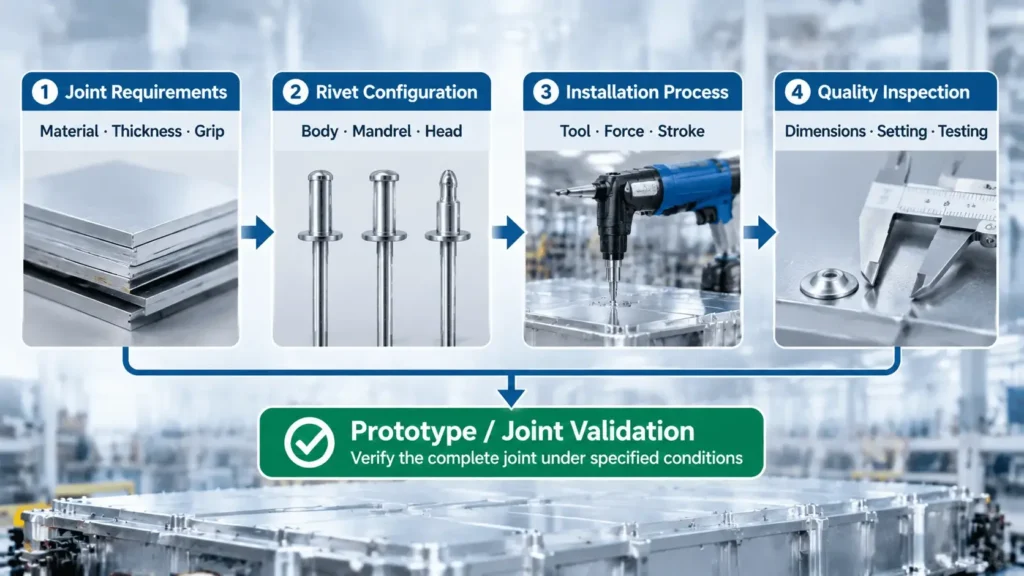
In volume production, the rivet is the smallest part of the system. Automated setting brings its own checklist:
- Automated rivet feeding — standardized dimensions are what make feeding reliable
- Controlled installation force and stroke — monitored or controlled by the setting equipment to support consistent rivet formation
- Installation process monitoring, where equipped — not every system provides it, and its absence is a process-design fact, not a defect
- Hole and grip range consistency — the joint inputs the rivet depends on
- Setting quality inspection — check head seating, proper rivet formation and signs of incomplete or inconsistent installation; inspection frequency and acceptance criteria should match the joint’s risk and the production quality plan
Two qualifications keep this list honest. Controlled force and stroke support a good joint but do not prove one: the installed result still depends on the rivet specification, the hole condition and the sheet stack, which is exactly what the inspection looks at. And that is the right standard for EV battery enclosure fasteners generally — judged by what the production line can repeat, not by what one setting achieved.
Grip range deserves its own warning in EV work, because sheet combinations change during development: a gauge change, a gasket addition or a coating-thickness shift can push a rivet selected at design review out of its range. Grip range must match the actual combined sheet thickness — as manufactured, not as drawn. Our grip range guide covers the selection mechanics.
The joint-design fundamentals — spacing, edge distance, sheet bearing, eccentric loading — follow the same five-step framework we apply to industrial assemblies generally, so they are compressed here. What production adds is the discipline: repeatability is a property of the process, not a promise about any single joint.
Common Mistakes When Selecting Blind Rivets for EV Enclosures
Six common specification mistakes are worth checking before approving a blind rivet for an EV enclosure:
- Treating closed-end rivets as proof of an IP rating. They may help reduce ingress through the rivet body, depending on their design and sealing performance, but the rating belongs to the complete joint and enclosure system.
- Checking only the rivet body material while ignoring the mandrel. The mandrel stays in the joint and ages with it.
- Assuming stainless steel is always the best choice for battery enclosures. Exposure varies by position; the material decision follows the joint, not the category.
- Selecting fasteners from strength values without joint-level evaluation. Rivet strength, installed strength and joint performance are different numbers from different tests.
- Ignoring blind-side clearance during installation design. The tail needs room to form; interference behind the sheet is found at design review or not at all.
- Overlooking service access in charging infrastructure. A joint that will be opened is specified differently from one that will not.
FAQ
What should be checked before installing blind rivets in an EV battery enclosure?
- Six things: material compatibility across the body, mandrel and sheets; grip range against the actual combined sheet thickness; hole dimensions and tolerances; blind-side clearance for tail formation; the sealing strategy for the joint; and the loads the joint will carry. Each one is a design check, and the rivet specification follows from them — not the other way around.
Do closed-end blind rivets make a battery enclosure waterproof?
- No. Closed-end blind rivets can help reduce water ingress through the rivet body, but their actual sealing performance depends on the specific design. They do not seal the interface between the connected sheets or give the complete assembly an IP rating. Ingress protection depends on the entire joint design, including gaskets, sealants and enclosure construction.
Which rivet materials are suitable for aluminum-steel mixed assemblies?
- There is no fixed pairing. When aluminum sheet meets a steel bracket, the corrosion risk depends on which dissimilar metals are electrically connected within the joint and whether moisture or another electrolyte is present. The rivet body, mandrel and connected sheets should be assessed according to their actual contact relationships, with isolation or coating strategies considered where appropriate. Treat any standard combination as a starting point to verify, not as a verified answer.
Can blind rivets be removed for battery service or repair?
- Yes, but removal is destructive: the usual methods drill out or break the head, and the rivet is not reused. That is acceptable for one-off rework and worth designing for where service access is planned — but a joint expected to open repeatedly should use a fastener meant for removal.
Are blind rivets suitable for automated EV assembly lines?
- They are widely used with automated setting systems: standardized dimensions support automatic feeding, and setting force and stroke can be controlled by the equipment. Suitability still depends on the process around the rivet — hole preparation, fixturing, grip range consistency and monitoring where the system provides it. Repeatability belongs to the process, not to any single joint.
Conclusion: Choose for the Joint, Validate for the Pack
The case for blind rivets in EV enclosures is practical: one-sided installation across mixed materials at production volume. So are the boundaries — blind-side clearance, sealing as a joint property, corrosion risk as a function of material compatibility, electrical contact and environmental exposure, and the fact that system-level validation governs what no fastener choice can. An engineer who can run the checks in this guide against their own joint geometry knows both whether the rivet belongs there and what to confirm next. That is what battery pack fastening at scale asks for: a joint decision made deliberately, not a grade name on a purchase order.
Evaluating Blind Rivets for an EV Enclosure or Charging Project?
Send us your joint materials, combined sheet thickness, required rivet dimensions, material preferences and estimated order volume. As a blind rivet manufacturer, RivetFast can review your specifications and help identify suitable standard or customized rivet options based on your project requirements. Contact RivetFast to discuss your application.