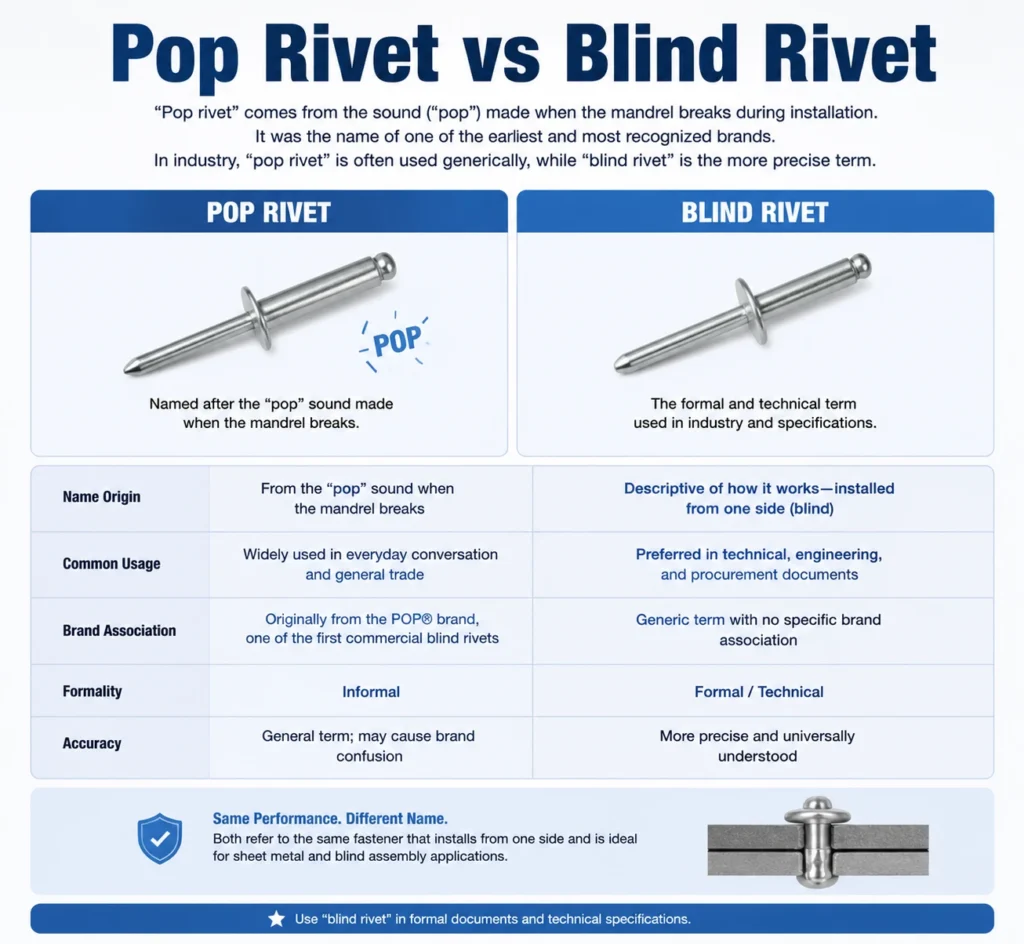
Are Blind Rivets and Pop Rivets the Same?
Yes. In most cases, blind rivets and pop rivets mean the same fastening method. The difference is not in the product itself, but in the language used to describe it.
“Blind rivet” is the professional and technical term. “Pop rivet” is the everyday term many people use, especially in hardware stores, general maintenance, and informal conversation.
If you are preparing technical documents or sourcing fasteners for industrial use, blind rivet is the better term.
What Is a Blind Rivet?
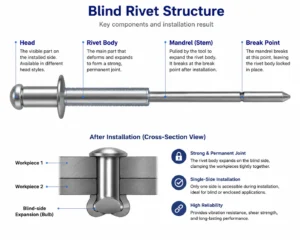
A blind rivet is a permanent mechanical fastener designed to be installed from one side only. That is why it is called “blind” — you do not need access to the back side of the workpiece.
A standard blind rivet has two main parts:
Rivet body: the hollow shell that forms the permanent joint.
Mandrel: the stem that passes through the body during installation and breaks at the designed setting point.
When the rivet is installed correctly, the body expands on the blind side and creates a secure connection between the materials.
Internal link: Blind Rivet Installation Guide
How Blind Rivets Work
Blind rivets are popular because they are fast, simple, and efficient to install. They are widely used in sheet metal work, enclosures, machinery, HVAC assemblies, and other applications where rear access is limited.
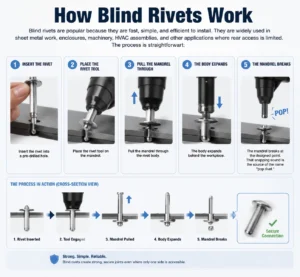
The process is straightforward:
Insert the rivet into a pre-drilled hole.
Place the rivet tool on the mandrel.
Pull the mandrel through the rivet body.
The body expands behind the workpiece.
The mandrel breaks at the designed point.
That snapping sound is the source of the name “pop rivet.”
Internal link: How to Use a Rivet Gun
Why Are They Called Pop Rivets?
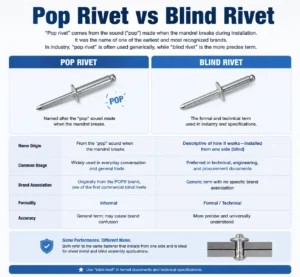
The term “pop rivet” comes from the sound produced when the mandrel breaks during installation. It became widely used because POP® was one of the earliest and most recognized commercial blind rivet brands.
In common industry language, “pop rivet” is often used as a generic term. However, in formal procurement and technical writing, blind rivet is more precise and avoids trademark confusion.
Which Term Should You Use in Procurement?
Use blind rivet in all formal documents. Reserve “pop rivet” for informal discussion if needed.
If you are selling non-POP branded products, avoid using “POP rivet” in your official product descriptions.

Not sure which rivet type fits your project?
Contact us with your sheet thickness, material, and environment, and we’ll help you select the right option.
Ask for a Sample
Blind Rivet vs Pop Rivet at a Glance
In practical terms, they are usually the same fastener. The real difference is how they are described.
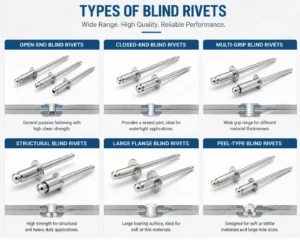
Main Types of Blind Rivets
Not all blind rivets are designed for the same job. The correct type depends on sealing needs, thickness variation, and strength requirements.
Open-End Blind Rivets
This is the most common and economical type. It is suitable for general sheet metal fastening and many standard industrial assemblies.
Closed-End Blind Rivets
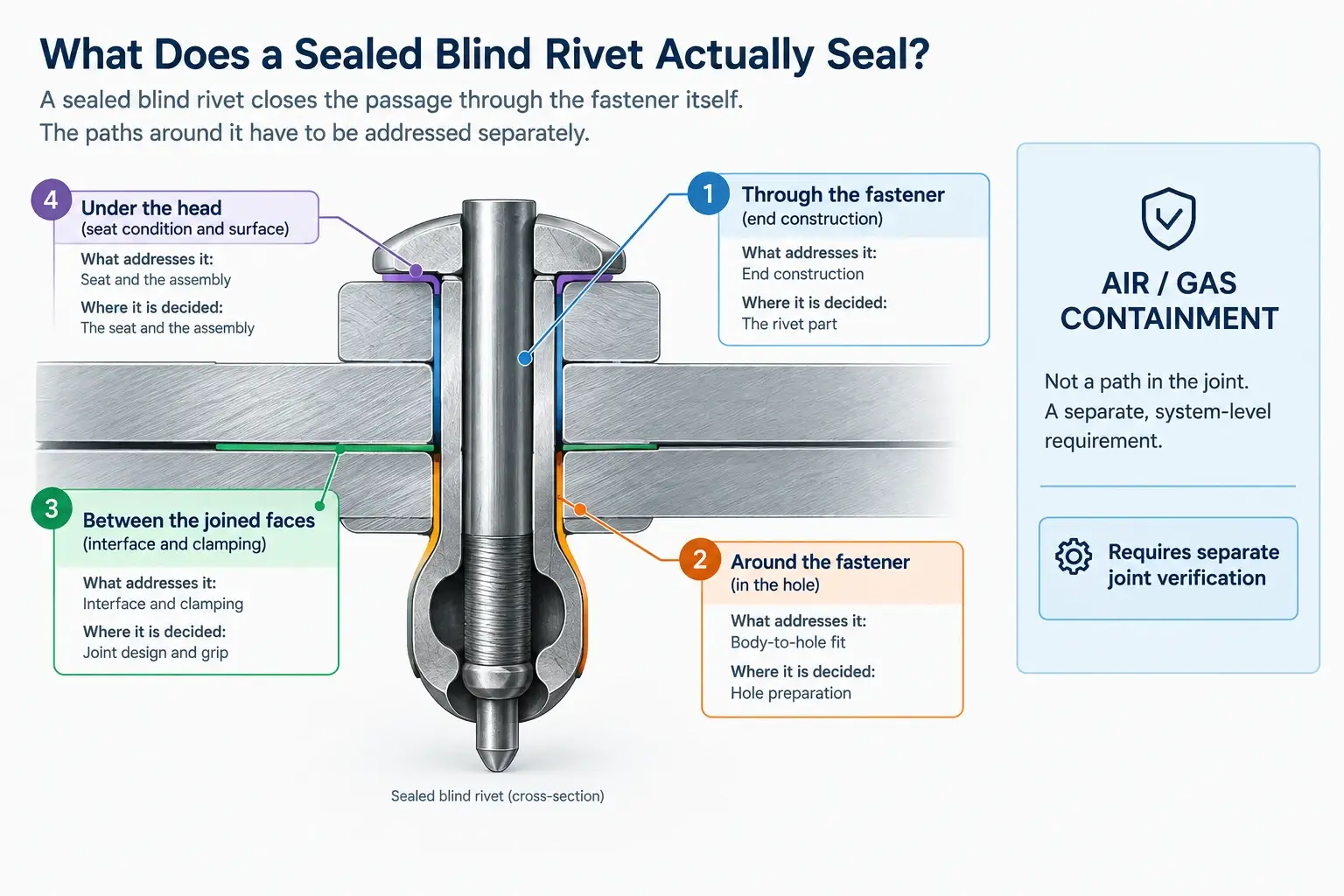
These rivets are sealed at the tail end and are better for applications that need improved resistance to moisture or dust.
Multi-Grip Blind Rivets
Multi-grip rivets are designed to cover a wider grip range. They can help reduce SKU count and simplify procurement.
Structural Blind Rivets
Structural blind rivets are designed for higher strength applications. They are better suited to assemblies where load performance matters.
Internal link:different types of blind rivets
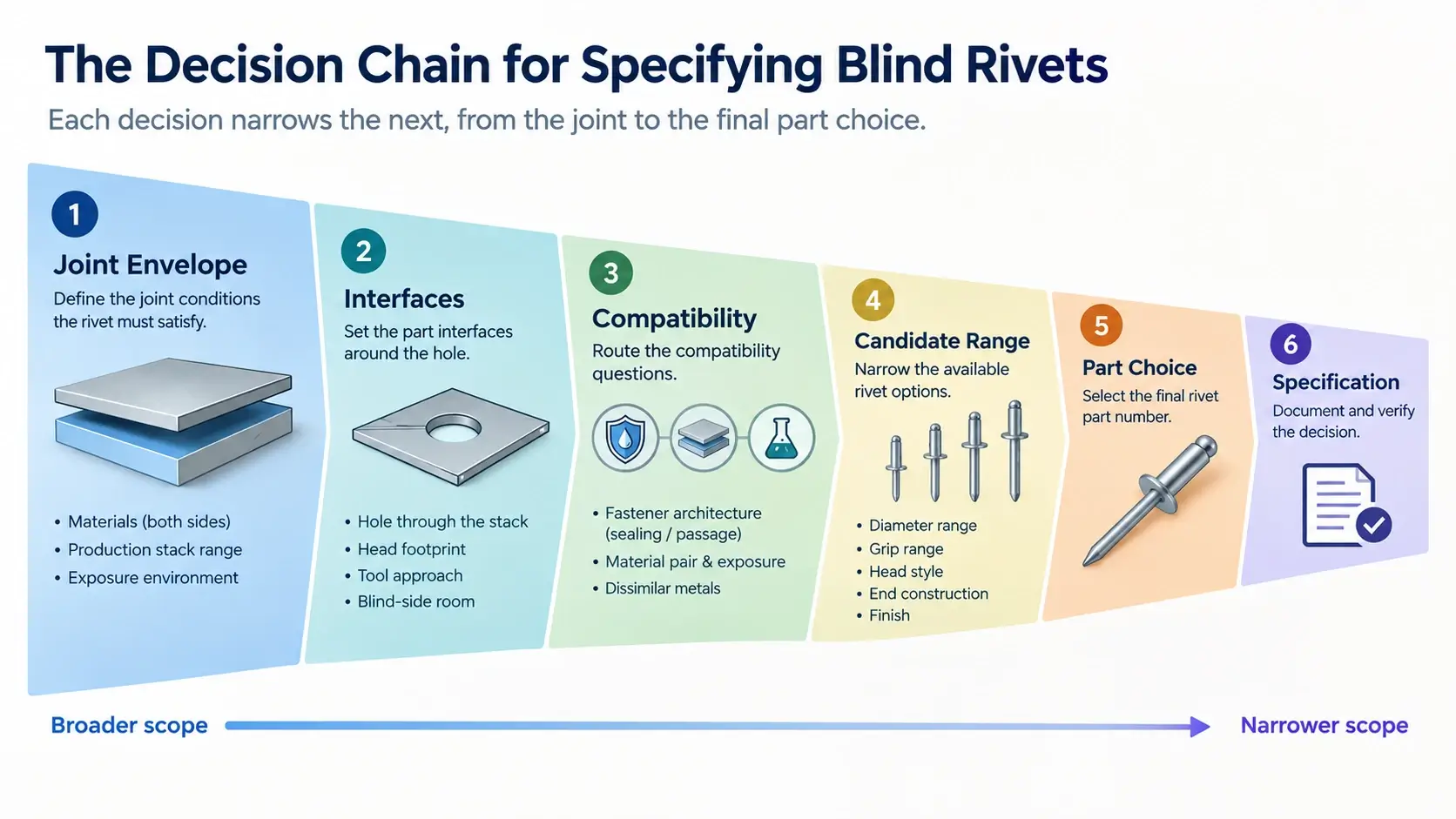
How to Choose the Right Blind Rivet
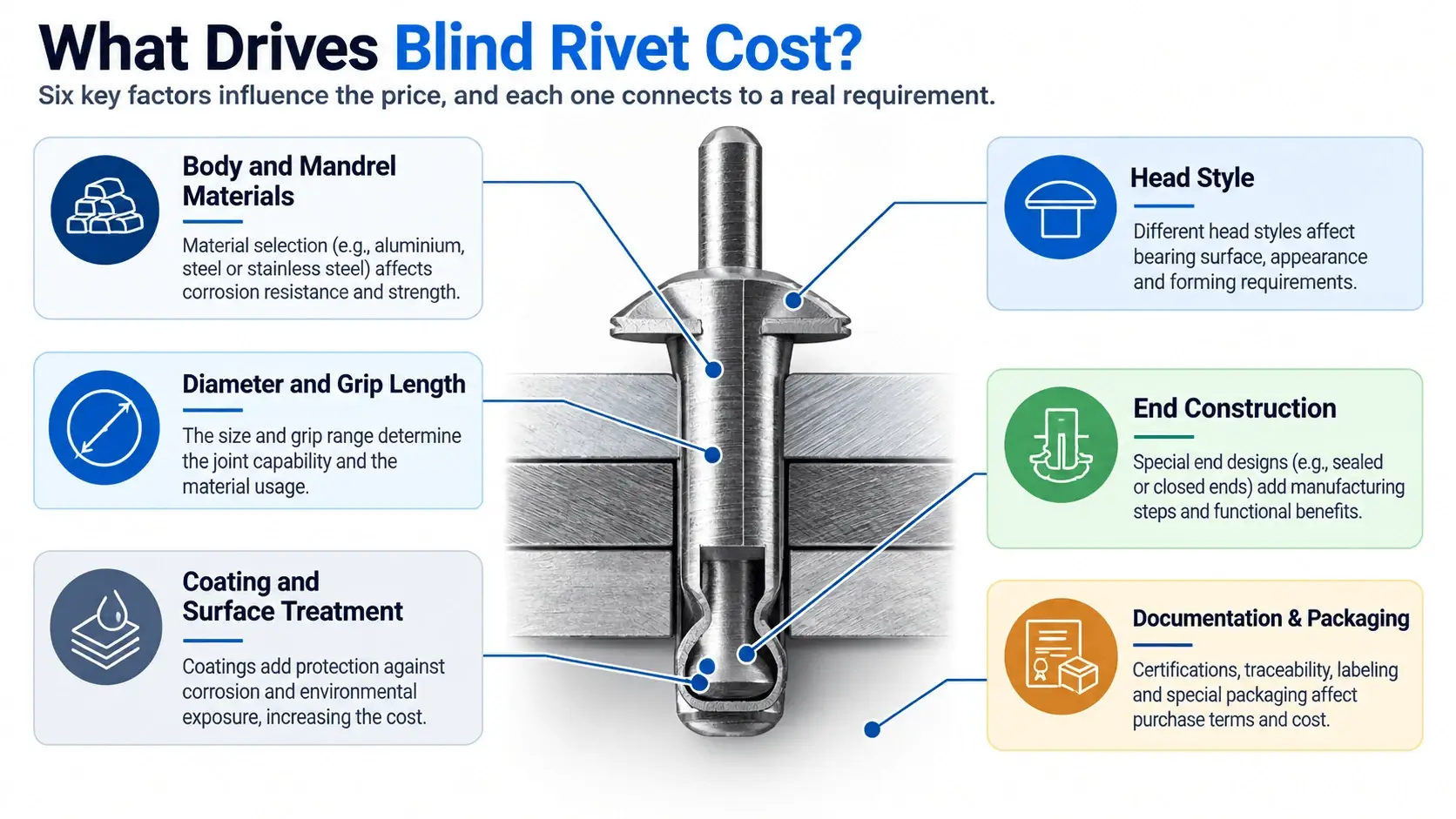
Choosing the right rivet is not just about diameter. Industrial buyers should check five key points before ordering.
1. Material Compatibility
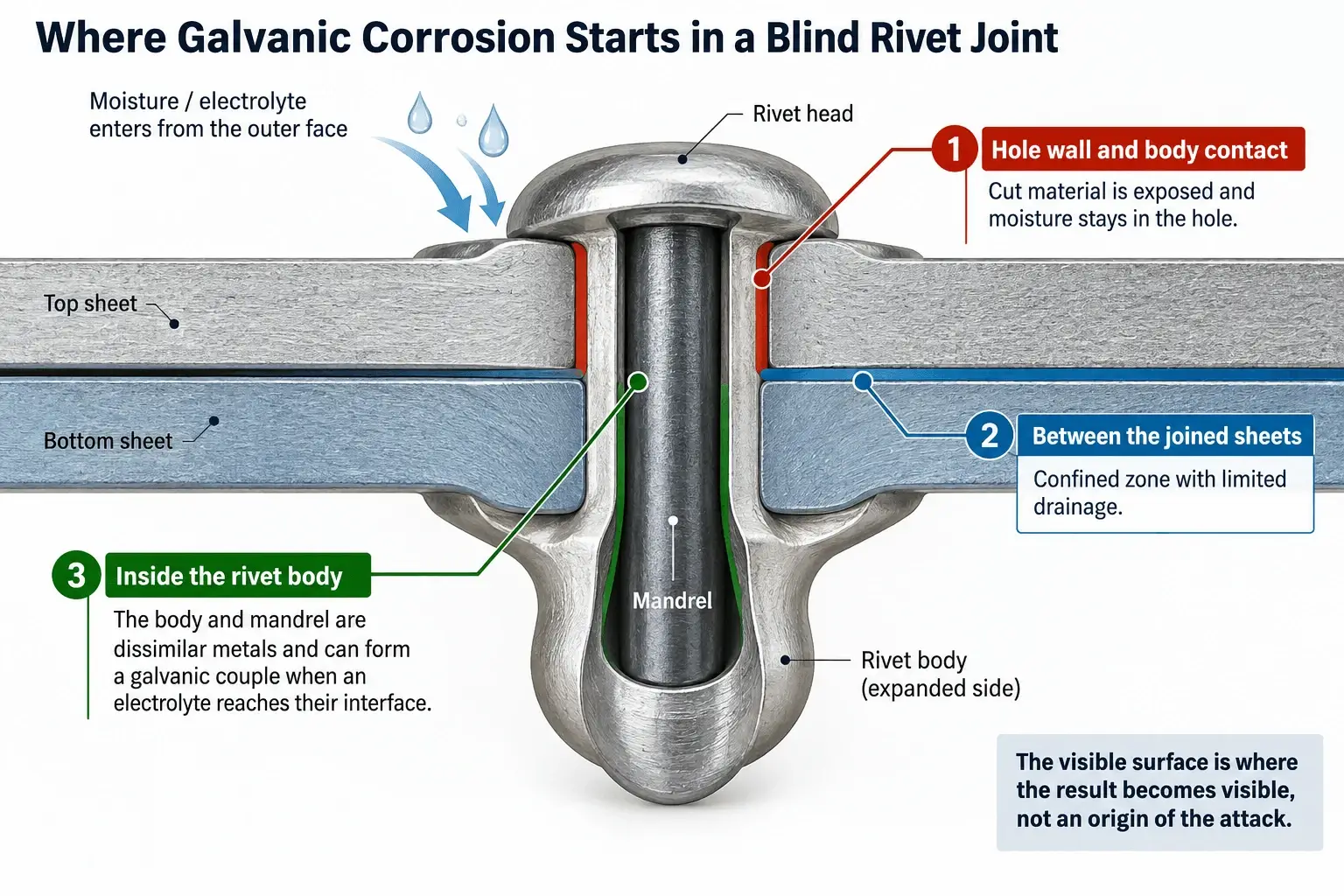
The rivet material should be compatible with the workpiece material to reduce corrosion risk. In many cases, matching materials is the safest starting point.
2. Strength Requirement
Check both shear and tensile strength. If the joint is load-bearing, standard blind rivets may not be enough, and a structural type may be required.
3. Grip Range
Grip range is the total thickness range that the rivet can properly clamp. The joint thickness must fall within the recommended range for reliable setting.
4. Head Style
Choose the head style based on appearance, clearance, and surface requirements:
Dome head for general use.
Countersunk head for flush finish.
Large flange head for soft or thin materials.
5. Installation Tool
Make sure the rivet is compatible with your manual, pneumatic, or automated installation tool. Tool power, nosepiece type, and clearance all matter in real production environments.
Internal link: Blind Rivet Grip Range Guide
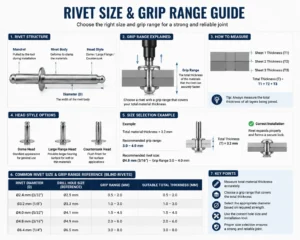
Buyer Selection Table
This table can be used as a quick selection reference during sourcing and RFQ preparation.
Common Mistakes
Many blind rivet problems come from selection errors rather than product defects. The most common mistakes are choosing the wrong grip range, ignoring material compatibility, and selecting a rivet based only on price.
Here are the mistakes that cost buyers the most time and money:
Selecting a rivet that is too short or too long.
Ignoring galvanic corrosion risk.
Choosing a low-cost source without testing.
Skipping certification or traceability requirements.
Overlooking packaging and export protection.
A rivet that falls outside the correct grip range may not form a proper joint and can create vibration, loosening, or failure.
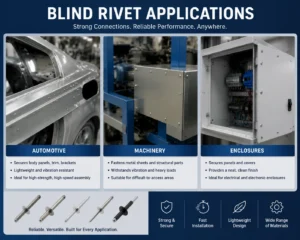
Common Applications
Blind rivets are used in many industries where one-side installation is important. They are common in automotive, HVAC, electronics enclosures, sheet metal fabrication, and industrial machinery.
Typical use cases include:
Body panels and brackets.
Control cabinets and enclosures.
Ductwork and ventilation systems.
Machine guards and housing panels.
Field repair and maintenance work.
Their main advantages are speed, accessibility, and reliable installation.
Internal link: Blind Rivet Applications
How to Choose a Reliable Blind Rivet Supplier
A reliable blind rivet supplier should be able to provide stable quality, consistent dimensions, and export-ready packaging. For industrial applications, supplier reliability is often more important than the lowest unit price.
Look for these capabilities:
Material testing.
Batch traceability.
Stable production capacity.
OEM customization.
Export packaging support.
Relevant quality certifications.
If your project is time-sensitive, ask for sample testing before placing bulk orders.
Internal link:How to Choose a Reliable Blind Rivet Manufacturer

FAQ
Are blind rivets and pop rivets the same?
Yes. In most cases, they refer to the same fastener. “Blind rivet” is the technical term, and “pop rivet” is the common name.
Are blind rivets permanent?
Yes. Blind rivets are generally considered permanent fasteners, although they can be removed by drilling if necessary.
Are blind rivets strong enough for industrial use?
Yes, but only if the correct type is selected. Structural blind rivets are better for load-bearing applications.
Can blind rivets be waterproof?
Closed-end rivets improve resistance to moisture and dust, but sealing performance depends on the full assembly design.
Which blind rivet material is best?
It depends on the workpiece, environment, and strength requirement. Aluminum is common for general use, stainless steel is better for corrosion resistance, and steel is often chosen for higher strength.
What is the difference between blind rivets and solid rivets?
Blind rivets are installed from one side only. Solid rivets require access to both sides and are usually chosen for higher structural performance.
Conclusion
Blind rivet and pop rivet usually mean the same fastener, but blind rivet is the better term for industrial procurement and technical documentation. The real buying decision is not about the name — it is about material, grip range, strength, head style, and supplier quality.
If you want this article to rank well and convert well, publish it with a clear structure, useful visuals, and a strong technical CTA.
Looking for blind rivets for industrial use?
We support standard and custom rivets in aluminum, steel, and stainless steel with OEM packaging and export-ready supply.
Request a Quote