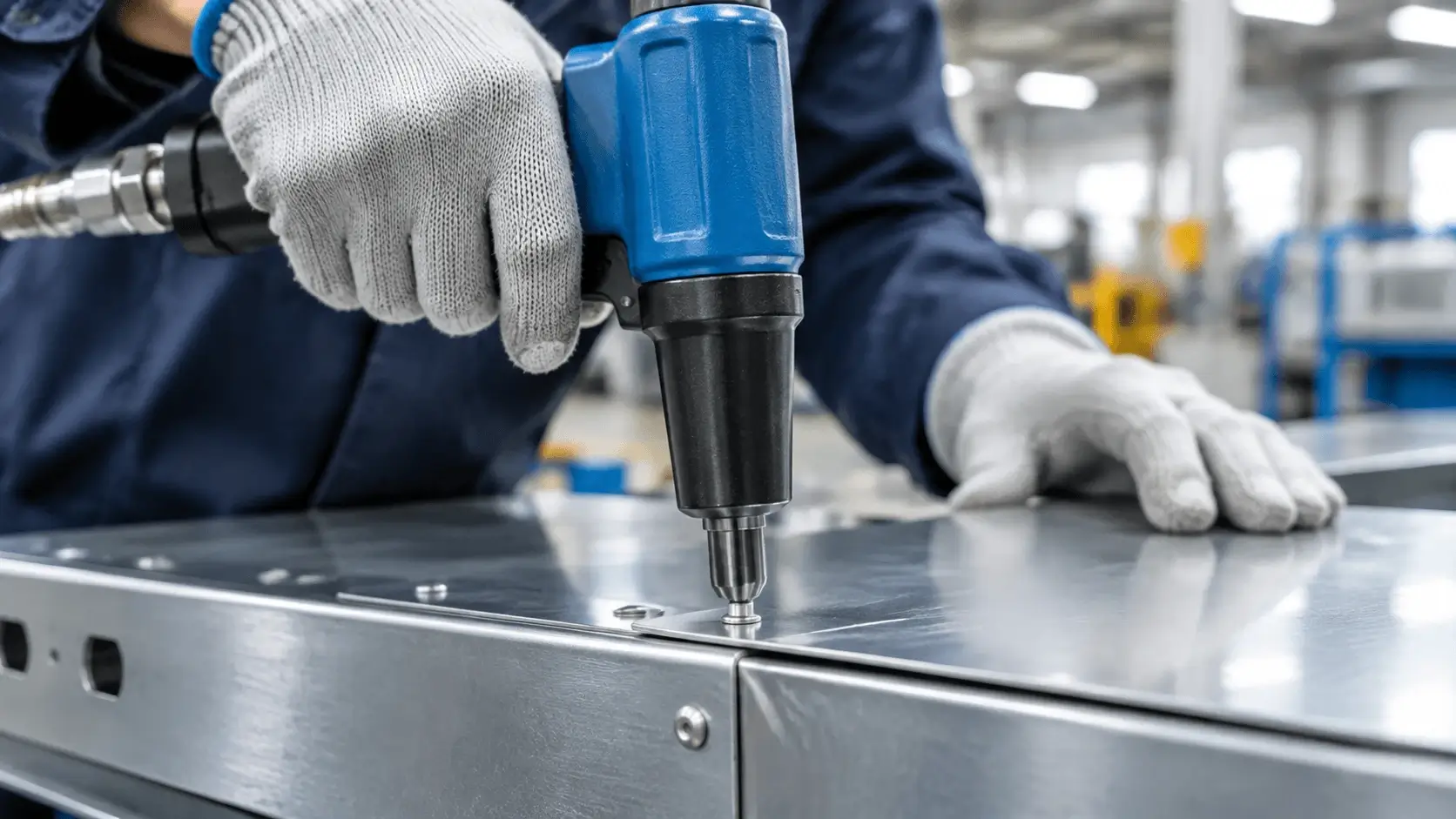
Two grades, one decision, and a price difference that has to be weighed against the cost of getting it wrong. What actually separates 304 from 316 in a blind rivet — and where the grade name stops telling you anything about the joint.
A purchase order for stainless steel blind rivets rarely names a grade. The supplier comes back with a question instead: 304 or 316? The answer will rarely turn on mechanical properties — under load the two grades behave much the same way. It decides something slower and harder to reverse: whether that joint still performs and still looks like stainless steel through its service life, or starts asking for cleaning and inspection well before the equipment is old.
This is not a choice between a good grade and a better one. It is a choice between 304 stainless steel blind rivets and 316 stainless steel blind rivets — two grades whose mechanical behavior is broadly similar and whose corrosion behavior separates under one condition: chloride. If the material category itself is still open — stainless against aluminum or steel — that comparison belongs to our guide to aluminum vs steel vs stainless steel blind rivets.
What’s the Difference Between 304 and 316 Stainless Steel?
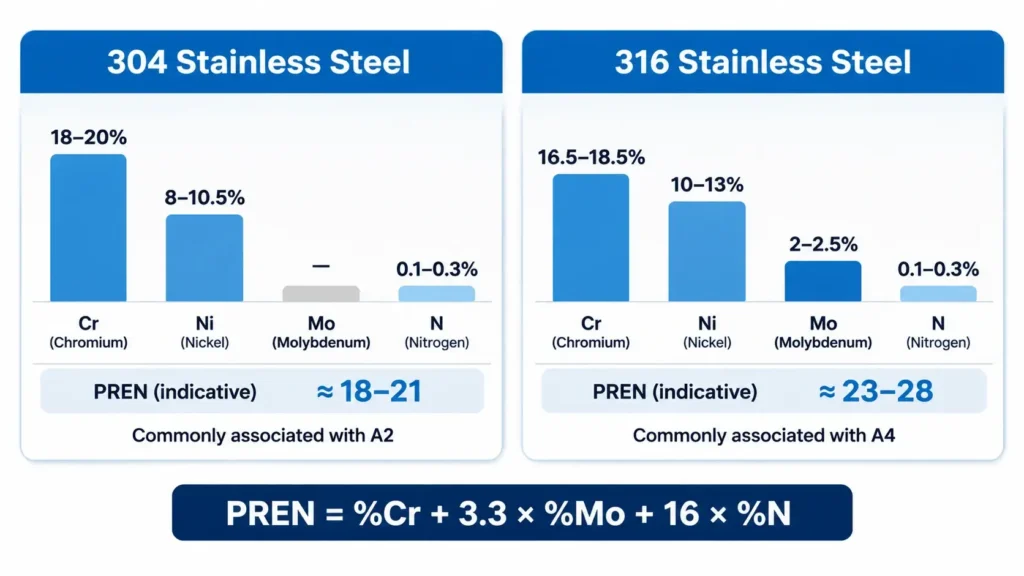
Both are austenitic stainless steels from the 300 series, and both resist corrosion through the same mechanism: a thin chromium oxide layer that re-forms when the surface is damaged. What separates them is molybdenum. 316 contains roughly 2 to 2.5 percent of it; 304 contains none by design. Molybdenum raises that passive layer’s resistance to local breakdown where chlorides are present, and that is the basis of the difference in pitting and crevice corrosion resistance.
Nickel is the element most often misread. 316 carries more of it — about 10 to 13 percent against 8 to 10.5 percent in 304 — but nickel’s main job is to stabilize the austenitic structure, not to resist chlorides. The molybdenum is what shifts the corrosion behavior; the higher nickel is a consequence of the alloy design that carries it, not the source of the added resistance.
Table 1 — Typical chemical composition and corrosion resistance comparison
| Property | 304 | 316 |
|---|---|---|
| Chromium (Cr) | 18–20% | 16.5–18.5% |
| Nickel (Ni) | 8–10.5% | 10–13% |
| Molybdenum (Mo) | No intentional addition | 2–2.5% |
| PREN (indicative) | Approx. 18–21 | Approx. 23–28.5 |
| Fastener grade family | Commonly associated with A2 | Commonly associated with A4 |
On the composition rangesTypical chemical composition ranges are shown for reference. Exact limits depend on the applicable material standard and product specification — the EN and AISI/UNS ranges for the same grade family can differ slightly.
On the PREN valuesThe figures above are calculated from representative chromium, molybdenum and nitrogen contents. The top of the 316 range reflects high-molybdenum, high-nitrogen material at the edge of the specification, not the middle of it. The PREN of a specific rivet can only be established from that material’s certified chemical analysis — which is the document to request when a closer comparison is needed.
A single number is often used to put that difference on a scale — the pitting resistance equivalent number:
PREN = %Cr + 3.3(%Mo) + 16(%N)
All three values are mass percentages. Three limits apply. It excludes nickel, so it does not describe every aspect of corrosion performance. It is a comparative index of pitting tendency, not a prediction of service life or of salt spray hours survived. And the spread within a single grade is wide enough that the number should inform a decision, not settle one.
Buyers working to European fastener designations meet the same two families as A2 and A4. A2 is commonly associated with the 304 family, A4 with the 316 family — useful as a first filter, misleading if read as equivalence. A2 and A4 are fastener grade designations, and ISO 3506 sets chemical and mechanical requirements primarily for bolts, screws, studs and nuts. Blind rivets fall under their own product standards. A rivet made from A2-family material is therefore not, on that basis alone, a rivet that conforms to ISO 3506; the applicable rivet specification and the mill certificate govern.
One test worth retiring is the magnet. Austenitic stainless is non-magnetic in the annealed condition, but cold working — drawing the wire, forming the body — can generate a weakly magnetic phase. A magnet cannot separate 304 from 316, and it cannot confirm a grade at all. Attraction may come from cold work, from residual ferrite, or from contamination picked up on the shop floor.
Corrosion Resistance: How 304 and 316 Perform in Different Environments
Stainless steel in chloride service does not fail by rusting evenly. The two mechanisms that matter are localized, and both start where the passive layer is already weakest.
Pitting begins at a single weak point in the film. Chloride ions break it locally, the exposed metal dissolves, and the pit becomes its own trap: the chemistry inside turns acidic and oxygen-starved while the surrounding surface stays passive and cathodic. The pit grows inward rather than spreading sideways, so the damage can be deep before anything shows on the surface.
Crevice corrosion runs the same chemistry inside a geometry that cannot refresh its oxygen supply. In a narrow gap the oxygen is consumed faster than it can be replaced; the shielded area turns anodic, the open surface around it stays cathodic, and chloride and acid concentrate in the gap. A blind riveted joint contains two such geometries: the interface where two sheets overlap, and the annulus between the rivet body and the hole wall.
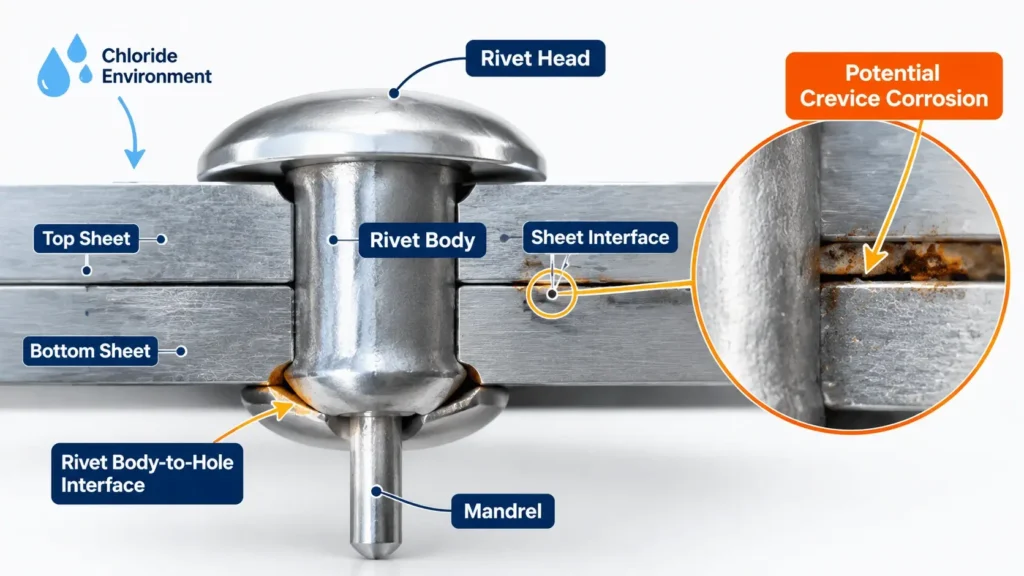
Molybdenum raises the chloride concentration and the temperature at which that breakdown begins. It does not remove the mechanism. The practical consequence is a shift in the threshold: an environment that pits 304 may leave 316 intact, and an environment aggressive enough will eventually attack both.
On a real installation that difference does not announce itself. It arrives as three different surface conditions that all get called rust, and that call for three different responses.
Table 2 — What a rust stain on stainless steel actually tells you
| What you see | Likely cause | How to read it |
|---|---|---|
| Rust staining | Free iron contamination, carbon steel particles embedded from tooling or nearby work | External contamination. Does not necessarily mean the stainless itself has failed |
| Tea staining | Shallow surface corrosion under chloride deposits | Real corrosion, but usually cosmetic first. Severe cases warrant a check for deeper attack |
| Pitting corrosion | Local breakdown of the passive film, forming pits | Actual material damage. Needs assessment of whether it is still progressing |
The distinction is commercial, not academic. A rust streak on a 304 panel near the coast is often contamination to be removed, not a reason to replace the assembly. Tea staining is different: it is corrosion, it returns wherever salt keeps depositing, and on 304 in severe marine exposure it is a signal about grade selection rather than housekeeping.
Where cleaning is the answer, it is a graded response rather than a single step: appropriate cleaning, contamination removal and, where necessary, professional surface restoration or passivation. Which of the three applies depends on which of the three conditions in the table you are looking at. Cleaning reduces salt deposits and buys time; it does not substitute for choosing the right grade in the first place.
And 316 is not corrosion-proof. In direct sea spray, under sustained salt deposits, or in locations that will never be washed, 316 can still pit. Those cases call for a higher-alloy material or an engineering review of the joint — not a larger order of the same rivet.
Salt spray testing deserves the same discipline. A result is only meaningful against a defined test method, a defined product configuration and agreed acceptance criteria, and it should not be converted into an outdoor service life. Accelerated tests rank materials; they do not predict years.
Mechanical Strength: Is a 316 Blind Rivet Stronger Than a 304 One?
Not by enough to drive a standard blind rivet selection. In comparable material conditions the two grades have broadly comparable mechanical characteristics, and a rivet is not cut from plate stock — it is formed from cold-drawn wire, where the degree of cold work and the process route set the properties. Actual strength depends on the material condition, the body geometry, the mandrel design and the manufacturing process.
What gets lost most often is the difference between four separate numbers: the tensile properties of the material, the tensile strength of an installed rivet, its shear strength, and the performance of the joint the rivet sits in. Material tensile properties alone do not tell you the tensile or shear strength of an installed rivet, and neither tells you how the joint behaves under a given load direction in a given sheet thickness.
Table 3 — Which factor decides what
| Selection factor | Primary consideration |
|---|---|
| Corrosion resistance | 304 vs 316 |
| Tensile strength | Rivet design and material condition |
| Shear strength | Body dimensions and joint design |
| Grip range | Sheet thickness and rivet specification |
| Installation performance | Rivet and mandrel design |
That is why the grade question and the load question are separate ones. For most standard blind rivet applications, choosing between 304 and 316 is a corrosion-resistance decision, not a strength upgrade. Where load does drive the design, evaluate the specified rivet’s tensile and shear performance, its body diameter, mandrel and grip range — rather than assuming a grade change will raise them.
Cost, Availability and Long-Term Maintenance
316 costs more than 304, and the molybdenum is the reason. The premium is real, but on its own it rarely decides the project. A riveted joint also carries hole making, labor, inspection and whatever maintenance the environment demands, and in high-volume production the material difference is a real number rather than a rounding error. Which is why the comparison belongs at the level of the finished joint: the gap between the grades is a line item, and the gap between a joint that performs and one that has to be reworked is a budget event.
Availability is a separate question from price. Which diameters and which body-and-mandrel combinations are held in stock, at what minimum order quantity and on what lead time, are things to confirm per order rather than assume from a catalog page.
The third cost never appears in the quotation. Specify 304 into a chloride environment and the expense returns as cleaning cycles, recurring staining, replacement panels and the labor to reach them. That does not make 316 cheaper over its life in every case — in dry indoor service it is money spent on a property the joint will never need.
304 vs 316: Which Stainless Steel Blind Rivet Should You Choose?
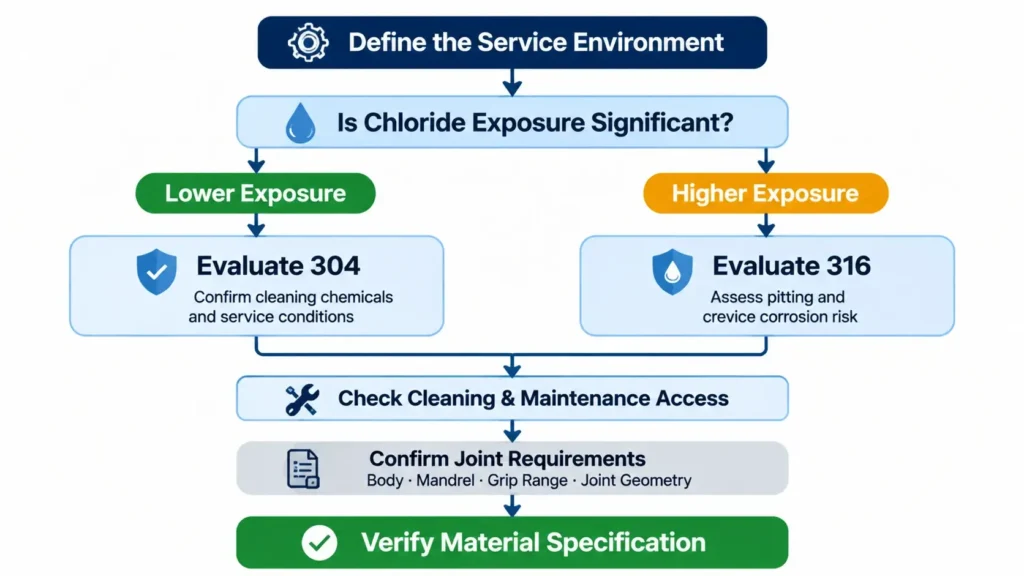
The table below maps common environments to a starting grade. It is guidance, not a specification. The variables that actually decide are chloride concentration, temperature, joint geometry, how long deposits are allowed to sit, and whether the joint can be inspected and cleaned.
Table 4 — Application environment and starting grade
| Application environment | General guidance | Main consideration |
|---|---|---|
| Dry indoor environments | 304 | Limited chloride exposure |
| General inland outdoor use | 304 | Atmospheric conditions and maintenance |
| Coastal buildings | 316 generally preferred | Salt deposits and exposure severity |
| Marine splash zones | 316 or a higher alloy may be required | Severe chloride exposure |
| Food processing | 304 or 316 | Cleaning chemicals and process conditions |
| Chemical processing | Depends on the medium | Chemical concentration and temperature |
| Roadside / de-icing salt | 316 generally preferred | Chloride deposits; check severity and cleaning frequency |
| Mixed-metal assemblies | Depends on the material combination | Galvanic corrosion |
Two rows need a note. Food processing is often treated as an automatic 316 application, but the cleaning chemistry decides, not the industry label: a plant using chloride-free detergents at moderate temperature may run 304 without trouble — depending also on the process media, rinse-water chloride, temperature and cleaning frequency — while a chloride-based sanitizer pushes the same plant toward 316. Chemical processing cannot be answered from a table at all — it depends on the specific medium, its concentration and its temperature.
The mixed-metal row is a different mechanism and should not be folded into the others. Galvanic corrosion comes from the potential difference between two dissimilar metals in an electrolyte. Pitting comes from local breakdown of the passive film. Crevice corrosion comes from oxygen starvation inside a gap. Different causes, different countermeasures: isolation and material pairing for the first, grade selection for the second, joint geometry and sealing for the third.
Distance from the coast is a rough indicator and nothing more. Wind direction, humidity, prevailing salt deposition, surface finish and maintenance frequency all move the threshold — which is why a site a few hundred meters inland on a sheltered side can outlast one several kilometers away on an exposed coast.
Looking for stainless steel blind rivets for your application? Explore our blind rivet range or contact RivetFast with your required specifications.
Don’t Overlook the Rivet Body and Mandrel
Everything above treats the rivet as a single material. It is not. A blind rivet is a body, a mandrel and a joint, and the grade named in a product description or quotation may describe the body alone. Three things are worth checking before the order goes out.
01 Rivet body material
Is the body 304, 316 or another grade entirely? This is the one the designation normally covers, and the one the product specification and its supporting material documentation should state explicitly.
02 Mandrel material
What is the mandrel made of, and does it match the corrosion requirement of the body? Body and mandrel do not have to be the same material. Matched A2/A2 and A4/A4 rivets exist in the market, and so do mixed pairs; which combinations a given supplier stocks is a catalog question, not an assumption. On a blind rivet the mandrel is not removed — the stem breaks and the remainder stays inside the body — so its material is part of the installed joint, not a tool that leaves.
03 Rivet design
Open-end or closed-end? A closed-end body keeps water and contaminants from entering through the rivet itself, which matters where the joint faces spray or washdown. It does not seal the interface between the two sheets, and it does not by itself give the assembly an IP rating. Those are separate requirements with separate solutions.
Where the residual mandrel ends up, and how much of it is exposed, depends on the rivet design and the joint. It is not uniform across types and should not be assumed in either direction.
Selecting the correct stainless steel grade is only one part of corrosion-resistant blind rivet selection. The body material, the mandrel material, the rivet design and the joint environment should all be considered.
What to confirm with your supplier
- What stainless steel grade is used for the rivet body?
- What material is used for the mandrel?
- Is the rivet open-end or closed-end?
- Is the selected rivet suitable for the specified chloride exposure and installation environment?
These four answers, rather than the grade name alone, determine whether a stainless steel blind rivet holds up in service.
Common Mistakes When Selecting Stainless Steel Blind Rivets
- Testing the grade with a magnet. Cold working, residual ferrite or surface contamination can all produce magnetic attraction in austenitic stainless steel. A magnet cannot reliably identify the grade or separate 304 from 316.
- Specifying 316 by default. In dry indoor service the molybdenum buys nothing, and the premium is paid on every joint.
- Changing the grade and stopping there. 316 near the coast still collects salt deposits. Without a cleaning regime it will stain too, only more slowly.
- Reading the grade and ignoring the mandrel. The body is half the system; the mandrel is the half that stays inside the joint.
- Treating A2 or A4 as proof of ISO 3506 conformity. Those designations describe a fastener material family, not a blind rivet’s compliance with its own product standard.
FAQ
Can 304 stainless steel blind rivets be used outdoors?
- Yes, in most inland outdoor exposures. 304 handles rain, humidity and normal atmospheric conditions well. The limiting factor is chloride: near the coast, at roadside locations exposed to de-icing salt, or in aggressive industrial atmospheres, salt accumulates on the surface and 304 becomes prone to tea staining and pitting. In those environments 316 is generally the better starting choice, though severe or persistent exposure can call for a higher-alloy material or an engineering review.
Is 316 stainless steel magnetic?
- In the annealed condition, no — austenitic stainless is non-magnetic. But blind rivets are formed from cold-drawn wire, and cold working can generate a weakly magnetic phase, so a finished 316 rivet may show slight attraction. The same is true of 304. A magnetic response may come from cold work, residual ferrite or contamination — it does not identify the grade.
Is A2 the same as 304, and A4 the same as 316?
- They are commonly associated rather than equivalent. A2 is the fastener designation associated with the 304 family and A4 with the 316 family, which makes the mapping a useful first filter. But these designations sit under ISO 3506, a standard written primarily for bolts, screws, studs and nuts. Blind rivets follow their own product standards, so the material certificate is what confirms the grade.
Why do stainless steel rivets develop rust stains near the coast?
- Usually one of three things. Free iron contamination from tooling or nearby carbon steel leaves surface stains that are not the stainless itself corroding. Chloride deposits cause tea staining, a shallow surface corrosion that returns wherever salt keeps settling. Or the passive film has broken down locally and pitting has begun. The appearance differs, and so does the remedy.
Does a closed-end blind rivet provide better corrosion protection?
- It closes one path, not all of them. A closed-end body keeps water and contaminants from entering through the rivet itself, which helps where the joint faces spray or washdown. It does not seal the interface between the two sheets, and it does not by itself give the assembly an IP rating. The lap joint still needs its own protection strategy.
Choosing Between 304 and 316: The Short Version
304 and 316 are not two grades on a quality scale. They are two answers to one question: how much chloride will this joint see, and will anyone clean it? Answer that and the grade usually chooses itself. Dry indoor work goes to 304 without apology. Coastal and roadside work starts at 316, with a maintenance plan attached. Splash zones and permanent salt deposits go to an engineering review, because neither grade is guaranteed there.
Then check the half of the rivet the grade name does not cover — the mandrel, and whether the body is open or closed. That is where a correctly specified grade most often stops being a correctly specified joint.
Not sure which grade your application needs?
Send us your operating environment, required specifications, estimated quantity and drawings. RivetFast can help evaluate suitable material options for your project.
Technical references
- British Stainless Steel Association — Calculation of Pitting Resistance Equivalent Numbers (PREN)
- Australian Stainless Steel Development Association — Preventing coastal corrosion and tea staining
- EN ISO 3506 — Mechanical properties of corrosion-resistant stainless steel fasteners (fastener scope: bolts, screws, studs and nuts)
- AISI/UNS and EN 10088 grade designations for 304 (1.4301 / S30400) and 316 (1.4401 / S31600)