Industrial buyers often face a common challenge when sourcing blind rivets: aluminum, steel, and stainless steel options may look similar on a spec sheet, but their real-world performance differs significantly. Choosing the wrong rivet material doesn’t just affect the fastener — it affects the entire assembly.
The consequences of a poor material choice include:
- Insufficient joint strength — the rivet fails under loads the application requires
- Corrosion problems — rust or galvanic corrosion compromises the connection over time
- Higher maintenance costs — premature failure means replacements, warranty claims, and reputational damage
- Unnecessary costs — selecting premium materials when standard options already meet application requirements
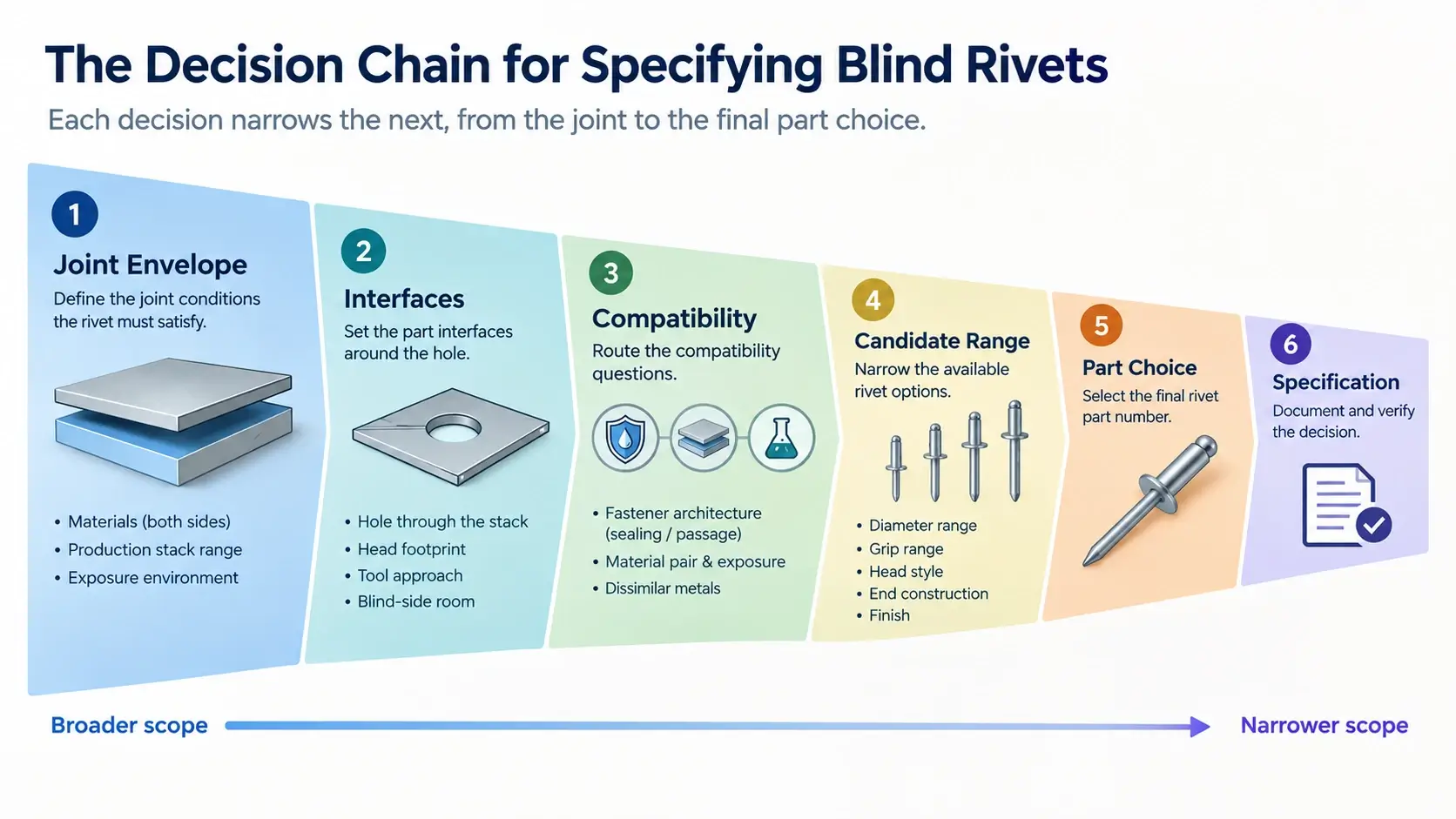
The right material depends on five factors: application environment, required mechanical strength, base material compatibility, corrosion exposure, and budget constraints. This guide compares all three materials across these dimensions — and introduces a critical decision variable many buyers overlook: body and mandrel material combinations.
Blind Rivet Materials Overview: Aluminum, Steel, and Stainless Steel
Before comparing performance, it helps to understand what makes each material distinct. The three most common blind rivet materials serve different purposes, and knowing their inherent properties is the foundation of a sound selection.
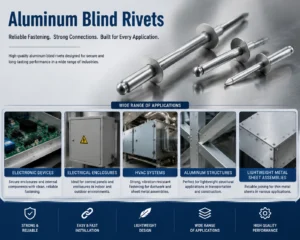
Aluminum Blind Rivets — Lightweight and Corrosion-Resistant
Aluminum blind rivets are the go-to choice when weight reduction and cost efficiency matter more than raw strength. Aluminum naturally forms an oxide layer that provides good corrosion resistance in many indoor and controlled outdoor environments. However, additional protection may be required in marine or highly corrosive conditions.
| Property | Description |
|---|---|
| Weight | Lightest of the three materials |
| Corrosion resistance | Good in most indoor and controlled environments (natural oxide layer) |
| Installation | Low installation force required |
| Cost | Most economical option |
Common applications: Electronics, electrical enclosures, HVAC systems, aluminum structures, and light sheet metal assemblies.
Limitations: Aluminum has lower tensile and shear strength compared to steel and stainless steel. It is not recommended for heavy-load applications or high-vibration environments where joint integrity is critical.
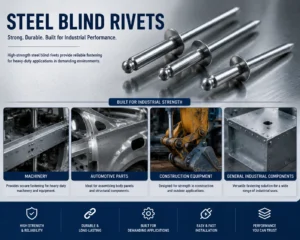
Steel Blind Rivets — Strength and Cost-Effectiveness
Steel blind rivets are widely used where higher mechanical strength is required but the environment doesn’t demand the premium corrosion resistance of stainless steel. Steel offers excellent tensile and shear strength at a moderate cost, making it the workhorse of industrial fastening.
| Property | Description |
|---|---|
| Strength | High tensile and shear strength |
| Durability | Excellent for industrial applications |
| Corrosion resistance | Moderate — requires protective coating for outdoor use |
| Cost | Mid-range, strong value proposition |
Common applications: Machinery, automotive components, construction equipment, and general industrial assemblies.
Limitations: Steel has lower corrosion resistance than stainless steel and typically requires a protective surface treatment — such as zinc plating — to prevent rust. (For a detailed guide on surface finishes and coatings, see our blind rivet surface finishes guide .)
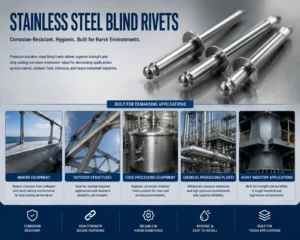
Stainless Steel Blind Rivets — Premium Performance for Harsh Environments
Stainless steel is the material of choice when corrosion resistance and long-term reliability are top priorities. Its chromium content creates a self-healing passive layer that resists rust, chemical attack, and high temperatures — making it essential for demanding environments.
| Property | Description |
|---|---|
| Corrosion resistance | Excellent — resists rust, chemicals, and salt spray |
| Strength | High strength, depending on alloy grade and rivet design |
| Temperature resistance | Suitable for elevated temperatures |
| Cost | Highest of the three materials |
Common stainless steel grades used for industrial blind rivets include 304 and 316, with 316 providing better corrosion resistance in marine and chemical environments.
Common applications: Marine equipment, outdoor structures, food processing equipment, chemical processing plants, and heavy industrial applications.
Limitations: Stainless steel costs more than aluminum and steel, and its higher hardness requires greater installation force. However, for harsh environments, the longevity and reliability it provides typically justify the premium.
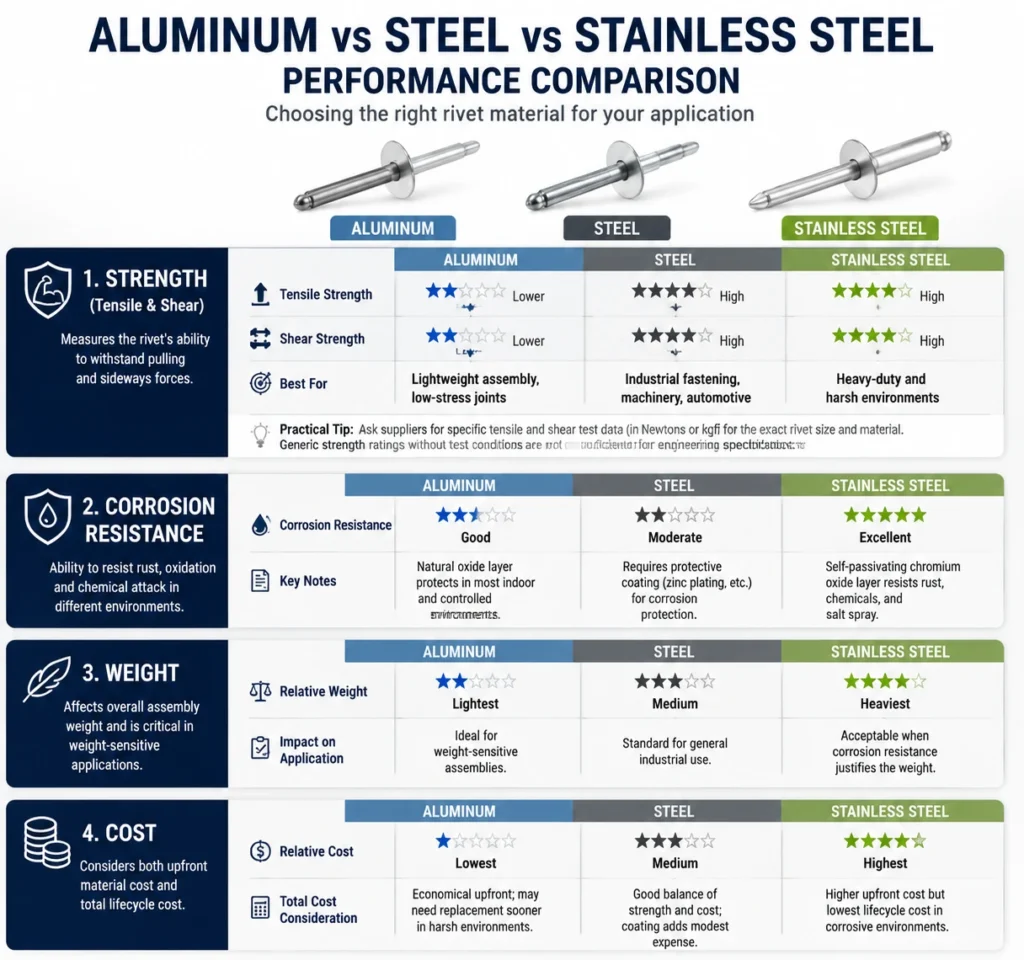
Aluminum vs Steel vs Stainless Steel: Performance Comparison
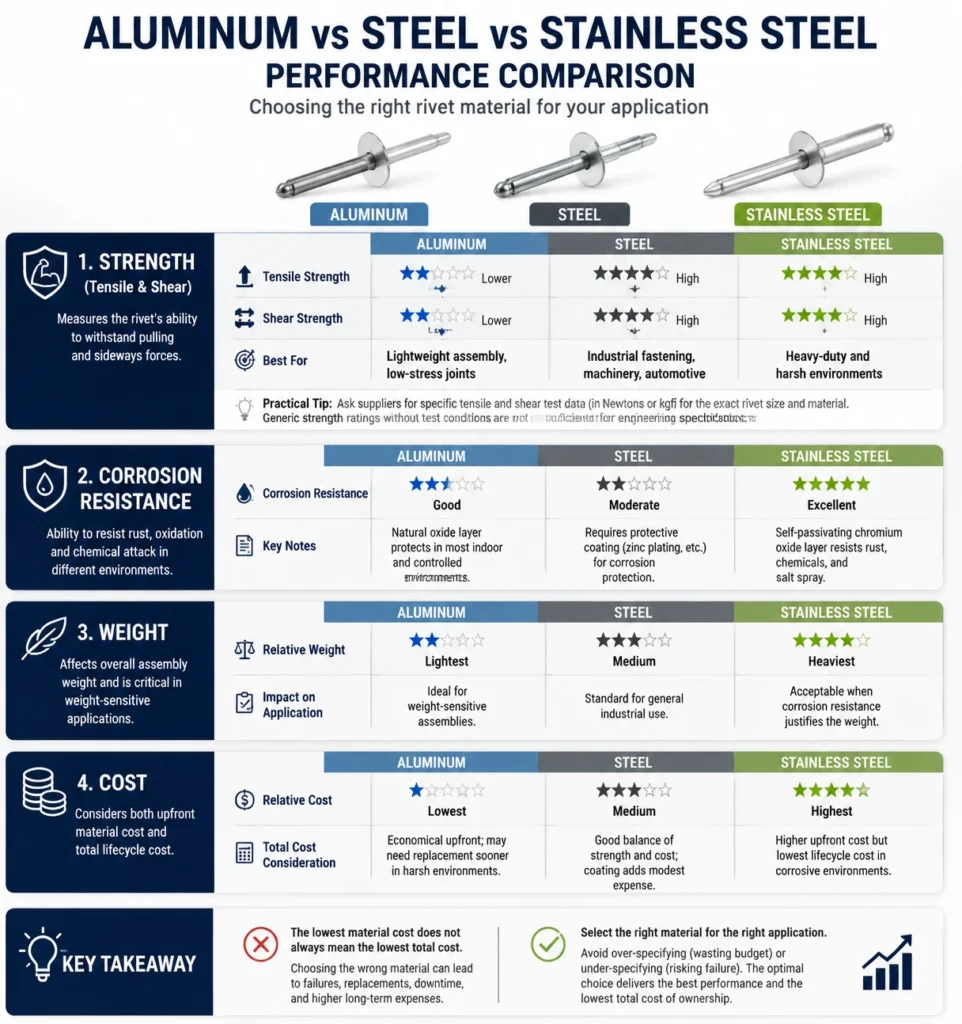
Now let’s compare the three materials head-to-head across the four dimensions that matter most to B2B buyers: strength, corrosion resistance, weight, and cost.
Tensile and Shear Strength Comparison
Strength is the first filter in rivet material selection. Industrial buyers searching for “blind rivet strength comparison” are typically looking for specific tensile and shear values, not vague labels like “high” or “low.”
| Material | Tensile Strength | Shear Strength | Best For |
|---|---|---|---|
| Aluminum | Lower | Lower | Lightweight assembly, low-stress joints |
| Steel | High | High | Industrial fastening, machinery, automotive |
| Stainless Steel | High | High | Heavy-duty and harsh environments |
Steel and stainless steel generally provide comparable mechanical strength — both significantly higher than aluminum. However, the strongest option is not always the best choice. An over-specified rivet adds unnecessary cost, while an under-specified one risks joint failure.
Practical tip: When requesting quotes, ask suppliers for specific tensile and shear test data (in Newtons or kgf) for the exact rivet size and material combination you’re considering. Generic strength ratings without test conditions are not sufficient for engineering specifications.
Corrosion Resistance Comparison
| Material | Corrosion Resistance | Key Notes |
|---|---|---|
| Aluminum | Good | Natural oxide layer protects in most indoor and controlled environments |
| Steel | Moderate | Requires protective coating (zinc plating, etc.) for corrosion protection |
| Stainless Steel | Excellent | Self-passivating chromium oxide layer resists rust, chemicals, and salt spray |
Aluminum performs well in many indoor and sheltered applications. Steel requires surface treatment to prevent rust — without it, steel rivets will corrode in any humid environment. Stainless steel is the clear choice for moisture, chemical exposure, and outdoor environments.
Weight Comparison
| Material | Relative Weight | Impact on Application |
|---|---|---|
| Aluminum | Lightest | Ideal for weight-sensitive assemblies |
| Steel | Medium | Standard for general industrial use |
| Stainless Steel | Heaviest | Acceptable when corrosion resistance justifies the weight |
For industries where weight reduction is a design priority — automotive, aerospace, electronics, portable equipment — aluminum blind rivets provide a distinct advantage. In many of these applications, the weight savings compound across hundreds or thousands of fasteners per assembly.
Cost Comparison
| Material | Relative Cost | Total Cost Consideration |
|---|---|---|
| Aluminum | Lowest | Economical upfront; may need replacement sooner in harsh environments |
| Steel | Medium | Good balance of strength and cost; coating adds modest expense |
| Stainless Steel | Highest | Higher upfront cost but lowest lifecycle cost in corrosive environments |
The lowest material cost does not always mean the lowest total cost. A buyer who chooses steel rivets for an outdoor application to save 40% on material cost may face rust-related failures within two years — replacement labor, downtime, and warranty costs far exceed the savings. Conversely, specifying all-stainless rivets for a dry indoor electronics enclosure wastes 30–50% of the budget with no performance benefit.
Blind Rivet Material Combinations: Body and Mandrel Pairing
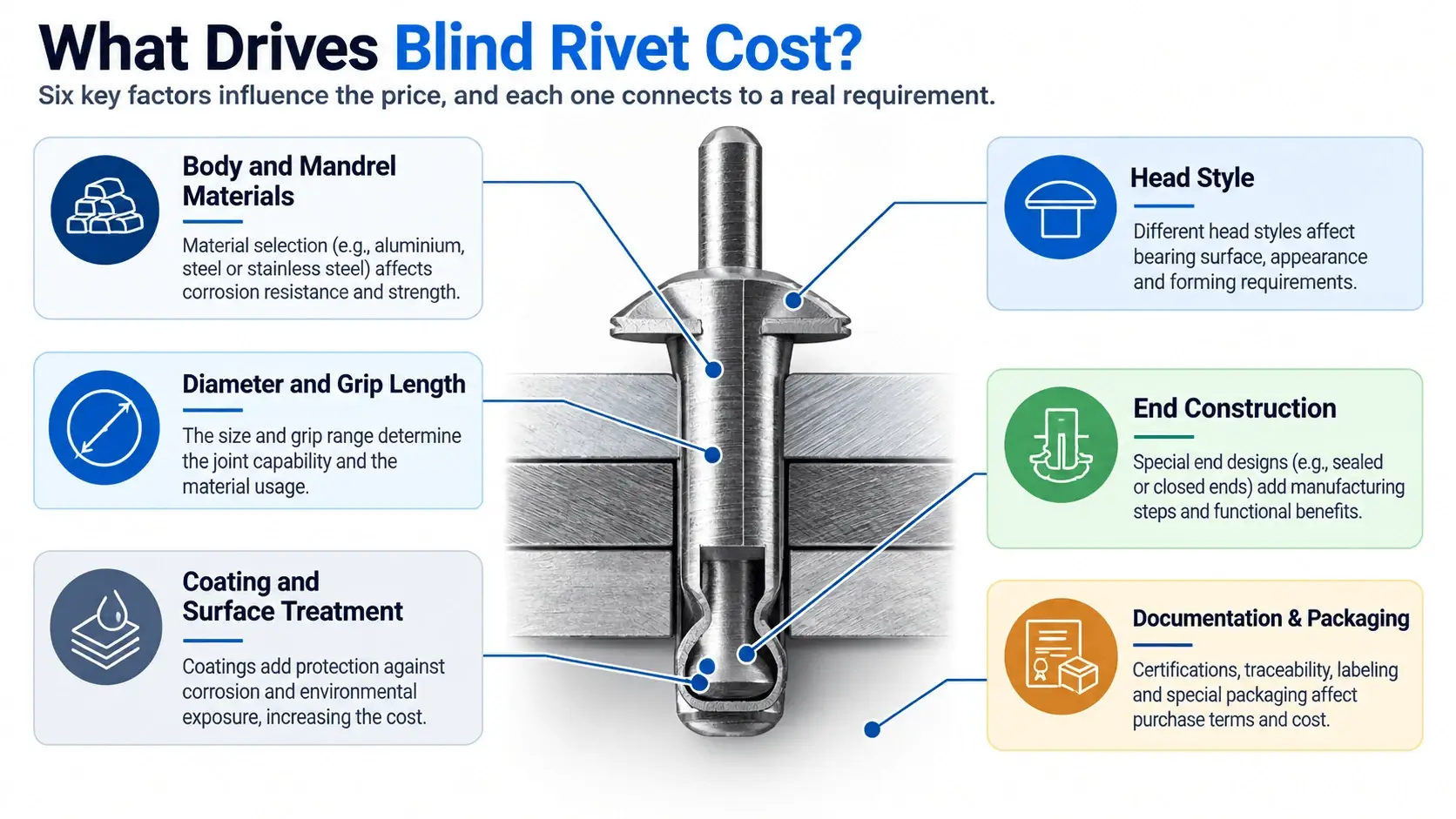
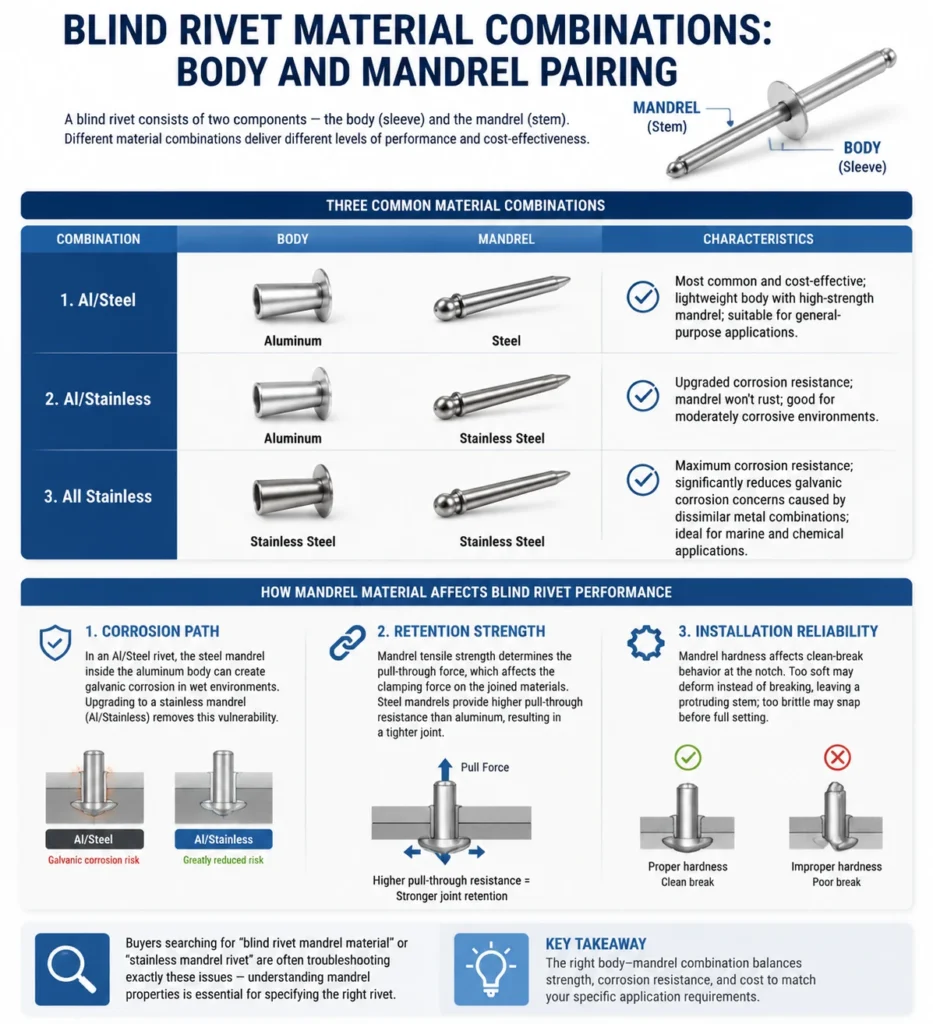
Here is a decision dimension that many buyers overlook: a blind rivet consists of two components — the body (the sleeve that remains in the joint) and the mandrel (the stem that gets pulled during installation). These two components can be made from different materials, and the combination significantly affects both performance and cost.
Three Common Material Combinations
| Combination | Body | Mandrel | Characteristics |
|---|---|---|---|
| Al/Steel | Aluminum | Steel | Most common and cost-effective; lightweight body with high-strength mandrel; suitable for general-purpose applications |
| Al/Stainless | Aluminum | Stainless Steel | Upgraded corrosion resistance; mandrel won’t rust; good for moderately corrosive environments |
| All Stainless | Stainless Steel | Stainless Steel | Maximum corrosion resistance; significantly reduces galvanic corrosion concerns caused by dissimilar metal combinations; ideal for marine and chemical applications |
How Mandrel Material Affects Blind Rivet Performance
The mandrel is not just a disposable installation tool — its material directly impacts joint performance. During installation, the mandrel head creates the blind-side bulge that locks the rivet in place. If the mandrel is too weak, the rivet may not set properly; if it’s too hard, it may snap prematurely.
Mandrel material matters for three reasons:
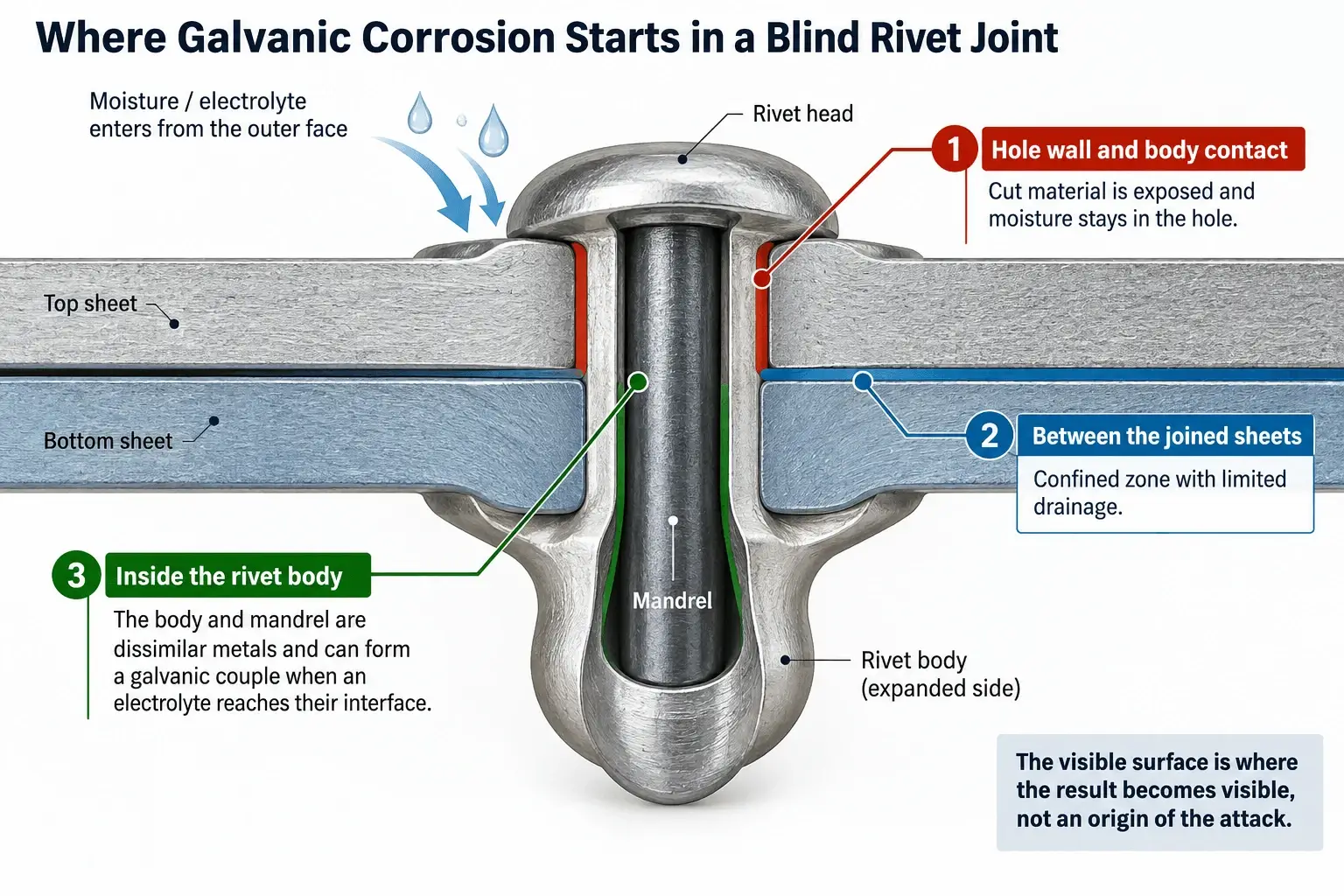
- Corrosion path. In an Al/Steel rivet, the steel mandrel sits inside the aluminum body. In wet environments, this dissimilar metal contact can create galvanic corrosion conditions, where the steel mandrel may corrode faster and affect long-term joint reliability. Upgrading to a stainless mandrel (Al/Stainless) removes this vulnerability.
- Retention strength. The mandrel’s tensile strength determines how much force is needed to pull it through the body, which in turn affects the clamping force on the joined materials. A steel mandrel provides higher pull-through resistance than aluminum, resulting in a tighter joint.
- Installation reliability. Mandrel hardness affects the clean-break behavior at the notch. A mandrel that’s too soft may deform instead of breaking, leaving a protruding stem; one that’s too brittle may snap before full setting.
Buyers searching for “blind rivet mandrel material” or “stainless mandrel rivet” are often troubleshooting exactly these issues — understanding mandrel properties is essential for specifying the right rivet.
How to Choose the Right Blind Rivet Material by Application
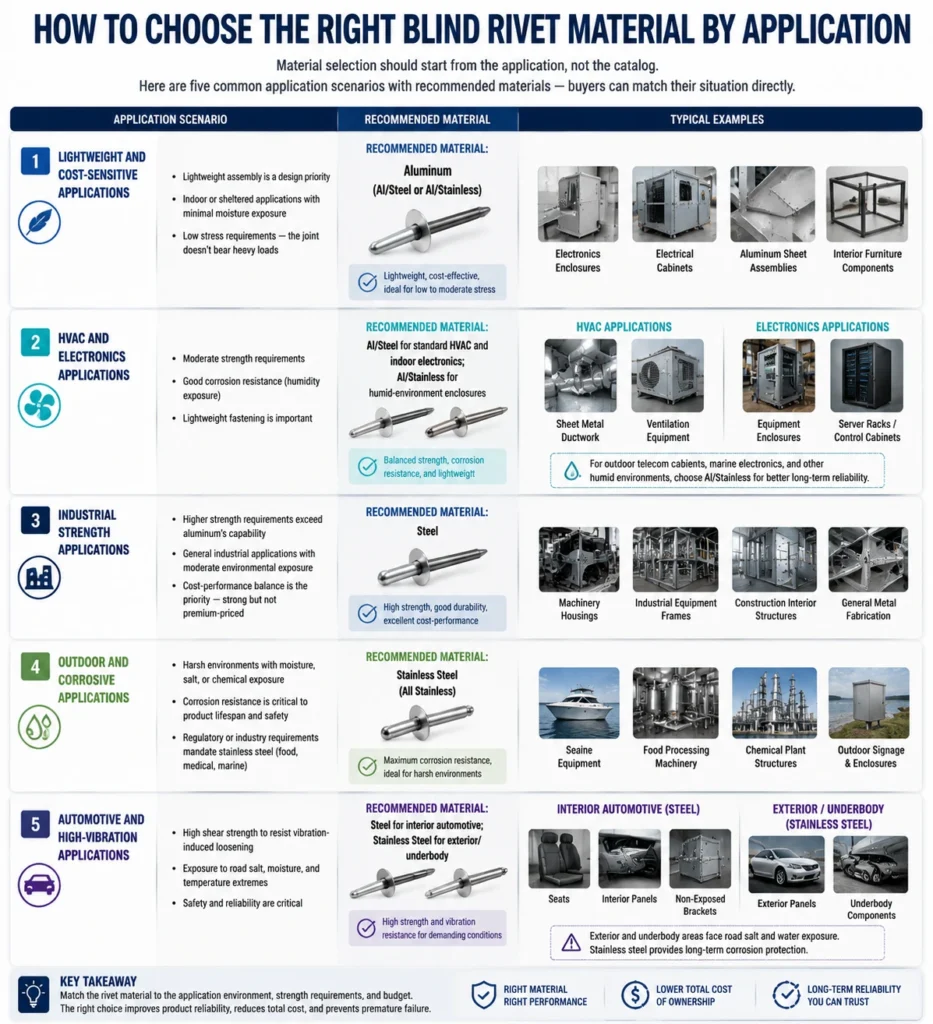
Material selection should start from the application, not the catalog. Here are five common application scenarios with recommended materials — buyers can match their situation directly.
Lightweight and Cost-Sensitive Applications
- Lightweight assembly is a design priority
- Indoor or sheltered applications with minimal moisture exposure
- Low stress requirements — the joint doesn’t bear heavy loads
Recommended material: Aluminum (Al/Steel or Al/Stainless)
Typical examples: Electronics enclosures, electrical cabinets, aluminum sheet assemblies, interior furniture components.
HVAC and Electronics Applications
HVAC duct systems and electronic equipment enclosures represent a significant segment of blind rivet demand. These applications share common requirements: moderate strength, good corrosion resistance (humidity exposure), and lightweight fastening.
HVAC applications: Sheet metal ductwork, ventilation equipment, and aluminum panels typically use Al/Steel or Al/Stainless rivets — the aluminum body won’t react with aluminum ducting, and the low installation force suits thin-gauge sheet metal.
Electronics applications: Equipment enclosures, control cabinets, and server racks often use Al/Steel rivets for interior joints. For enclosures in humid environments (outdoor telecom cabinets, marine electronics), Al/Stainless provides better long-term reliability.
Recommended material: Al/Steel for standard HVAC and indoor electronics; Al/Stainless for humid-environment enclosures.
Industrial Strength Applications
- Higher strength requirements exceed aluminum’s capability
- General industrial applications with moderate environmental exposure
- Cost-performance balance is the priority — strong but not premium-priced
Recommended material: Steel
Typical examples: Machinery housings, industrial equipment frames, construction interior structures, general metal fabrication.
Outdoor and Corrosive Applications
- Harsh environments with moisture, salt, or chemical exposure
- Corrosion resistance is critical to product lifespan and safety
- Regulatory or industry requirements mandate stainless steel (food, medical, marine)
Recommended material: Stainless Steel (All Stainless)
Typical examples: Marine equipment, food processing machinery, chemical plant structures, outdoor signage and enclosures, coastal construction.
Automotive and High-Vibration Applications
Automotive and high-vibration environments demand high shear strength to resist vibration-induced loosening, and often involve exposure to road salt, moisture, and temperature extremes.
For interior automotive components (seats, interior panels, non-exposed brackets), steel blind rivets provide adequate strength and vibration resistance. For exterior or underbody applications exposed to road salt and water, stainless steel is strongly recommended — the corrosion environment is aggressive enough that coated steel will eventually fail.
Recommended material: Steel for interior automotive; Stainless Steel for exterior/underbody.
Material Compatibility and Galvanic Corrosion Considerations
Selecting the right rivet material isn’t only about the rivet itself — it’s about how the rivet material interacts with the base material being joined. Mismatched materials are a leading cause of premature fastener failure, and the culprit is often galvanic corrosion.
Matching Rivet Material with Base Material
| Base Material | Recommended Rivet Material | Notes |
|---|---|---|
| Aluminum sheet | Aluminum or Al/Stainless | Best compatibility; avoid steel mandrel in wet environments |
| Steel sheet | Steel or Stainless Steel | Steel-to-steel is standard; upgrade to stainless for outdoor |
| Stainless steel sheet | Stainless Steel (All Stainless) | Same metal minimizes galvanic risk |
| Galvanized steel sheet | Steel or Stainless Steel | Monitor galvanic behavior at zinc interface |
| Plastic components | Aluminum or Steel (depending on load) | No galvanic risk; choose based on strength needs |
The general principle: match the rivet material to the base material whenever possible. When dissimilar metals are unavoidable, ensure the environment is dry, or apply protective coatings and isolation barriers to break the galvanic circuit.
How to Minimize Galvanic Corrosion
Galvanic corrosion occurs when two dissimilar metals are in electrical contact in the presence of an electrolyte (moisture, salt water, or humidity). The more “active” metal corrodes preferentially. In a blind rivet joint, this means the rivet or base material can corrode faster than either would alone.
Practical mitigation strategies:
- Use same-metal combinations — All-stainless rivets with stainless sheet minimize the dissimilar metal interface.
- Upgrade the mandrel — Switch from Al/Steel to Al/Stainless to remove the most corrosion-prone component.
- Apply barrier coatings — Zinc plating, Dacromet, or paint on the steel component can delay galvanic attack.
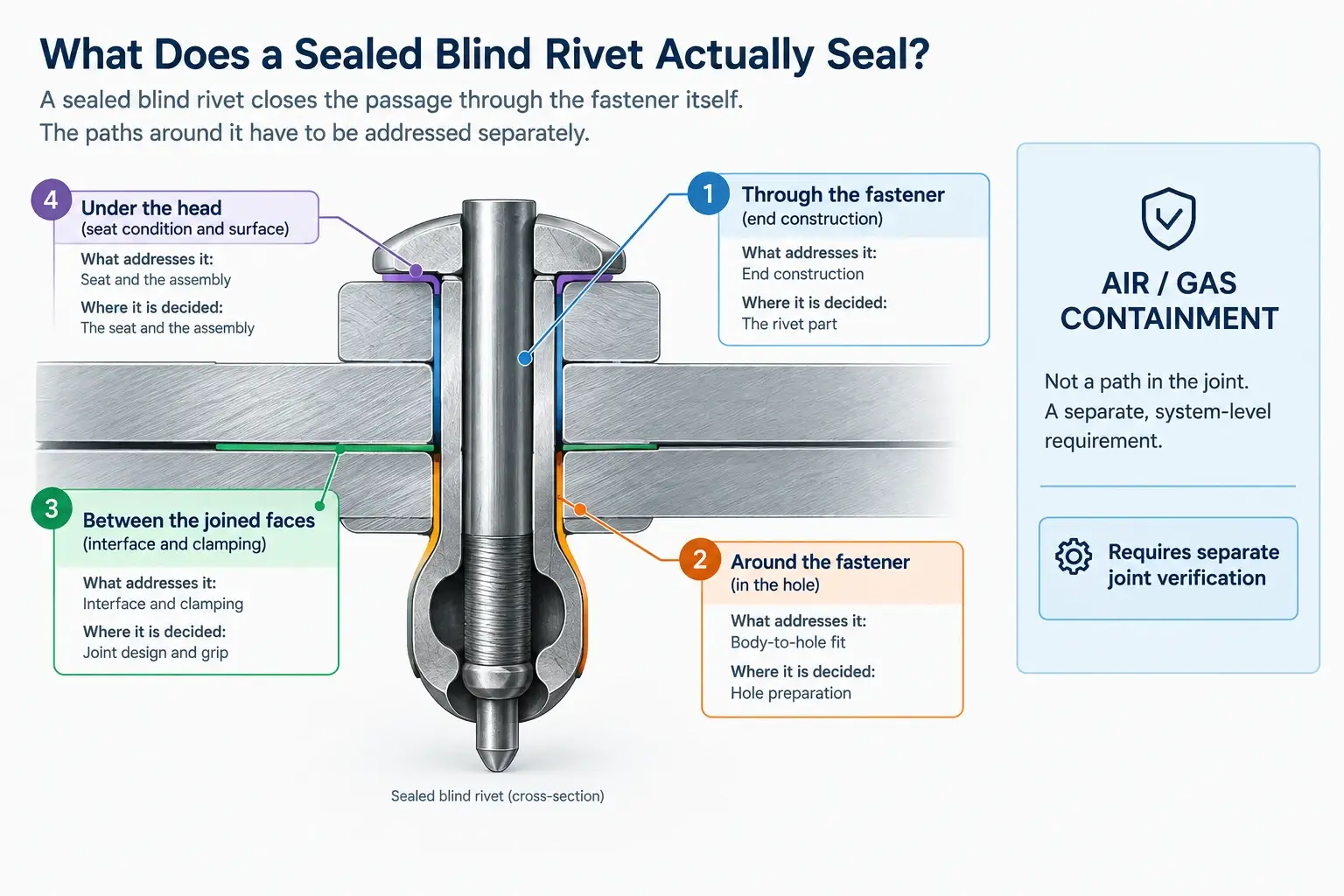
- Design for dry environments — If dissimilar metals must be used, ensure the joint stays dry through sealing or enclosure design.
Blind Rivet Material Quick Selection Chart
Use this chart as a fast-reference tool when writing material specifications or evaluating supplier quotes.
| Requirement | Recommended Material |
|---|---|
| Lowest weight | Aluminum |
| Lowest cost | Aluminum |
| Higher tensile and shear strength | Steel |
| General outdoor application | Al/Stainless or coated Steel |
| Corrosive environment | Stainless Steel (All Stainless) |
| General industrial use | Steel |
| Premium durability | Stainless Steel |
| Automotive interior | Steel |
| Automotive exterior / underbody | Stainless Steel |
| HVAC ductwork | Al/Steel or Al/Stainless |
| Electronics enclosures (indoor) | Al/Steel |
| Marine / chemical | All Stainless Steel |
Need a detailed material comparison for your sourcing spec?
Download our blind rivet material selection sheet — or send your application requirements for a tailored recommendation.
What to Verify Before Ordering Blind Rivets in Bulk
Choosing the right material is only half the equation. Before placing a bulk order, buyers should verify that the supplier can deliver the material quality, documentation, and customization they’ve promised.
Material Certification
Before placing a bulk order, request and confirm:
- Material test reports (MTR) — verifying the chemical composition matches the specified alloy grade
- Material certificates — confirming the raw material source and grade (e.g., 304 vs 316 stainless steel)
- Batch traceability — ensuring each production batch can be traced back to a specific raw material lot
A supplier that cannot provide material certificates is either not testing material composition or not controlling their supply chain — both are risks for bulk orders.
Testing Reports
Request the following test data from your supplier:
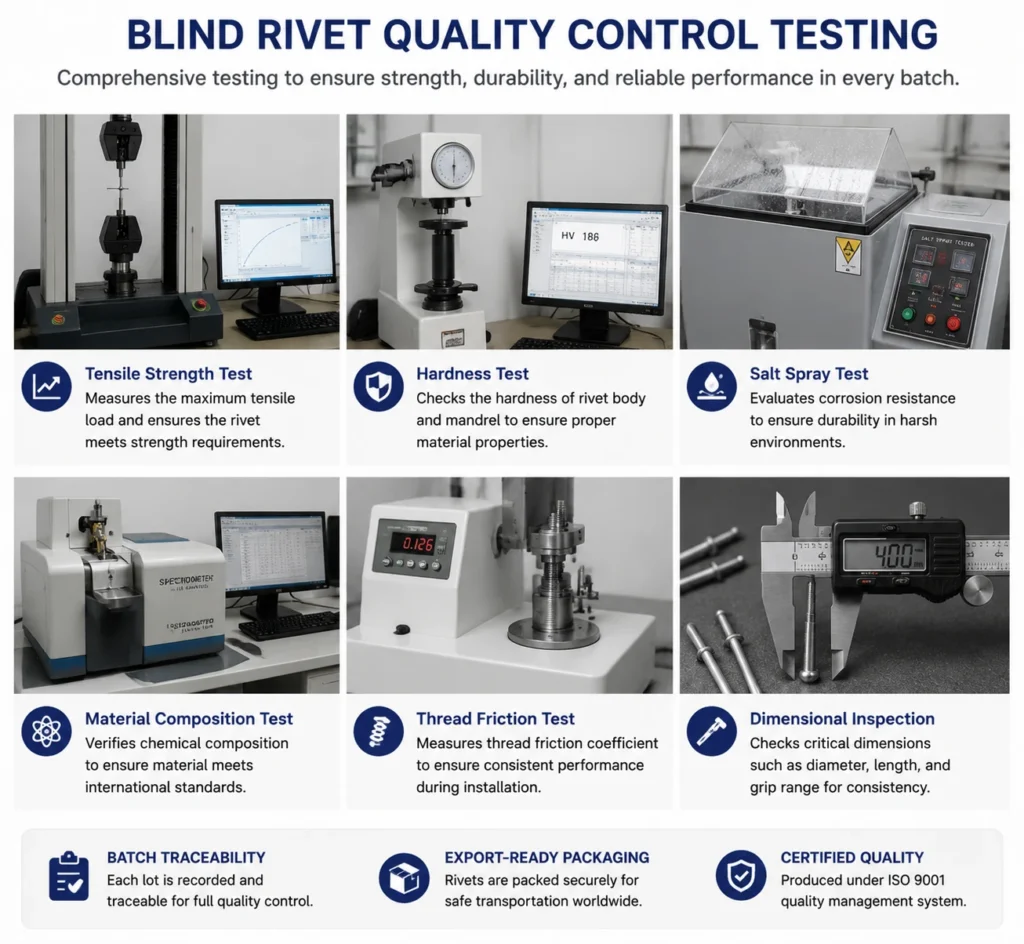
- Tensile test reports — confirming the rivet’s tensile strength meets specification
- Shear test reports — confirming shear strength values
- Salt spray test results — demonstrating corrosion resistance performance
- Spectrometer analysis — verifying material composition matches the specified alloy
At RivetFast, in-house testing equipment includes salt spray testing, tensile testing, hardness testing, spectrometer material analysis, thread friction testing, and torque testing. All test reports are available to buyers on request — if you need specific test data for your application, contact us with your requirements.
OEM and Customization Capability
For buyers with custom material requirements — non-standard sizes, special material pairings, or OEM packaging — verify the supplier’s development capability:
- Can they produce custom material combinations on request?
- What is the sample development lead time?
- Can they support custom head styles, grip ranges, or surface treatments?
- Do they offer OEM packaging and labeling?
With 15+ years of blind rivet manufacturing experience, RivetFast supports large-volume orders with stable production capacity and ISO 9001 quality management.
The factory operates 200+ automated machines with an annual production capacity of 2 billion pieces, while supporting OEM customization for project-specific requirements.Custom material pairings can be developed for project-specific requirements.
Conclusion: Choosing the Right Blind Rivet Material
There is no single “best” blind rivet material for every application. Aluminum excels for lightweight, cost-sensitive projects. Steel provides excellent strength for general industrial use. Stainless steel delivers maximum corrosion resistance and long-term reliability in harsh environments.
By evaluating application environment, required strength, base material compatibility, corrosion exposure, and budget — and paying attention to body-and-mandrel combinations — buyers can specify the material that delivers the best value, not just the lowest or highest price.
Need help selecting the right blind rivet material for your project?
Contact RivetFast for professional recommendations and OEM solutions — we’ll provide the optimal material combination with samples and a competitive quote within 24 hours.
FAQ
Are aluminum blind rivets weaker than steel blind rivets?
Yes. Aluminum blind rivets generally have lower tensile and shear strength than steel rivets, making them more suitable for lightweight applications. However, aluminum offers natural corrosion resistance and lower weight, which may be more important than raw strength depending on the application.
What is the difference between aluminum-steel and all-stainless blind rivets?
Aluminum-steel rivets have an aluminum body with a steel mandrel — lightweight and cost-effective but susceptible to galvanic corrosion in humid environments. All-stainless rivets have both body and mandrel in stainless steel, providing maximum corrosion resistance and significantly reducing galvanic corrosion concerns, at a higher cost.
Which blind rivet material is best for outdoor applications?
It depends on the severity of the outdoor environment. For general outdoor use with moderate moisture, aluminum rivets with stainless steel mandrels (Al/Stainless) or coated steel rivets offer good corrosion resistance at a reasonable cost. For harsh outdoor environments with salt spray, chemical exposure, or coastal conditions, all-stainless-steel blind rivets are the recommended choice.
Can stainless steel rivets be used with aluminum parts?
Yes, but buyers should consider galvanic corrosion risks. When stainless steel and aluminum are in contact in a moist environment, galvanic corrosion can occur. Suitable designs, protective coatings, or isolation barriers can mitigate this risk.
Can the rivet body and mandrel be made of different materials?
Yes. Common combinations include aluminum body with steel mandrel (Al/Steel — most popular, cost-effective), aluminum body with stainless steel mandrel (Al/Stainless — improved corrosion resistance), and all-stainless (body and mandrel both stainless — maximum performance). The combination affects both performance and cost.
How do I choose the right blind rivet material for bulk orders?
Consider application environment, required strength, base material compatibility, corrosion requirements, budget, and supplier quality capabilities. Request material certificates, testing reports, and samples before placing a bulk order to verify the material meets your specifications.