
Introduction: Why Choosing the Right Rivet Matters for Sheet Metal Applications
Selecting the right rivets for sheet metal is essential for creating strong, reliable, and long-lasting assemblies. Rivets are widely used in industries such as automotive, electronics, HVAC systems, construction equipment, and industrial machinery because they provide a fast and efficient way to join thin metal components.
However, choosing the wrong rivet can lead to serious problems, including weak joints, vibration-related loosening, corrosion between incompatible metals, installation difficulties, and increased maintenance costs.
For manufacturers and engineers, rivet selection is not only about choosing a fastener that fits a hole. The correct rivet must match the material, thickness, load requirements, installation conditions, and working environment of the application.
A properly selected rivet can help:
-
Improve joint strength and reliability.
-
Increase production efficiency.
-
Extend product service life.
-
Reduce assembly and maintenance costs.
This guide explains how to choose the right sheet metal rivets by evaluating:
-
Rivet types.
-
Rivet materials.
-
Rivet sizes and grip range.
-
Application requirements.
Whether you are an engineer, buyer, or manufacturer, understanding these factors will help you select the most suitable rivet solution for your project.
Understanding Sheet Metal Rivets Before Selection
What Are Rivets Used for in Sheet Metal?
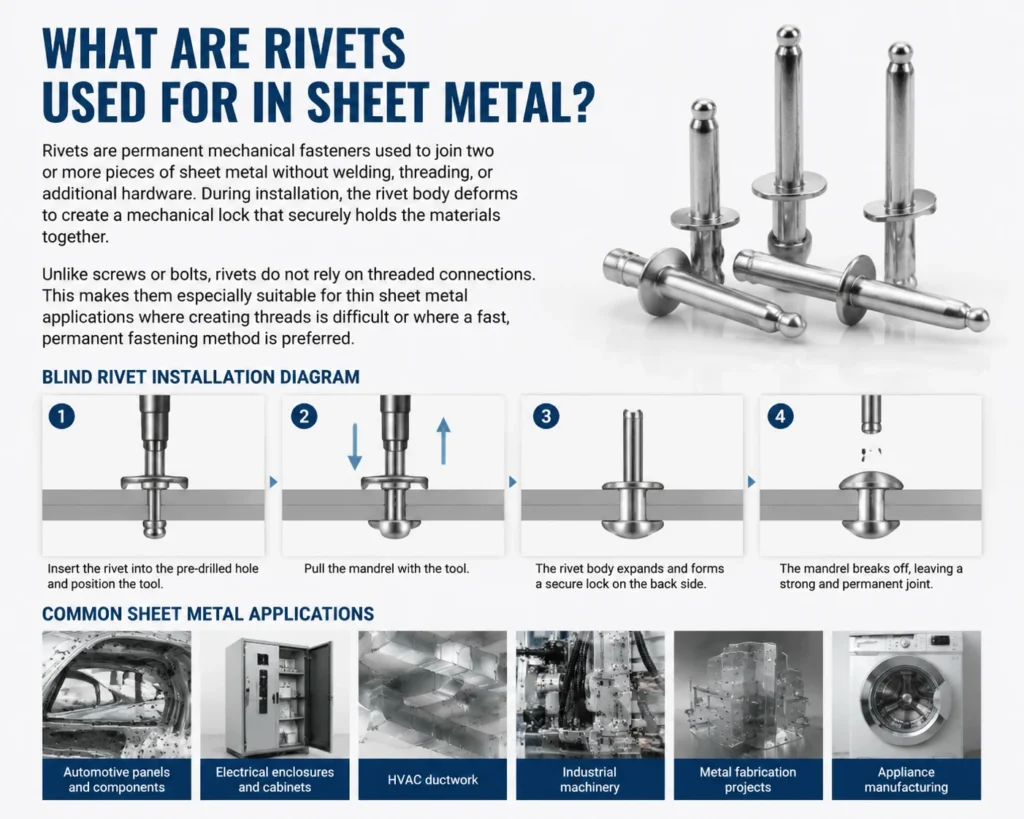
Rivets are permanent mechanical fasteners used to join two or more pieces of sheet metal without welding, threading, or additional hardware. During installation, the rivet body deforms to create a mechanical lock that securely holds the materials together.
Unlike screws or bolts, rivets do not rely on threaded connections. This makes them especially suitable for thin sheet metal applications where creating threads is difficult or where a fast, permanent fastening method is preferred.
Common sheet metal applications include:
-
Automotive panels and components.
-
Electrical enclosures and cabinets.
-
HVAC ductwork.
-
Industrial machinery.
-
Metal fabrication projects.
-
Appliance manufacturing.
Why Are Rivets Suitable for Sheet Metal Applications?
Rivets are widely used in sheet metal assembly because they provide several advantages.
Fast Installation
Blind rivets can be installed quickly using simple tools, making them ideal for high-volume manufacturing environments.
Reliable Mechanical Strength
A properly selected rivet creates a secure joint that can withstand vibration, movement, and operational stress.
Suitable for Thin Materials
Unlike welding or threaded fasteners, rivets can effectively join thin metal sheets without significantly weakening the material.
Cost-Effective Assembly
For large-scale production, riveted fastening often provides a lower installation cost compared with other joining methods.
How to Choose the Right Rivet Type for Sheet Metal
Choosing the correct rivet type is the first step in ensuring fastening performance. The best option depends on factors such as:
-
Access to the installation area.
-
Required strength.
-
Whether the connection needs to be removable.
-
Production requirements.
Blind Rivets for One-Side Installation
Blind rivets, also known as pop rivets, are one of the most commonly used rivets for sheet metal applications.
The biggest advantage of blind rivets is that they can be installed from only one side of the workpiece. This makes them ideal for applications where the back side of the assembly is inaccessible.
Common blind rivet types include:
Open-End Blind Rivets
Open-end blind rivets are the standard choice for general fastening applications.
Advantages:
-
Easy installation.
-
Cost-effective.
-
Suitable for various materials.
Typical applications:
-
Metal fabrication.
-
Electronics.
-
General industrial assembly.
Closed-End Blind Rivets
Closed-end blind rivets provide better sealing performance because the rivet body remains enclosed after installation.
They are suitable for applications requiring:
-
Reduced moisture penetration.
-
Better environmental protection.
-
Improved joint sealing.
Structural Blind Rivets
Structural blind rivets are designed for applications requiring higher strength and better vibration resistance.
They are commonly used in:
-
Automotive components.
-
Heavy equipment.
-
Industrial machinery.
For most sheet metal projects requiring fast installation and reliable performance, blind rivets are often the preferred choice.
https://www.rivetfast.com/blind-rivets/
Solid Rivets for Maximum Strength
Solid rivets are known for their excellent mechanical strength and long-term durability.
Unlike blind rivets, solid rivets require access to both sides of the material during installation. Because of this requirement, they are typically used in applications where maximum strength is more important than installation convenience.
Advantages include:
-
High shear strength.
-
Excellent durability.
-
Strong permanent joints.
Common applications:
-
Aerospace structures.
-
Heavy-duty equipment.
-
High-load assemblies.
Solid rivets are a good choice when both sides of the workpiece are accessible and the application requires maximum fastening strength.
Semi-Tubular Rivets for Efficient Assembly
Semi-tubular rivets are designed with a partially hollow end, allowing them to be installed with less force compared with solid rivets.
They are commonly used when:
-
Fast assembly is required.
-
Automated production is involved.
-
Moderate fastening strength is sufficient.
Typical applications include:
-
Electronics.
-
Hardware products.
-
Light industrial components.
Rivet Nuts for Threaded Sheet Metal Connections
Rivet nuts, also called threaded inserts, provide a reliable threaded fastening point in thin sheet metal.
They are especially useful when components need to be:
-
Removed and reinstalled.
-
Secured with screws or bolts.
-
Attached to thin materials where tapping threads is not practical.
Common applications:
-
Sheet metal enclosures.
-
Machinery panels.
-
Equipment covers.
-
Electrical cabinets.
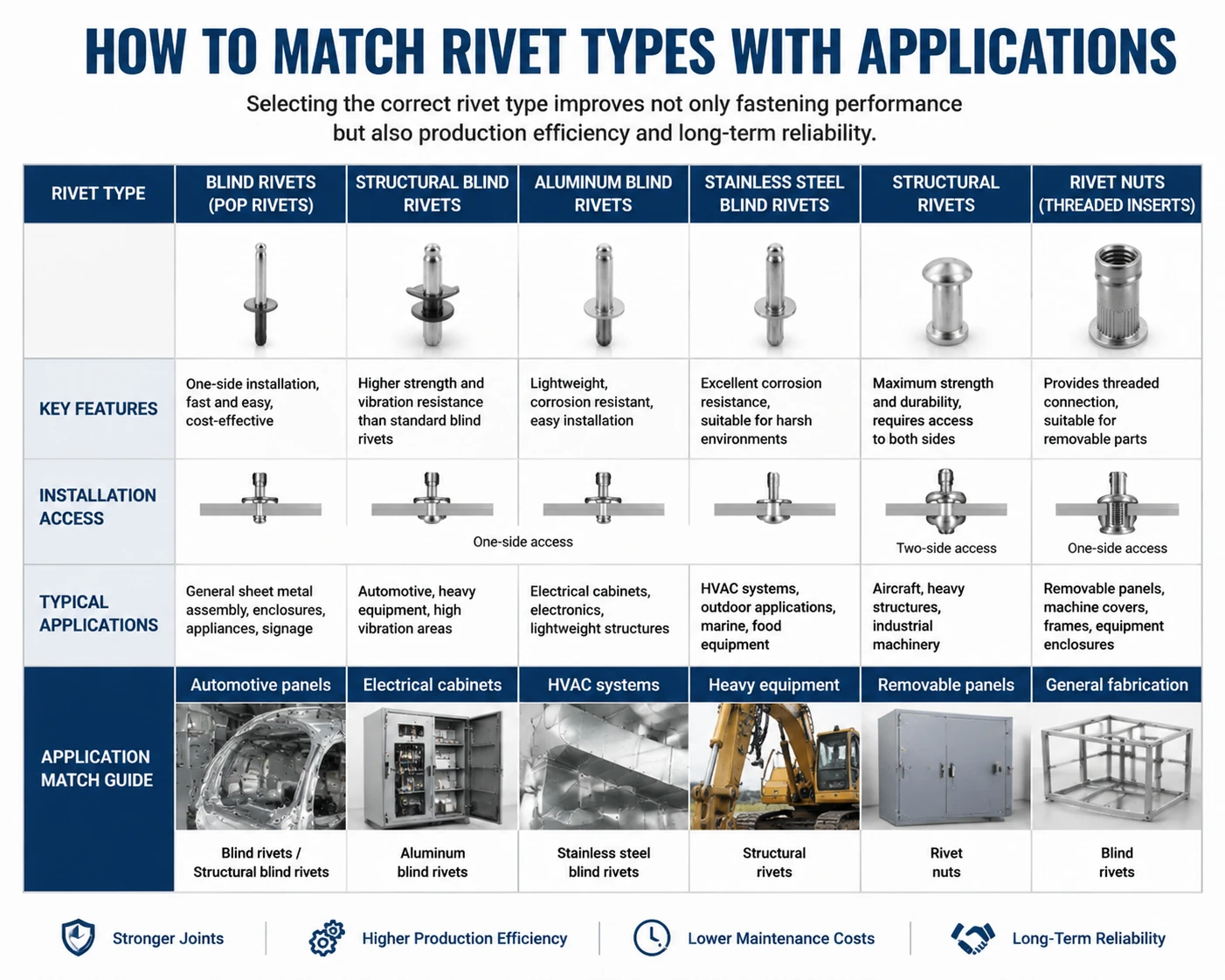
How to Match Rivet Types with Applications
Selecting the correct rivet type improves not only fastening performance but also production efficiency and long-term reliability.
 Looking for the right rivets for your sheet metal project?
Explore RivetFast’s industrial rivet solutions for reliable performance, consistent quality, and application-specific support.
https://www.rivetfast.com/blind-rivets/
https://www.rivetfast.com/rivet-nuts/
How to Select the Right Rivet Material and Size for Sheet Metal Applications
How to Select the Right Rivet Material
Choosing the correct rivet material is just as important as selecting the right rivet type. The material affects the rivet’s:
-
Strength.
-
Corrosion resistance.
-
Weight.
-
Compatibility with the sheet metal.
-
Performance in different environments.
The most common rivet materials used for sheet metal applications include aluminum, stainless steel, and steel. The best choice depends on the application requirements, operating environment, and the material being joined.
Aluminum Rivets for Lightweight Applications
Aluminum rivets are one of the most widely used options for general sheet metal fastening applications.
They offer an excellent balance of:
-
Lightweight construction.
-
Good corrosion resistance.
-
Easy installation.
-
Cost efficiency.
Because aluminum rivets are softer than steel or stainless steel rivets, they are easier to install and require less setting force. This makes them especially suitable for thin sheet metal and applications where reducing overall weight is important.
Common applications include:
-
Electronics enclosures.
-
Automotive components.
-
Appliances.
-
Lightweight metal structures.
-
General fabrication projects.
Aluminum rivets are often the preferred choice when weight reduction and installation efficiency are more important than maximum mechanical strength.
Stainless Steel Rivets for Corrosion Resistance
Stainless steel rivets are selected when durability and environmental resistance are critical.
Compared with aluminum rivets, stainless steel rivets provide:
-
Higher mechanical strength.
-
Superior corrosion resistance.
-
Better performance in harsh environments.
They are commonly used in applications exposed to:
-
Moisture.
-
Outdoor conditions.
-
Chemicals.
-
Temperature changes.
Typical applications include:
-
Marine equipment.
-
Outdoor structures.
-
HVAC systems.
-
Food processing equipment.
-
Industrial machinery.
For projects requiring long-term reliability in demanding environments, stainless steel blind rivets are often an ideal solution.
Steel Rivets for High-Strength Industrial Applications
Steel rivets provide excellent mechanical strength and are commonly used in industrial applications where load capacity is a primary concern.
Advantages include:
-
High tensile strength.
-
Strong shear performance.
-
Good cost efficiency.
Steel rivets are suitable for applications where corrosion exposure is limited or additional surface protection is available.
Common applications include:
-
Heavy equipment.
-
Machinery components.
-
Industrial fabrication.
-
Structural assemblies.
When selecting steel rivets, consider whether the operating environment requires additional corrosion protection, such as plating or coating.
Copper and Brass Rivets for Special Requirements
Copper and brass rivets are less common in modern industrial sheet metal applications but remain useful for specific requirements.
They may be selected when properties such as:
-
Electrical conductivity.
-
Decorative appearance.
-
Non-magnetic characteristics.
are important.
Typical applications include:
-
Electrical components.
-
Decorative metal products.
-
Specialty manufacturing applications.
For most industrial sheet metal fastening projects, aluminum, stainless steel, and steel remain the primary material choices.
How to Match Rivet Material with Sheet Metal Material
Material compatibility is one of the most important considerations when selecting rivets.
The rivet and sheet metal should be compatible in terms of:
-
Mechanical strength.
-
Corrosion resistance.
-
Environmental exposure.
-
Thermal expansion characteristics.
A suitable material combination helps maintain joint performance and prevents premature failure.
However, the final selection should also consider:
-
Load requirements.
-
Operating environment.
-
Expected service life.
How to Avoid Galvanic Corrosion Between Different Metals
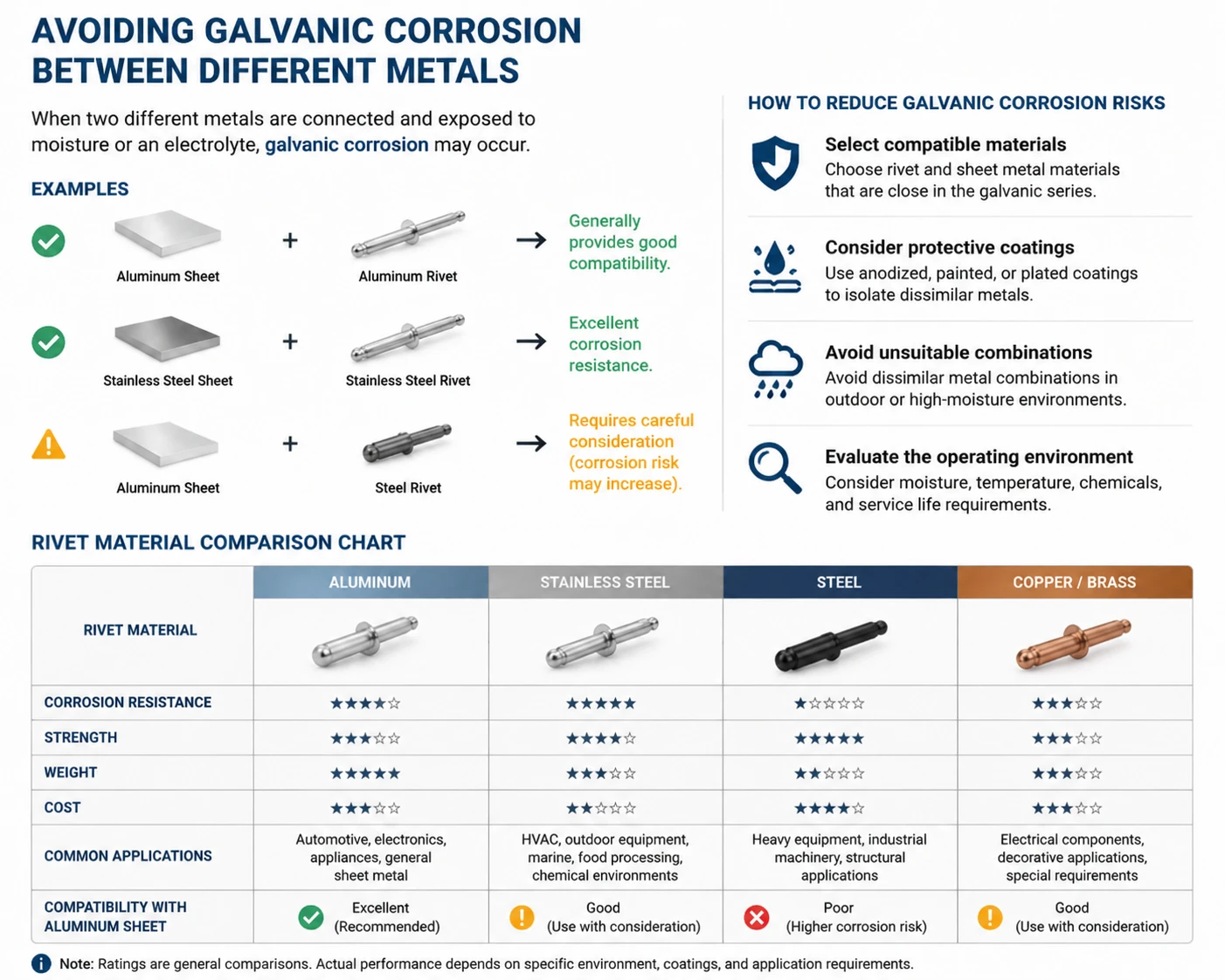
When two different metals are connected and exposed to moisture or an electrolyte, galvanic corrosion may occur.
For example:
-
Aluminum sheet + Aluminum rivet → Generally provides good compatibility.
-
Stainless steel sheet + Stainless steel rivet → Excellent corrosion resistance.
-
Aluminum sheet + Steel rivet → Requires careful consideration because corrosion risk may increase.
To reduce galvanic corrosion risks:
-
Select compatible rivet and sheet metal materials.
-
Consider protective coatings.
-
Avoid unsuitable metal combinations in outdoor environments.
-
Evaluate the complete operating environment.
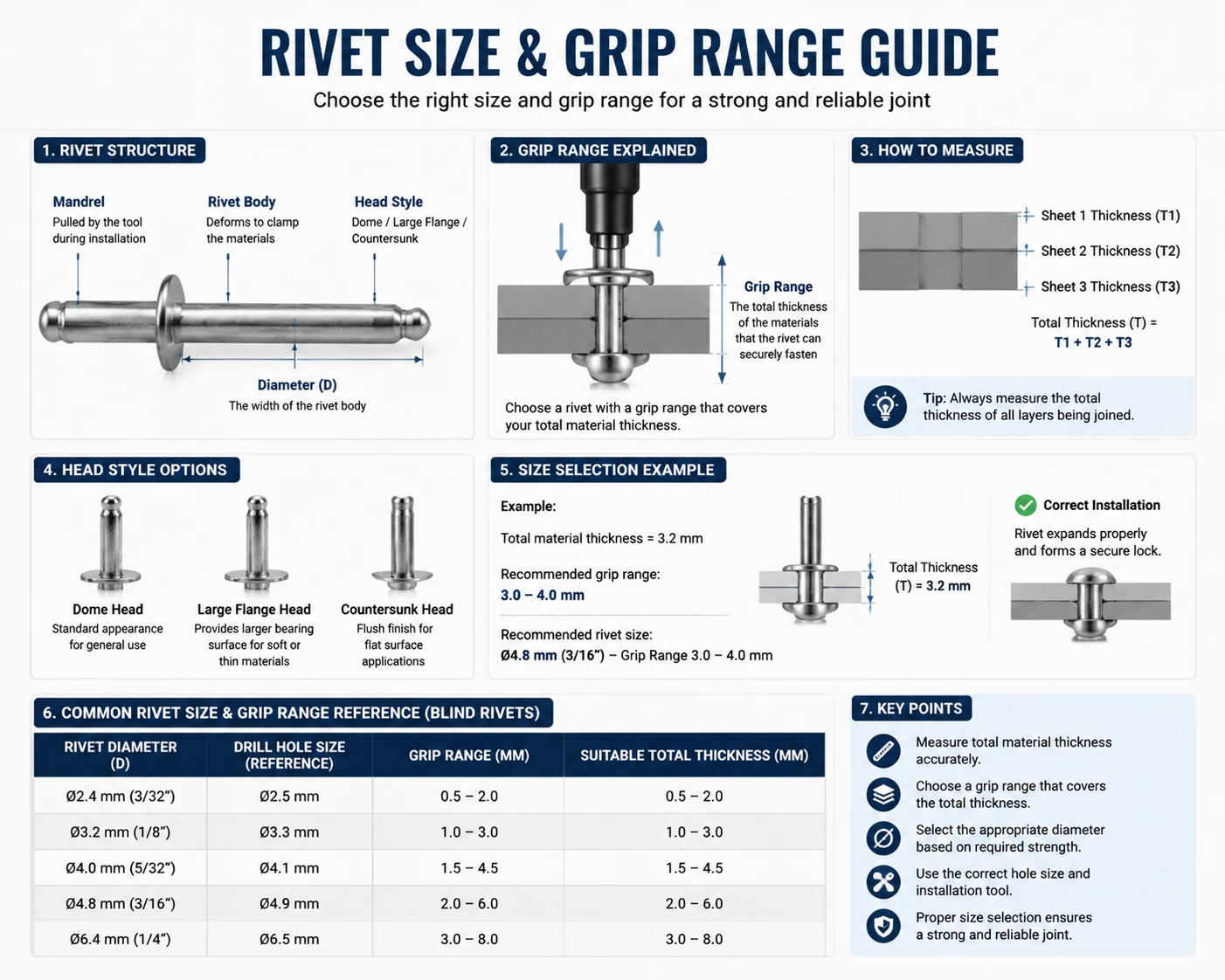
How to Determine the Correct Rivet Size
Selecting the correct rivet size is critical for achieving a strong and reliable joint.
The main factors to consider include:
-
Rivet diameter.
-
Rivet length.
-
Grip range.
-
Hole size.
-
Sheet thickness.
-
Required load strength.
A rivet that is too small may not provide enough strength, while a rivet that is too large may damage the material or create installation difficulties.
Select the Correct Rivet Diameter
Rivet diameter directly affects the strength and load capacity of the joint.
A larger diameter generally provides:
-
Higher shear strength.
-
Better load distribution.
-
Increased joint reliability.
However, the diameter must match the sheet thickness and application requirements.
General considerations:
-
Thin sheet metal applications: smaller diameter rivets may be sufficient.
-
Higher-load applications: larger diameter rivets may be required.
When selecting rivet diameter, always consider the balance between:
-
Joint strength.
-
Material thickness.
-
Installation requirements.
Choose the Proper Rivet Length
Rivet length must match the total thickness of the materials being joined.
The basic calculation is:
Material Thickness + Required Rivet Allowance = Correct Rivet Length
If the rivet is too short:
-
The rivet may not form a proper locking head.
-
Joint strength may be reduced.
If the rivet is too long:
-
Installation quality may decrease.
-
The finished appearance may be affected.
Before selecting a rivet, accurately measure the combined thickness of all materials being fastened.
Understand Rivet Grip Range
Grip range is one of the most important specifications when selecting blind rivets.
It refers to the total thickness range that a rivet can securely fasten.
For example:
A blind rivet with a grip range of 3.0–6.0 mm can properly join materials with a combined thickness within that range.
Choosing the wrong grip range may cause:
-
Incomplete setting.
-
Loose joints.
-
Poor fastening performance.
For blind rivets, always confirm:
-
Total material thickness.
-
Required grip range.
-
Rivet specification before ordering.
Consider Head Style and Hole Size
The rivet head style affects both appearance and performance.
Common head styles include:
-
Dome head.
-
Large flange head.
-
Countersunk head.
Dome head rivets are suitable for general applications where a standard protruding head is acceptable.
Large flange rivets provide a larger bearing surface and are suitable for softer materials or thin sheets.
Countersunk rivets are used when a flush surface is required.
The hole size must also match the rivet specification.
A hole that is:
-
Too small: difficult installation and possible material damage.
-
Too large: reduced joint strength and poor rivet expansion.
Proper hole preparation ensures the rivet expands correctly and creates a secure mechanical lock.
Measure Sheet Thickness Before Selecting a Rivet
Accurate thickness measurement is one of the simplest but most important steps in rivet selection.
Before choosing a rivet, confirm:
-
Total material thickness.
-
Number of layers being joined.
-
Required grip range.
-
Installation conditions.
Incorrect thickness measurement is one of the most common reasons for rivet selection errors.
Consider Shear and Tensile Strength Requirements
Rivet selection should also consider the mechanical forces applied to the joint.
Shear Strength
Shear strength refers to the rivet’s ability to resist forces that move materials sideways against each other.
Common examples:
-
Vibration.
-
Sliding forces.
-
Mechanical movement.
Tensile Strength
Tensile strength refers to resistance against forces pulling the materials apart.
Important for:
-
Heavy loads.
-
Structural applications.
-
High-stress environments.
For demanding applications, selecting rivets based only on size is not enough. The rivet must also provide sufficient mechanical performance for the actual working conditions.
Best Rivets for Different Sheet Metal Applications, Common Selection Mistakes, and Choosing a Reliable Rivet Manufacturer
Best Rivets for Common Sheet Metal Applications
The best rivet for a sheet metal application depends on more than just the material being joined. Engineers and buyers should consider:
-
Required strength.
-
Operating environment.
-
Material compatibility.
-
Installation method.
-
Production requirements.
Different industries have different fastening challenges. Selecting the right rivet type and material helps improve product reliability, assembly efficiency, and long-term performance.
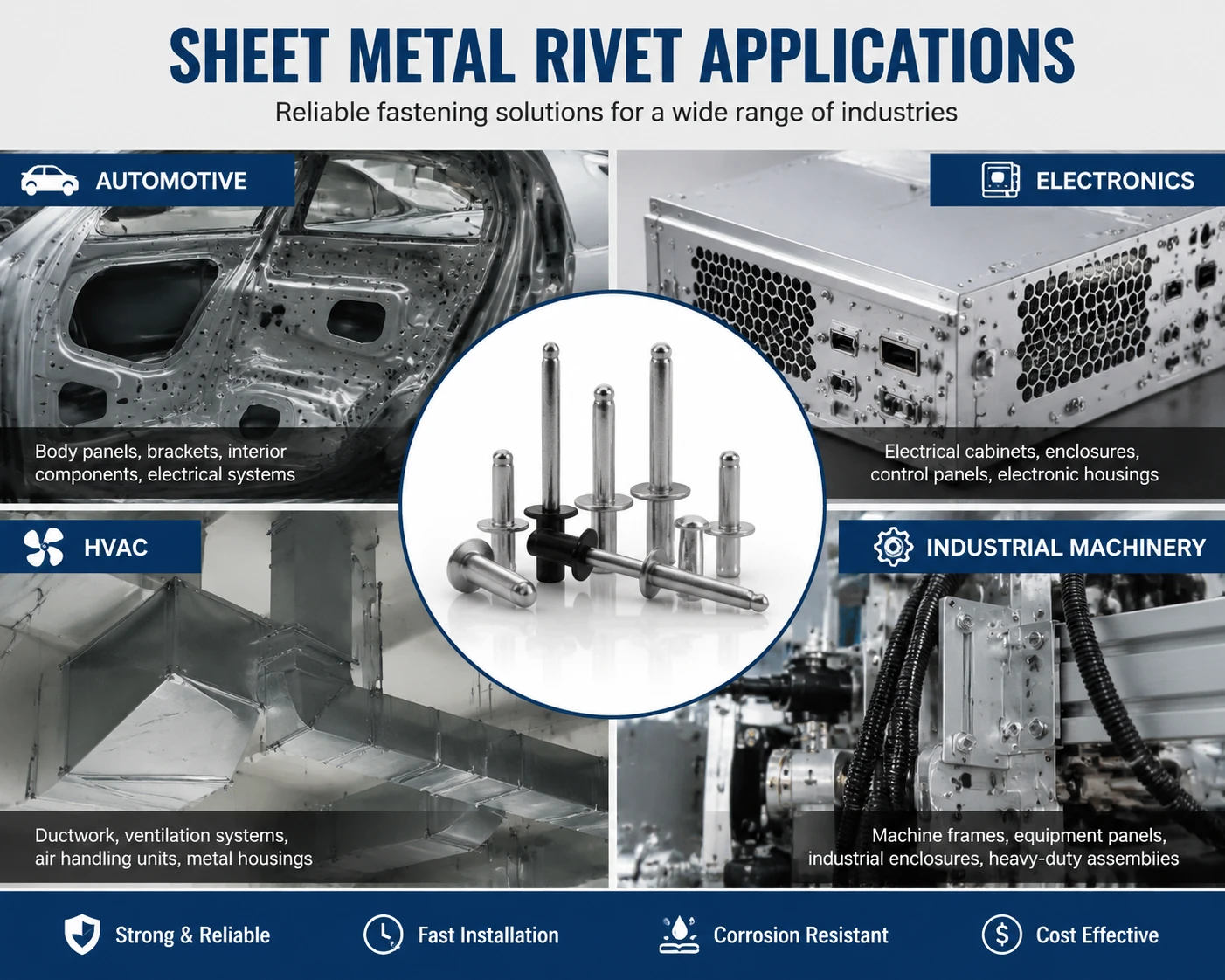
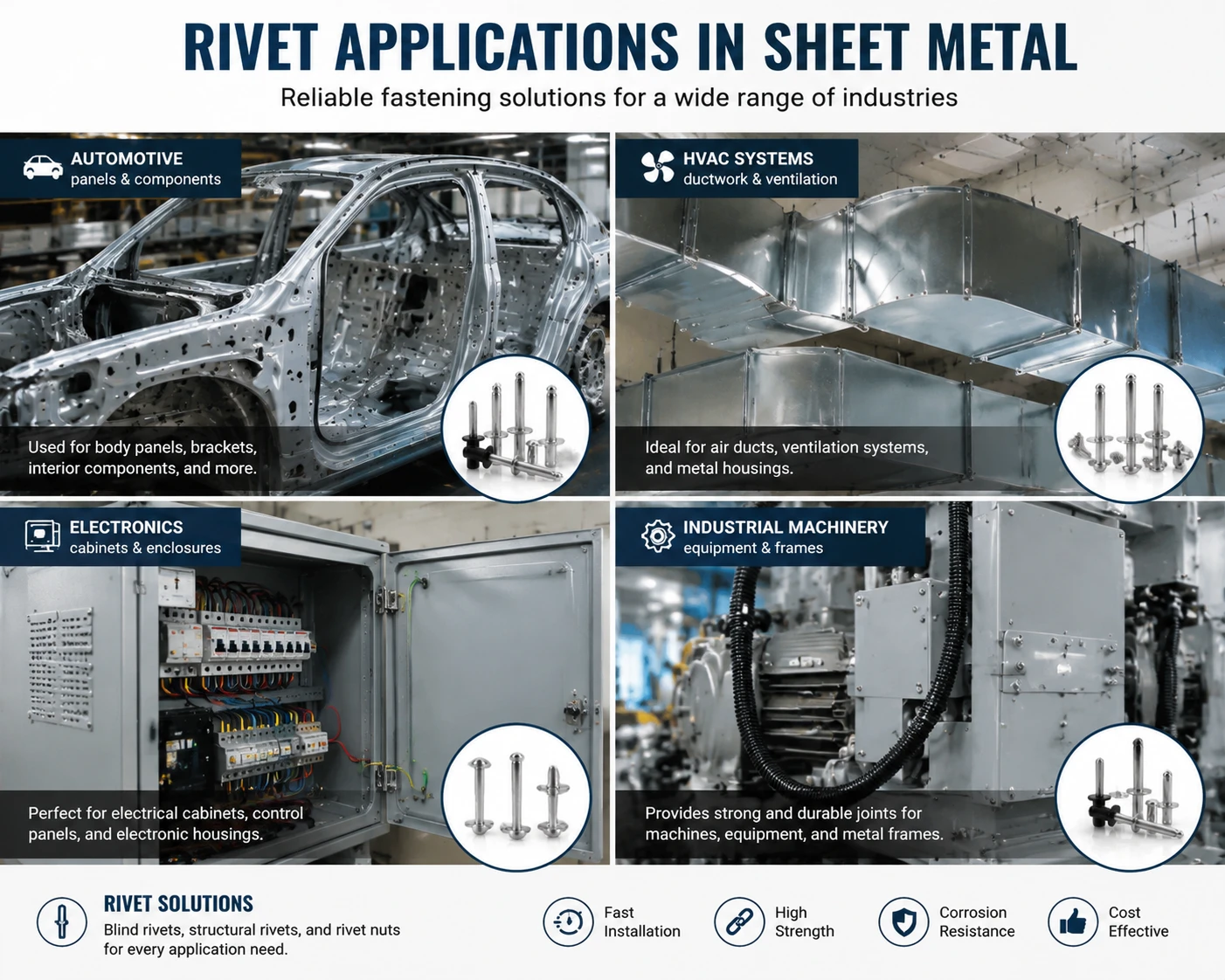
Automotive Sheet Metal Applications
The automotive industry requires fastening solutions that can withstand:
-
Continuous vibration.
-
Mechanical stress.
-
Weight limitations.
-
Environmental exposure.
For automotive sheet metal applications, blind rivets and structural blind rivets are commonly used because they provide reliable fastening performance while allowing fast installation.
Recommended rivet options:
Aluminum blind rivets
Suitable for:
-
Lightweight components.
-
Interior panels.
-
General automotive assemblies.
Advantages:
-
Low weight.
-
Easy installation.
-
Good corrosion resistance.
Structural blind rivets
Suitable for:
-
High-load components.
-
Areas exposed to vibration.
-
Safety-critical assemblies.
Advantages:
-
Higher shear strength.
-
Better vibration resistance.
-
Improved joint reliability.
Common automotive applications include:
-
Body panels.
-
Brackets.
-
Interior components.
-
Battery enclosure systems.
-
Electrical components.
Electronics and Electrical Cabinets
Electronics and electrical equipment often use thin sheet metal that requires precise and clean fastening.
The main requirements include:
-
Compact size.
-
Easy installation.
-
Minimal material deformation.
-
Reliable long-term connection.
Recommended rivets:
Small diameter blind rivets
Advantages:
-
Suitable for thin materials.
-
Fast assembly.
-
Cost-effective.
Aluminum blind rivets
Advantages:
-
Lightweight.
-
Corrosion resistant.
-
Easy to install.
Typical applications:
-
Electrical cabinets.
-
Control panels.
-
Equipment enclosures.
-
Electronic housings.
For electronics applications, choosing the correct rivet size is especially important because excessive installation force may damage surrounding components.
HVAC Systems and Ductwork
HVAC systems and sheet metal ductwork require fastening solutions that can perform in environments exposed to:
-
Moisture.
-
Temperature changes.
-
Airflow.
-
Outdoor conditions.
Recommended rivets:
Stainless steel blind rivets
Advantages:
-
Excellent corrosion resistance.
-
Long service life.
-
Reliable performance in harsh environments.
Common applications:
-
Air ducts.
-
Ventilation systems.
-
Metal housings.
-
Outdoor HVAC equipment.
For HVAC applications, material compatibility is critical because corrosion can affect system durability over time.
Industrial Machinery
Industrial machinery often requires rivets that can withstand:
-
Heavy loads.
-
Continuous vibration.
-
Mechanical stress.
-
Long operating cycles.
Recommended rivets:
Structural blind rivets
Steel rivets
Advantages:
-
High mechanical strength.
-
Strong joint performance.
-
Suitable for demanding environments.
Common applications:
-
Machine frames.
-
Equipment panels.
-
Industrial enclosures.
-
Heavy-duty assemblies.
When selecting rivets for machinery, engineers should prioritize strength and reliability rather than only initial cost.
Metal Fabrication and Enclosures
Metal fabrication projects require flexible fastening solutions because applications vary widely.
Common requirements include:
-
Fast assembly.
-
Reliable joining.
-
Compatibility with different sheet materials.
-
Efficient production.
Recommended rivets:
Blind rivets
Advantages:
-
Simple installation.
-
No access to rear side required.
-
Suitable for many fabrication processes.
Rivet nuts
Advantages:
-
Provide threaded fastening points.
-
Allow repeated assembly and removal.
Typical applications:
-
Metal boxes.
-
Cabinets.
-
Equipment covers.
-
Custom fabricated structures.
Common Mistakes When Choosing Sheet Metal Rivets
Selecting the wrong rivet can reduce product performance and increase production costs. Below are some of the most common mistakes made during rivet selection.
Choosing Rivets Only Based on Price
Cost is an important factor, but the cheapest rivet is not always the most economical choice.
Low-cost rivets may result in:
-
Lower mechanical strength.
-
Poor corrosion resistance.
-
Inconsistent dimensions.
-
Higher failure risk.
A failed fastening connection can lead to:
-
Product recalls.
-
Rework costs.
-
Production delays.
-
Customer complaints.
A better approach is to evaluate the total value, including:
-
Product quality.
-
Service life.
-
Supplier reliability.
-
Long-term performance.
Ignoring Material Compatibility
Using incompatible materials can lead to galvanic corrosion and reduced joint life.
For example:
Using a steel rivet with aluminum sheet metal may create corrosion risks in humid or outdoor environments.
Before selecting a rivet, always evaluate:
-
Sheet metal material.
-
Rivet material.
-
Environmental conditions.
-
Expected service life.
Correct material matching helps maintain joint strength and prevent premature failure.
Selecting the Wrong Grip Range
Grip range is one of the most frequently overlooked factors when choosing blind rivets.
A rivet with an incorrect grip range may cause:
-
Loose joints.
-
Incomplete deformation.
-
Poor fastening performance.
Before ordering blind rivets, always confirm:
-
Total material thickness.
-
Number of layers being joined.
-
Required rivet grip range.
Choosing the correct grip range ensures proper installation and reliable joint performance.
Using Standard Rivets in High-Stress Applications
Not all rivets are designed for demanding environments.
Standard blind rivets may not be suitable for applications involving:
-
High vibration.
-
Heavy loads.
-
Structural requirements.
In these situations, consider:
-
Structural blind rivets.
-
High-strength rivets.
-
Application-specific fastening solutions.
Choosing the correct rivet type helps prevent unexpected failures.
Ignoring Installation Tools and Requirements
Even a properly selected rivet may fail if installed incorrectly.
Before selecting a rivet, consider:
-
Available installation tools.
-
Required setting force.
-
Production speed.
-
Operator requirements.
For high-volume manufacturing, selecting a rivet that works efficiently with automated or semi-automated equipment can significantly improve production efficiency.
How to Choose a Reliable Rivet Manufacturer
Choosing the right rivet is only part of achieving reliable fastening performance. A professional rivet manufacturer can provide technical support, consistent quality, and customized solutions based on application requirements.
When evaluating a rivet supplier, consider the following factors:
Quality Control and Product Testing
A reliable rivet manufacturer should have strict quality control systems covering:
-
Raw material inspection.
-
Dimensional inspection.
-
Mechanical performance testing.
-
Production process control.
Consistent quality ensures that every batch meets the required specifications and reduces the risk of fastening failures.
For industrial buyers, stable quality is often more valuable than simply choosing the lowest-cost supplier.
Custom Rivet Solutions and OEM Support
Different industries may require customized fastening solutions.
A professional manufacturer should be able to support:
-
Custom dimensions.
-
Special materials.
-
Customized finishes.
-
OEM production requirements.
This is especially important for companies developing new products or managing specialized assembly processes.
Stable Supply and Consistent Performance
For manufacturers with ongoing production needs, supply reliability is essential.
A dependable rivet supplier should provide:
-
Stable production capacity.
-
Consistent product quality.
-
Reliable delivery schedules.
-
Long-term cooperation support.
Supply stability helps reduce production interruptions and improves overall manufacturing efficiency.
Technical Support for Rivet Selection
Choosing the correct rivet is not always straightforward.
A professional rivet manufacturer can provide guidance on:
-
Selecting the right rivet type.
-
Choosing suitable materials.
-
Matching diameter and grip range.
-
Improving fastening performance.
Technical support helps buyers avoid selection mistakes and achieve better assembly results.
Need help selecting the right rivets for your sheet metal applications?
Contact RivetFast for professional rivet solutions, technical guidance, and OEM support.
https://www.rivetfast.com/contact-us/
Frequently Asked Questions About Sheet Metal Rivets
What is the best rivet for sheet metal?
The best rivet depends on the application requirements, including material, thickness, load, and installation conditions. For general sheet metal applications, blind rivets are often the most practical choice because they are easy to install and suitable for one-side access. For higher-strength requirements, structural blind rivets or solid rivets may be more suitable.
How do I choose the right rivet size?
Choose rivet size based on:
-
Material thickness.
-
Rivet diameter.
-
Grip range.
-
Required joint strength.
Always confirm the total thickness of the materials being joined before selecting a rivet.
What rivet material is best for outdoor applications?
Stainless steel rivets are often recommended for outdoor applications because they provide excellent corrosion resistance. However, the final choice should also consider environmental exposure, sheet metal material, and required strength.
What is grip range in blind rivets?
Grip range refers to the total thickness range that a blind rivet can securely fasten. Selecting the correct grip range ensures proper rivet installation and prevents loose or weak joints.
Can different metals be joined with rivets?
Yes, but material compatibility must be carefully considered. Using incompatible metals may cause galvanic corrosion, especially in outdoor or humid environments.
Conclusion: Selecting the Right Rivet Improves Sheet Metal Performance
Choosing the right rivet for sheet metal applications requires careful consideration of:
-
Rivet type.
-
Material compatibility.
-
Rivet size.
-
Grip range.
-
Load requirements.
-
Working environment.
The correct rivet selection helps create stronger joints, improve manufacturing efficiency, reduce maintenance costs, and extend product service life.
For most industrial applications, the best approach is to evaluate the complete fastening requirement rather than selecting a rivet based on only one factor.
A reliable rivet manufacturer can provide not only high-quality fasteners but also technical guidance to help you choose the most suitable solution.
Need Help Selecting the Right Rivets?
Looking for reliable sheet metal rivets for your industrial application?
RivetFast provides high-quality blind rivets, rivet nuts, and customized fastening solutions with consistent quality, professional technical support, and OEM capabilities. Contact us today for expert rivet selection guidance and a customized fastening solution for your project.