
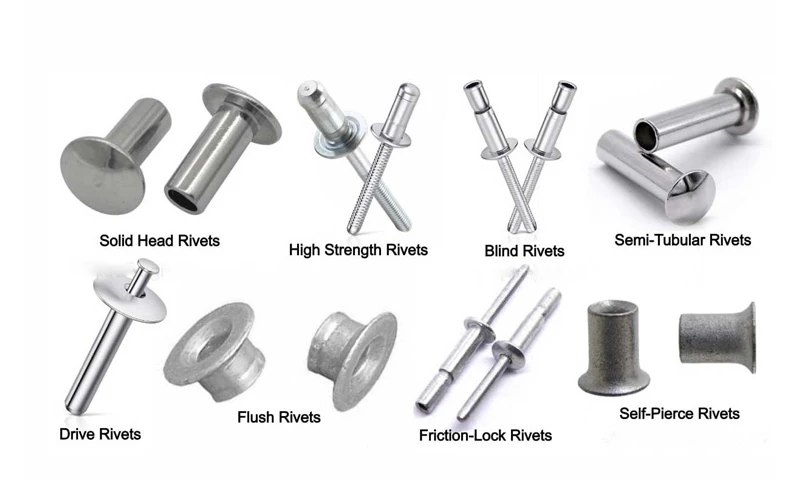
In modern industrial production, riveting remains a critical method for joining metals and composite materials. Whether in automotive manufacturing, electronic equipment assembly, or construction, selecting the right blind rivet can significantly improve production efficiency and product reliability. This article provides a comprehensive guide to blind rivet classifications, application scenarios, performance metrics, and installation techniques to assist industrial procurement professionals and engineers in making informed decisions.
What Are Blind Rivets and Their Applications
Blind rivets, also known as blind fasteners, are a highly efficient industrial riveting solution that enables secure fastening without requiring holes on both sides of the workpiece. They primarily consist of a rivet body and a mandrel, and the riveting process is completed by pulling the mandrel to achieve a durable and stable connection.
Common Materials and Characteristics
- Aluminum Rivets: Lightweight and corrosion-resistant, suitable for automotive interiors and lightweight structures.
- Salt spray resistance: over 150 hours
- Typical tensile strength: 800–1200 N
- Carbon Steel Rivets: High strength, suitable for mechanical equipment and load-bearing structures.
- Tensile strength: 1300–1800 N (≥1500 N recommended for high-vibration environments)
- Salt spray resistance: 48 hours
- 304 Stainless Steel Rivets: High-temperature and corrosion-resistant, suitable for outdoor environments and chemical equipment.
- Salt spray resistance: over 500 hours, effectively delaying corrosion and aging
- Tensile strength: 1600–2200 N
Applications of Blind Rivets in Industrial Riveting
Due to their efficiency and reliability, blind rivets are widely used in various industrial applications. Highlighting pain points and corresponding solutions enhances credibility.
1. Automotive Manufacturing
- Pain Point: Body panels and chassis components can loosen or detach in high-frequency vibration environments.
- Solution: Use steel or high-strength rivets with a tensile strength of ≥1500 N to ensure secure fastening.
- Keywords: automotive riveting, industrial blind rivets
2. Electronic Equipment
- Pain Point: Equipment vibration can cause heat sinks and panels to loosen.
- Solution: Use single-sided blind rivets for quick and secure fastening while preventing vibration-induced loosening.
3. Construction and Assembly Engineering
- Pain Point: Outdoor metal structures are susceptible to moisture and corrosion.
- Solution: Use 304 stainless steel blind rivets, with salt spray resistance over 500 hours, to effectively delay corrosion and aging.
4. Furniture and Home Appliances
- Pain Point: Mass production on assembly lines is time-consuming and inefficient.
- Solution: Utilize the single-sided installation feature of blind rivets to complete assembly efficiently, significantly reducing processing time.
Technical Specifications and Performance Comparison
Selecting the correct blind rivet requires evaluating load-bearing requirements, environmental conditions, and installation speed. The table below summarizes tensile strength, shear strength, salt spray resistance, and core application scenarios for common materials:
| Material | Standard Diameter | Average Tensile Strength | Average Shear Strength | Salt Spray Resistance | Core Application Scenarios |
|---|---|---|---|---|---|
| Aluminum Alloy | 2.4–6.4 mm | 800–1200 N | 450–700 N | 150 hours | Lightweight equipment, indoor furniture, light sheet metal |
| Carbon Steel | 2.4–6.4 mm | 1300–1800 N | 800–1100 N | 48 hours | Indoor shelving, general machinery, standard enclosures; for high-vibration applications, select ≥1500 N rivets to prevent loosening |
| 304 Stainless Steel | 2.4–6.4 mm | 1600–2200 N | 1000–1400 N | 500 hours | Outdoor engineering, humid environments, heavy-duty equipment; effectively delays corrosion and aging |
💡 Application Recommendations:
- High-frequency vibration → Select carbon steel or high-strength rivets with tensile strength ≥1500 N
- Damp outdoor environments → Use 304 stainless steel rivets
- Mass production assembly lines → Utilize single-sided installation to reduce assembly time
Installation and Usage Guide
Proper installation ensures the blind rivet’s tensile strength and long-term durability.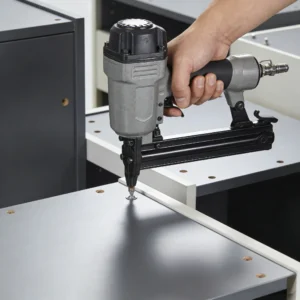
Tool Preparation
- Manual or pneumatic rivet gun: Use a manual gun for small batches; for production exceeding 500 units/day, use pneumatic equipment to increase efficiency by up to 60%.
- Rivet diameter should be slightly larger than the hole; rivet length should cover material thickness.
Installation Steps
- Drill a hole matching rivet specifications; diameter tolerance ≤0.2 mm.
- Insert rivet into pre-drilled hole.
- Secure mandrel in the rivet gun and pull steadily.
- When the mandrel breaks, the rivet body fully expands, clamping the sheets securely.
Troubleshooting & Precautions
- Loosening due to vibration → Use higher tensile strength rivets.
- Abnormal mandrel breakage → Control riveting force, avoid impacts >2500 N.
- Shear failure → Match rivet diameter to sheet thickness.
- Corrosion → Use stainless steel rivets in humid or outdoor environments.
- Ensure material thickness is within recommended range.
- Avoid repeatedly pulling the same rivet to prevent damage.
Advantages of Blind Rivets
- Quick Installation: Single-sided access; one person can complete assembly independently.
- Improved Efficiency: Each rivet installs in 3–8 seconds, boosting production line output.
- Corrosion Resistance: Particularly effective for stainless steel and aluminum rivets.
- Cost Savings: Reduces tooling and labor; labor costs can be lowered by ~30%.
- High Reliability: Strong sealing, shock-resistant, IP65 rated; long-term deformation <0.05 mm, stable in vibration and temperature variations.
Additional Notes:
- Standard stock can ship within 24 hours; custom orders in 3–5 days.
- Under equivalent performance, procurement costs are lower, reducing maintenance frequency.
Successful Application Cases
Case 1: Automotive Parts Manufacturing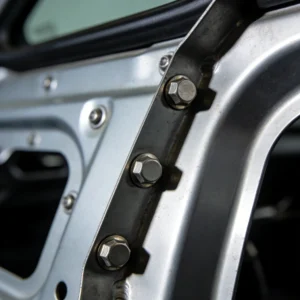
A manufacturer used stainless steel blind rivets to assemble energy storage components. After 100,000 vibration simulation cycles, no loosening or leakage occurred, with a stable assembly pass rate of 99.8%.
Case 2: Furniture Panel Assembly
A furniture manufacturer used aluminum rivets for panel assembly, increasing daily output by 55%. Products exhibited uniform, smooth appearance, and customer return rate remained below 0.5%.
Call to Action
Choosing the right blind rivets ensures product quality and significantly improves production efficiency. Whether in automotive, electronics, construction, or furniture industries, selecting the proper riveting solution reduces costs and enhances competitiveness.
👉 Request samples or a customized blind rivet solution today to make your production more efficient and reliable!
Internal Link Suggestions: